ON THIS PAGE
Progress0%






Our Global Presence :





AI for cash application combines machine learning, document processing, and ERP integration to automate payment matching, improve accounts receivable efficiency, and reduce manual work.
AI-powered cash application handles missing remittance details, partial payments, deductions, and multiple invoices, routing uncertain matches to finance teams for review.
ACH transfers and EDI 820 data can simplify automation, while checks, virtual cards, and cross-border payments often require additional validation and complex allocation logic.
Cash application results depend on data quality and payment complexity. Tracking match rates, unapplied cash, posting accuracy, and labor hours helps measure actual business value.
Successful AI implementation requires clean customer records, reliable ERP integration, confidence thresholds, audit trails, and approval workflows to protect financial accuracy and accountability.
Choosing between buying, building, or combining AI solutions depends on budget, integration needs, customization, and internal expertise, with each approach offering different cost and control trade-offs.
AI for cash application helps businesses match incoming payments to outstanding invoices with less manual work. It uses machine learning, data extraction, and intelligent matching to process remittance information, identify likely invoice matches, and flag exceptions for review. This reduces repetitive tasks and helps accounts receivable teams apply cash more accurately.
The need for better payment processing is clear. According to the Federal Reserve’s 2024 payments data, the US recorded 236.6 billion noncash payments in 2024, worth approximately $140.01 trillion. Handling this volume efficiently requires reliable processes and accurate payment data.
Treasury teams also face pressure to improve liquidity management. Deloitte’s 2024 Global Corporate Treasury Survey found that 49% of respondents prioritized building scalable corporate treasuries, up from 39% in 2022. Efficient cash application supports this goal by helping businesses gain a clearer view of incoming funds.
This guide explains how an AI cash application works, compares it with rule-based matching, covers payment types and enterprise use cases, and examines expected results, implementation challenges, costs, and deployment strategies.
AI cash application uses artificial intelligence to match incoming customer payments with the correct invoices, update accounts receivable records, and reduce manual processing. It combines machine learning, document processing, and payment data analysis to identify which invoices a payment settles, even when remittance details are incomplete or inconsistent.
Traditional cash application relies on predefined rules, such as matching invoice numbers, customer IDs, and payment amounts. AI systems evaluate additional signals, including historical payment behavior, outstanding balances, remittance documents, and previous matching decisions. This helps finance teams process transactions that do not follow standard patterns.
AI cash application sits within the order-to-cash (O2C) process, which runs from customer orders through payment collection and reconciliation. It connects accounts receivable, billing, collections, deductions management, and enterprise resource planning (ERP) systems.
When a payment arrives, the system identifies the payer, extracts remittance details, predicts the invoices being settled, and assigns a confidence score. High-confidence matches may proceed automatically under approved controls, while uncertain cases go to an analyst for review.
Three AI approaches support this process:
AI improves cash application by matching payments using multiple data points, including customer history, invoice balances, and remittance details. Unlike fixed rules, it can identify likely matches when references are missing, interpret different document formats, handle complex allocations, and learn from verified corrections, reducing manual reviews and unapplied cash.
Traditional cash application systems rely on fixed rules to match payments to open invoices. They work well when invoice references, customer IDs, and amounts are consistent. However, missing information or minor discrepancies often send payments to a manual review queue.
AI evaluates multiple signals, including payment amounts, customer history, invoice balances, and remittance details. Machine learning identifies patterns that fixed rules may miss, increasing the potential for touchless processing.
The Hackett Group reported a median automated match rate of 70% among users assessed in its research on cash application software, with about one-third exceeding 80%. Actual results depend on payment mix, data quality, and implementation.
Customers may transfer money without invoice references, combine several invoices into one payment, or use outdated identifiers. AI can compare payments against open receivables, historical amounts, customer-specific patterns, and invoice due dates.
For example, if a customer pays $18,500 without remittance advice, the system can search for invoice combinations that total that amount and verify that the payer and payment history support the match. If several combinations are plausible, it routes the payment for review rather than treating the prediction as confirmed.
Remittance advice arrives through emails, PDFs, scanned checks, spreadsheets, customer portals, and EDI messages. Traditional systems may require separate templates for different formats.
AI document processing combines optical character recognition (OCR), language models, and structured extraction to identify invoice numbers, amounts, customer references, and deduction explanations. It can handle different layouts, although extracted details still need validation against accounting records.
Enterprise payments often involve partial settlements, multiple invoices, credit notes, deductions, overpayments, and foreign currencies. AI can suggest invoice allocations, identify likely deduction categories, and recognize recurring customer payment patterns.
For instance, it may identify a familiar promotional allowance that a distributor deducted. However, the system should not approve the deduction unless supported by evidence and company policies.
Rule-based systems require regular updates when customers change payment references, introduce new portals, or alter remittance formats. AI can learn from verified matches, analyst corrections, and changing transaction patterns, reducing manual rule maintenance.
AI still requires monitoring. Finance teams must review accuracy, investigate exceptions, validate model updates, and correct unreliable data. Combining AI predictions with accounting rules and human oversight helps enterprises increase automation without compromising financial accuracy.
Cash application automation collects payment and remittance data, identifies customers, matches payments to open invoices, and posts approved transactions to the ERP. AI extracts information from documents, assigns confidence scores to proposed matches, and routes uncertain cases to analysts for review before updating accounts receivable records.
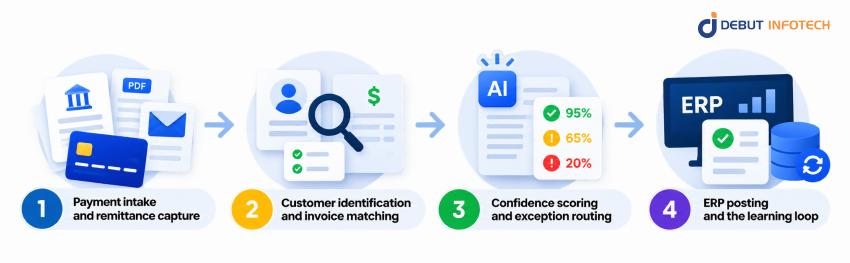
The system collects payments from bank transfers, checks, lockboxes, card processors, and other channels. It imports bank statements, remittance emails, PDFs, and EDI messages. OCR and AI extract invoice references, payment amounts, customer details, and deduction explanations. Validation checks flag missing information and duplicate records.
The system identifies the payer using bank details, customer records, remittance references, and historical patterns. It then compares the payment with open invoices. Matching can cover one payment against one invoice, one payment against multiple invoices, or partial settlements involving several open items.
Each proposed match receives a confidence score based on available evidence. Clear matches may qualify for automatic processing, while conflicting references, unexplained shortfalls, or ambiguous allocations go to an analyst. Thresholds should reflect transaction risk and internal controls.
Approved matches are posted to the ERP or accounts receivable system, clearing the relevant open items. The system retains supporting evidence, validation results, and decision history.
Automated cash application can process ACH transfers, wire payments, checks, lockbox transactions, corporate cards, virtual cards, real-time payments, EDI 820 remittance messages, and cross-border transfers. Processing difficulty depends on remittance quality, payment references, currency differences, and the complexity of matching transactions to outstanding invoices.
| Payment type | Remittance source | Difficulty |
| ACH transfers | Bank files, customer emails, payment portals | Low to medium when references are complete |
| Wire transfers | Bank statements, SWIFT messages, separate remittance advice | Medium to high when references are missing |
| Paper checks | Check images, lockbox files, remittance slips | Medium to high due to scanning quality and manual references |
| Lockbox payments | Bank lockbox files, scanned checks, remittance documents | Medium; depends on image quality and data consistency |
| Corporate cards | Payment processor reports, merchant records, customer remittance | Medium to high when settlement batches combine transactions |
| Virtual cards | Card settlement reports, payment advice, remittance files | Medium to high because fees and invoice references may differ |
| Real-time payments | Bank APIs, instant payment messages, supplementary remittance data | Medium; fast settlement does not guarantee complete invoice information |
| EDI 820 | Structured electronic remittance advice | Low to medium when mappings and identifiers are consistent |
| Cross-border payments | Bank statements, SWIFT messages, remittance files, FX records | High when currencies, bank fees, and multiple entities are involved |
ACH transfers and domestic wires can be relatively straightforward when payment references identify the customer and invoice. However, bank statements may contain abbreviated payer names or generic transfer descriptions.
Checks create additional work because remittance slips may be handwritten, scanned poorly, or separated from the check itself. Lockbox services help centralize check processing, but extracting and matching the accompanying documents still requires reliable data capture.
Card and virtual card transactions often involve settlement batches, processing fees, and payment references that do not match invoice numbers. The system must distinguish the amount received by the bank from the gross amount paid by the customer. Otherwise, fees may appear as unexplained short payments.
Real-time payment rails can reduce the delay between payment initiation and receipt. However, instant settlement does not automatically resolve invoice matching. The system still needs usable payer and remittance information.
EDI 820 is a standardized electronic payment order or remittance advice transaction commonly used to communicate payment details and the invoices being settled. Its structured format can simplify matching, provided customer-specific mappings and reference fields are configured correctly.
Cross-border payments introduce more complexity. AI must account for currency conversion, exchange-rate differences, intermediary bank fees, legal entities, and inconsistent international references. The platform should distinguish genuine invoice discrepancies from foreign-exchange and bank-charge differences.
Enterprises should prioritize payment channels based on transaction volume, exception rates, and the cost of manual handling. Automating high-volume ACH or structured EDI payments first can produce early gains.
More complex wire, card, and cross-border flows can follow once the matching controls and exception workflows have been tested.
The main AI use cases in cash application include extracting remittance details from emails and PDFs, predicting invoice matches when references are missing, classifying deductions, clearing unapplied cash, and flagging potential duplicate payments. Agentic AI can also investigate payment exceptions and prepare resolutions in accordance with approved financial controls.
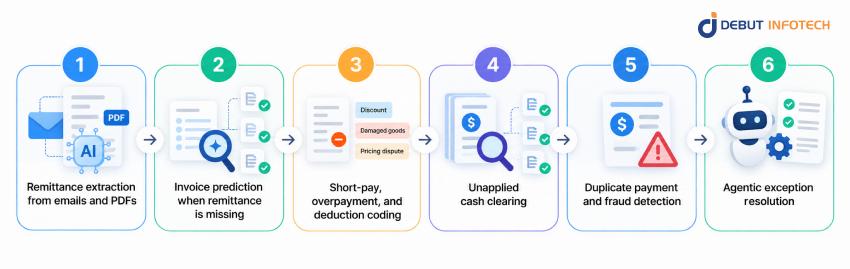
Remittance extraction is one of the most practical uses of AI for cash application. Customers often send payment details in email messages, PDF attachments, spreadsheets, scanned documents, or portal downloads. Extracting this information manually takes time and introduces errors.
AI document processing can identify invoice references, payment amounts, deduction codes, customer names, and explanations for short payments. It can also associate an attachment with the correct payment when the email subject or file name provides limited information.
For example, a customer may email a remittance PDF stating that a transfer covers 12 invoices. The system extracts the invoice numbers and amounts, checks them against open receivables, and prepares the proposed application. The analyst reviews only missing or conflicting details.
When customers omit remittance advice, AI can estimate which open invoices a payment may settle. It compares the payment amount, payer identity, outstanding balances, previous payment patterns, and invoice dates.
Suppose a customer transfers $24,000 without providing invoice references. The system identifies four open invoices totaling $24,000 and checks whether the customer’s historical behavior supports that combination. It can then recommend the likely match.
This capability is useful when customers pay consolidated balances or regularly omit invoice numbers. However, the system should consider competing matches and uncertainty. A payment should not be assigned automatically merely because the total equals an invoice balance.
Customers sometimes pay less than the invoiced amount because of discounts, damaged goods, pricing disputes, promotional allowances, service issues, or freight deductions. Others overpay or send amounts that include credit notes.
AI can compare the payment with invoice balances, extract the customer’s explanation, and suggest a deduction category or reason code. It may also identify recurring patterns, such as a customer frequently deducting the same contractual allowance.
The system should distinguish classification from approval. It can recommend a reason code, but write-offs, disputed deductions, and adjustments should follow the company’s authorization limits.
Unapplied cash occurs when a business receives cash but cannot confidently associate it with an invoice or customer account. Large unapplied balances complicate receivables reporting, collections, and cash forecasting.
AI can prioritize unmatched payments, identify likely customers, search open invoices, and suggest next steps. It can also group recurring exceptions by cause, helping teams identify missing references, outdated customer records, or unreliable payment channels.
AI can flag potential duplicate payments, duplicate remittance documents, unusual payment amounts, mismatched payer details, and suspicious changes in payment behavior. For example, two transfers with similar amounts and references may indicate a duplicate payment rather than separate settlements.
These alerts are risk signals, not definitive fraud findings. The system should cross-check transaction identifiers, dates, bank references, and customer records. Suspected fraud should follow the organization’s established investigation and escalation procedures.
Agentic AI can coordinate multiple steps to resolve a cash application exception. It may retrieve payment records, inspect remittance documents, compare open invoices, check approved deduction policies, and prepare a proposed resolution.
For example, an agent could identify an unmatched transfer, locate a remittance attachment in an email, and prepare the corresponding invoice allocation. If the amount includes an unexplained deduction, it can create a case and draft a clarification request.
The agent should operate within defined permissions. Low-risk actions may proceed automatically, while write-offs, disputed balances, unusual transactions, and uncertain matches require approval. This approach reduces repetitive investigation while keeping financial decisions accountable.
The results of AI for cash application depend on the quality of payment data, the number of payment channels, the complexity of customer remittances, and the ERP environment. Enterprises should treat published vendor figures as reference points, not guaranteed outcomes.
The Hackett Group reported a 70% median auto-match rate, with one-third of assessed end users exceeding 80%. Its research also found that 61% of respondents applied for payments on the same day they received them. These findings offer a more useful baseline than assuming every organization can immediately reach 95% or higher.
Company size alone does not determine matching performance. A smaller business with clean customer records and standardized ACH payments may outperform a global enterprise that handles multiple currencies and has fragmented ERP systems.
The following ranges are planning estimates, not independently established industry benchmarks.
| Enterprise profile | Indicative initial target | Potential mature target |
| Small business with standardized payments | 60–75% | 80–90% |
| Mid-sized business with mixed payment channels | 50–70% | 75–90% |
| Large enterprise with multiple entities and complex remittances | 40–65% | 70–90%+ |
Targets should be adjusted after analyzing historical transactions. Measure both transaction-level and invoice-line-level accuracy because a payment may be matched at the header level while individual invoice allocations remain incorrect.
During the first months, the system may need to learn customer-specific patterns, resolve data issues, and refine exception rules.
By months three to six, teams may see improved matching if feedback is consistent. Further gains over 12 to 24 months depend on new payment channels, customer behavior, and model maintenance. There is no universal maturity curve.
Vendor case studies illustrate what is possible. Keurig Dr Pepper reportedly achieved 98% no-touch cash application after deploying HighRadius, alongside productivity improvements. These are company-specific results and should not be generalized to every implementation.
Enterprises should measure unapplied cash value and age, manual hours per thousand payments, exception resolution time, posting accuracy, and cost per transaction. Establish a baseline before implementation, then track results monthly to verify savings and identify remaining bottlenecks.
Enterprises should assess data quality, ERP compatibility, payment complexity, security requirements, and existing financial controls before implementing AI cash application. They should also establish confidence thresholds, human review procedures, audit trails, and measurable performance targets. Testing with real transaction patterns helps confirm readiness before a wider rollout.
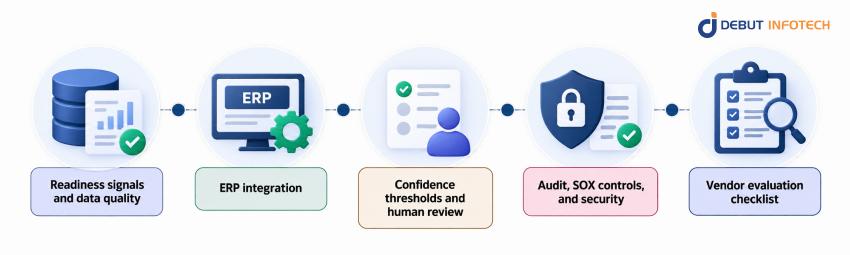
Before implementing an AI-powered cash application, review how payments, remittance records, invoices, and customer information are stored. Duplicate customer IDs, missing invoice references, and disconnected payment channels can reduce the accuracy of matching.
Analyze historical transactions, including successful matches, manual corrections, unapplied cash, deductions, and unresolved exceptions. Check that the data represents different payment types, currencies, and legal entities. Clean inconsistencies and document recurring problems before evaluating an AI model.
The AI platform must connect reliably with the ERP and accounts receivable systems that hold invoice balances and payment records. Integration may use APIs, supported connectors, secure file transfers, bank feeds, or middleware.
Define how the system retrieves invoices, validates customer records, posts payments, and handles rejected transactions. Test partial payments, reversals, credit notes, duplicate files, and connection failures. Businesses with multiple ERP instances should standardize customer identifiers, currencies, entity mappings, and posting rules to prevent incorrect payment allocations.
Set confidence thresholds according to transaction risk. Payments with clear references may qualify for automatic posting, while ambiguous matches require review. High-value transactions, unusual deductions, and restricted accounts may require additional checks regardless of score.
Define who can approve exceptions, change matching policies, authorize write-offs, and release held transactions. Review thresholds regularly as the system’s performance changes. Automation should reduce unnecessary manual work without allowing uncertain decisions to bypass financial controls.
Maintain traceable records linking each payment to its remittance, proposed invoice match, validation results, approvals, and ERP posting. Where applicable, align the process with Sarbanes-Oxley (SOX) requirements and internal financial reporting controls.
Assess encryption, access permissions, segregation of duties, data retention, incident response, and vendor access. Confirm whether customer data is used to train external models and whether deployment options meet data residency requirements.
Ask prospective vendors or AI agent development partners:
Choose a solution based on verified performance, integration fit, financial controls, and total ownership cost. Test it with representative transactions before expanding automation across the enterprise.
Cash application automation can struggle with poor remittance data, inconsistent customer records, changing payment patterns, and complex invoice allocations.
Other challenges include model drift, employee resistance, and limited visibility into matching decisions. Addressing these issues requires data cleansing, regular performance monitoring, staff training, and explainable matching logic.
AI cash application depends on usable payment and remittance information. Scanned documents may be difficult to read, email attachments may omit invoice references, and bank descriptions may contain only abbreviated customer names. These problems reduce matching confidence and create exceptions.
Document processing can recover some missing information, but it cannot reliably reconstruct every absent detail. Enterprises should improve remittance capture at the source, standardize customer instructions where possible, and maintain a clear process for requesting missing information.
Customer records may contain duplicate accounts, outdated trading names, inconsistent payer IDs, and multiple bank accounts. One customer may pay through several subsidiaries, while a centralized treasury team may settle invoices for different legal entities.
These relationships can confuse matching models and lead to incorrect allocations. Data cleansing, customer hierarchy management, payer-to-customer mapping, and clear entity-level rules help reduce the problem. Changes to sensitive customer or banking records should require appropriate approval.
Matching performance can decline when customer payment behavior changes, new payment channels appear, or invoice formats are updated. A model trained on historical patterns may also perform poorly when the business enters a new market or acquires another company.
Monitor match accuracy, exception rates, false matches, and performance across customer groups. Investigate sudden changes and retrain or recalibrate models when evidence supports doing so. Keep regression tests to ensure that improving one payment category does not reduce accuracy in another.
Cash application automation changes how analysts spend their time. Employees who previously matched payments manually may need to review exceptions, investigate deductions, maintain customer mappings, or monitor system performance.
Without training and clear communication, staff may distrust the recommendations or continue using spreadsheets outside the approved workflow. Involve analysts during testing, explain how their corrections improve the process, and establish clear responsibilities for reviewing and approving automated decisions.
Finance teams need to understand why a payment was matched to an invoice, especially when the transaction affects financial reporting or a customer dispute. A confidence score alone does not provide sufficient evidence.
The system should show the source records, invoice balances, reference matches, allocation logic, and relevant validation checks. It should also record manual overrides and the reasons for them. If a decision cannot be explained or reconstructed, the enterprise may struggle to investigate errors or support an audit.
Enterprises can automate cash applications by building a custom AI solution, buying a vendor platform, or combining both approaches. The right choice depends on payment complexity, internal technical skills, budget, and integration needs.
A custom solution gives businesses greater control over matching logic, workflows, security, and ERP integration. It suits enterprises with complex payment processes or unique requirements. However, development takes longer and requires ongoing investment in engineering, testing, maintenance, and model improvements.
A vendor platform usually offers faster deployment through existing AI capabilities, standard connectors, and prebuilt workflows. It can reduce internal development work, but customization may be limited. Subscription fees, transaction-based pricing, and vendor dependency can also increase long-term costs.
Before deciding, compare these factors:
| Decision factor | Buy | Build | Hybrid |
| Upfront cost | Low to medium | High | Medium to high |
| Standard payment workflows | Strong fit | Often unnecessary | Suitable |
| Proprietary payment logic | Depends on customization | Strong fit | Strong fit |
| Time to initial deployment | Usually shorter | Usually longer | Moderate |
| Control over architecture | Vendor-dependent | High | Moderate to high |
| Internal engineering needs | Lower | Higher | Moderate |
| Long-term maintenance | Shared with vendor | Internal responsibility | Shared |
A hybrid approach can work well when a vendor handles standard payment matching while custom components manage complex allocations, company-specific rules, or legacy ERP integrations.
Before making a final decision on a vendor or AI agent development services, estimate both upfront and ongoing costs, including implementation, licenses, integration, support, and model maintenance. Run a pilot using real payment data before committing. Compare match accuracy, exception rates, processing time, and total cost to determine which option delivers measurable value.
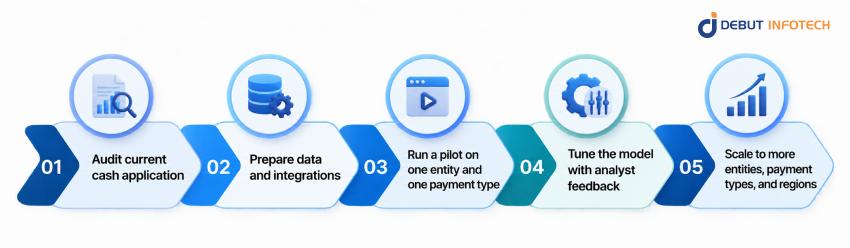
Document how payments move from bank receipt to invoice clearing and ERP posting. Identify payment channels, remittance sources, manual tasks, and recurring exceptions.
Measure the current touchless match rate, unapplied cash balance, resolution time, posting accuracy, and labor hours. Review successful matches and difficult cases, including partial payments and missing remittance details. Use these findings to establish a baseline and set measurable targets.
Connect bank feeds, payment files, remittance sources, customer records, open invoices, and ERP interfaces. Clean duplicate customer records, standardize identifiers, and map payment references to the correct legal entities.
Prepare historical transactions for testing, including successful matches and complex exceptions. Establish access permissions, audit logging, data retention, and recovery procedures before enabling automatic posting.
Start with a manageable scope, such as one legal entity receiving high volumes of ACH payments. A focused pilot makes it easier to identify problems and measure results.
Initially, run the system in recommendation-only mode or compare its matches with analyst decisions. Test normal transactions, ambiguous cases, duplicate files, and integration failures. Enable automatic posting only after the system meets agreed accuracy and control requirements.
Review incorrect matches, rejected recommendations, and unresolved exceptions with accounts receivable staff. Determine whether problems stem from poor data, missing rules, extraction errors, or unreliable predictions.
Use verified corrections to refine customer mappings, adjust confidence thresholds, and test changes against historical transactions. Track false matches as well as touchless rates. Higher automation is not beneficial if posting errors increase.
After the pilot meets its targets, extend automation to additional payment channels, legal entities, currencies, and business units. Validate local requirements and financial controls before each rollout.
Create a standard playbook for data preparation, testing, approvals, employee training, and monitoring. Assign clear responsibilities across finance, IT, security, and data teams.
Continue measuring match accuracy, unapplied cash, exception volume, processing time, and manual effort after launch. Establish escalation procedures for model drift and integration failures. A phased rollout helps enterprises expand AI cash application while limiting disruption to financial operations.
The next stage of AI for cash application will involve more connected workflows, faster payment processing, and greater use of AI agents to investigate exceptions. The focus will shift from matching individual transactions to coordinating related accounts receivable activities under defined financial controls.
Agentic AI for cash application can retrieve remittance records, investigate unmatched payments, compare invoice balances, prepare deduction classifications, and recommend next actions. With suitable permissions, it may also update case statuses or initiate approved workflows.
Gartner’s January 2026 research on autonomous agents in order-to-cash processes reflects growing interest in using agents for judgment-based finance tasks. However, enterprises still need approval gates, audit records, and clear limits on what agents can execute independently.
Real-time payments reduce the delay between payment initiation and receipt, creating opportunities for faster matching and more current receivables records. However, the benefit depends on whether usable remittance information is available simultaneously.
Generative AI can also draft customer requests for missing remittance advice, summarize deduction disputes, and prepare explanations for analysts. These messages should be checked against customer records and approved communication policies before being sent automatically.
When cash application shares reliable data with collections and cash forecasting, finance teams can see which invoices have been settled, which balances remain open, and where payment delays require attention. This reduces conflicting information between departments and improves visibility into expected cash receipts.
Embedded ERP AI may suit organizations seeking simpler integration with existing finance workflows. Standalone platforms may offer broader remittance capture, specialized matching capabilities, or support for multiple ERP systems.
The strongest option will depend on the enterprise’s payment complexity, existing technology, control requirements, and total cost. Businesses should prioritize explainable decisions, reliable integrations, and measurable financial outcomes over automation claims alone.
AI for cash application helps businesses match payments faster, reduce unapplied cash, and improve accounts receivable efficiency. Success depends on clean data, suitable integrations, clear controls, and careful testing.
Debut Infotech helps businesses build AI-powered solutions that improve financial workflows, automate repetitive tasks, and support better decision-making.
As a top-notch AI development company, we can help you develop custom AI for cash application, including intelligent payment matching, remittance data extraction, exception handling, and ERP integration.
Our team can tailor the solution to your payment processes, existing systems, and security requirements. Even if you need a custom platform or enterprise AI integration services for your current finance software, we can help you reduce manual workloads and improve cash application efficiency.
AI automates cash application by matching incoming customer payments with the correct invoices using remittance advice, bank statements, and ERP data.
It can handle different payment formats, identify short payments, and flag mismatches for review. This helps finance teams process payments faster and spend less time on manual data entry.
Yes, AI can automate most of the cash application process, from extracting payment details to matching transactions with open invoices and updating accounting records. It can also flag exceptions for human review. The level of automation depends on data quality, system integrations, payment complexity, and the accuracy of matching rules.
Cash application involves assigning incoming customer payments to the correct invoices and updating accounts receivable records.
Payment reconciliation checks whether payment records match bank statements, accounting entries, and other financial records. Both processes support accurate financial reporting, but cash application focuses on invoices, while reconciliation checks consistency across records.
When AI cannot match a payment to an invoice, it flags the transaction as an exception instead of forcing a match. The finance team can review remittance details, check for missing invoices, or contact the customer. Once resolved, the payment can be applied correctly, reducing errors in accounts receivable records.
Automated payment matching identifies which invoices correspond to incoming payments using transaction data, customer references, and remittance details.
Cash application goes further by recording those matches in the accounts receivable system and updating invoice balances. Payment matching is one step in the broader cash application process, which includes posting payments.
AI automates payment-to-invoice matching by analyzing transaction amounts, invoice numbers, customer IDs, remittance advice, and payment references.
Machine learning models can recognize patterns and handle minor data inconsistencies. When confidence is high, the system automatically matches payments. Uncertain matches are flagged for review, helping finance teams avoid incorrect postings.
AI handles complex payment matching by analyzing multiple data points and identifying relationships between payments and invoices. It can match partial payments, combine payments covering several invoices, account for deductions, and recognize inconsistent references. When a transaction remains unclear, the system flags it for review rather than applying cash incorrectly.
To reduce unapplied cash with AI, automate remittance data extraction, improve payment-to-invoice matching, and integrate bank feeds with your ERP and accounts receivable systems. AI can also identify recurring exceptions, detect missing remittance details, and prioritize unresolved payments. Reviewing these exceptions regularly helps finance teams clear unapplied cash faster.

Our Latest Insights


USA
2501 Chatham, Rd Suite R Springfield, IL 62704
+1-708-515-4004
info@debutinfotech.com
UK
7 Pound Close, Yarnton, Oxfordshire, OX51QG
+44-770-304-0079
info@debutinfotech.com
Canada
154 Eden Oak Trail, Kitchener, ON N2A 0H9
+1-708-515-4004
info@debutinfotech.com
INDIA
Sector 101-A, Plot No: I-42, IT City Rd, JLPL Industrial Area, Mohali, PB 140306
9888402396
info@debutinfotech.com