ON THIS PAGE
Progress0%






Our Global Presence :






Data quality directly affects model reliability and generalization.
Validation helps identify overfitting and misleading performance.
Model selection should reflect technical and business requirements.
Production ML requires monitoring, governance, and retraining.
Training costs depend on data, experimentation, compute, and deployment requirements.
Machine learning model training determines how effectively a model learns from data, generalizes to new inputs, and performs in production. For businesses adopting predictive analytics and intelligent automation, training quality can directly influence prediction reliability, operating efficiency, development costs, and long-term model performance.
The importance of these capabilities continues to grow alongside enterprise machine learning adoption. According to Grand View Research, the global machine learning market is estimated at $135.8 billion in 2026 and projected to reach $684.4 billion by 2033.
However, reliable model performance depends on more than selecting an algorithm and providing training data. Data quality, model selection, validation, optimization, and production controls all influence the wider machine learning workflow.
This guide explains how to train a machine learning model from initial data preparation through production deployment and retraining. It also covers training approaches, algorithm selection, evaluation metrics, performance improvement, infrastructure, costs, timelines, and common production challenges.
Machine learning model training is the process of using training data to optimize a model for a defined task. During training, the learning algorithm fits model parameters, rules, or structure to patterns in the training data.
How a model learns depends on its model family and training method. Linear models estimate coefficients, decision trees learn splitting rules, and neural networks optimize weights across interconnected layers.
Training quality directly affects how reliably the model performs on new data and under real operating conditions.
Model training determines how reliably a machine learning system performs on unseen data. Poor training can lead to inaccurate predictions, overfitting, unstable performance, and weak results in production.
Three factors matter most:
These factors directly influence model reliability, decision quality, and production performance.
The machine learning model training process fits a model to data according to a defined objective. The exact fitting method depends on the algorithm and may involve optimization, statistical estimation, recursive splitting, or another learning procedure.
For models trained iteratively, the model generates an output, measures it against an objective, updates its parameters, and repeats the process until a stopping condition is reached.
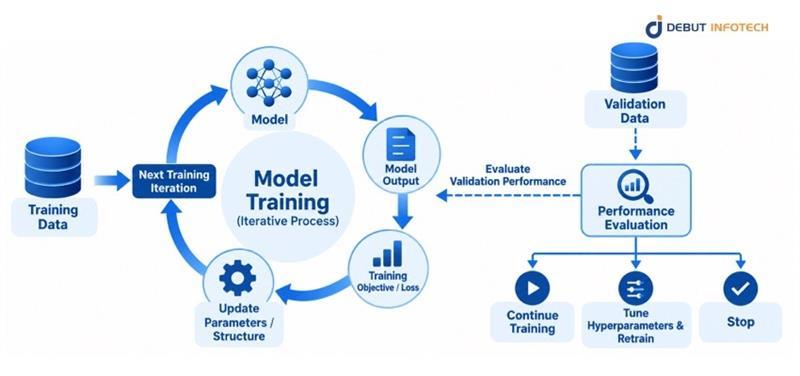
Note: The learning signal varies by training approach. Supervised models use labeled outcomes, unsupervised models learn from structure within unlabeled data, and reinforcement learning uses reward signals generated through interaction.
The model receives input features in the format required by the selected algorithm. In supervised machine learning, each training example also includes a known target or label that provides the expected outcome.
Using its current parameters or fitted structure, the model produces a task-specific output, such as a prediction, score, cluster assignment, or representation.
A loss function or training objective measures how well the current model output satisfies the training goal and guides the fitting process.
Loss should not be confused with ML performance metrics. Loss supports model training, while evaluation metrics measure how well the model performs for the intended task.
The learning procedure adjusts the model to improve the objective. Neural networks commonly use gradient-based optimization, while other machine learning algorithms use different fitting methods.
Iterative models continue training until convergence, a predefined training limit, or another stopping condition is reached.
Neural networks may train across batches and epochs, while other algorithms follow different fitting procedures.
Validation data is kept separate from parameter updates and is used to assess generalization, compare configurations, tune hyperparameters, and support early stopping or model selection.
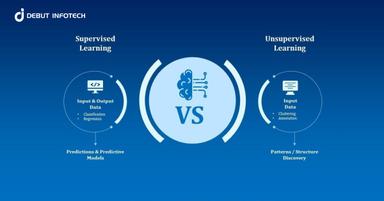
Machine learning approaches differ primarily in the data and feedback available to guide learning. These differences determine what the model can learn and which problems the approach can address.
Learning Signal: Known Outcomes
How It Learns: Supervised machine learning uses labeled training data where each input is paired with a known target. The model learns relationships between inputs and expected outputs.
Typical Applications: Fraud Detection · Credit Scoring · Churn Prediction · Demand Forecasting
Learning Signal: Patterns Within Data
How It Learns: Unsupervised machine learning works with unlabeled data and does not rely on predefined targets. The model identifies structures, similarities, clusters, or unusual observations within the data.
Typical Applications: Customer Segmentation · Clustering · Anomaly Detection · Exploratory Analysis
Learning Signal: Limited Labels + Unlabeled Data
How It Learns: Semi-supervised learning combines a smaller labeled dataset with a larger pool of unlabeled data. Labels provide direct guidance while unlabeled data helps the model learn broader patterns.
Typical Applications: Medical Imaging · Document Classification · Label-Constrained Applications
Learning Signal: Data-Generated Signals
How It Learns: Self-supervised learning creates supervisory signals from the data itself. The model learns reusable representations through training tasks generated from available data.
Typical Applications: Foundation-Model Pretraining · Language Models · Computer Vision · Multimodal AI
Learning Signal: Rewards From Interaction
How It Learns: Reinforcement learning trains an agent through interaction with an environment. The agent receives rewards or penalties and learns actions that maximize cumulative reward.
Typical Applications: Robotics · Control Systems · Dynamic Planning · Resource Optimization
Modern systems can use several learning approaches across different stages. Foundation models, for example, may begin with self-supervised pretraining and later undergo supervised fine-tuning.
Regardless of the learning approach, model development follows a broader machine learning workflow that connects problem definition, data preparation, training, evaluation, deployment, monitoring, and retraining.
Training a production-ready machine learning model involves more than fitting an algorithm to data. A reliable end-to-end ML process connects problem definition, data preparation, model selection, training, validation, testing, deployment, monitoring, and retraining.
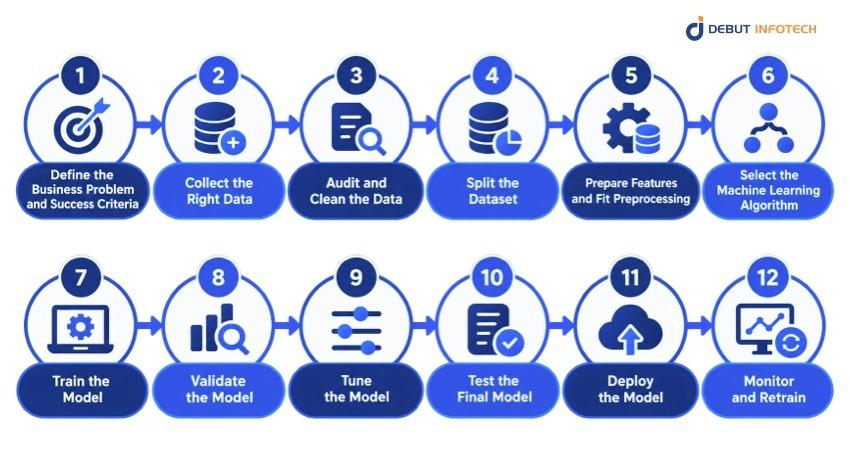
Define what the model needs to predict, how its output will be used, and what success means. Establish measurable requirements before development begins.
Technical Checks: Target · Error tolerance · Business success criteria
Collect representative training data that reflects the users, transactions, devices, time periods, or operating conditions the model will see after deployment. Ensure important segments and rare outcomes are sufficiently represented.
Technical Checks: Coverage · Label quality · Sampling bias
Review the available data for duplicates, invalid records, inconsistent labels, schema issues, and other quality problems before preprocessing or model development begins.
Technical Checks: Data quality · Schema consistency · Label reliability
Separate the dataset using a strategy that reflects real production conditions. Time-dependent or grouped datasets may require chronological or entity-level splits for reliable evaluation.
Technical Checks: Split strategy · Leakage prevention · Test-set isolation
Apply data preprocessing for machine learning, including suitable transformations, encoding, scaling, imputation, or feature preparation. The resulting features should remain consistent with what will be available during inference.
Technical Checks: Feature relevance · Training-only fitting · Inference availability
Establish a baseline and compare suitable machine learning algorithms based on the problem, data characteristics, performance requirements, and production constraints.
Technical Checks: Baseline · Model suitability · Operational constraints
Train candidate models using the training data and defined objective. Maintain traceability across experiments so results can be reproduced and compared consistently.
Technical Checks: Reproducibility · Versioning · Training configuration
Evaluate candidate models using validation data or appropriate cross-validation methods. Apply ML performance metrics that reflect the intended task and business objective.
Technical Checks: Primary metric · Error analysis · Generalization
Adjust hyperparameters using validation results or cross-validation. Additional model complexity should be retained only when it delivers meaningful performance improvement.
Technical Checks: Search strategy · Cross-validation · Performance tradeoff
Evaluate the selected model against the untouched test set and compare the results with predefined acceptance criteria before production use.
Technical Checks: Final metrics · Failure cases · Acceptance criteria
Deploy the approved model using batch, streaming, or real-time inference based on application requirements. Machine learning model deployment should support controlled production releases and future model updates.
Technical Checks: Serving mode · Monitoring · Rollback
Track model behavior and production performance after deployment. Retrain, replace, or update the model when validated evidence shows meaningful changes in data, performance, or operating conditions.
Technical Checks: Drift & serving consistency · Live performance · Retraining triggers
The broader machine learning development lifecycle continues after deployment, with monitoring, retraining, and model replacement helping maintain reliable production performance.
Effective data preparation for machine learning starts with checking whether the available data is reliable, relevant, and suitable for the prediction task. Poor-quality data can lead to unstable results, weak generalization, and misleading model performance.
Good training data should reflect the conditions the model is expected to handle after deployment.
Key considerations include:
Strong data quality in machine learning depends on whether the dataset accurately reflects the problem the model will face in production.
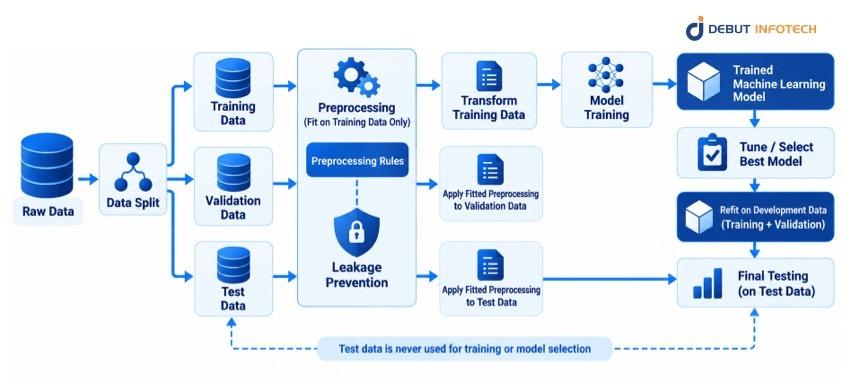
Preprocessing steps that learn from data, such as imputation, scaling, encoding, feature selection, or dimensionality reduction, should be fitted on the training data. During cross-validation, these steps should be fitted separately within each training fold and applied to its corresponding validation fold. After model selection, the final preprocessing and model pipeline can be refitted using the appropriate development data before one-time evaluation on the untouched test set.
Resampling, class balancing, and training-time augmentation should generally be applied only to the training data. Validation and test sets should preserve the intended evaluation distribution unless a different evaluation design is explicitly required.
Data preprocessing for machine learning may include:
There is no fixed dataset size that guarantees successful machine learning model training. Data requirements vary with task complexity, model type, feature dimensionality, class distribution, noise, and expected production performance.
Rather than relying on a record-count benchmark, teams should examine how model performance changes as more training data is introduced.
Useful indicators include:
If performance continues improving, additional data may be valuable. If gains plateau, better labels, features, or coverage may provide greater returns than simply increasing dataset size.
Choosing among machine learning algorithms depends on the prediction task, data structure, available labels, and the relationships the model needs to capture. Different algorithm families make different assumptions about the data, so model selection should reflect the characteristics of the problem.
Establish an appropriate baseline before comparing more complex models. The baseline provides a reference for determining whether additional model complexity produces enough benefit to justify its technical and operational cost.
| Problem Type | Common Models / Approaches | What Influences the Choice |
| Classification | Logistic Regression, Random Forest, Gradient Boosting | Class distribution, feature relationships, decision boundaries |
| Regression | Linear Regression, Random Forest, XGBoost | Linearity, feature interactions, noise, target distribution |
| Clustering | K-Means, DBSCAN, Hierarchical Clustering | Cluster shape, density, expected number of groups |
| Anomaly Detection | Isolation Forest, One-Class SVM, Autoencoders | Rarity of anomalies, dimensionality, availability of labeled examples |
| Time-Series Forecasting | ARIMA, Gradient Boosting, LSTM/Temporal Neural Networks | Seasonality, forecast horizon, temporal dependencies, data frequency |
| Computer Vision | CNNs, Vision Transformers, Pretrained Vision Models | Image volume, annotation availability, transfer-learning potential |
| Natural Language Processing | Transformers, Embedding-Based Models, Traditional Text Classifiers | Text length, labeled data, contextual complexity, task type |
When selecting the right ML model, teams should also examine whether the data contains linear or nonlinear relationships, high-dimensional features, temporal dependencies, sparse inputs, or limited labeled examples.
There is rarely one universally correct algorithm for a problem. Candidate models should be compared using consistent dataset splits, preprocessing pipelines, baselines, and evaluation criteria before final selection.
Different techniques can improve model selection, generalization, and predictive performance. The right combination depends on the dataset, selected model families, and validation strategy.
Evaluates model performance across multiple data splits to provide a more reliable estimate of generalization than a single validation split.
Tests different configuration values, such as learning rate, tree depth, regularization strength, or network settings, to identify stronger model configurations.
Constrains model complexity to reduce overfitting. Common approaches include L1 and L2 penalties, dropout in neural networks, and model-specific complexity controls.
Stops iterative training when validation performance no longer improves, reducing unnecessary computation and limiting overfitting.
Removes redundant or low-value inputs that can add noise, increase computation, or make the resulting model unnecessarily complex.
Combines predictions from multiple models to improve robustness or predictive performance. Common ensemble approaches include bagging, boosting, and stacking.
Uses knowledge from a pretrained model for a related task, which can reduce the amount of task-specific data and computation required for training.
These techniques can support improving ML model performance, but their value should be assessed using consistent validation criteria and production requirements.
Fine-tuning is a form of transfer learning that adapts a pretrained model using task-specific or domain-specific data. Depending on the method, teams may update all model parameters or train only selected parameters or added components.
Parameter-efficient fine-tuning can reduce compute requirements by keeping most base-model parameters frozen.
| Comparison Factor | Training From Scratch | Transfer Learning / Feature Extraction | Fine-Tuning |
| Starting Point | No pretrained parameters | Pretrained model | Pretrained model |
| Training Data Requirement | Typically highest | Often lower | Usually lower than training from scratch |
| Compute Requirement | Typically highest | Often lower | Varies by fine-tuning strategy |
| Training Time | Usually longest | Often shorter | Usually shorter than training from scratch |
| Model Adaptation | Learns the target task entirely from task-specific data | Reuses learned representations with limited adaptation | Updates pretrained parameters or selected components |
| Best Fit | Specialized problems without a suitable pretrained model | Related tasks where pretrained representations remain useful | Domain or task specialization |
| Key Advantage | Full control over model learning and architecture | Lower data and compute requirements | Deeper task-specific adaptation |
| Key Tradeoff | Higher data, compute, and development requirements | Depends on source-task similarity | Poor tuning can degrade useful pretrained knowledge |
Projects involving generative AI, intelligent automation, or broader AI architectures may require capabilities beyond traditional model training. Explore our experienced AI development company for these requirements.
Model evaluation should reflect the decision the model supports and the consequences of prediction errors. The right ML performance metrics depend on the task, class distribution, operating threshold, and business impact of different outcomes.
| Business Risk or Evaluation Need | Recommended Metric | What It Measures |
| Missing important positive cases is costly | Recall | How many actual positive cases the model identifies |
| False alerts create unnecessary cost or review work | Precision | How often positive predictions are correct |
| Precision and recall both matter | F1 Score | Harmonic balance between precision and recall |
| Classes are relatively balanced and error costs are similar | Accuracy | Overall proportion of correct predictions |
| Evaluate classification discrimination across thresholds | ROC-AUC | How well the model distinguishes positive from negative cases across thresholds |
| Positive cases are rare | PR-AUC | Precision-recall performance across different thresholds |
| Average prediction error matters | MAE | Average absolute difference between predicted and actual values |
| Large prediction errors carry greater consequences | RMSE | Prediction error that penalizes larger mistakes more heavily |
Strong overall performance can hide weak results for specific customer groups, transaction types, locations, devices, or operating conditions. Segment-level evaluation helps identify these gaps.
For classification models, threshold selection should reflect the acceptable balance between missed cases, false alerts, review capacity, and downstream business impact.
Production readiness also depends on stability, calibration, latency, and performance under real operating conditions. Improving machine learning model accuracy alone has limited value if the selected metric does not reflect the actual business decision.
Improving ML model performance requires identifying which part of the system is limiting results. The most effective intervention depends on whether the constraint comes from data, labels, model capacity, objectives, or production behavior.
Begin with error analysis to identify where and why the current model fails before changing the data, features, training objective, or model architecture.
1. Data Coverage
Add examples from underrepresented segments, rare outcomes, or operating conditions where the model performs poorly.
2. Label Quality
Review ambiguous, inconsistent, or incorrect labels around high-error cases before making further model changes.
3. Feature Quality
Reassess whether the available features capture the information needed for prediction and remain available at inference time.
4. Model Capacity
If the model consistently underfits, evaluate a more expressive algorithm or architecture that can represent more complex relationships.
5. Training Objective
Adjust loss functions, class weights, or task-specific objectives when different prediction errors carry different consequences.
6. Decision Threshold
For classification systems, tune the operating threshold when the default cutoff produces an unsuitable balance between false positives and false negatives.
7. Production Feedback
Compare live performance with validation results and investigate drift, changing user behavior, or upstream data changes when performance declines after deployment.
Efforts toward improving machine learning model accuracy should remain tied to the metric that matters for the application. Higher accuracy alone does not guarantee better operational performance.
Model fit determines whether patterns learned during training generalize effectively to unseen data.
Underfitting
The model is too limited to capture important relationships in the data. Performance remains weak on both training and validation data.
Good Fit
The model captures useful relationships while maintaining strong performance on unseen data.
Overfitting
The model learns the training data too closely, including noise or dataset-specific patterns. Training performance may remain strong while validation performance is materially weaker or begins deteriorating as training or model complexity increases.
The objective when improving ML model performance is not to maximize training scores, but to achieve reliable performance on data the model has not previously seen.
Reliable model training depends on controlling technical risks that can affect model reliability, operating costs, and production performance.
Technical Challenge: Training data may underrepresent important populations, rare outcomes, changing conditions, or business-critical edge cases.
Business Consequence: Aggregate model performance may look strong while predictions remain unreliable for important segments or uncommon events.
Control: Improve sampling, dataset coverage, label quality, class weighting, threshold selection, and segment-level evaluation.
Technical Challenge: Information unavailable at prediction time unintentionally influences model training or validation.
Business Consequence: Reported model performance can materially overstate expected production performance.
Control: Enforce split-aware preprocessing, prediction-point feature design, and strict test-set isolation.
Technical Challenge: Features, preprocessing logic, or data behavior in production differ from the conditions used during model training.
Business Consequence: A model can perform well during validation but produce weaker or inconsistent results after deployment.
Control: Maintain consistent preprocessing pipelines, validate production features, and monitor training-serving consistency.
Technical Challenge: Training data, features, or model behavior may introduce bias, expose sensitive information, or make important predictions difficult to explain.
Business Consequence: This can create unfair outcomes, regulatory concerns, or reduced trust in high-impact workflows.
Control: Review datasets for systematic bias, restrict sensitive data access, evaluate important segments separately, and apply suitable explainability and governance controls.
Technical Challenge: Changes in datasets, features, configurations, or runtime environments are not consistently tracked.
Business Consequence: Model comparisons, audits, investigations, and retraining become harder to manage.
Control: Version data, code, hyperparameters, environments, and model artifacts throughout the machine learning development lifecycle.
Technical Challenge: Model complexity and experimentation requirements exceed available compute or storage capacity.
Business Consequence: Training cycles become slower and more expensive without proportional performance gains.
Control: Align experimentation and model complexity with available ML training infrastructure.
The machine learning lifecycle does not end at deployment. MLOps connects experimentation, deployment, monitoring, governance, and retraining into a controlled production lifecycle.
After machine learning model deployment, teams need visibility into both model behavior and the systems supporting inference. Monitoring should cover more than uptime or latency. It should also track whether incoming data and prediction patterns still resemble the conditions used during training.
Key areas include:
Retraining can be event-driven, scheduled, or hybrid. Its cadence should reflect drift, new data, performance changes, risk, and operational requirements.
A retrained model should pass the same validation, testing, and acceptance controls as the previous production version before replacement.
Effective MLOps makes continuous model improvement an ongoing operational discipline rather than a one-time training exercise.
There is no standard duration for machine learning model training. A training run may take seconds, hours, days, or longer depending on the model, dataset, experimentation requirements, and available compute.
Training runtime is also different from the complete machine learning model development timeline. Data preparation, experimentation, validation, integration, and deployment can require more time than the final training run.
Several factors influence training duration:
Businesses should estimate timelines across the complete machine learning workflow, not only the duration of a single training run.
The cost of machine learning model training varies with data readiness, model complexity, experimentation requirements, infrastructure, and production needs. The broader cost to develop a machine learning model also includes engineering, deployment, and ongoing maintenance.
Data-related costs can include collection, cleaning, labeling, transformation, validation, and storage. Poor-quality or incomplete datasets can increase preparation effort significantly.
Development costs cover model selection, feature engineering, experimentation, hyperparameter tuning, validation, and ML engineering effort.
ML training infrastructure may include CPU or GPU compute, memory, storage, cloud services, experiment tracking, and supporting data pipelines.
Production costs can include model serving, APIs, monitoring, security, integration, versioning, retraining, and rollback capabilities.
Businesses should therefore estimate ML costs across the complete ML lifecycle, rather than considering training compute alone.
ML training for business applications is most valuable when it supports a defined prediction, decision, risk assessment, or automated workflow. Different applications require different training data, validation strategies, and suitable modeling methods.
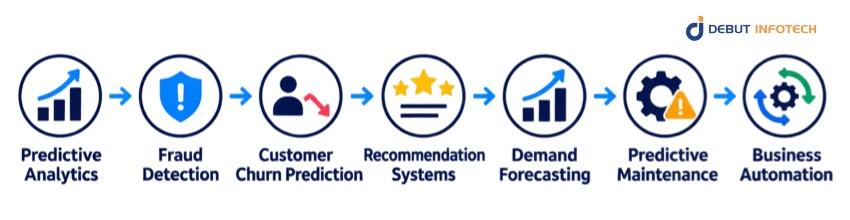
Businesses use predictive analytics to estimate future outcomes, risks, behaviors, and operational trends. Reliable training depends on representative historical data and validation that reflects real decision conditions.
Fraud detection models identify suspicious transactions, behaviors, or patterns. Training should account for rare events, class imbalance, changing fraud patterns, and the cost of missed cases.
Churn models estimate which customers are likely to disengage. Effective training requires clear prediction windows, relevant behavioral data, and controls against data leakage.
Recommendation models rank products, services, content, or next-best actions. Training should reflect current user behavior, interaction patterns, and changing business priorities.
Demand forecasting models estimate future sales, inventory needs, workloads, or resource requirements. Reliable forecasting depends on historical coverage, seasonality, temporal validation, and the ability to adapt to changing market conditions.
Predictive maintenance models use sensor, operational, and service data to estimate equipment failure risk or maintenance needs. Training quality depends on failure-event coverage, data reliability, and consistent monitoring of equipment conditions.
Machine learning training for business applications can also support automated classification, prioritization, routing, anomaly detection, and decision support. These systems should be evaluated for reliability, operational impact, and fit within the broader production ML lifecycle.
The tools used for ML training depend on the data environment, selected models and algorithms, infrastructure requirements, and production architecture. A typical technology stack supports experimentation, training, deployment, and ongoing model operations.
Tools such as Pandas, NumPy, Apache Spark, and SQL support data cleaning, transformation, feature engineering, and large-scale processing before model training begins.
Scikit-learn, XGBoost, TensorFlow, and PyTorch are commonly used to build and train different types of machine learning models. The appropriate framework depends on model complexity, data type, and performance requirements.
Platforms such as MLflow help teams track datasets, parameters, metrics, experiments, and model versions across the machine learning development lifecycle.
Cloud platforms such as Amazon SageMaker AI, Azure Machine Learning, and Google Cloud Gemini Enterprise Agent Platform provide managed infrastructure for scalable model training and deployment.
Containerization, orchestration, monitoring, and model-serving tools support reliable model deployment and ongoing operations. Technologies such as Docker, Kubernetes, MLflow, and cloud-native monitoring services can help manage production models at scale.
The final technology stack should reflect data volume, model complexity, security requirements, deployment architecture, and long-term operational needs.
Production ML requires control across training, deployment, monitoring, and retraining. Our approach connects technical decisions with data readiness, deployment architecture, and long-term model reliability.
Organizations that need support across data engineering, model development, deployment, and MLOps can explore our machine learning development company capabilities.
We define the business objective, prediction target, success criteria, and production constraints. Data readiness is assessed across coverage, label quality, feature suitability, and data quality in machine learning.
Focus areas: Business objective · Training data · Success metrics · Architecture requirements
We structure experiments so datasets, features, code, hyperparameters, and runtime environments remain traceable. Candidate models are compared using consistent validation criteria and reproducible training configurations.
Focus areas: Experiment tracking · Model comparison · Validation · Reproducibility
Validated models are integrated into the required production environment through batch, API, streaming, or enterprise workflows. After production deployment, we monitor drift, performance, latency, feature health, and retraining triggers.
Focus areas: Deployment · Monitoring · Drift detection · Governance · Retraining · Rollback
This approach keeps the complete end-to-end ML lifecycle connected instead of treating model training as a standalone activity.
Machine learning model training teaches a model from data by learning patterns and adjusting parameters. Inference happens after training, when the model uses those learned patterns to make predictions or generate outputs from new data.
Model parameters are learned automatically from training data, such as weights or coefficients. Hyperparameters are set before or during experimentation and control how training works, including learning rate, tree depth, regularization, or batch size.
Yes. Semi-supervised learning, transfer learning, fine-tuning, and data augmentation can reduce labeling requirements. However, strong data quality in machine learning remains important because limited labels make poor or inconsistent examples more influential.
Not always. Many traditional machine learning algorithms train effectively on CPUs. GPUs are more useful for deep learning and large-scale workloads where parallel processing can significantly reduce training time.
A model is production-ready when it meets defined performance thresholds and behaves reliably on unseen data and important segments. Teams should also validate latency, stability, observability, and rollback readiness before machine learning model deployment.
Custom training may be appropriate when existing models cannot meet domain-specific requirements or proprietary data creates a clear advantage. Teams should compare performance needs, data availability, compute requirements, integration complexity, and overall ML model training effort.

Our Latest Insights


USA
2501 Chatham, Rd Suite R Springfield, IL 62704
+1-708-515-4004
info@debutinfotech.com
UK
7 Pound Close, Yarnton, Oxfordshire, OX51QG
+44-770-304-0079
info@debutinfotech.com
Canada
154 Eden Oak Trail, Kitchener, ON N2A 0H9
+1-708-515-4004
info@debutinfotech.com
INDIA
Sector 101-A, Plot No: I-42, IT City Rd, JLPL Industrial Area, Mohali, PB 140306
9888402396
info@debutinfotech.com