ON THIS PAGE
Progress0%






Our Global Presence :





Machine learning improves fraud detection by combining behavioral, transactional, device, identity, and relationship signals to generate risk scores and support targeted actions.
Hybrid fraud prevention is often more practical than replacing rules entirely, combining deterministic controls, ML models, decision thresholds, and human investigation.
Model selection should follow the fraud pattern and data available, with supervised models for known fraud, anomaly detection for unfamiliar behavior, and graph models for connected fraud networks.
Production implementation requires more than model training, including reliable data pipelines, feature engineering, decision workflows, monitoring, fallback controls, governance, and continuous feedback.
Fraud detection ROI depends on more than prevented losses, with false positives, customer friction, investigation workload, infrastructure, compliance, maintenance, and legitimate revenue also affecting business value.
ML fraud detection costs can range from $25,000 to $150,000+, while the blog notes a general ML development timeline of 6–16 weeks; actual fraud-system costs depend on integrations, data readiness, real-time requirements, and controls.
When legitimate customers are blocked while fraudulent transactions still pass through, the problem is not simply a shortage of detection rules. It is often a decision system that is unable to interpret the changing behavior across transactions, accounts, devices and identities. To overcome this challenge, businesses can leverage machine learning for fraud detection, which learns fraud patterns from past and real-time data, assigns risk scores, and enables more timely and targeted responses.
However, a model alone cannot deliver reliable machine learning fraud prevention. The best systems integrate ML with policy rules, manual checks, good labels, data pipelines that are secure, explainable decisions and continuous monitoring. The effectiveness of their performance is dependent on the fraud type, data readiness, response time, integrations, regulatory context, and relative cost of false-positive and missed fraud. This guide explores how these systems function, which models are appropriate for certain situations, the impact they have on value creation, and the factors to consider when assessing implementation barriers, costs, time, return on investment and development partners.
Machine learning for fraud detection uses statistical AI models to calculate the similarity between a transaction, login, claim, refund, or application to risky transactions. A model reviews signals together rather than individually such as amount, timing, device, location, account history, identity information and connections to other entities. It then returns a classification or risk score that an organization can use within its decision workflow.
The output supports four connected functions:
These functions are linked and not interchangeable. A model score is a sign of risk but not necessarily a sign of fraud. Clear thresholds, human review and documented decisions are particularly relevant with regard to an action that may impact a legitimate customer.
Different learning methods address different data conditions. Supervised models train on labeled legitimate and fraudulent outcomes to detect known patterns. Unsupervised models identify unusual behavior when reliable labels are limited. Graph models examine the connections between accounts, devices, merchants, providers or claims and reveal related activity that is not evident in individual records.
Machine learning is a subset of artificial intelligence. AI fraud detection can thus integrate ML models with policy rules, graph analysis, AI document processing and investigator tools. It is appropriate for organizations that have significant numbers of events, reliable data, evolving fraud patterns, and definite results. A rules engine or managed fraud detection platform might be a more convenient starting point when the problem is limited and stable or the data is limited.
Rule-based systems compare activity with predefined conditions, such as an amount limit, repeated login attempts, or a transaction from a listed location. They are transparent, quick to apply, and effective when a policy or known threat can be expressed clearly. Problems arise when businesses depend on rules as the entire detection strategy because modern fraud changes faster than static logic can be rewritten.
The main limitations include:
Rules still have an important role. They are appropriate for explicit policy restrictions, known malicious indicators, emergency blocks, and fallback decisions when model or data services are unavailable. A better architecture consists of a deterministic set of rules and machine learning risk scores, decision thresholds, human review, and a managed feedback loop. Rules are used for clear conditions, models are used for complex patterns, and the investigator adds context and judgment where conditions are not clearly defined or when they are of high impact.
A working fraud system is more than just an algorithm that is linked to a transaction feed. The key steps within fraud detection using machine learning include gathering reliable signals, transforming signals into meaningful characteristics, assessing risk, selecting an action to take, and refining future decisions based on verified results.
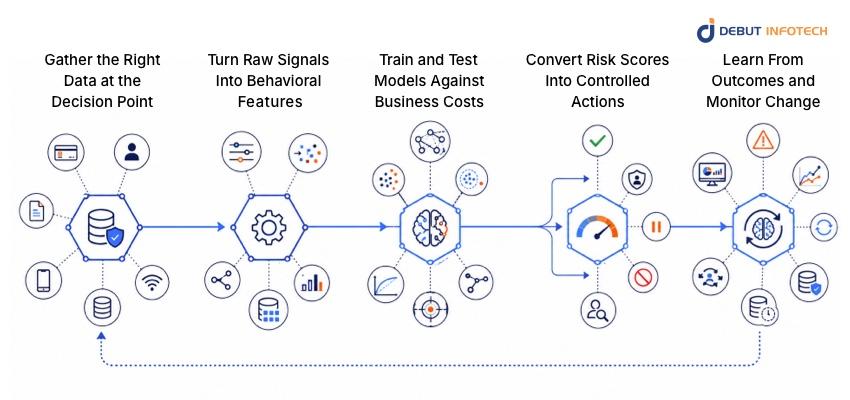
The process begins when an event such as a payment, login, claim, application, or refund enters the system. Live details are combined with relevant history, including transaction velocity, account age, previous behavior, device and network information, identity evidence, and relationships with other entities. The objective is not to collect every available field. It is to use permitted, decision-relevant data with clear ownership. Quality checks should detect missing values, stale records, duplicate events, and delayed services before unreliable inputs affect a customer decision.
Individual fields rarely explain risk on their own. Feature engineering converts them into context, such as the number of purchases made within an hour, the distance from a customer’s usual location, or several accounts using the same device. Entity resolution connects records belonging to related people, accounts, merchants, addresses, providers, or claims. A shared feature store can keep these calculations consistent during training and live scoring, preventing differences between the model built in development and the model used in production.
Supervised models learn from labeled outcomes such as confirmed chargebacks, account takeovers, or analyst decisions. Unsupervised and graph techniques can reveal anomalies or connected activity when labels are incomplete. Training and evaluation data should be separated by time to reduce leakage from future information. Overall accuracy can mask poor detection, as there are often few fraudulent events. A more useful view is provided by precision, recall, false-positive rate, PR-AUC, score calibration and latency. Teams then determine the thresholds based on the possible loss, customer friction, risk appetite and availability of review capacity.
A model estimates risk and a decision engine determines the response. It can combine the score with policy rules and operational context to approve an event, request additional verification, place a temporary hold, decline where permitted, or begin Fraud Investigation. AWS’s near-real-time fraud guidance demonstrates this scoring-and-response pattern. Reason codes help analysts understand alerts, while timeouts, fallback rules, and human review prevent a missing service or uncertain score from creating an unsafe automated decision.
New labels are generated based on chargeback, confirmed claim, appeal, findings by analysts, and customer reports. These outcomes feed the next training cycle and indicate if the system is making a positive impact on business outcomes. Teams should monitor data quality, feature availability, score distributions, drift, performance across relevant segments, review workload, and fraud loss. Versioned releases, approval gates, retraining triggers, champion–challenger tests, and rollback procedures keep updates controlled. This feedback loop allows the fraud analytics platform to adapt without treating every model change as automatically safe or effective.
The right model depends on the evidence available and the decision the business must make. Labeled transaction records support different methods from sparse claims data or networks of connected accounts. Selection should consider data volume, label quality, scoring latency, interpretability, maintenance effort, and the financial impact of errors, not benchmark accuracy alone.
| Model family | Best fit | Why teams use it | Important limitation |
| Logistic regression | Reliable labels, structured features, fast decisions, and strong audit requirements | Produces an interpretable baseline and can be scored with low latency | It may miss complex, nonlinear interactions unless teams engineer them explicitly. |
| Decision trees and random forests | Labeled tabular data with mixed feature types and nonlinear patterns | Handle interactions and are relatively straightforward to train and deploy | Individual trees can overfit, while large forests become harder to explain and maintain. |
| Gradient-boosted trees | High-volume, labeled transaction, account, order, or claims data | Often perform well on structured data while remaining practical for real-time scoring | They require careful tuning, calibration, drift monitoring, and explanation of material decisions. |
| Clustering, isolation forests, and one-class models | Few dependable labels or a need to find new behavior | Surface unusual users, transactions, merchants, or providers without examples of every scheme | An anomaly is not proof of fraud, so outputs can create noisy alerts without thresholds and investigation. |
| Neural networks and autoencoders | Large datasets with sequential, behavioral, image, audio, or document patterns | Learn complex representations that manual features may not capture | They usually demand more data, computing resources, specialist skills, and explainability controls. |
| Graph analytics and graph neural networks | Shared devices, addresses, accounts, merchants, or providers indicate coordinated activity | Reveal fraud rings, mule networks, collusion, and synthetic-identity relationships hidden in isolated records | Building and refreshing an accurate graph can be complex, especially when decisions must occur in real time. |
| NLP and document models | Claims, invoices, applications, emails, or case notes contain relevant evidence | Extract entities, inconsistencies, and patterns from unstructured content | Results depend on document quality, language, context, and human validation for consequential decisions. |
No model family is best in every environment. Supervised approaches fit known patterns with reliable labels; anomaly methods help surface unfamiliar activity; graph models reveal connected behavior; and document models extract signals from unstructured evidence. AWS provides a reference architecture using graph neural networks for near-real-time connected fraud detection, illustrating why architecture must follow the fraud pattern.
Production systems commonly use an ensemble or layered design rather than one algorithm. A gradient-boosted model might score a transaction, a graph model might assess connected entities, and rules might enforce explicit policies before a human reviews an uncertain case. Large language models are better suited to evidence extraction, case summaries, and investigator assistance than primary transaction scoring. The final choice should reflect measurable loss, customer friction, review capacity, latency, explainability, and the organization’s ability to monitor and retrain the model.
Machine Learning for Fraud Detection can be used to evaluate risk in financial transactions, digital accounts, claims, orders, invoices and internal processes. Its value lies in combining a number of weak signals, which may seem insignificant on their own. The following use cases show how data becomes a pattern and then a proportionate business response:
Stripe documents similar payment applications, including device fingerprinting and account-takeover analysis. These systems provide estimates of risk, they are not a factual or legal determination of fraud. Scores should be used to inform documented policies, proportionate interventions and human review, especially in situations where a decision may result in receiving no payment, coverage, access or other key service.
Build Fraud Detection That Fits Your OperationsSee how our machine learning development company services connect data, models, workflows, and monitoring into one production-ready solution.
The benefits of machine learning for fraud detection should appear in operating and financial measures, not in a higher model score alone. A useful system must help the business identify more harmful activity while controlling customer friction, investigation effort, and total operating cost. When the data and workflow are reliable, machine learning can support several outcomes:
Fraud detection ROI should include more than avoided loss. A full evaluation takes into account the cost of incorrect decisions, compliance tasks, model maintenance, implementation effort, infrastructure and vendor fees, review labour and recovered legitimate revenue. A more effective model could still be detrimental to value if it denies too many legitimate customers or becomes so complex that investigators cannot keep up with it. On the other hand, if the number of missed frauds rises, then the number of alerts is not evidence of improvement.
The results depend on usable labels, representative features, reliable integrations, well-calibrated thresholds, review capacity, and continuous monitoring. Businesses should compare the system with an agreed rule-based or manual baseline, measure outcomes across relevant customer and risk segments, and test changes in shadow mode or a controlled pilot before expanding automated actions. This makes the value claim observable, reviewable, and tied to the organization’s actual risk appetite.
Rules and machine learning are not interchangeable detection methods. A rule makes a deterministic decision when a stated condition is met. A model estimates the probability of risk from relationships within data. The choice depends on available evidence, measurable outcomes, and the amount of uncertainty the business can tolerate.
| Decision factor | Rule-based approach | Machine learning approach |
| Detection logic | Applies conditions written by fraud or risk teams | Learns statistical relationships from historical and live signals |
| Best use | Explicit policies, known indicators, emergency blocks, and low-data environments | Complex, high-volume, behavioral, or connected fraud patterns |
| Response to change | New patterns require manual rule design and testing | Models can identify broader patterns but require updated data and controlled retraining |
| Explainability | Usually provides a direct reason for the decision | Depends on model type, feature design, and explanation controls |
| False positives | Broad thresholds can treat unusual legitimate activity as fraud | Calibrated scores can support more selective interventions, but poor labels or thresholds still create errors |
| Operating burden | Rule conflicts, exceptions, and retirement must be managed | Data quality, drift, versioning, monitoring, and rollback must be managed |
| Data requirement | Can operate with limited history | Needs representative features and often confirmed outcomes |
| Failure handling | Requires tested rule ordering and defaults | Requires timeouts, fallback logic, and safe behavior when models or features are unavailable |
Machine learning offers an advantage when risk depends on many interacting signals or connected entities. It does not automatically outperform rules. A model trained on weak labels, stale features, or unrepresentative data may produce unreliable scores, while a well-designed rule can remain the safest control for a clear restriction.
The practical choice is often a hybrid Fraud Prevention architecture. Rules enforce non-negotiable policies and known threat indicators. Models rank uncertain activity, and a decision engine converts both inputs into approval, verification, hold, decline, or review. Investigators resolve consequential cases and return confirmed outcomes to the system. Teams should evaluate the complete workflow against fraud loss, false positives, approval rates, review workload, latency, and operating cost, not compare algorithms in isolation.
A production fraud system must connect a model to real decisions, investigator workflows, security controls, and measurable outcomes. AI fraud detection software development should therefore progress through defined stage gates rather than move directly from an experimental model to automated blocking. The following sequence helps teams control technical and business risk.
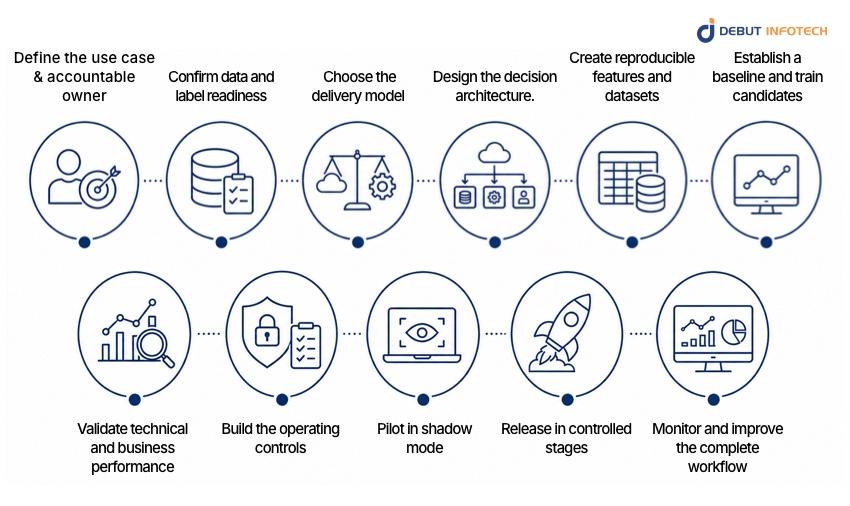
An offline model can perform well and still fail in operation. Slow features, unreliable integrations, unclear actions, or an overloaded review team can eliminate its expected value. Production readiness is reached when the entire system, not only the algorithm, delivers safer, explainable, and sustainable decisions.
The most serious fraud detection challenges usually appear after a model leaves the laboratory and begins influencing real decisions. Data changes, services fail, attackers adapt, and incorrect actions affect customers and investigators. Teams should assign an owner, consequence, monitoring signal, and response plan to each material risk before deployment.
| Risk area | What can go wrong | Required control |
| Imbalanced data | High overall accuracy hides missed fraud or excessive alerts because legitimate events dominate the dataset | Evaluate precision, recall, PR-AUC, calibration, cost-weighted errors, and thresholds |
| Unreliable labels | Delayed chargebacks, inconsistent reviews, or incomplete claims teach the model the wrong pattern | Govern label definitions, outcome windows, review quality, and corrections |
| Model drift | Customer behavior, products, channels, or fraud tactics change after training | Monitor data, features, scores, and confirmed outcomes; define investigation and retraining triggers |
| False positives | Genuine users are challenged, blocked, or sent to review unnecessarily | Calibrate risk bands, use proportionate actions, support overrides and appeals, and track customer impact |
| Uneven performance | A model performs poorly for a relevant customer or risk segment | Test segments, inspect proxy variables, document limitations, and require human oversight |
| Adversarial behavior | Attackers probe controls, manipulate inputs, or distribute activity across connected identities | Use layered signals, rate limits, red-team tests, graph analysis, and incident response |
| Weak explanations | Analysts cannot evaluate alerts or justify consequential decisions | Provide reason codes, traceable evidence, model documentation, and explanation methods suited to the model |
| Privacy and security | Sensitive information is collected without need, exposed, misused, or retained too long | Apply minimization, encryption, access controls, retention policies, logging, and breach procedures |
| Latency and outages | The score arrives after the decision or a failed feature service causes an unsafe response | Load-test the workflow and define timeouts, fallbacks, degraded modes, and recovery objectives |
| Vendor dependency | Proprietary data formats, features, or models make migration expensive | Negotiate export, API, ownership, documentation, service-level, and exit terms |
Applicable controls depend on the data, industry, jurisdiction, and impact of the decision. Payment systems that store, process, or transmit payment account data should assess applicable PCI DSS v4.0.1 requirements. Organizations processing personal data in the EU must evaluate GDPR obligations, including safeguards relevant to automated decisions. Covered U.S. healthcare entities and business associates must apply the HIPAA Privacy and Security Rules when handling PHI or ePHI.
For U.S. supervised banking organizations, the Federal Reserve’s April 2026 Revised Guidance on Model Risk Management emphasizes a risk-based approach and supersedes SR 11-7. Other sectors and countries impose different requirements. Teams should involve qualified legal, compliance, security, and model-risk reviewers before launch rather than treating a technical control as proof of compliance. This information is general guidance, not legal advice.
AI fraud detection is transitioning from transaction scoring to integrated, ongoing decision-making processes. The most relevant trends are not just newer algorithms, but trends that impact what signals teams can use, how fast models respond and how investigators regulate the result.
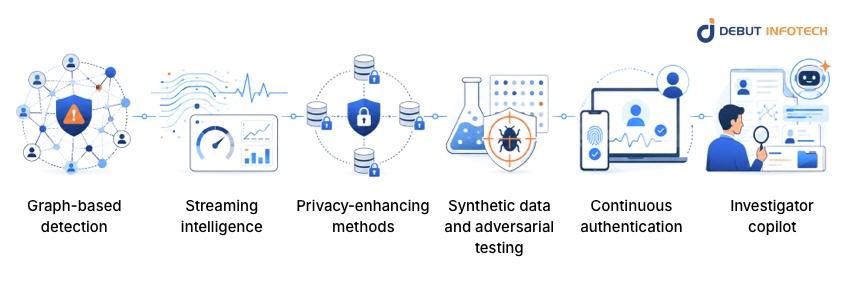
Continuous evaluation is becoming as important as model training. Champion–challenger tests compare proposed models or thresholds before replacement, while monitoring connects drift to fraud loss, customer friction, and review workload. Agentic tools should not independently establish fraud or trigger consequential actions. Logged decisions, bounded authority, rollback procedures, and qualified human approval remain necessary.
The cost of AI fraud detection software development depends on data readiness, decision speed, integrations, controls, and operating scope. The common range is between $25,000 to $150,000+ and a timeline of 6–16 weeks for general ML projects. These are not fraud-specific estimates; systems may require phased delivery and ongoing investment.
The main cost drivers include:
The realistic budget should differentiate between a one time cost and a recurring cost. Continuous expenses can be cloud infrastructure, data providers, monitoring, retraining, support, investigator labor, security testing and vendor licenses. A managed fraud detection platform might involve some subscription and data-portability fees, but will still save initial build time, while a custom solution will have a higher initial investment, but offer more control.
Businesses should validate all assumptions before approving a budget. The most reliable estimate follows a discovery and data-readiness assessment, not a generic per-model price.
Selecting the right partner is not just about comparing prices or looking at a generic AI portfolio, it’s about finding the right fit for your specific needs. A capable machine learning development company should understand fraud operations, data engineering, security, compliance, and the commercial cost of false decisions. Evaluate candidates against evidence before committing to implementation.
Finally, assess communication quality. A reliable partner should challenge weak assumptions, explain trade-offs clearly, and connect choices to fraud detection ROI. Begin with a discovery or data-readiness assessment before approving a production build.
Fraud detection projects often become difficult when a promising model must connect with live data, operational rules, and investigation teams. At Debut Infotech, we support this transition through our machine learning development company services, which cover data preparation, feature engineering, custom model development, anomaly detection, workflow integration, deployment, and MLOps.
Our approach to machine learning for fraud detection begins with the business risk rather than a preferred algorithm. Through our AI consulting services, we can assess data readiness, define measurable loss and customer-friction metrics, and determine whether rules, supervised learning, anomaly detection, or a hybrid design fits the use case.
Our expertise extends across industries where AI-driven automation is essential. We have developed AI development solutions for the title insurance industry to streamline document analysis and verification workflows, as well as deep learning solutions for the recruitment industry that enhance intelligent search and decision-making across large datasets. These projects reflect our ability to build scalable AI systems capable of automating complex, data-intensive processes which are capabilities that translate well to fraud detection use cases such as document validation, anomaly detection, risk scoring, and workflow automation.
Before development, we recommend a limited discovery phase using a representative data sample. Assumptions are documented, fraud detection challenges identified, acceptance thresholds are proposed and ownership and monitoring responsibilities set. This provides your team with proof to review our proposed architecture, delivery timeline, estimated cost and the operational fit before moving to production or a formal long-term support services contract.
Build a Clear Path to DeploymentTell us what you need to detect. We’ll help define the data, architecture, costs, controls, and delivery roadmap.
Businesses use machine learning for fraud detection because static rules cannot efficiently evaluate every changing behavioral, transactional, device, and network signal. Models can generate risk scores in real time, identify patterns analysts may miss, and adapt through retraining. The business value comes from reducing fraud losses while controlling false declines, investigation workloads, and customer friction, not from automation alone.
Not on its own. Rules remain effective for enforcing policies, applying regulatory restrictions, blocking known fraud indicators, and responding to urgent threats. Machine learning is better at ranking complex or unfamiliar patterns. Most businesses need a hybrid architecture: rules establish non-negotiable boundaries, models prioritize risk, and investigators review uncertain or high-impact decisions.
There is no universal accuracy percentage because performance depends on the data, fraud type, threshold, and operating environment. Overall accuracy can also be misleading when legitimate events greatly outnumber fraud. Evaluate precision, recall, false-positive rate, false-negative cost, PR-AUC, approval rate, detection latency, and analyst workload. The best threshold produces the strongest business trade-off under live conditions.
Common machine learning models include logistic regression, decision trees, random forests, gradient-boosted trees, neural networks, isolation forests, autoencoders, clustering methods, and graph models. Supervised models learn from confirmed outcomes, while unsupervised approaches identify unusual behavior without complete labels. Stripe also identifies anomaly detection, risk scoring, and network analysis as practical fraud-prevention applications.
No single model is best for every fraud problem. Gradient-boosted trees often provide a useful starting point for structured transaction data, while anomaly-detection models can surface emerging patterns. Graph models suit coordinated networks, and deep learning may help with complex sequential or unstructured data. The correct choice depends on label quality, latency, explainability, infrastructure, and decision cost.

Our Latest Insights


USA

2501 Chatham, Rd Suite R Springfield, IL 62704
+1-708-515-4004
info@debutinfotech.com
UK

7 Pound Close, Yarnton, Oxfordshire, OX51QG
+44-770-304-0079
info@debutinfotech.com
Canada

154 Eden Oak Trail, Kitchener, ON N2A 0H9
+1-708-515-4004
info@debutinfotech.com
INDIA

Sector 101-A, Plot No: I-42, IT City Rd, JLPL Industrial Area, Mohali, PB 140306
9888402396
info@debutinfotech.com

9001:2015
Quality Certified

ISO 27001
Security Certified

A+ Rating
Accredited Business

Certik
Security & Audit


Copyright © 2026, Debut Infotech. All rights reserved. | Privacy Policy