ON THIS PAGE
Progress0%






Our Global Presence :






AI copilot development cost ranges from $30,000 to $500,000+, based on scope, integrations, models, security, RAG, and infrastructure.
Complexity drives cost and timelines, with task-specific copilots costing less than multi-department systems with automation and orchestration.
RAG supports changing business knowledge, while fine-tuning suits specialized model behavior, task performance, and consistent outputs.
Third-party integrations increase costs when copilots connect with CRM, ERP, databases, communication tools, and internal systems.
Enterprise copilots need strong security, including access controls, monitoring, evaluation, audit logs, guardrails, and compliance.
API-hosted vs. self-hosted inference depends on usage, infrastructure costs, latency, utilization, model needs, and data-control requirements.
AI copilots can help employees find information, automate routine tasks, work across business systems, and make faster decisions. But the cost to build an AI copilot varies widely. A simple task-focused copilot may cost tens of thousands of dollars. At the same time, an enterprise system with advanced integrations, RAG, security controls, and custom workflows can require a much larger budget.
Understanding AI Copilot Development Cost before development begins helps you set a realistic budget and avoid unexpected expenses. Model selection, data preparation, integrations, infrastructure, compliance, and ongoing usage can all affect the final price.
This guide breaks down typical development costs by project tier and build phase. It also explains the factors that influence pricing, hidden operating costs, RAG versus fine-tuning, API-hosted versus self-hosted inference, and whether you should build, extend, or buy. You’ll also learn how to reduce costs and calculate the expected payback period.
An enterprise AI copilot typically costs $200,000–$500,000+ to develop, with simpler business copilots starting around $30,000. The final price of AI copilot software development depends on integrations, AI model choice, RAG, security, infrastructure, customization, and the number of users and workflows supported.
| Copilot tier | Typical development cost | Typical timeline | What is usually included |
| Basic | $30,000–$75,000 | 8–14 weeks | Chat interface, one primary use case, API-based LLM, basic prompts, limited knowledge base, basic authentication, testing |
| Mid-level | $75,000–$200,000 | 3–6 months | RAG, multiple workflows, several integrations, admin controls, analytics, stronger security, evaluation framework |
| Enterprise | $200,000–$500,000+ | 6–12+ months | Multiple departments, complex integrations, advanced RAG, custom workflows, enterprise security, compliance, monitoring, AI governance, high availability |
The $30,000–$75,000 tier is suitable for a focused AI assistant. For example, a company could build an internal HR copilot that answers policy questions, retrieves information from approved documents, and directs employees to the right forms. The project becomes more expensive when the copilot starts taking actions across several systems.
A mid-level copilot is usually the point at which the system becomes a genuine business tool rather than a simple chatbot. It may retrieve information from company documents, call CRM APIs, create support tickets, summarize records, draft emails, and perform controlled actions. A project in the $75,000–$200,000 range can meet these requirements when the scope remains well-defined.
Enterprise systems can exceed $500,000 when they serve thousands of employees, support multiple departments, connect to legacy systems, require strict compliance controls, or need custom model infrastructure. The AI copilot development cost for enterprises also rises when the project requires multiple environments, high availability, extensive audit logging, advanced access controls, or 24/7 operational support.
These development figures should not be confused with ongoing AI usage costs. An API-based model is generally billed according to usage. For example, OpenAI’s published GPT-5 pricing lists input and output token charges separately, while its GPT-4.1 pricing also varies by input, cached input, and output tokens.
The practical approach to planning is to treat the initial development budget and the operating budget as two separate numbers. A company may spend $120,000 building a copilot and then pay several thousand dollars per month for model calls, cloud infrastructure, vector search, monitoring, maintenance, and support. A realistic business case should account for both.
Ten major factors affect AI copilot development cost for startups, including copilot type, technical complexity, model selection, UI/UX, data preparation, RAG, integrations, security, development rates, and infrastructure. Each factor changes the engineering effort, resources, infrastructure requirements, or ongoing operating expenses.
The copilot’s purpose determines how much functionality the development team needs to build. A focused assistant can rely on a narrow workflow, while an enterprise-wide system may need multiple workflows, user roles, data sources, and business systems.
| Copilot Type | Cost Impact | Why It Affects Cost |
| FAQ / Knowledge Copilot | Low | Developers build basic retrieval and response logic around a limited knowledge source |
| Task Automation Copilot | Low | Developers add workflow logic and controlled actions for specific tasks. |
| Departmental Copilot | Medium | Developers support multiple workflows, users, permissions, and department-specific data. |
| Multi-Department Copilot | High | Developers connect several workflows, systems, data sources, and access rules. |
| Enterprise-Wide Copilot | Very High | Developers build shared orchestration, extensive integrations, governance, and role-based access controls. |
A task-specific copilot is designed around a narrow job. Examples include generating sales emails, answering HR questions, summarizing support tickets, or helping developers search technical documentation. A focused system needs fewer workflows, integrations, permissions, and test cases.
An enterprise-wide copilot has a much broader responsibility. It may serve HR, sales, finance, customer support, operations, and management on a single platform. Each department introduces different data sources, permissions, workflows, and expected responses. This increases both development time and testing requirements.
A business should therefore avoid defining the project as “an AI copilot for the whole company” at the beginning. Start with the highest-value workflow. Expand the system once you have proven that the first use case produces measurable results.
Complexity increases when the copilot moves beyond answering questions and starts reasoning across data, calling tools, or completing business processes. Each additional capability requires more backend logic, testing, and failure handling.
| Development Complexity | Cost Impact | Why It Affects Cost |
| Basic Q&A | Low | Developers implement simple prompts, responses, authentication, and conversation handling |
| Context-Aware Assistant | Low | Developers add conversation memory and contextual prompt management. |
| RAG-Based Copilot | Medium | Developers build ingestion, embedding, retrieval, ranking, and context assembly pipelines. |
| Tool-Using Copilot | High | Developers implement API calls, tool permissions, validation, and error handling. |
| Autonomous Workflow Copilot | Very High | Developers build orchestration, decision logic, approvals, monitoring, and recovery mechanisms. |
Basic copilots can use a standard LLM API, a simple prompt structure, a web interface, and a limited set of documents. Development becomes more complex when the system must reason across multiple data sources, maintain conversation context, call external tools, execute workflows, or handle different user permissions.
Complexity also affects testing. A simple question-answering assistant may require hundreds of evaluation cases. An enterprise copilot that can update CRM records or initiate financial workflows requires many more scenarios, including incorrect requests, unauthorized actions, missing information, and unexpected model behavior.
Model selection affects both development requirements and long-term inference spending. The right choice depends on the complexity of the tasks, response requirements, data controls, and expected request volume.
| AI Model Option | Cost Impact | Why It Affects Cost |
| Small API Model | Low | Developers integrate a lightweight hosted model with relatively low inference costs. |
| OpenAI GPT | Medium | Developers integrate paid API inference while managing prompts, tokens, and model-specific behavior. |
| Premium Reasoning Model | High | Developers manage higher inference costs and optimize routing for complex requests. |
| Fine-Tuned Model | High | Developers prepare training data, run fine-tuning jobs, and evaluate model-specific performance. |
| Self-Hosted Open Model | Very High | Engineers manage GPUs, model serving, scaling, monitoring, and infrastructure |
API-based models are generally faster to deploy because the development team does not have to operate the underlying model infrastructure. The application sends requests to the model provider and pays according to usage.
Self-hosted models provide greater control but introduce infrastructure, deployment, scaling, monitoring, and optimization costs. A company may need GPUs, model-serving infrastructure, engineers, and additional security controls.
Fine-tuning can add another layer of cost. It requires preparing training data, running training jobs, evaluating the resulting model, and maintaining the process as business requirements change. Fine-tuning should therefore be justified by a specific performance requirement rather than used simply because the project is large.
The interface determines how deeply the copilot fits into an employee’s workflow. A simple chat window requires limited frontend work, whereas a copilot embedded across several applications requires more design and engineering effort.
| UI/UX Option | Cost Impact | Why It Affects Cost |
| Basic Chat Interface | Low | Developers build a single conversation screen with basic input and response components. |
| Branded Web Copilot | Low | Designers add branded layouts, responsive behavior, feedback controls, and conversation history. |
| Embedded Application Copilot | Medium | Developers integrate contextual AI features into an existing business application. |
| Cross-Platform Copilot | High | Developers support multiple interfaces, device types, authentication flows, and testing environments |
| Full Enterprise Experience | Very High | Designers and developers create advanced workflows, personalization, accessibility, and multi-platform experiences. |
A basic chat interface is inexpensive compared with a copilot embedded throughout an organization’s applications. A simple web chat may need only conversation history, authentication, feedback controls, and file handling.
A cross-platform copilot may require web, mobile, desktop, browser extensions, or integrations inside tools employees already use. Each environment introduces additional design, development, testing, and maintenance work.
The interface should reflect how people use the copilot. If employees need AI assistance while working in a CRM, embedding the assistant inside the CRM may create more value than building another standalone application.
Business data often requires substantial preparation before an AI copilot can use it reliably. The effort depends on the number of sources, data formats, quality, update frequency, and training requirements.
| Data Preparation Level | Cost Impact | Why It Affects Cost |
| Clean Structured Data | Low | Developers connect existing structured sources with minimal transformation work |
| Basic Document Processing | Low | Developers extract, clean, segment, and standardize common document formats |
| Multiple Data Sources | Medium | Engineers build pipelines that normalize information from several systems and formats. |
| Complex Enterprise Data | High | Engineers resolve inconsistent schemas, permissions, duplicates, and outdated information |
| Training Dataset Preparation | Very High | Teams label, clean, validate, version, and prepare large datasets for model training. |
AI models can provide useful, business-specific answers only when they have access to reliable business information. Preparing that information may involve collecting documents, removing duplicates, correcting outdated content, defining metadata, converting file formats, and establishing access rules.
Poor data quality can increase costs because developers spend more time fixing retrieval problems and evaluating inaccurate answers. A clean and well-structured knowledge base reduces this work.
Data preparation is therefore part of AI copilot development rather than a separate administrative task. The quality of the underlying information directly affects the quality of the final system.
RAG gives a copilot access to business-specific information without placing all that information inside the model itself. Its cost depends on the size of the knowledge base, the retrieval architecture, the update frequency, and the search requirements.
| RAG Setup | Cost Impact | Why It Affects Cost |
| Small Knowledge Base | Low | Developers configure basic document ingestion, embeddings, and vector retrieval. |
| Managed Vector Search | Medium | Developers configure hosted vector infrastructure, metadata, indexing, and retrieval. |
| Multi-Source RAG | High | Engineers combine documents, databases, APIs, permissions, and retrieval strategies. |
| Real-Time RAG | High | Engineers build continuous ingestion, synchronization, indexing, and freshness controls |
| Enterprise RAG | Very High | Engineers manage large-scale retrieval, access controls, ranking, monitoring, and evaluation. |
Retrieval-augmented generation, or RAG, allows a copilot to retrieve relevant information from a company’s data before generating an answer. A typical implementation may involve document processing, embeddings, a vector database, retrieval logic, ranking, access controls, and response generation.
The AI copilot implementation cost depends on the size and complexity of the knowledge base. A few thousand internal documents are easier to manage than millions of records that change continuously.
Vector infrastructure also creates an ongoing expense. For example, Pinecone’s current pricing includes a $20-per-month Builder plan and a $50 monthly minimum for its Standard plan, with usage-based charges above the included minimum.
Integrations determine how deeply the copilot interacts with existing business systems. Reading information from a single API requires less work than securely executing actions across multiple systems.
| Integration Scope | Cost Impact | Why It Affects Cost |
| Single API | Low | Developers connect one external service through its existing API |
| CRM Integration | Medium | Developers handle customer data, authentication, permissions, and API operations |
| Communication Tools | Medium | Developers integrate messaging APIs, user identities, notifications, and conversation context |
| CRM + ERP | High | Engineers synchronize data and coordinate actions across separate enterprise systems. |
| Multi-System Automation | Very High | Engineers orchestrate APIs, permissions, transactions, retries, and cross-system error handling |
Integrations are often one of the largest hidden development costs. Connecting a copilot to Salesforce, HubSpot, SAP, Microsoft Dynamics, Slack, Teams, Jira, ServiceNow, or internal databases requires API work and permission management.
The complexity depends on what the copilot is allowed to do. Reading a customer record is simpler than updating that record. Creating a support ticket is simpler than approving a refund. Each action requires authentication, validation, error handling, logging, and testing.
Businesses should rank integrations according to usage and value. Connecting ten systems during the first release may increase custom AI copilot development cost without producing ten times the business value.
Security requirements become more demanding when a copilot handles sensitive information or performs business actions. Compliance also affects architecture, access controls, logging, retention, and testing.
| Security / Compliance Level | Cost Impact | Why It Affects Cost |
| Standard Authentication | Low | Developers implement identity verification and basic session controls |
| Role-Based Access | Medium | Engineers enforce permissions across users, tools, and data sources. |
| GDPR Controls | Medium | Developers implement privacy, data handling, retention, and user-rights requirements |
| SOC 2 Controls | High | Teams implement stronger logging, access management, monitoring, and operational controls |
| HIPAA / High-Risk Workloads | Very High | Engineers add strict data controls, auditing, safeguards, and compliance-focused testing. |
Security requirements may include encryption, identity management, role-based access control, audit logging, data retention controls, prompt-injection protection, and restricted tool access.
Compliance requirements can further increase development effort. A healthcare application may require HIPAA-related controls. A system serving European users may need to consider GDPR requirements. Organizations pursuing SOC 2 compliance may also require stronger controls around access, monitoring, logging, and operational processes.
Guardrails should be designed into the architecture rather than added after development. The system needs to know which users can access which data and which actions the AI is allowed to perform.
Team composition and location can change the hourly development rate and total project cost. Larger projects may require several specialists, while smaller copilots can use a leaner team with overlapping responsibilities.
| Team / Region | Cost Impact | Rate Range | Why It Affects Cost |
| Small Team, Lower-Cost Region | Low | $25–$50/hr | A lean team handles several roles while regional rates reduce labor costs. |
| Small Team, Mid-Cost Region | Medium | $40–$80/hr | Moderate regional rates combine with a limited number of specialists |
| Specialized Team, Mid-Cost Region | High | $60–$120/hr | Dedicated AI, backend, frontend, QA, and DevOps specialists increase labor hours. |
| Enterprise Team, Higher-Cost Region | Very High | $100–$200+/hr | Multiple senior specialists handle complex architecture, security, integrations, and delivery |
A typical enterprise copilot team may include a project manager, an artificial intelligence/machine learning engineer, a backend developer, a frontend developer, a UX designer, a QA engineer, a DevOps engineer, and a security specialist. Smaller projects can combine several of these roles.
Developer rates also vary by location and engagement model. Teams in North America and Western Europe generally command higher rates than teams in many Eastern European, Latin American, and Asian markets. However, hourly rate alone does not determine total cost of developing an enterprise AI copilot.
A lower-cost team that requires more supervision or produces more rework may cost more overall. Businesses should compare the complete delivery cost, technical capability, communication, experience, and expected AI copilot development timeline and cost.
Hosting costs depend on how much computing power, storage, networking, and availability the copilot requires. Usage volume also matters because a system serving thousands of users creates a different infrastructure profile from an internal tool serving a small team.
| Hosting Setup | Cost Impact | Why It Affects Cost |
| Basic Cloud Hosting | Low | The application uses modest compute, storage, database, and networking resources. |
| Scalable Managed Infrastructure | Medium | Cloud services automatically adjust resources as usage changes |
| High-Volume Inference | High | Increased model requests require more compute capacity and supporting infrastructure. |
| Dedicated AI Infrastructure | High | Dedicated compute resources support predictable performance and model-serving requirements |
| High-Availability Enterprise Infrastructure | Very High | Engineers add redundancy, failover, monitoring, scaling, security, and disaster recovery. |
Cloud costs depend on the number of users, requests, data volume, response speed, storage requirements, and availability targets. The architecture may require application servers, databases, object storage, monitoring, networking, security services, and model infrastructure.
Self-hosted AI adds another layer of cost because the organization pays for the infrastructure required to run the model. AWS, for example, describes custom-model hosting in terms of Custom Model Units, with costs tied to the infrastructure required to keep model copies available for inference.
Infrastructure should be sized for the expected workload rather than the maximum theoretical workload. Overprovisioning from the outset can lead to unnecessary monthly expenses.
A mid-level AI copilot with a development budget of around $125,000 provides a useful reference point for understanding how the money is spent. The exact allocation will vary by project, but the following breakdown gives a practical planning model.
| Build phase | Approx. Share of budget | Example cost at $125,000 mid-tier budget |
| Discovery and requirements | 8% | $10,000 |
| Prompt and UX design | 10% | $12,500 |
| Backend and orchestration | 20% | $25,000 |
| LLM integration | 12% | $15,000 |
| RAG and vector setup | 15% | $18,750 |
| Testing and evaluation | 15% | $18,750 |
| Deployment and production setup | 10% | $12,500 |
| Project management, contingency and other engineering | 10% | $12,500 |
| Total | 100% | $125,000 |
Discovery comes first because developers need to understand the business process, users, data, integrations, security requirements, and success criteria. Spending too little time here can create expensive changes later.
Backend and orchestration usually take a substantial share of Enterprise AI Copilot Development cost because the copilot needs more than a large language model connection. The application must manage authentication, conversation state, tool calls, business rules, integrations, logging, errors, and data access.
Testing and evaluation also deserve a meaningful budget. A copilot can produce fluent answers while still giving incorrect information. Evaluation should measure factual accuracy, retrieval quality, tool-call accuracy, response consistency, safety, latency, and cost.
RAG setup becomes a significant phase when the copilot needs company-specific knowledge. The development team may need to build ingestion pipelines, chunk documents, create embeddings, configure retrieval, apply metadata filters, and test whether the right information is returned.
The initial AI-powered copilot development quote does not always show the full cost of running an AI copilot. Some expenses appear only after the system starts handling real users, larger datasets, and higher request volumes.
These costs can affect the total AI copilot development pricing significantly over time. Planning for them early gives you a more accurate ownership estimate and helps prevent unexpected increases after deployment.
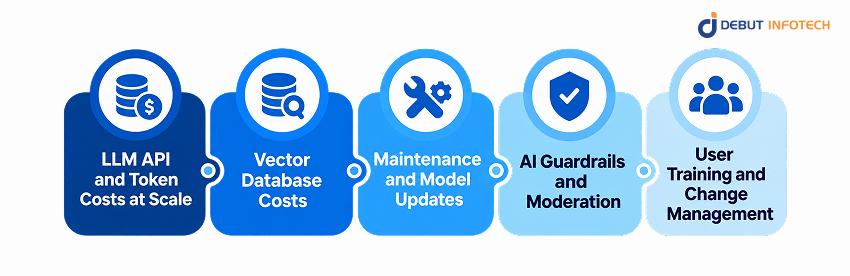
LLM API costs can become a major recurring expense as usage grows. Every request consumes input and output tokens, and long prompts, conversation histories, documents, and retrieved context can increase these token counts.
A copilot used by thousands of employees may generate millions of tokens each month. Model pricing also varies, so using an expensive model for every request can unnecessarily raise operating costs. Model routing and token optimization can help control this expense.
A RAG-based copilot usually needs a vector database to store embeddings and support similarity searches. Costs can increase with the number of documents, storage requirements, query volume, indexing, and re-indexing.
Frequently changing knowledge bases can increase processing costs because new or modified documents must be re-embedded. Businesses should also account for backup, monitoring, scaling, and data transfer expenses when estimating the long-term cost of their RAG infrastructure.
An AI copilot requires ongoing maintenance after launch. APIs change, models are updated, integrations can break, and business information becomes outdated.
Developers may need to adjust prompts, update retrieval logic, fix integration errors, improve response quality, and test new model versions.
Maintenance can also include performance monitoring and security patches. Setting aside a recurring budget for these activities helps keep the copilot reliable as its technical environment changes.
Guardrails add development and operating costs because the copilot needs controls around what it can receive, generate, and execute. These may include sensitive data detection, prompt injection protection, content moderation, access restrictions, output validation, and limits on tool use.
Higher-risk workflows may also require human approval before the AI performs certain actions. The more authority a copilot has, the more testing and control mechanisms are needed to prevent costly or harmful mistakes.
Employees may need training before they can use a copilot effectively. They need to understand what the system can do, how to phrase requests, how to verify responses, and when human review is required.
Training may include documentation, workshops, onboarding materials, internal support, and usage guidelines. Change management also takes time because employees may continue using existing processes unless the new system clearly improves their daily work and receives organizational support.
RAG and fine-tuning solve different problems. RAG is usually the more practical choice when the copilot needs access to changing company information. Fine-tuning is more appropriate when the goal is to change how a model behaves, follows a pattern, or performs a specialized task.
| Factor | RAG | Fine-tuning |
| Upfront cost | Usually lower | Usually higher |
| Business data updates | Easier | Requires additional training |
| Knowledge retrieval | Strong fit | Poorer fit for frequently changing facts |
| Behavior/style adaptation | Moderate | Stronger |
| Ongoing cost | Retrieval and vector infrastructure | Model hosting/API plus retraining |
| Best suited for | Internal knowledge, policies, documents | Specialized behavior, formats, repeated task patterns |
RAG usually has a lower starting cost because the company does not need to train the base model. The development team builds a retrieval layer around it. When a policy document changes, the knowledge base can be updated without retraining the entire model.
Fine-tuning can make sense when a business has a large, high-quality dataset and a repeatable task where model behavior needs to improve consistently. A useful decision rule is simple: use RAG for changing knowledge and fine-tuning when the main problem is model behavior or task performance.
API-hosted inference is usually cheaper to start because the business pays for model usage without purchasing or operating dedicated model infrastructure. This works well when traffic is uncertain or moderate.
Self-hosting can become more attractive when usage is consistently high. The company assumes infrastructure costs, but gains greater control over the model, deployment environment, data handling, and potentially the cost per inference.
A simplified comparison looks like this:
| Usage level | API-hosted inference | Self-hosted inference |
| Low | Usually more economical | Usually inefficient |
| Moderate | Often the best starting point | May be viable for specific requirements |
| High and predictable | Costs can become substantial | Can become more economical |
| Very high | Requires careful token optimization | Strong case if utilization remains high |
| Strict data-control requirements | Depends on provider and contract | Stronger fit |
There is no universal volume at which self-hosting becomes cheaper. The crossover depends on the model, GPU hardware, utilization, latency target, redundancy requirements, engineering salaries, electricity or cloud costs, and API price.
For example, if an API costs $X per million processed tokens, the monthly API bill can be compared with the monthly cost of GPUs, storage, networking, monitoring, engineering, and redundancy. Self-hosting becomes financially attractive only when the avoided API charges consistently exceed those additional costs.
AWS also offers different inference service tiers, including standard, reserved, priority, and flex options. This shows why infrastructure economics should be evaluated based on the actual workload rather than assuming self-hosting is automatically cheaper.
Businesses generally have three choices. They can build a custom copilot, extend an existing platform, or buy a SaaS copilot. Building a custom AI copilot generally costs $100,000–$500,000+, extending an existing platform can cost $30,000–$200,000, while SaaS copilots may start at below $100 per user per month. The right option depends on customization, ownership, timeline, integration needs, and long-term costs.
Therefore, businesses comparing AI solutions can also review AI chatbot development cost when deciding whether a chatbot or copilot better fits their requirements and budget.
| Approach | Typical Cost | Timeline | Ownership | Customization | Stability | Best For |
| Custom build | $100,000–$500,000+ | 4–12+ months | High | Very high | High | Businesses needing proprietary workflows, deep integrations, and full control |
| Extend existing platform | $30,000–$200,000 | 2–6 months | Medium | High within platform limits | High | Businesses with existing systems that can support additional AI capabilities |
| Buy SaaS copilot | $20–$100+ per user/month | Weeks to months | Low | Limited | Medium–High | Businesses with standard use cases that prioritize faster deployment and lower upfront costs |
Custom development is appropriate when the copilot is closely tied to proprietary workflows or data. It offers control over the model architecture, interface, integrations, security, and future roadmap.
The trade-off is cost. A custom system requires engineering resources before it produces value. It also leaves the company responsible for maintenance and ongoing development.
Extending an existing CRM, ERP, collaboration platform, or enterprise AI environment can reduce development time. The business can reuse authentication, data structures, APIs, user accounts, and existing workflows.
This is often a strong middle ground. The business gains more control than it would with a generic SaaS product, without having to build every component from scratch.
Buying is often the best option when the business has a common use case and limited need for customization. It also shifts much of the infrastructure and model maintenance to the vendor.
The limitation is control. The company may have limited influence over the underlying model, pricing, data architecture, integrations, and product roadmap.
Build custom when the copilot is strategically important, requires proprietary workflows, or needs deep customization. Extend an existing platform when the required systems already provide useful AI capabilities. Buy SaaS when the use case is standard, and speed matters more than customization.
You can reduce AI copilot development costs by limiting the first release, choosing models based on task complexity, using RAG instead of unnecessary fine-tuning, reusing existing systems, optimizing token consumption, limiting integrations, testing early, and working with an experienced team to minimize rework and technical errors.
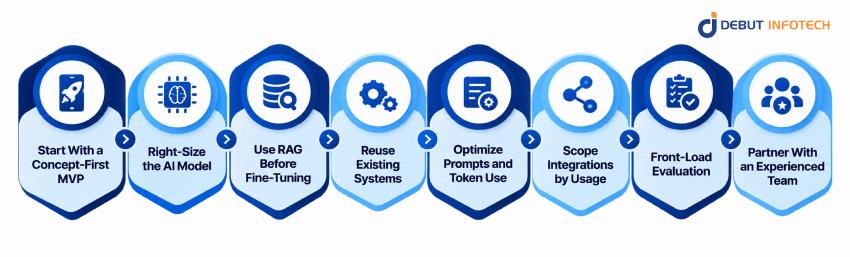
Begin with one clearly defined business problem instead of developing every planned feature at once. Choose a workflow with frequent usage and measurable value. Build only the functions needed to solve that problem, then evaluate adoption, accuracy, cost, and time savings. This approach reduces the initial development budget while giving you real evidence about what should be expanded, changed, or removed in later versions.
Using the most capable model for every request can increase operating costs without improving every response. Match model capability to task complexity. A smaller model may handle classification, simple summaries, routing, or basic questions, while a stronger model handles complex reasoning. Model routing can automate this process. It allows the copilot to reserve higher-cost inference for requests where additional capability provides measurable value.
If the copilot mainly needs access to company policies, product information, reports, or other changing content, RAG is often a more practical starting point than fine-tuning. It allows the system to retrieve current information without retraining the model whenever documents change. This can reduce both upfront development work and future update costs. Fine-tuning can still be considered when the main requirement involves specialized behavior or task performance.
Existing authentication, databases, APIs, cloud services, design systems, and business applications can reduce development effort. Before building a new component, check whether your current technology stack already provides the required capability. For example, an existing CRM integration may provide customer data that the copilot can access through an API. Reusing proven systems reduces duplicate engineering work, shortens development time, and can simplify maintenance after deployment.
Prompt design affects both performance and recurring model costs. Avoid sending unnecessary conversation history, duplicate instructions, or irrelevant documents with every request. Retrieve only the information needed for the current task and summarize long histories when appropriate. Caching repeated context can also reduce redundant processing where supported. These changes may appear small individually, but they can produce meaningful savings when the copilot handles thousands of requests each day.
Do not connect every business system during the first release simply because an API is available. Rank integrations according to user demand, frequency, business value, and implementation effort. A CRM integration used every hour may deserve early development, while a rarely accessed legacy system can wait. Limiting the initial integration scope reduces development and testing costs while allowing the team to validate whether each connection produces enough value to justify expansion.
Testing the copilot early can reduce expensive rework later. Create representative questions, expected answers, retrieval tests, and tool-use scenarios before the system reaches production. Evaluate accuracy, relevance, latency, hallucinations, permissions, and failure cases throughout development. Early evaluation can expose problems with prompts, data, retrieval, or model selection before they become deeply embedded in the application. This makes later improvements faster and less expensive.
An experienced AI development team can reduce unnecessary development cycles by selecting an appropriate architecture, model, retrieval strategy, and integration approach from the beginning. The goal should not be finding the lowest hourly rate. A team offering custom AI development services that delivers faster and avoids major rework can produce a lower total project cost. Experience also helps with security, evaluation, deployment, and scaling, all of which become harder to fix once an AI copilot reaches production.
An AI copilot is worth the development cost when it solves a frequent, measurable problem and generates enough savings or revenue to justify development and operating expenses. It may not be worthwhile when adoption is low, the use case is unclear, or expected savings cannot support the investment.
The decision should therefore consider the development tier, expected usage, ongoing costs, and financial return rather than the technology alone.
An AI copilot is usually worth considering when employees spend substantial time on repetitive tasks such as searching documents, preparing reports, summarizing information, drafting responses, reviewing records, or moving data between systems. These activities create measurable time costs. If the copilot can reduce that workload while maintaining acceptable accuracy, the resulting productivity gains can provide a strong reason to invest.
A basic copilot in the $30,000–$75,000 range can make sense when one team has a narrow, repeatable problem. For example, an HR department may need an assistant that answers policy questions from approved documents. A support team may need help summarizing tickets. These projects do not require a company-wide platform to create value. A focused implementation can prove the business case before larger spending begins.
A mid-level copilot costing around $75,000–$200,000 is better suited to businesses with several connected workflows. It may combine RAG, multiple business integrations, workflow automation, analytics, stronger security, and more advanced evaluation. This tier can provide meaningful value when employees need AI assistance across several processes, but the company does not yet require a highly customized enterprise-wide platform.
An enterprise copilot costing $200,000–$500,000 or more can be justified when AI is integrated across several departments or critical business processes. Large organizations may require connections to CRM, ERP, HR, communication, and internal data systems. They may also need strict access controls, audit logs, compliance measures, high availability, and advanced monitoring. These requirements increase cost, but they may be necessary for large-scale deployment.
Development may not be justified when the proposed use case is too narrow, employee usage is expected to be low, or the process does not save enough time to justify the cost. It may also be a poor investment when the company’s data is unreliable, required integrations are unavailable, or employees still need to perform most of the work manually after receiving AI assistance.
Businesses with simpler conversational requirements can also consider an AI chatbot development company, which may offer a more cost-effective option for customer support, FAQs, and basic automation.
Cost should ultimately be compared with measurable financial return. If a $100,000 copilot saves enough employee time to create $20,000 in monthly value, the simple payback period is five months before ongoing costs are considered. If the same system creates only $3,000 in monthly value, payback takes more than two years. The second case requires a closer review of scope, pricing, and expected adoption.
The safest approach is to start with the business case rather than the technology. Define the workflow, estimate current costs, calculate expected time savings, identify the required data and integrations, and set a payback target. If the numbers support the investment, build an MVP and measure the results. If they do not, reduce the scope or reconsider whether a custom copilot is the right solution.
AI Copilot Development Cost depends on the scope, technology, data, integrations, security, infrastructure, and expected usage. A focused copilot may fit a modest budget, while an enterprise system can require hundreds of thousands of dollars.
The right investment starts with a clear business problem and measurable value. Compare development and operating costs with the time, revenue, or efficiency gains the copilot can create. A copilot is worth the cost when its expected business value can justify the investment within an acceptable payback period.
AI copilot development becomes easier to manage when your technology choices match your business goals and budget. Debut Infotech helps businesses plan and build AI copilots around specific workflows, data requirements, integrations, and user needs. As a leading AI copilot development company, we focus on building practical solutions that can scale as usage grows.
Our team can help you with:
From an initial MVP to an enterprise-grade copilot, we can help you choose the right AI copilot architecture, control development costs, and prepare the system for production. The focus stays on measurable business value, reliable performance, and a development plan that supports long-term growth.
Developing an AI copilot in 2026 typically costs $30,000 to $250,000+, depending on its features, integrations, AI model, and complexity. A basic copilot with limited functionality may stay near the lower end, while enterprise-grade copilots with custom models, advanced automation, security, and multiple integrations can cost considerably more.
The average AI copilot development cost falls around $50,000 to $150,000 for a production-ready solution. This usually covers the AI model integration, user interface, backend development, testing, security, and deployment. The actual figure can vary based on the copilot’s features, data requirements, integrations, and expected user volume.
AI copilot features directly impact development costs. Basic chat, document search, and content generation are relatively affordable. Features such as voice interaction, real-time data access, workflow automation, personalization, multi-agent support, and advanced analytics require more development effort, testing, infrastructure, and API usage, which increases overall costs.
AI copilot integration typically costs $10,000 to $50,000, depending on the systems involved. Connecting a copilot to a single straightforward application costs less than integrating it with a CRM, ERP, databases, internal tools, and third-party APIs. Custom authentication, data synchronization, security controls, and complex workflows can also increase the integration bill.
Ongoing AI copilot maintenance can cost roughly 15% to 25% of the initial development cost per year. These expenses cover model and API updates, bug fixes, security patches, performance monitoring, infrastructure, prompt improvements, and feature updates. Costs can rise with higher usage, larger data volumes, or frequent changes to connected systems.
An AI copilot can take 3 to 9 months to develop, depending on its scope. A simple copilot that uses an existing LLM and a few integrations may take about 3 months. More complex enterprise copilots with custom workflows, extensive integrations, security requirements, testing, and personalization can take six months or longer.
Building an AI copilot using an existing LLM typically costs $30,000 to $150,000. Using models such as GPT, Claude, or Gemini can reduce model development work, but you still pay for application development, API integration, data handling, security, testing, and deployment. High usage can also create ongoing LLM API expenses.

Our Latest Insights


USA
2501 Chatham, Rd Suite R Springfield, IL 62704
+1-708-515-4004
info@debutinfotech.com
UK
7 Pound Close, Yarnton, Oxfordshire, OX51QG
+44-770-304-0079
info@debutinfotech.com
Canada
154 Eden Oak Trail, Kitchener, ON N2A 0H9
+1-708-515-4004
info@debutinfotech.com
INDIA
Sector 101-A, Plot No: I-42, IT City Rd, JLPL Industrial Area, Mohali, PB 140306
9888402396
info@debutinfotech.com