ON THIS PAGE
Progress0%





Our Global Presence :



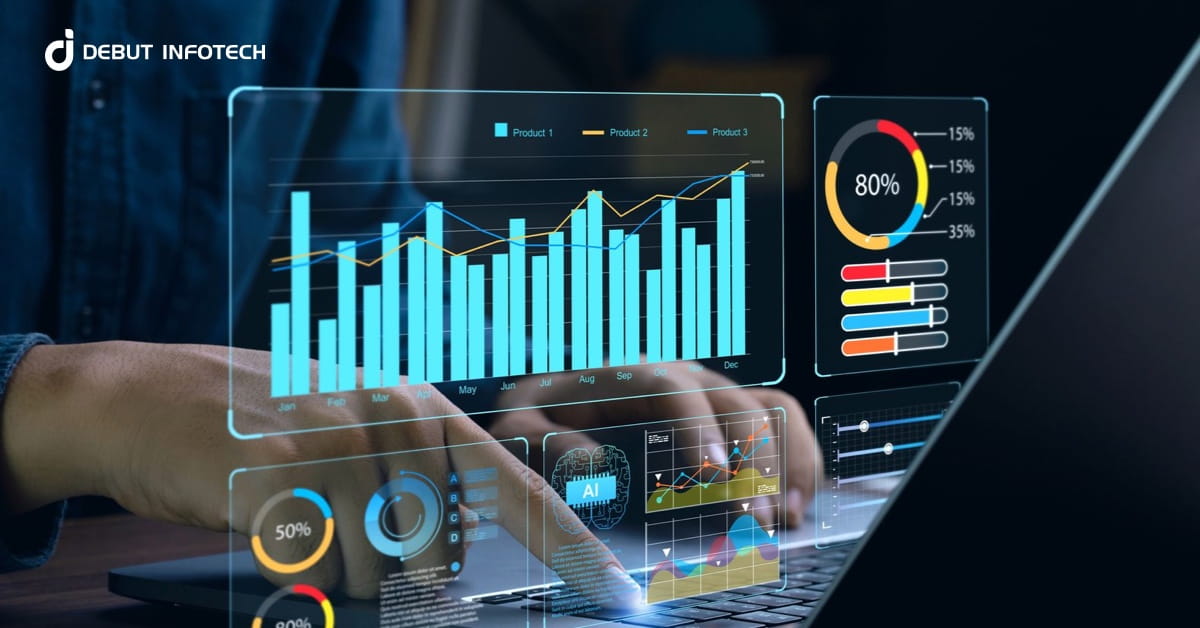


Predictive analytics has become a critical capability for organizations looking to make data-driven decisions and anticipate future outcomes. By analyzing historical data and identifying patterns, predictive analytics helps businesses forecast trends, reduce risks, and improve operational efficiency. As demand grows across industries, predictive analytics software development has emerged as a strategic investment for companies seeking long-term competitive advantage.
Modern predictive analytics solutions combine advanced algorithms, machine learning models, and scalable software systems. From demand forecasting and fraud detection to risk modeling and customer behavior analysis, predictive analytics software enables organizations to move from reactive decision-making to proactive planning. This guide explores what predictive analytics software development involves, how it works, and the key steps required to build reliable and scalable solutions.
Predictive analytics software development refers to the process of designing, building, and deploying software systems that analyze historical and real-time data to predict future outcomes. These systems use statistical techniques, machine learning models, and data processing frameworks to generate actionable insights.
Unlike traditional analytics tools that focus on descriptive or diagnostic analysis, predictive analytics software is designed to forecast probabilities and trends. A predictive analytics software development company typically builds custom solutions that integrate data pipelines, predictive models, and user-facing dashboards into a unified platform. These solutions support use cases such as churn prediction, credit scoring, demand forecasting, and operational risk assessment.
Organizations generate massive volumes of data, but without predictive capabilities, much of this data remains underutilized. Predictive analytics software development enables businesses to extract forward-looking insights and make informed decisions based on data rather than assumptions.
One key benefit is improved risk management. Predictive analytics and risk modelling software development services help organizations identify potential threats before they materialize. This is especially valuable in industries such as finance, healthcare, and supply chain management.
Predictive analytics also enhances operational efficiency by optimizing resource allocation and improving planning accuracy. When combined with machine learning development services, predictive systems continuously improve their accuracy over time, delivering increasing value as data grows.
Effective predictive analytics software development relies on several interconnected components that work together to deliver accurate, scalable, and actionable predictions. Each component plays a distinct role in transforming raw data into meaningful insights that support business decision-making.
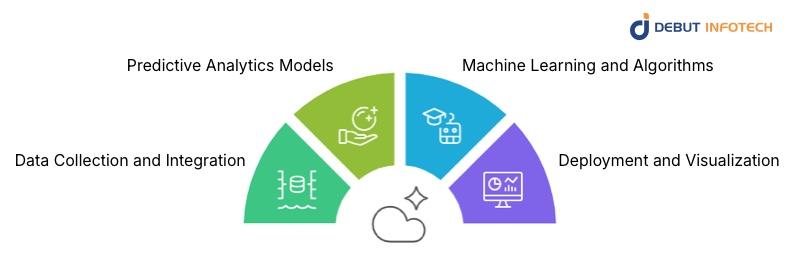
Data is the foundation of predictive analytics. Predictive analytics software must collect and integrate data from multiple sources, including internal databases, enterprise systems, APIs, IoT sensors, and third-party platforms. These data sources often vary in format, structure, and frequency, making integration a critical step.
During predictive analytics software development, data pipelines are designed to clean, normalize, and transform incoming data into a consistent format suitable for analysis. High data quality and consistency directly impact model accuracy, as incomplete or biased datasets can lead to unreliable predictions. Strong data governance practices also help ensure long-term system reliability.
Predictive analytics models identify patterns, correlations, and trends in historical data. A Predictive Analytics model may use techniques such as regression for numerical predictions, classification for categorizing outcomes, or time-series analysis for forecasting future values.
Model selection is a critical step in predictive analytics software development services, as different use cases require different approaches. The chosen model must balance accuracy, interpretability, and performance. Proper evaluation and testing help ensure models deliver consistent and explainable results in real-world scenarios.
Machine learning enables predictive analytics software to learn from data and improve its predictions over time. Algorithms are trained on historical datasets and continuously refined as new data becomes available. Common approaches include supervised learning for labeled data and unsupervised learning for discovering hidden patterns.
Advanced techniques such as deep learning in predictive analytics are increasingly used for complex datasets that involve large volumes of data or unstructured inputs, such as text and images. These methods enhance prediction accuracy and allow systems to adapt to changing patterns and evolving business conditions.
Predictive insights must be accessible and easy to interpret for decision-makers. Predictive analytics software typically includes dashboards, visual reports, and APIs that present predictions in a clear and actionable format. Visualization tools help users understand trends, probabilities, and potential outcomes at a glance.
Seamless deployment ensures predictive models operate reliably in production environments. This includes integrating models into existing workflows, monitoring performance, and updating systems as data and business requirements change. Well-executed deployment bridges the gap between predictive analytics and real-world decision-making.
Predictive analytics software can be tailored to meet different business objectives and industry requirements. Each solution type is designed to address specific challenges by transforming historical and real-time data into actionable insights.
Demand forecasting software is used to predict future customer demand, sales trends, and inventory requirements. These solutions help businesses optimize production planning, reduce overstock or stockouts, and improve supply chain efficiency.
By analyzing historical sales data, seasonal patterns, and market trends, demand forecasting systems enable organizations to make informed decisions about inventory levels and resource allocation. This type of predictive analytics software is widely used in retail, manufacturing, and e-commerce.
Risk and fraud detection systems are designed to identify unusual patterns and potential threats before they result in financial or operational losses. These solutions are commonly used in banking, insurance, and fintech environments.
By leveraging predictive analytics and machine learning, these systems can assess transaction risks, detect fraudulent activity, and support compliance efforts. Predictive insights allow organizations to take preventive actions rather than reacting after incidents occur.
Customer behavior analytics platforms focus on understanding and predicting how customers interact with products or services. Common use cases include churn prediction, personalized recommendations, and customer lifetime value analysis.
These platforms analyze behavioral data from multiple touchpoints, helping businesses tailor marketing strategies, improve customer engagement, and increase retention. Predictive analytics software development plays a key role in enabling data-driven personalization at scale.
Operational analytics solutions support internal processes such as predictive maintenance, supply chain optimization, and workforce planning. By forecasting equipment failures or operational bottlenecks, these systems help reduce downtime and improve efficiency.
In industries like manufacturing and logistics, operational predictive analytics enables proactive maintenance and smarter resource utilization. This leads to cost savings and more resilient operations.
Predictive analytics software development follows a structured approach to ensure accuracy, scalability, and real-world usability. The following steps outline how predictive analytics solutions are typically designed, built, and deployed.
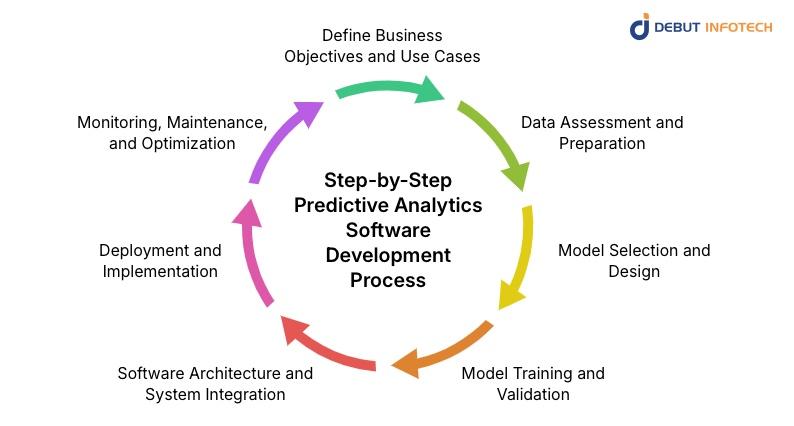
The first step in predictive analytics software development is clearly defining business objectives. This includes identifying the specific problems the software will address, such as forecasting demand or reducing operational risk.
Clear use cases help determine data requirements, model selection, and system architecture. Without well-defined objectives, predictive analytics initiatives risk becoming overly complex or misaligned with business goals.
Data preparation is one of the most critical stages of predictive analytics software development services. This step involves evaluating data sources, cleaning datasets, handling missing values, and ensuring data consistency.
High-quality data directly impacts the accuracy of predictive models. Many machine learning consulting firms emphasize data readiness as a prerequisite for successful predictive analytics implementation.
Selecting the right predictive analytics model depends on the problem being solved and the nature of the data. Models may range from simple statistical approaches to advanced machine learning and deep learning techniques.
During this stage, developers and data scientists define model features, training methods, and evaluation metrics. Proper model design ensures the system delivers reliable and explainable predictions.
Once the predictive model is designed, the next step is training it using historical data. During training, the model learns patterns and relationships that allow it to make future predictions. This process often involves iterative testing to fine-tune accuracy and performance.
Validation is equally important in predictive analytics software development. Models are tested against unseen data to ensure they generalize well and do not overfit. Reliable validation helps organizations trust predictions before deploying them into production environments.
Predictive analytics software must be designed to integrate seamlessly with existing enterprise systems. This includes databases, business intelligence tools, ERP platforms, and third-party applications.
A scalable architecture ensures the software can handle growing data volumes and increasing computational demands. Many predictive analytics software development services focus on modular designs that allow models to be updated or replaced without disrupting the entire system.
Deployment involves moving predictive models from development environments into production. This may include cloud-based deployment, on-premise integration, or hybrid setups depending on organizational needs.
During this stage, performance monitoring tools are implemented to track model accuracy and system reliability. Proper deployment ensures predictive insights are delivered in real time or near real time, supporting operational decision-making.
Predictive analytics systems require continuous monitoring to remain effective. Over time, changes in data patterns can reduce model accuracy, a challenge often referred to as model drift.
Ongoing maintenance includes retraining models, updating algorithms, and refining features based on new data. Regular optimization ensures the predictive analytics software continues to deliver accurate insights and long-term value.
The cost of predictive analytics software development can vary significantly depending on the solution’s complexity, data requirements, and technology stack. There is no fixed pricing model, as most predictive analytics platforms are built as custom solutions tailored to specific business needs.
One of the primary cost factors is data preparation and management. Cleaning, integrating, and structuring large datasets often requires substantial effort, especially when data is sourced from multiple systems. Poor data quality can increase development time and overall costs.
Another major factor is model complexity. Simple predictive models based on basic statistical methods are generally more cost-effective, while advanced machine learning or deep learning models require more development time, computational resources, and specialized expertise. Projects involving real-time predictions or large-scale data processing also tend to be more expensive.
Software architecture and infrastructure also influence costs. Cloud-based deployments, scalability requirements, and integration with existing enterprise systems can add to the overall budget. Additionally, ongoing expenses such as model retraining, performance monitoring, and system maintenance should be considered as part of the long-term investment.
Finally, team expertise and development approach play an important role. Working with experienced machine learning development companies or a specialized predictive analytics software development company can increase upfront costs but often reduces risks and long-term maintenance expenses by ensuring better accuracy, scalability, and reliability.
Successful predictive analytics software development begins with strong alignment between technical teams and business stakeholders. Clear communication ensures models address real-world problems rather than theoretical scenarios.
Another best practice is prioritizing data quality and governance. Clean, well-structured data significantly improves prediction accuracy. Organizations should also focus on explainability, ensuring decision-makers understand how predictions are generated.
Security and compliance are equally important, especially when handling sensitive data. Adopting industry standards and robust access controls helps maintain trust and regulatory compliance.
While predictive analytics offers significant benefits, building and maintaining effective solutions come with its own set of Machine Learning challenges. Understanding these common issues helps organizations plan better and implement predictive analytics software more successfully.
The future of predictive analytics is closely tied to advances in artificial intelligence and machine learning. Techniques such as deep learning in predictive analytics are enabling more accurate predictions from unstructured data sources like images and text.
Automation and real-time analytics are also gaining traction, allowing businesses to act on predictions instantly. As tools become more accessible, predictive analytics software development is expected to expand across industries, enabling smarter, faster decision-making.
Debut Infotech helps organizations design and implement scalable predictive analytics solutions tailored to their business needs. From data strategy and model development to system integration and deployment, our team delivers end-to-end predictive analytics software development services.
By combining expertise in machine learning development services and enterprise software engineering, we help businesses transform raw data into actionable insights. Our approach focuses on accuracy, scalability, and long-term maintainability, ensuring predictive systems continue to deliver value as data and business requirements evolve.
Predictive analytics software development enables organizations to move beyond reactive decision-making and anticipate future outcomes with greater confidence. By combining data engineering, machine learning models, and scalable software systems, predictive analytics transforms data into strategic insights.
As businesses continue to rely on data-driven strategies, investing in predictive analytics software development becomes essential for sustainable growth. With the right approach, tools, and expertise, organizations can build predictive systems that support smarter decisions and long-term success.
A. Predictive analytics software development involves creating systems that analyze historical and real-time data to forecast future outcomes. It combines data engineering, machine learning models, and software architecture to deliver actionable predictions.
A. Predictive analytics software uses statistical techniques and machine learning algorithms to identify patterns in data. These patterns are then used to generate predictions that help organizations anticipate trends, risks, or opportunities.
A. Predictive analytics is widely used across industries such as finance, healthcare, retail, manufacturing, logistics, and marketing. It supports use cases like demand forecasting, fraud detection, and customer behavior analysis.
A. Predictive analytics software development commonly uses machine learning frameworks, data processing tools, cloud platforms, and visualization technologies. Advanced solutions may also include deep learning models for complex data analysis.
A. The development timeline depends on data complexity, use cases, and system requirements. Simple solutions may take a few months, while enterprise-scale predictive analytics platforms require longer development cycles.
A. Common challenges include poor data quality, model bias, integration complexity, and maintaining model accuracy over time. Addressing these challenges requires strong data preparation and continuous model monitoring.
A. Businesses invest in predictive analytics software development to improve decision-making, reduce risks, optimize operations, and gain a competitive edge through data-driven insights.

Our Latest Insights


USA
2501 Chatham, Rd Suite R Springfield, IL 62704
+1-708-515-4004
info@debutinfotech.com
UK
7 Pound Close, Yarnton, Oxfordshire, OX51QG
+44-770-304-0079
info@debutinfotech.com
Canada
154 Eden Oak Trail, Kitchener, ON N2A 0H9
+1-708-515-4004
info@debutinfotech.com
INDIA
Sector 101-A, Plot No: I-42, IT City Rd, JLPL Industrial Area, Mohali, PB 140306
9888402396
info@debutinfotech.com