ON THIS PAGE
Progress0%





Our Global Presence :



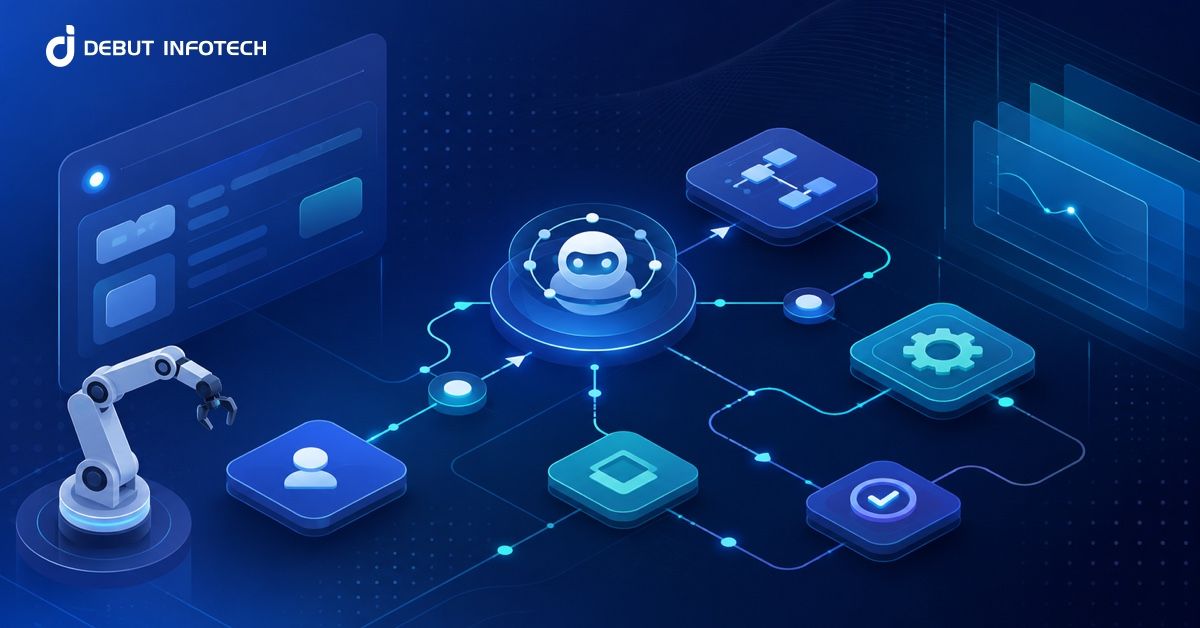


There have never been so many choices in enterprise automation, or so many questions about which to choose. As AI capabilities have advanced, the debate over AI agents vs RPA has become louder, yet much of the noise misses the point. These are not competing products fighting for the same job. These are separate tools, built on different architectural assumptions, and picking the wrong one for a particular task costs you real money.
At Debut Infotech, we engage with enterprise teams that typically inherit a mix of RPA deployments, workflow engines, and new AI agent efforts, and the difficulty they consistently confront is not a lack of automation but a lack of understanding of what each layer should be doing.
If you’re assessing a first investment in automation, expanding an existing RPA program, or figuring out where AI agents go in your existing stack, the aim here is to give you the decision-making framework that generic vendor comparisons never deliver. We’ll identify each technology, explore where each excels and where each disappoints, conduct an automation technologies comparison, and then respond to the specific issue most decision-makers have on their minds: can AI replace RPA, or can the two co-exist?
It’s important to know what each of these intelligent automation tools is before getting into the RPA vs workflow automation argument. Loose definitions cost you money in procurement – and, in enterprise automation, those costs can be substantial.
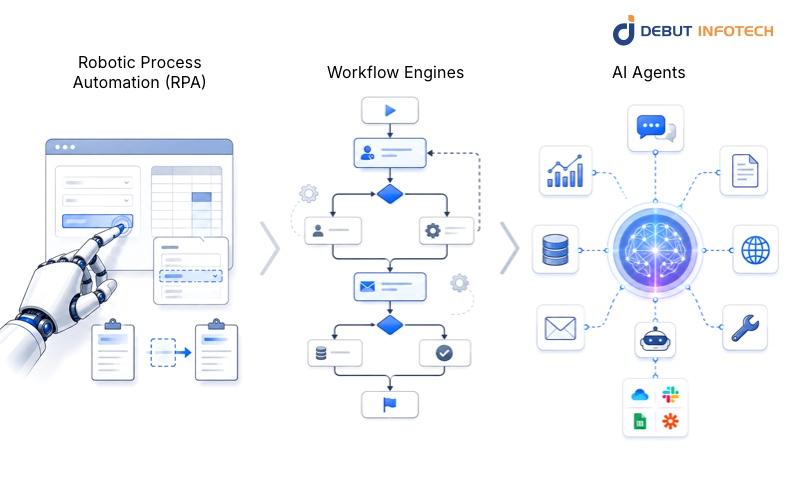
RPA (Robotic Process Automation) automates repetitive, rule-based tasks, mimicking human interaction with programs and executing prepared scripts without thought or adaptation. It drives productivity in high-volume activities such as invoice processing and data entry, allowing them to be executed faster and more economically.
But the RPA limitations enterprise are just as evident. It is sensitive to changes in the application interface, and can cost 30-50% of the total budget for business deployments in maintenance. Because it is so fragile, it needs to be fixed frequently, especially when source interfaces change or unexpected exceptions occur.
Workflow engines are built on RPA and coordinate events and system integrations in a series based on process logic. Examples include Apache Airflow and enterprise systems such as ServiceNow and Salesforce.
These are rule-based and can handle state and sequences in multi-step processes, but require explicit programming for branches and exceptions. Workflow engines are good for automating stable, well-understood procedures, but not for jobs that need judgment or adaptive decision making.
An AI agent is a software system that understands intent, decomposes tasks into phases, and adapts to changing situations to achieve a goal independently. While standard RPA bots execute a predefined sequence regardless of the results, AI agents analyze each step’s results and adapt their behavior accordingly.
They apply reasoning with large language models and possess tool-calling abilities that enable them to communicate with multiple systems and handle unstructured data. Additionally, vertical AI agents are specialized agents that operate in specific domains and possess cognitive capabilities that enable them to autonomously make decisions within their responsibilities.
The best approach to understanding these tools is to see how they treat the same categories of work differently.
High-Volume, Structured, Stable Tasks: RPA wins hands down here. Moving data from one ERP system to another, creating standard-compliance reports, and processing invoices in a standard format – these are precisely the tasks RPA was built for. Fast, affordable, reliable, and verifiable. Neither workflow engines vs AI agents are better suited for this use case, and replacing a working RPA deployment with an AI agent for certain jobs increases cost and non-determinism where neither is needed.
Multi-Step Process Orchestration with Defined Rules: The right tool is a workflow engine. Employee onboarding spanning HR, IT, and Finance platforms. Contract approval routing with conditional escalation. Rollback logic and release processes that depend on other things. When the process is clear, the rules are stable, and it’s important that the system can be audited, AI agents for workflow automation engine give the right amount of control with a lot less upkeep than a similar RPA implementation.
Decision-Based, Exception-Heavy, or Unstructured Workflows: This is where AI agents for RPA vs workflow automation add real value that neither RPA nor workflow engines can offer. Extracting crucial clauses from a free-form contract from a supplier. Prioritize incoming support tickets by content, urgency, and account context. Researching a prospect and writing a targeted outreach email.
| Criteria | RPA | Workflow Engine | AI Agents |
| Input type | Structured, predictable | Structured, defined | Structured and unstructured |
| Decision-making | None (rule-following only) | Rule-based branching | Reasoning-based, adaptive |
| Handles exceptions | Poorly (breaks or escalates) | Programmed fallbacks only | Reasons through exceptions |
| Setup complexity | Medium | Medium–High | High initially |
| Maintenance burden | High (interface changes) | Medium | Lower once deployed |
| Auditability | High | Very High | Moderate (improving) |
| Cost at scale | Predictable | Predictable | Variable (token costs) |
| Best process type | Repetitive, stable, high-volume | Multi-step, approval-based | Complex, variable, judgment-required |
| Integration approach | UI-level and API | API and system events | API, tools, and reasoning |
The case for AI agents is strongest when we understand where RPA truly fails, in fact, not in theory, but as organizations experience it once deployed.
When application UIs change, like when the layout changes or new fields are added, RPA bots that depend on those UIs can fail. This is a workable problem on a local scale, but it snowballs at the enterprise level, where maintenance expenses balloon and eat into the budgets of RPA programs. This is a basic issue of RPA that cannot be solved by better tools.
No Unstructured Data Processing
The struggle for Robotic Process Automation (RPA) is the increasing volume of unstructured data, such as emails, PDFs, and voice transcripts, that exists in organizational workflows. RPA struggles to decipher this data, and teams have to resort to expensive workarounds such as OCR layers and manual review processes. The more unstructured inputs there are, the more RPA fails, no matter how well it was originally implemented.
Assumptions of Linear Process
RPA assumes linear, predictable procedures, while real enterprise workflows include exceptions, edge cases, and discussions that require human interaction. There are many outliers that can lower the predicted efficiency gains of RPA programs when executed at scale.
Knowledge Encoded in Scripts
A good RPA workflow embeds process information within its scripts. Business changes, system updates, or new legislation mean this knowledge needs to be reverse-engineered and re-coded, a major operational risk for organizations with sophisticated RPA implementations.
These RPA limitations in enterprise environment are not edge cases; they represent a constant pattern in large-scale installations. The more AI tools enterprises add to their stack, the more RPA’s rigidity becomes highlighted by comparison. For instance, a conversational AI layer can interpret an unstructured customer email and reply, and then the downstream RPA bot can work on the structured output. But when that layer of discussion is absent, the bot gets shut down.
Workflow engines address some of RPA’s concerns but bring their own limitations.
When such structures change, a team is restructured, an approval threshold changes, and upgrading the workflow takes development work. And as more live procedures are added, this technical debt will accumulate over time in large businesses.
This is the core question for most enterprise automation decisions in 2025. The honest answer is: not always, and not everywhere. But there are clear signals that point toward AI agents as the right tool.
Use AI agents when:
Keep using RPA when:
Keep using workflow engines when:
The most capable enterprise automation architectures do not choose one of these tools — they assign each tool to the layer of work it is best suited for.
This is where the architectural difference becomes most visible in practice.
Consider a procurement workflow. A company receives supplier invoices via email. Some match purchase orders exactly. Some have discrepancies — different quantities, unexpected line items, currency differences, amended terms. Some are from new suppliers not yet in the system.
An RPA bot handles the straightforward matches well. It reads the structured invoice data, compares it to the PO, and routes it to payment. For every other case, it fails or escalates. A human reviews the exception queue.
A workflow engine can give you more comprehensive routing – multiple routes depending on the type of discrepancy, escalation stages, and SLA timeframes. But it still can’t read an email from the supplier explaining why the invoice is different from the PO and determine whether the explanation is OK.
An AI agent can review the invoice, review the supplier’s email, compare the two to the PO, notice the discrepancy, decide whether the explanation is consistent with the company’s procurement policy and either resolve it on its own or send it to the right person with a simple summary of the problem and the proposed course of action. Agentic AI orchestrates whole automated workflows. It identifies dependencies between activities, prioritizes stages, and assures smooth execution from beginning to end.
That is the distinction between task automation and outcome automation.
The narrative that “AI agents will replace RPA” lacks evidence. Both RPA and AI agents serve distinct purposes based on task complexity and data needs. For regulated tasks such as financial reconciliation, RPA’s determinism is essential, unlike AI’s variable outputs.
It’s integration, not replacement. RPA does the high-volume work, and AI takes care of interpretation and decision-making. The best enterprise automation combines RPA, AI and workflow engines. Traditional automation is still alive and well, with 66% of organizations using rule-based technology.
In the most mature enterprise automation installations, these technologies don’t compete with each other; they build a stack in which each layer complements the others.
Workflow Engine: Specifies the total flow of the process, controls states, scheduling and dependencies, and offers the audit trail. This is the orchestration layer.
RPA: Handles high-volume, structured mechanical tasks within the workflow — data entry, UI-level system integration, report generation, and standard data transforms. This is the execution layer for deterministic work.
AI Agents: Handle the tasks within the workflow that require judgment — reading unstructured inputs, resolving exceptions, making context-dependent decisions, researching, and summarizing information. This is the intelligence layer.
The three-layer approach represents a move to integrated intelligence architectures for enterprise automation, rather than standalone technologies. Vertical AI agents for specific use cases, such as finance or HR, are also in demand, as are conversational AI interfaces that allow users to talk to automation in natural language.
When enterprise teams evaluate intelligent automation tools, cost comparisons are always part of the conversation. The framing matters here.
| Cost Factor | RPA | Workflow Engine | AI Agents |
| Initial implementation | Medium | Medium–High | High |
| Licensing | Per-bot or per-process | Platform subscription | API/model costs + platform |
| Maintenance (annual) | High (30–50% of build cost) | Medium | Lower for stable deployments |
| Infrastructure | Low–Medium | Medium | Medium–High |
| Developer skill required | RPA specialist | Integration/backend dev | AI engineer + prompt engineering |
| Total cost at high volume | Scales linearly | Scales well | Variable — token costs matter |
The maintenance cost of RPA is frequently underestimated in initial business cases. A deployment that looks cost-effective at launch can become expensive to sustain when the environment it operates in changes regularly. AI agent deployments carry higher initial engineering costs but lower long-term maintenance overhead for processes that involve unstructured data and variable inputs.
The decision about which automation technology to deploy is rarely purely technical. It involves understanding the stability of your processes, the variability of your inputs, your regulatory environment, your existing infrastructure, and your team’s capacity to maintain what gets built. Getting this wrong is expensive — not because the technology fails, but because the wrong tool for a given job creates a maintenance burden and a quality ceiling that compounds over time.
Working with an experienced AI agent development company during the architecture phase changes the outcome significantly. Teams with production experience across RPA, workflow engines vs AI agents can assess your process portfolio, identify which automation approach fits each category of work, and design a stack that is both capable now and extensible as AI capabilities continue to develop. Debut Infotech’s AI development solutions span the full automation stack — from AI architecture consulting through implementation and ongoing optimization.
When evaluating AI agent development companies, the right questions are not about which AI model they prefer — they are about how many production deployments they have shipped, what industries they have worked in, and how they approach the AI agent development cost conversation honestly rather than underselling complexity to win the deal.
The AI agents vs RPA vs workflow engines conversation will continue to generate noise as vendors stake out territory and analysts publish rankings. Cut through it by returning to first principles: what is the nature of the task, what are the inputs, how variable is the process, and what level of determinism does the outcome require? Those questions have clear answers, and those answers map directly to which tool is right.
RPA is effective for high-volume, structured tasks, while workflow engines are ideal for multi-step, audit-heavy processes. AI agents excel in tasks needing judgment and adaptation, especially as unstructured data increases. AI Agent development Company, Debut Infotech, assists enterprises in developing automation strategies across these layers. If your automation program is struggling with maintenance, exceptions, or complexity, consider integrating AI agents.
A. RPA automates repetitive tasks by mimicking human interactions but struggles with varied inputs. Workflow engines manage multi-step processes with set rules and approvals. In contrast, AI agents adapt to changing conditions to achieve goals. The main difference is that RPA and workflow engines follow predefined logic, while AI agents make context-based decisions.
A. There is no one-size-fits-all solution for automation; the best choice depends on the task. RPA excels in high-volume, structured tasks, workflow engines are ideal for multi-step processes with rules, and AI agents handle unstructured data and complex decisions. Mature automation programs typically integrate all three.
A. RPA excels in regulated workflows like financial reconciliation and payroll due to its predictable execution, while AI agents handle manual exception management that RPA can’t automate. The best enterprise automation combines both technologies.
A. RPA has lower initial costs but high ongoing maintenance (30-50% of budgets), mainly due to interface changes. AI agents have higher initial costs but lower long-term maintenance for unstructured data. AI costs also depend on per-token LLM API pricing, necessitating careful financial planning.
A. RPA struggles with unstructured content, varying inputs, and judgment-based decisions, often failing when interfaces change and routing exceptions to humans. In contrast, AI agents overcome these limitations by processing unstructured data, adapting to changes, reasoning through exceptions, and making autonomous decisions.
A. If your RPA exception queues require much human time, you have unstructured workflow inputs, need judgment calls that can’t be pre-programmed, or your automation has plateaued due to variable unautomated work, then AI agents should be included in your automation roadmap.
A. Vertical AI agents are specialized for specific industries like legal, healthcare, finance, and logistics. They are equipped with domain-specific knowledge and workflows, allowing them to outperform general-purpose tools in relevant tasks.

Our Latest Insights

USA
2501 Chatham, Rd Suite R Springfield, IL 62704
+1-708-515-4004
info@debutinfotech.com
UK
7 Pound Close, Yarnton, Oxfordshire, OX51QG
+44-770-304-0079
info@debutinfotech.com
Canada
154 Eden Oak Trail, Kitchener, ON N2A 0H9
+1-708-515-4004
info@debutinfotech.com
INDIA
Sector 101-A, Plot No: I-42, IT City Rd, JLPL Industrial Area, Mohali, PB 140306
9888402396
info@debutinfotech.com