



Table of Contents
Home / Use Case / Generative AI
Generative AI Use Cases: Enterprise Applications, Industry Examples, Costs, Risks and Implementation


Generative AI has moved beyond experimentation into practical business applications across content, software development, customer service, analytics, healthcare, finance, manufacturing, and other industries. Gartner projected that over 80% of enterprises would have used generative AI APIs, models, or deployed generative AI-enabled applications in production by 2026, compared with less than 5% in 2023.
Organizations now use it to generate content, summarize documents, analyze data, automate workflows, support employees, and create more specialized industry solutions. McKinsey identified 63 generative AI use cases across 16 business functions and estimated that they could generate $2.6 trillion to $4.4 trillion in annual economic value. About 75% of this potential value is concentrated in customer operations, marketing and sales, software engineering, and research and development.
However, choosing the right application requires more than selecting an AI model. Businesses also need to consider data readiness, technical architecture, implementation costs, security, governance, and measurable ROI.
This guide explores the most valuable generative AI use cases, from core enterprise applications to industry-specific opportunities. It also explains what risks organizations need to manage, what implementation can cost, and how businesses can evaluate and launch their first use case.
Core Enterprise Generative AI Use Cases
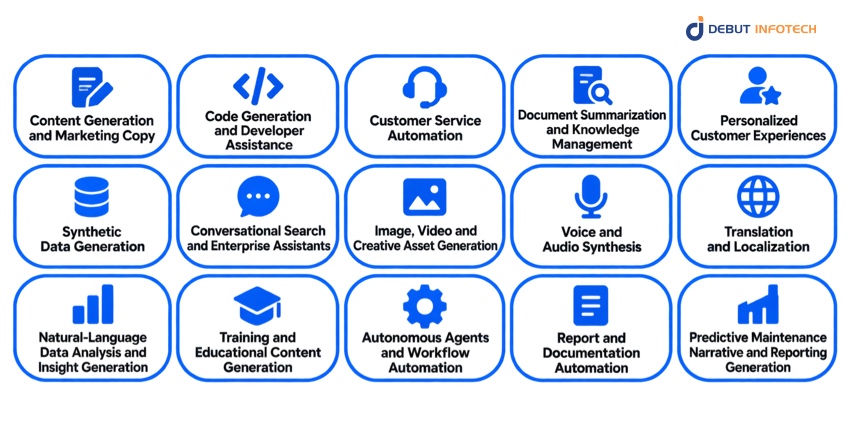
Enterprise generative AI use cases and applications are expanding from content creation into software development, customer operations, knowledge management, and personalization. The strongest real-world examples of generative AI in business usually target repetitive knowledge work where employees spend substantial time searching, drafting, interpreting, or responding to information.
Each use case below combines a practical business application with a real company example, a supporting metric, and the technical approach typically used to build it.
| Generative AI use case | What it does | Key benefit | Real-life example | Technical approach |
| Content generation & marketing copy | Creates marketing content, product descriptions, emails, ads, and campaign variations | Faster content production and lower drafting effort | Pfizer – Charlie | RAG, fine-tuning |
| Code generation & developer assistance | Generates code, tests, documentation, and debugging suggestions | Reduces development time and routine coding work | Code foundation models, RAG | |
| Customer service automation | Answers customer questions and assists support agents | Faster resolution and lower support costs | Klarna | RAG, LLMs, workflow integration |
| Document summarization & knowledge management | Summarizes documents and retrieves internal information | Reduces time spent searching and reviewing documents | Morgan Stanley – AI Assistant | RAG, vector databases |
| Personalized Customer Experiences | Generates personalized recommendations based on customer data | Improves customer engagement and recommendation relevance | Stitch Fix | Embeddings, similarity search, real-time inference |
| Synthetic data generation | Creates artificial datasets for testing and model training | Supports AI development while reducing exposure to sensitive records | JPMorgan AI Research | Generative models, synthetic-data pipelines |
| Conversational search & enterprise assistants | Lets employees query internal systems using natural language | Speeds up information retrieval and employee decision-making | PwC – ChatPwC | RAG, enterprise search, LLMs |
| Image, video & creative asset generation | Produces campaign visuals, concepts, images, and creative variations | Scales creative production and reduces asset-development time | Coca-Cola – Create Real Magic | Diffusion models, multimodal AI |
| Voice & audio synthesis | Generates speech, translates audio, and supports voice applications | Speeds up localization and voice-content production | Spotify | Speech-to-text, translation, voice synthesis |
| Translation & localization | Translates and adapts content across languages and markets | Expands content reach and reduces localization effort | Duolingo | Multilingual models, RAG |
| Natural-language data analysis & insight generation | Converts questions into queries and generates data insights | Makes data analysis faster and more accessible | Moderna – Dose ID | Text-to-SQL, semantic layers, LLMs |
| Training & educational content generation | Creates learning materials, assessments, and training exercises | Reduces content-development time and supports personalized learning | Khan Academy – Khanmigo | RAG, foundation models |
| Autonomous agents & workflow automation | Plans and executes multi-step tasks across connected systems | Reduces manual workflow effort and improves process efficiency | Walmart – Pactum | Agent frameworks, tool calling, orchestration |
| Report & documentation automation | Generates drafts of reports, compliance documents, and audit materials | Reduces reporting effort and accelerates documentation | Deloitte – DARTbot | RAG, document processing, templates |
| Predictive maintenance reporting | Turns equipment data and maintenance signals into actionable reports | Speeds up issue interpretation and maintenance decisions | Siemens – Senseye | Predictive models, IoT data, RAG, LLMs |
1. Content Generation and Marketing Copy
Generative AI can produce first drafts of product descriptions, email campaigns, advertisements, social media posts, landing-page copy, sales materials, and other marketing assets. Teams can use it to create multiple variations quickly, then have marketers review and refine the output.
Pfizer has used its Charlie AI platform to help employees work with generative AI across areas including marketing and content creation. The company has positioned Charlie as an internal platform that provides employees with access to generative AI capabilities within a controlled enterprise environment.
The main productivity benefit is drafting speed. Instead of starting each piece of content from scratch, marketers can provide the model with the audience, objective, product information, brand guidelines, and desired format. The model produces an initial version that a human can edit.
The technical approach can combine a foundation model with RAG and fine-tuning. RAG can provide current product information, approved claims, campaign details, and brand guidelines. Fine-tuning can help when the organization needs consistent output behavior or a particular writing style across large volumes of content.
For regulated industries such as pharmaceuticals, governance is equally important. Generated copy still needs to be reviewed against approved claims, legal requirements, and internal brand standards.
2. Code Generation and Developer Assistance
Generative AI has become a practical development assistant for writing code, explaining unfamiliar functions, generating tests, fixing bugs, documenting software, and supporting code migration.
Google provides one of the clearest enterprise examples. The company has reported that more than 30% of new code at Google is generated by AI and then reviewed and accepted by engineers. Google has also reported productivity gains from using AI across its software-development workflows.
The value comes from reducing the amount of routine coding work developers need to perform manually. Developers can describe what they want in natural language and receive a code suggestion, then inspect, test, modify, and approve it.
The underlying technology typically involves a code-specialized foundation model, IDE integration, repository context, retrieval from technical documentation, and automated testing.
Context is critical. A model that only receives a short prompt may generate syntactically correct code that does not fit the application’s architecture. Providing repository context, coding standards, dependencies, API documentation, and relevant files produces more useful results.
Enterprises also need security controls. Generated code should undergo the same testing, code review, dependency scanning, and security checks as manually written code.
3. Customer Service Automation
Customer service is one of the most established generative AI use cases for businesses because support agents repeatedly answer questions using product information, policies, account data, troubleshooting documentation, and previous interactions.
Klarna reported that its AI assistant handled customer interactions equivalent to the work of 700 full-time customer-service agents. The company also said the system contributed to approximately $40 million in annual cost savings.
A production customer service application typically uses RAG to ground responses in up-to-date company information. The system retrieves relevant documents or customer information before the language model generates a response.
A typical architecture can include
- An LLM for response generation
- A retrieval layer for company knowledge
- Customer and order-data integrations
- Intent classification
- Conversation memory
- Guardrails and response filtering
- Human escalation
RAG is particularly useful because customer-service information changes. Product policies, pricing, delivery rules, return conditions, and account information can change more frequently than a foundation model is retrained.
The goal should also extend beyond automation volume. Enterprises should measure resolution rate, response accuracy, escalation rate, customer satisfaction, average handling time, and cost per resolved interaction.
4. Document Summarization and Knowledge Management
Large enterprises often have valuable information scattered across thousands or millions of documents. Employees may spend significant time locating the right information before they can make a decision or complete a task.
Generative AI can summarize long documents, compare multiple files, extract key points, answer questions about internal policies, and produce concise briefings from large collections of information.
Morgan Stanley provides a strong example. Its AI @ Morgan Stanley Assistant gives financial advisors access to the firm’s internal knowledge using generative AI. The company reported that 98% of Financial Advisor teams had adopted the Assistant.
The technical foundation is usually a RAG pipeline. Enterprise documents are ingested, divided into searchable sections, converted into embeddings, and stored in a vector database. When an employee asks a question, the system retrieves relevant content and provides it to the LLM as context.
This approach allows the application to work with private, frequently updated information without retraining the foundation model whenever a document changes.
Access control is a major part of the architecture. An employee should only receive information they are authorized to view. Retrieval therefore needs to respect enterprise identity and permission systems.
5. Personalized Customer Experiences
Generative AI can create personalized experiences by adapting content, recommendations, product explanations, messages, and interactions to individual customers. Unlike traditional recommendation engines, which primarily predict what a customer may prefer, generative AI can use customer context to produce a tailored response or experience in real time.
Stitch Fix has incorporated AI into its styling workflow to help stylists select products for clients. The company has reported that AI-supported recommendations play a major role in its product-selection process, with more than 75% of selections involving algorithmic recommendations.
The technical architecture can combine embeddings, vector similarity, recommendation models, and real-time inference. Customer preferences, previous purchases, product attributes, and behavioral signals can be converted into representations that allow the system to identify similar or relevant products.
A generative model can then turn those recommendations into a customer-facing response. For example, instead of simply displaying three products, the application can explain why each product fits the customer’s preferences and how the items work together.
This approach is useful when personalization requires both selection and explanation.
For enterprises, the quality of the underlying recommendation data still matters. Generative AI does not automatically fix poor customer data or weak recommendation logic. It works best when the retrieval and recommendation layers provide accurate context for the model to use.
6. Synthetic Data Generation
Synthetic data generation uses AI to create artificial datasets that reproduce important characteristics of real-world data without directly exposing the original records. Enterprises can use it for model training, software testing, simulations, and analytics where access to real data is restricted.
This is particularly useful in regulated industries. Financial institutions, healthcare organizations, and insurance companies often have large datasets but face strict privacy, security, and governance requirements around how those records can be accessed.
JPMorgan AI Research has explored synthetic data for applications including anti-money-laundering and fraud detection. Synthetic datasets can enable researchers to develop and test analytical approaches without relying entirely on sensitive production records.
The technical approach can involve generative models trained on the statistical characteristics of real datasets. Depending on the data type, organizations can use generative adversarial networks, variational autoencoders, diffusion models, or other specialized approaches.
The objective is not simply to create data that looks realistic. The synthetic dataset needs to preserve the characteristics that matter for the intended task while minimizing the risk of exposing sensitive information.
Enterprises should therefore test synthetic data for:
- Statistical similarity to real data
- Privacy leakage
- Bias and representation
- Utility for the target model
- Rare-event coverage
- Data quality
For fraud detection, for example, a synthetic dataset that accurately represents normal transactions but fails to reproduce unusual fraud patterns may have limited value.
7. Conversational Search and Enterprise Assistants
Enterprise assistants allow employees to search for internal information using natural language rather than navigating multiple databases, document repositories, and business applications.
PwC developed ChatPwC, an internal generative AI chatbot designed to help employees access information and support knowledge-intensive work. The company has described the platform as part of its broader effort to bring generative AI capabilities into its workforce.
The technical architecture typically combines RAG, enterprise search, identity management, document connectors, and an LLM.
When an employee asks a question, the application first identifies relevant information from approved enterprise sources. That information is then passed to the language model, which generates a natural-language response.
This is different from allowing an LLM to answer based solely on its training data. Enterprise assistants need current, organization-specific information. They also need to respect permissions.
For example, an employee might ask:
- “What is our current policy for approving international travel?”
The system can retrieve the latest approved policy, check whether the employee is authorized to access it, and generate a concise response with the relevant source.
The same architecture can connect to HR systems, CRM platforms, knowledge bases, document management systems, project tools, and other internal applications.
The main business benefit is reduced time spent searching for information. Employees can ask questions in ordinary language and receive an answer without knowing which database contains the underlying information.
8. Image, Video and Creative Asset Generation
Generative AI can create images, visual concepts, advertising assets, product mockups, storyboards, video elements, and other creative materials from text or reference inputs.
Coca-Cola’s Create Real Magic platform is a notable example. The initiative combined generative AI technologies from OpenAI, including GPT-4 and DALL-E, with Coca-Cola’s brand assets to allow users to create original artwork.
The underlying technology can involve diffusion models, multimodal foundation models, image conditioning, and brand-specific controls.
For enterprises, the advantage is scale. A creative team can produce multiple concepts for different campaigns, markets, formats, and audiences without manually creating every variation from scratch.
However, production systems need more than a good image model. Organizations also need controls for brand consistency, copyright and licensing, inappropriate content, image quality, and human approval.
A useful enterprise workflow may therefore look like this:
- Marketer defines the campaign objective.
- AI generates several concepts.
- Approved brand assets are supplied as context.
- The system produces image or video variations.
- Automated checks identify prohibited or inconsistent content.
- A creative professional reviews the final assets.
This keeps generative AI within a controlled creative process rather than treating model output as automatically publishable.
9. Voice and Audio Synthesis
Generative AI can produce synthetic speech, translate spoken content, clone approved voices, create audio narration, and automate parts of customer-service and media workflows.
Spotify has used generative AI to translate podcast episodes into other languages while retaining characteristics of the original podcaster’s voice. The company described the capability as a way to make podcast content more accessible to international audiences while maintaining a more natural listening experience.
The technical architecture can combine speech-to-text, machine translation, voice synthesis, voice cloning, and audio processing models.
A typical workflow starts by converting the original recording into text. The system translates the transcript, generates speech in the target language, and processes the audio to align timing and maintain the intended delivery.
The use case extends beyond podcasts. Enterprises can apply voice synthesis to:
- Interactive voice response systems
- Employee training
- Accessibility services
- Audiobooks
- Product tutorials
- Video localization
- Customer notifications
- Digital assistants
Voice applications also introduce specific risks. Organizations need clear consent and identity policies when cloning or reproducing a person’s voice. They should also consider safeguards against unauthorized impersonation and misleading synthetic audio.
10. Translation and Localization
Generative AI can translate and localize marketing content, product documentation, support materials, educational resources, and software content at a much larger scale than traditional manual workflows.
The technology can go beyond literal translation by considering context, tone, terminology, audience, and the purpose of the original content.
Duolingo has expanded its AI-supported content capabilities as its language-learning platform grows. The company reports 148 courses across 28 languages, illustrating the scale of language content that needs to be created and maintained.
The technical approach can combine multilingual foundation models, translation models, retrieval systems, terminology databases, and human review.
RAG is useful when translations need to follow company-specific terminology. A model can retrieve an approved glossary before generating the translated text. This helps maintain consistency for product names, technical terms, legal language, and other terminology that should not be translated freely.
Generative AI can also help with localization beyond language. A marketing campaign may need different phrasing, cultural references, examples, images, or calls to action for different markets.
For high-impact or regulated content, human review remains important. A fluent translation can still be factually or legally inappropriate for its target market.
The strongest implementations therefore treat AI translation as a production workflow with automated generation, terminology controls, quality evaluation, and human approval where the risk warrants it.
11. Natural-Language Data Analysis and Insight Generation
Generative AI can make enterprise data easier to query and interpret. Instead of writing SQL or navigating complex dashboards, employees can ask questions in natural language and receive a structured analysis or written explanation.
For example, a sales manager could ask, “Which regions had the largest drop in revenue last quarter, and what changed compared with the previous quarter?” A properly governed system can translate the question into a database query, retrieve the relevant data, analyze the results, and generate a concise explanation.
Moderna provides a real-world example of this approach. The pharmaceutical company developed Dose ID, a GPT-based application designed to help employees work with information and accelerate data-driven decision-making.
The underlying architecture commonly combines text-to-SQL, semantic layers, governed data access, database connectors, and an LLM. The semantic layer is particularly important because it helps map natural-language questions to the correct business definitions and database fields.
For instance, “revenue” might mean gross revenue, net revenue, or recognized revenue depending on the organization. A semantic layer can define the approved meaning before the model generates a query.
A reliable implementation should also validate generated SQL before execution. The system can check whether the query is syntactically valid, whether the requested tables are permitted, and whether the user has access to the underlying data.
The generated narrative should be treated as an interpretation of the retrieved results, not as an independent source of truth.
12. Training and Educational Content Generation
Generative AI can help organizations create employee training materials, onboarding content, practice exercises, assessments, simulations, role-specific learning modules, and knowledge checks.
This use case is especially relevant for enterprises with large workforces or frequently changing processes. Training teams can provide approved policies, product documentation, procedures, and job requirements as source material. Generative AI can then turn that information into learning content for different roles.
Khan Academy provides a well-known example through Khanmigo, its AI-powered learning assistant. Khan Academy has used Khanmigo to provide students with guided learning support and has also developed tools for teachers to assist with lesson planning, assessment, and classroom activities.
The technical approach can combine RAG, foundation models, structured content templates, learner profiles, and evaluation systems.
RAG helps ensure that generated training material is based on approved information. A learner profile can provide context about the employee’s role, experience level, or previous performance.
Generative AI can also create multiple versions of the same material. A new employee may receive a basic explanation, while an experienced employee can receive scenario-based exercises that require more advanced decision-making.
The main value is the ability to produce and update learning material faster. When company policies change, training teams can update the source content and regenerate affected modules rather than rebuilding every lesson manually.
Human review still matters. Training content can contain factual errors or unintentionally teach employees an incorrect process. For compliance-related training, every generated module should pass an appropriate review before publication.
13. Autonomous Agents and Workflow Automation
Autonomous agents are among the most significant extensions of generative AI because they move beyond generating individual outputs to completing multi-step tasks.
A conventional generative AI application may draft an email after receiving an instruction. An agentic system can interpret a broader objective, determine the steps required, retrieve information, use external tools, execute actions, evaluate results, and request human approval when necessary.
Walmart has explored this model through Pactum, an AI system that supports supplier negotiations. Walmart reported that the system had reached agreements with suppliers in 64% of negotiations in one reported deployment. The application demonstrates how AI can move into structured business processes where the system needs to communicate, negotiate within defined parameters, and work toward a measurable outcome.
The technical architecture typically includes:
- A foundation model
- An agent framework
- Tool and API calling
- Workflow orchestration
- Retrieval systems
- Short- and long-term memory
- Identity and access controls
- Guardrails
- Human approval checkpoints
The agent framework coordinates the AI-driven business processes. It determines which tool should be called, tracks the task state, passes outputs between steps, and decides whether the workflow should continue or stop.
This creates additional risks compared with a standard chatbot. An agent with permission to modify an ERP record or to send an external email can cause operational damage if they make an incorrect decision.
Enterprises should therefore begin with bounded workflows. The agent should have access only to the systems and actions required for the task. High-impact decisions can also require human approval before execution.
14. Report and Documentation Automation
Generative AI can automate large portions of report and documentation workflows. It can turn structured data, notes, source documents, and system records into first drafts of audit reports, compliance documents, financial narratives, technical documentation, meeting summaries, and management reports.
Deloitte has developed AI capabilities for audit and professional-services workflows, including DARTbot, as part of its broader AI-enabled audit platform. The system is designed to help professionals interact with large volumes of information and support audit-related analysis.
The underlying technical approach typically combines RAG, structured-data retrieval, document processing, templates, and foundation models.
A report-generation system can first collect the approved source information. The model then generates the narrative according to a predefined structure. Business rules and templates can control the format, while automated checks can flag missing information or unsupported claims.
This approach is useful because reporting often follows a repeatable structure. The organization knows what information needs to appear, which sources are authoritative, and which sections require specific language.
Human review remains necessary for high-stakes reports. Financial and compliance documents can have legal or regulatory consequences, so generated text should be traceable to its source data and reviewed before submission.
An effective system should also maintain an audit trail that shows the source information used, the model version, the generated output, edits, and final approval.
15. Predictive Maintenance Narrative and Reporting Generation
Predictive maintenance traditionally relies on machine-learning models to analyze sensor data and identify signs of equipment degradation or potential failure. Generative AI can extend that workflow by turning technical signals into understandable maintenance reports and recommendations.
Siemens provides a strong example through Senseye, its predictive maintenance technology. Senseye uses AI to monitor industrial equipment and identify potential problems before they lead to failures.
The important distinction is that generative AI does not need to replace the underlying predictive maintenance model. Instead, it can sit on top of it.
For example, a predictive system might detect abnormal vibration and temperature readings in an industrial machine. A generative layer can combine those signals with maintenance history, equipment documentation, previous incidents, and operating conditions to produce a report explaining the likely issue.
The technical architecture can combine:
- Time-series data
- Predictive maintenance models
- Anomaly detection
- Sensor and IoT integrations
- RAG over equipment documentation
- A generative foundation model
- Maintenance-management system integration
The generated report could summarize the detected anomaly, identify the affected equipment, provide relevant maintenance history, explain possible causes, and recommend the next inspection step.
This can reduce the time technicians spend interpreting raw system alerts.
However, the generated explanation should not override engineering measurements or established maintenance rules. The predictive model and sensor data remain the authoritative technical inputs. Generative AI is most useful as the interpretation and reporting layer that turns those inputs into information technicians can act on.
Find the Right Generative AI Use Cases
Not every AI use case is worth pursuing. Our experts assess your operations, identify practical opportunities, and help you prioritize solutions based on business value and feasibility.
Generative AI Use Cases Across Different Industries
Generative AI applications vary considerably by industry because organizations have different data, workflows, regulatory requirements, and customer interactions.
Beyond the core enterprise real-world generative AI use cases already covered, industry-specific implementations can address specialized problems such as clinical trial matching, regulatory filings, digital twins, legal discovery, and smart contract analysis.
The following applications focus on industry-specific opportunities rather than repeating the general generative AI use cases for enterprises discussed earlier.
| Industry | Industry-specific use cases | Key benefit | Real-life company example | Example application |
| Healthcare | Clinical trial patient matching, medical imaging synthesis, prior-authorization automation | Reduces administrative workload and accelerates clinical workflows | Cohere Health | Prior-authorization automation |
| Finance & Banking | Algorithmic trading strategy generation, regulatory filing automation, stress-test synthetic data | Speeds financial analysis and regulatory processes | Wells Fargo – Fargo | AI-powered banking assistance |
| Retail & E-commerce | Virtual try-on/AR, dynamic pricing rationale, supply-chain simulation | Improves shopping experiences and supports better operational decisions | Sephora – Beauty Bot | Conversational beauty shopping |
| Manufacturing | Digital twin simulation, generative part design, defect-pattern synthesis | Improves product design, testing, and quality control | BMW – AIQX | AI-supported manufacturing quality |
| HR & Talent | Workforce skills-gap simulation, AI interview practice | Supports workforce planning and scalable recruitment | Unilever | High-volume hiring support |
| Legal | E-discovery synthesis, case-outcome analysis, regulatory-change summaries | Reduces research and document-review workloads | Allen & Overy – Harvey | Faster contract review |
| Education | Adaptive assessment generation, subject-specific tutoring simulation | Enables more personalized learning and reduces content-creation effort | Khan Academy – Khanmigo | AI-powered learning support |
| Media & Entertainment | Synthetic dubbing, game asset generation, script continuity checks | Accelerates content production and localization | Netflix | Generative AI for visual effects and production |
| Cybersecurity | Adversary simulation, generative honeypots | Improves security testing and threat preparedness | Darktrace | AI-assisted threat detection and response |
| Real Estate | Investment memo generation, market simulation | Speeds property analysis and scenario planning | Zillow | AI-powered property search |
| Insurance | Underwriting narrative generation, claims fraud-pattern synthesis | Speeds underwriting and supports fraud detection | Lemonade – AI Jim | Automated claims processing |
| Blockchain & Web3 | Smart contract generation/audit assistance, tokenomics modeling, DAO proposal drafting | Accelerates development, analysis, and governance workflows | Chainalysis | AI-assisted blockchain investigations |
1. Healthcare
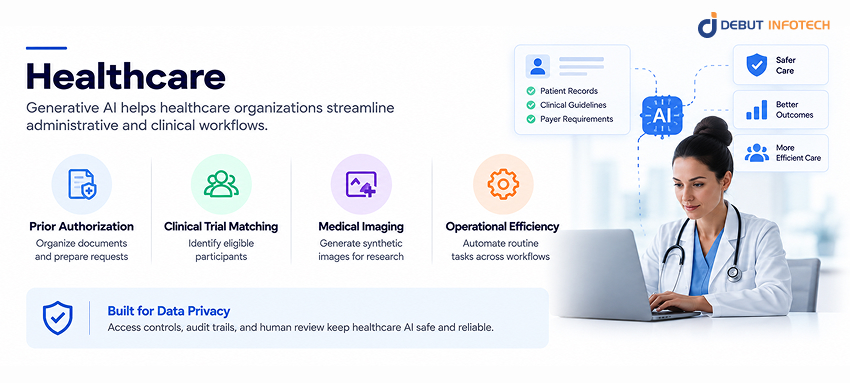
Healthcare organizations can use generative AI to handle specialized administrative and clinical workflows that involve large volumes of complex information. One practical application is prior-authorization automation, where AI can organize clinical documentation, identify relevant evidence, and prepare authorization requests for payer review.
Cohere Health uses AI to support prior-authorization workflows, helping healthcare organizations automate parts of the process between providers and health plans.
Other industry-specific enterprise generative AI use cases include clinical trial patient matching and medical imaging synthesis. A generative system can compare trial eligibility criteria against patient information to identify potentially suitable participants. In medical imaging research, generative models can produce synthetic images for research and model development.
These applications require strong safeguards because healthcare data is sensitive and generated information can influence patient care. RAG, access controls, audit trails, human review, and privacy-preserving data practices are important components of a production architecture.
2. Finance and Banking
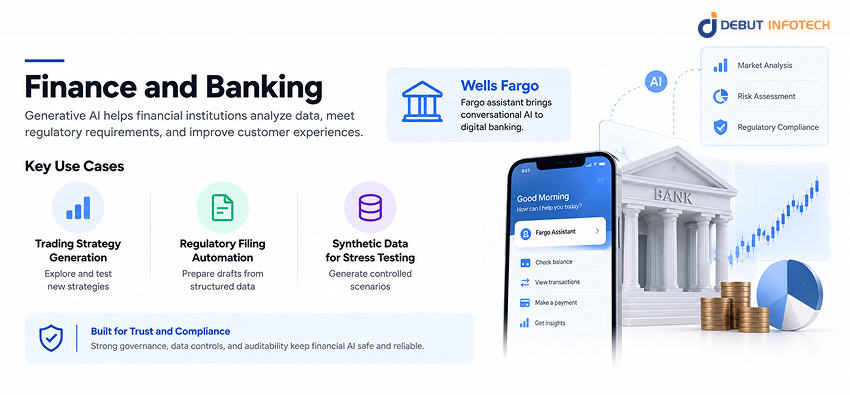
Financial institutions can apply generative AI to specialized workflows involving market analysis, regulatory requirements, and complex financial data.
Wells Fargo’s Fargo assistant provides customers with an AI-powered interface to manage their banking information. The assistant demonstrates how financial institutions can place conversational AI directly within digital banking experiences.
More specialized applications of generative AI include algorithmic trading strategy generation, regulatory filing automation, and synthetic data generation for stress testing. Generative models can help analysts explore potential trading strategies, prepare drafts from structured regulatory data, or generate controlled scenarios for testing financial models.
These applications require strict governance. Financial institutions need controls around data access, model validation, explainability, auditability, and regulatory compliance.
3. Retail and E-commerce
Retailers can use generative AI to create specialized shopping experiences that combine customer preferences, product information, and visual interaction.
Sephora’s Beauty Bot provides customers with conversational assistance around beauty products and recommendations. The application shows how generative AI can support product discovery through natural-language interaction.
Other retail-specific generative AI use cases for businesses include virtual try-on and augmented-reality shopping, dynamic pricing rationale, and supply-chain simulation.
Virtual try-on systems can combine computer vision and generative or multimodal models to show how products may look on a customer. Supply-chain simulations can generate different demand and disruption scenarios to help retailers assess potential operational responses.
Dynamic pricing requires additional care. Generative AI can explain pricing changes to internal teams or customers, but the underlying pricing decision should generally come from governed pricing models and business rules.
4. Manufacturing
Manufacturing companies can use AI to improve quality control, product development, and production planning.
BMW’s AIQX platform is a relevant example of AI applied to manufacturing quality. It uses AI-supported inspection and production data to identify quality issues and support faster intervention during manufacturing.
Beyond AI-enabled quality inspection, manufacturers can apply generative AI to other specialized areas:
- Digital twin simulation: Generate and evaluate different production scenarios before making changes to physical equipment, processes, or factory layouts.
- Generative part design: Produce alternative component designs based on requirements such as weight, strength, material, cost, and manufacturing constraints.
- Defect-pattern synthesis: Generate synthetic examples of manufacturing defects to expand datasets for quality-control and computer-vision systems.
These practical generative AI use cases can combine generative AI models with CAD systems, simulation engines, computer vision, IoT data, and manufacturing software. The architecture depends on the specific objective.
A generative design system needs engineering constraints and CAD integration, while defect-pattern synthesis requires representative production data and image-generation capabilities.
5. HR and Talent
HR teams can use generative AI for specialized workforce planning and hiring activities.
Unilever has used AI-enabled tools to support high-volume hiring, including digital assessments and candidate interactions. This demonstrates how AI can support recruitment at scale while reducing some of the manual work involved in early-stage candidate evaluation.
Other industry-specific generative AI applications for enterprise businesses include workforce skills-gap simulation and AI interview practice.
A skills-gap simulation system can analyze current workforce capabilities against projected business requirements and model different hiring or training scenarios. An AI interview environment can simulate role-specific questions and provide candidates with structured practice before an actual interview.
These systems need careful governance around bias, candidate privacy, transparency, and employment decisions. AI-generated recommendations should support HR professionals rather than operate as an uncontrolled decision-maker.
6. Legal
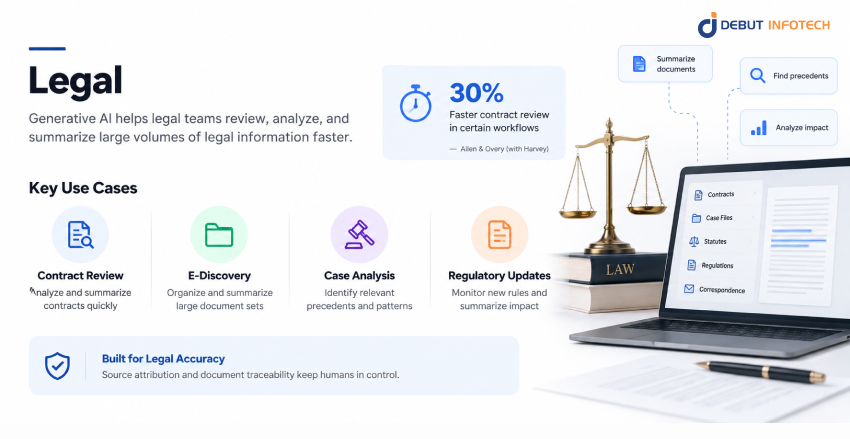
Legal organizations handle large volumes of contracts, case files, statutes, correspondence, and regulatory materials. Generative AI can help lawyers process this information more quickly while maintaining a structured review process.
Allen & Overy has used Harvey, an AI platform designed for legal work, to support tasks including contract review. The firm has reported that AI-assisted contract review can be completed 30% faster in certain workflows.
Industry-specific generative AI use cases for enterprises include e-discovery synthesis, case-outcome analysis, and regulatory change summaries.
An e-discovery system can organize large document collections and generate summaries for legal teams. Regulatory-change systems can monitor new rules and summarize how they may affect specific business activities. Case-analysis systems can help lawyers identify relevant precedents and patterns in historical decisions.
Legal AI requires strong source attribution. Lawyers need to know where an answer came from and should be able to inspect the underlying documents before relying on it.
7. Education
Education organizations can use generative AI to create more adaptive learning experiences. Rather than providing identical material to every learner, AI can generate exercises, explanations, and practice activities based on a student’s subject area and performance.
Khan Academy’s Khanmigo is a prominent example. The AI-powered learning assistant is designed to guide students through problems rather than provide answers. It also supports teachers with tasks such as lesson planning and assessment.
Industry-specific applications include adaptive assessment generation and subject-specific tutoring simulation.
An adaptive assessment system can generate questions at different difficulty levels and adjust the next question based on the learner’s performance. Subject-specific tutoring systems can use approved curriculum content and pedagogical rules to provide explanations and practice.
The model should be grounded in verified educational material. Schools also need controls around student data, age-appropriate interactions, teacher oversight, and evaluation of generated content.
8. Media and Entertainment
Media companies can use generative AI to produce and adapt content across languages, formats, and production workflows.
Netflix has explored generative AI in areas including visual effects and its INKubator program, which supports filmmakers experimenting with new production technologies.
Industry-specific applications include synthetic dubbing at scale, game asset generation, and script continuity checks.
Synthetic dubbing can combine speech recognition, translation, voice synthesis, and timing alignment to localize content. Game studios can use generative models to produce visual assets and variations during development. Script-analysis systems can track characters, locations, timelines, and plot details to identify continuity problems.
Media organizations also need clear rules around copyright, performer consent, licensing, and ownership of AI-generated material.
9. Cybersecurity
Cybersecurity teams can use generative AI to simulate attacks and produce new defensive scenarios. This can help security teams test their systems against threats that have not appeared frequently in their own historical data.
Darktrace has used AI to identify and respond to cyber threats. In one reported case involving the Boardriders ransomware incident, Darktrace’s technology detected unusual activity and helped the organization respond to the attack.
More specialized generative applications include adversary simulation and generative honeypots.
An adversary-simulation system can generate realistic attack paths or phishing scenarios for controlled security testing. Generative honeypots can create realistic but isolated environments designed to attract attackers and reveal their behavior.
Because these systems interact with security infrastructure, organizations need strict isolation and authorization controls. Generated attack scenarios should remain inside approved testing environments.
10. Real Estate
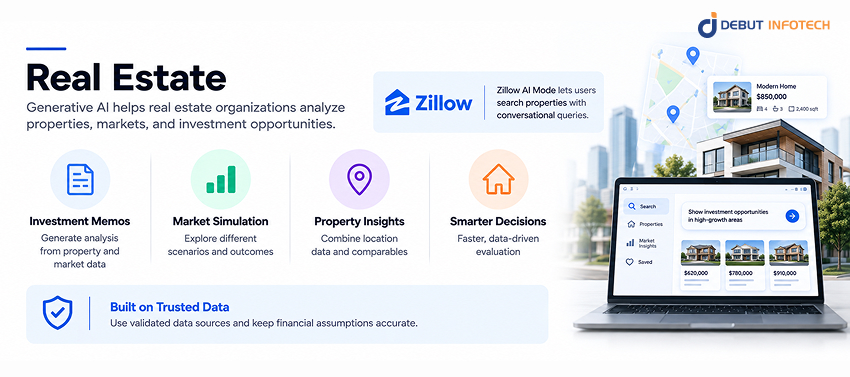
Real estate organizations can use generative AI to combine property information, market data, financial assumptions, and location intelligence into investment analysis.
Zillow has introduced Zillow AI Mode, which allows users to interact with property search through conversational queries and receive more contextual results.
Industry-specific generative AI business applications in real estate include investment memo generation and market simulation. An AI system can gather property details, rental assumptions, market indicators, and comparable transactions to produce a preliminary investment memo.
Market simulation can also help investors examine different scenarios, such as changes in interest rates, vacancy levels, rent growth, or property prices.
The financial assumptions should come from validated data sources. Generative AI can organize and explain the analysis, but it should not invent market data or silently alter financial assumptions.
11. Insurance
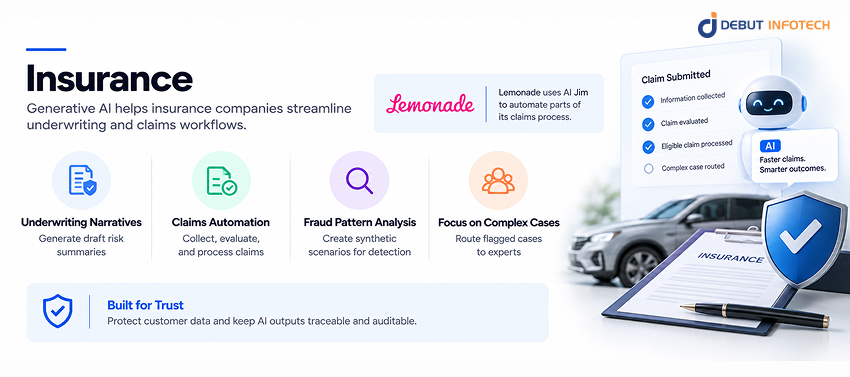
Insurance companies can apply generative AI to specialized underwriting and claims workflows.
Lemonade has used AI Jim to automate parts of its claims process. The AI-based claims system can collect information, evaluate claims, and automatically process eligible cases while routing more complex cases for further review.
Industry-specific generative applications include underwriting narrative generation and claims fraud-pattern synthesis.
Underwriting systems can use structured risk data and policy information to generate draft risk summaries for underwriters. Fraud-analysis systems can generate controlled synthetic scenarios that help train or test fraud-detection models.
Insurance applications require careful handling of customer information and clear auditability. AI-generated recommendations should remain traceable to the data and rules that produced them.
12. Blockchain and Web3
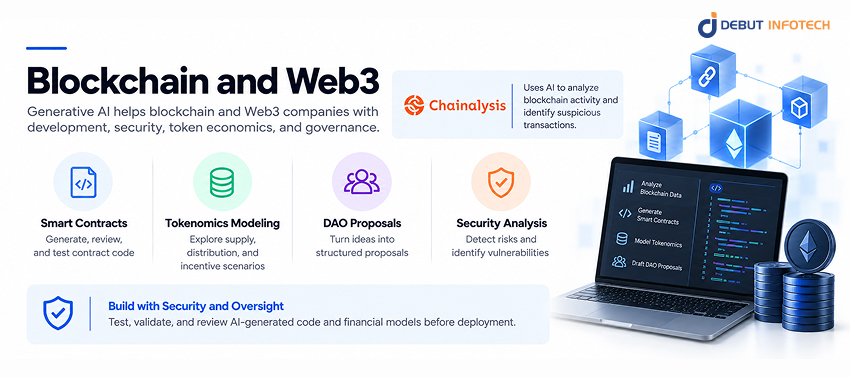
Blockchain and Web3 companies can use generative AI for specialized development, security, token economics, and governance workflows.
Chainalysis provides a relevant example of AI being applied to blockchain analysis and security. Its technology helps organizations investigate blockchain activity and identify suspicious transactions, making it a better example of AI-assisted blockchain analysis than smart contract generation or DAO management.
Other Industry-specific use cases of generative AI include:
Smart contract generation and audit assistance: Generate contract code, explain functions, identify potential vulnerabilities, and create test cases for developer review.
Tokenomics modeling: Generate and compare token supply, distribution, incentive, and governance scenarios before deployment.
DAO proposal drafting: Turn community discussions, voting requirements, and governance ideas into structured proposals for review.
These applications can combine LLMs, RAG, blockchain data, code-analysis tools, simulation environments, and smart contract development frameworks.
For high-value blockchain applications, generated code and financial models should undergo testing and independent review before deployment. Generative AI can speed up development and analysis, but security testing, formal verification where appropriate, and human oversight remain important.
Build AI That Fits Your Industry
Generic AI tools may not understand your workflows or requirements. Our generative AI development team builds industry-specific solutions designed around your processes, data, compliance needs, and users.
Generative AI Implementation Cost, Timeline & ROI
Generative AI implementation costs vary widely. A basic content-generation tool and a multi-system AI agent have different development, integration, security, and operating requirements. The final gen AI development cost depends on the model, data complexity, integrations, user volume, security controls, and ongoing maintenance.
Build vs. Buy
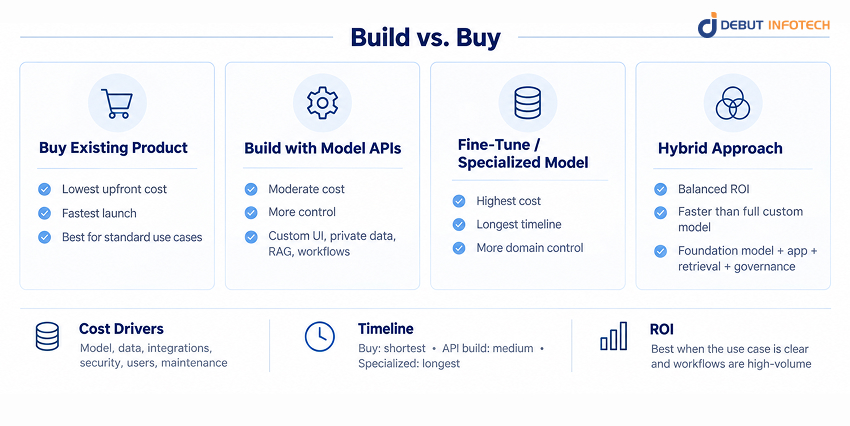
Organizations generally have three options: buy an existing AI product, build a custom application around model APIs, or develop and operate a specialized model and infrastructure stack.
Buying generative AI solutions reduces development time and works well when an existing product provides the required functionality.
Building around an API provides more control over the interface, private data, integrations, RAG pipeline, and workflows.
Fine-tuning or operating specialized models provides greater control but adds costs for training data, infrastructure, evaluation, and maintenance.
For many enterprises, a hybrid approach works best. They can use a commercial foundation model while building their own application, retrieval, integrations, and governance layers.
Typical Cost Ranges by Use Case Complexity
The following ranges provide a practical planning baseline. Actual costs depend on the project’s complexity, development team, location, model choice, integrations, and security requirements.
| Generative AI project | Typical development range | Approximate timeline |
| Basic content-generation tool | 15,000–40,000 | 4–8 weeks |
| RAG chatbot or knowledge assistant | 30,000–80,000 | 6–12 weeks |
| Enterprise AI assistant with integrations | 60,000–150,000+ | 3–6 months |
| Custom multimodal AI application | 80,000–200,000+ | 3–7 months |
| AI agent with multiple system integrations | 100,000–250,000+ | 4–9 months |
| Complex enterprise AI platform | 200,000–500,000+ | 6–12+ months |
These figures are planning estimates rather than fixed market prices. API usage creates a separate operating expense based on request volume, tokens, model size, and multimodal workloads.
Time-to-Value Benchmarks
A basic content-generation application can often deliver value within several weeks. RAG assistants typically require more time for document preparation, retrieval testing, permissions, and integrations. AI agents usually take longer because each automated action needs testing and safeguards.
Starting with a bounded pilot helps organizations measure value before committing to a larger deployment.
Common Hidden Costs
Development is only part of the total investment. Common hidden costs include:
- Data preparation: Cleaning, classifying, tagging, and structuring information for AI systems.
- Integration: Connecting AI to CRM, ERP, HR, payment, or legacy systems.
- Evaluation and monitoring: Testing accuracy, safety, performance, and model behavior.
- Model usage: API and infrastructure costs that increase with usage.
- Human oversight: Reviewing outputs, approving actions, and handling escalations.
- Model changes: Re-evaluating the system when providers update models or capabilities.
The most accurate ROI calculation therefore includes both development and operating costs.
A useful ROI formula is:
ROI = (Financial benefit – Total AI cost) ÷ Total AI cost × 100
For example, if an AI application costs $100,000 to build and operate during its first year but generates $180,000 in measurable savings and additional revenue, the first-year ROI would be 80%.
Benefits can include labor savings, increased revenue, faster processing, fewer errors, and lower operational costs. Measuring these benefits against a pre-AI baseline gives enterprises a clearer view of whether an implementation is producing sustainable value.
Framework: How to Choose and Start Your First Use Case
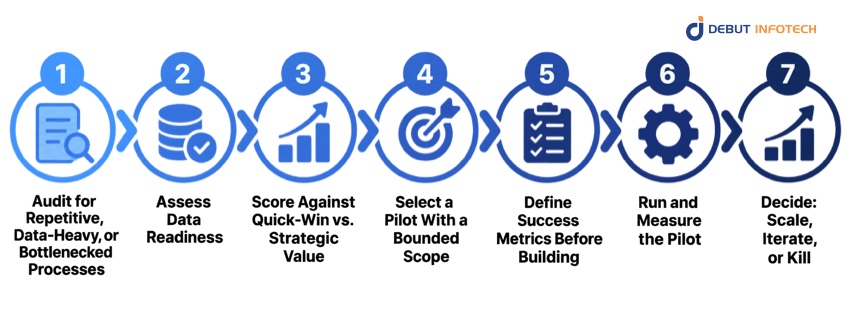
Choosing a first generative AI project should start with the business problem, not the model. The strongest candidates usually involve repetitive work, large volumes of information, measurable bottlenecks, or processes in which employees spend substantial time creating, searching for, analyzing, or moving information.
A structured selection process helps organizations avoid expensive experiments that produce impressive demos but little business value.
| Step | What to do | Key questions | Primary outcome |
| Audit processes | Identify repetitive, data-heavy, or bottlenecked processes where employees spend significant time on manual work | Where is time or cost concentrated? Which tasks involve repetitive, pattern-based work? | A shortlist of high-potential AI opportunities |
| Assess data readiness | Evaluate whether the data required for the use case is accessible, accurate, clean, current, and properly governed | Is the data accessible? Who owns it? Is it clean and sufficiently governed? | A clear view of data feasibility and gaps |
| Score quick-win vs. Strategic value | Compare potential use cases based on speed-to-impact, implementation complexity, cost, revenue potential, differentiation, and scalability | Can it deliver fast value? Could it create long-term competitive advantage? | Prioritized use-case ranking |
| Select a bounded pilot | Start with one process, one team, and one measurable outcome rather than attempting broad automation | Can the scope be contained? Which workflow and users should be included? | A focused, manageable pilot |
| Define success metrics | Establish measurable targets before development begins | What efficiency gains, cost reduction, accuracy, quality, or adoption rate would make the pilot successful? | Predefined KPIs and baseline measurements |
| Run and measure the pilot | Deploy the solution to the selected users and compare actual results against the predefined metrics | Is the system producing measurable business value? Where does it fail? | Evidence of performance, value, and weaknesses |
| Decide: scale, iterate, or kill | Use a formal go/no-go decision to determine whether the solution should expand, improve, or stop | Did the pilot meet its targets? Are the remaining issues fixable? | A clear scale, iteration, or discontinuation decision |
1. Audit for Repetitive, Data-Heavy, or Bottlenecked Processes
Start by identifying where employees spend the most time on manual, repetitive, or information-heavy work.
Look for processes involving:
- Repeated content creation
- Manual document review
- Frequent customer questions
- Large-scale data analysis
- Repetitive reporting
- Knowledge searches
- Manual data entry
- Routine software development
- Repeated administrative tasks
The goal is to identify where time and cost are concentrated before considering AI-powered solutions.
For example, if support agents spend several hours each day searching internal documentation before answering customers, an enterprise knowledge assistant could be a strong candidate.
If employees rarely encounter the problem, however, generative AI may not provide enough value to justify implementation.
Create a baseline for the current process. Measure time spent, labor costs, error rates, throughput, and other relevant performance indicators before introducing AI.
2. Assess Data Readiness
Once a promising process has been identified, evaluate whether the underlying data is accessible, accurate, up to date, and well governed enough to support the generative AI use case.
Ask:
- Where does the required data reside?
- Is it structured or unstructured?
- Who owns it?
- How frequently does it change?
- Is it complete?
- Are there duplicate or conflicting sources?
- Can the AI application access it securely?
- Are there restrictions on how the data can be processed?
This step can eliminate weak use cases early.
A customer support assistant may sound straightforward until the team discovers that product information is scattered across outdated PDFs, disconnected databases, and inconsistent internal documents.
In that situation, the problem is not primarily the language model. The organization needs to improve its information foundation first.
For RAG-based applications, data readiness directly affects retrieval quality and, in turn, the quality of generated responses.
3. Score Against Quick-Win vs. Strategic Value
Not every promising use case should be treated the same way. Some can produce measurable improvements quickly. Others may require significant investment but create a stronger long-term competitive advantage.
Score potential projects across two dimensions:
Quick-win value considers:
- Implementation complexity
- Time to deployment
- Expected cost savings
- Ease of adoption
- Availability of data
- Technical risk
Strategic value considers:
- Revenue potential
- Competitive differentiation
- Customer experience
- Long-term process transformation
- Scalability
- Strategic importance to the business
A simple internal content assistant might score highly as a quick win but have limited strategic differentiation. An AI-powered product-development system might require more investment but create a larger long-term advantage.
The objective is not to choose the easiest project. It is to understand the trade-off between speed-to-impact and long-term business value.
4. Select a Pilot With a Bounded Scope
Once the organization has ranked its options, choose one process, one team, and one measurable outcome for the initial pilot.
Avoid trying to automate an entire department at once.
For example:
Too broad:
“Build an AI customer-service platform.”
Better:
“Use RAG to help the Tier 1 support team answer product-configuration questions.”
The second definition gives the team a clear data scope, user group, workflow, and evaluation target.
A bounded pilot also makes it easier to identify technical problems before they affect a larger group of users.
For agentic applications, scope is even more important. Start with a workflow in which the agent has limited permissions and human approval can be introduced at critical points.
5. Define Success Metrics Before Building
The team should define how success will be measured before development begins.
Possible metrics include:
- Processing time
- Cost per transaction
- Resolution rate
- Accuracy
- Error rate
- Customer satisfaction
- Employee adoption
- Revenue generated
- Conversion rate
- Human review time
- Escalation rate
The metric should reflect the original business problem.
If the problem is an excessive customer service workload, measuring the number of AI-generated responses is less useful than measuring average handling time, resolution rate, and cost per resolved interaction.
If the objective is faster software development, the organization could measure development cycle time, review time, defect rates, and developer throughput.
Set a baseline before the pilot so that the team can compare results against the previous process.
6. Run and Measure the Pilot
The pilot should be treated as a controlled business experiment.
Grant the selected users access to the system, establish a defined evaluation period, and compare actual results against the metrics agreed upon before development.
Do not rely solely on positive user feedback. Employees may enjoy using an AI assistant without it producing measurable operational improvements.
Track both business and technical performance.
Business metrics show whether the application is creating value. Technical metrics show whether the AI system is performing reliably.
For a RAG assistant, for example, the team can measure response accuracy, retrieval relevance, latency, escalation rate, and user satisfaction.
For an AI coding assistant, the team can track development time alongside code-review findings and defect rates.
The pilot should also capture failure cases. Incorrect responses, irrelevant retrievals, unexpected outputs, and workflow failures provide the information needed to improve the system before wider deployment.
7. Decide: Scale, Iterate, or Kill
The final step is a formal go/no-go decision.
If the pilot meets its predefined targets, the organization can begin scaling it to additional users, processes, or business units.
If the system shows potential but misses some targets, the team can iterate. That may involve improving the data pipeline, changing the model, refining prompts, adding RAG, adjusting workflow logic, or introducing additional human review.
If the application consistently fails to deliver sufficient value, the organization should discontinue it.
A project should not continue simply because significant development money has already been spent.
The decision can follow a simple structure:
| Result | Decision |
| Meets or exceeds business targets | Scale |
| Shows value but misses key targets | Iterate |
| Produces limited measurable value | Kill |
| Creates unacceptable risk | Kill or redesign |
| Strong technical performance but weak business impact | Reassess the use case |
This final gate keeps generative AI investment tied to measurable business outcomes.
The most effective enterprise AI programs do not attempt to deploy everything at once. They identify a specific problem, validate the data, build a controlled pilot, measure the result, and expand only when the evidence supports doing so.
That approach also makes future investments easier to justify. Once an organization has demonstrated measurable value from one successful use case, it can apply the same evaluation framework to additional workflows.
Risks, Limitations & Governance Of Generative AI
Generative AI can improve productivity, but production systems introduce risks that simple prototypes may not reveal. Enterprises need controls for inaccurate outputs, sensitive data, regulatory requirements, model performance, and access to business systems.
1. Hallucination and Factual Errors
Generative AI can produce information that sounds convincing but is incorrect or unsupported. This is known as hallucination. The risk is higher in healthcare, finance, legal services, and other high-impact applications.
Organizations can reduce the risk through:
- RAG grounding: Retrieve information from approved sources before generating an answer.
- Guardrails: Restrict what the model can generate or access.
- Source attribution: Show users the documents supporting an answer.
- Human review: Require approval for high-risk outputs.
- Automated evaluation: Test responses against known answers and quality standards.
RAG helps ground responses in reliable information, but it does not eliminate hallucinations. Poor retrieval or incomplete source data can still produce incorrect results.
2. Data Privacy and Intellectual Property
Generative AI applications may process customer records, employee information, financial data, source code, proprietary documents, or other sensitive information. Organizations need clear policies governing what data can enter an AI system, where it is processed, how long it is retained, and whether it can be used for model training.
Data provenance also matters. Businesses should understand where training and retrieval data comes from and whether they have the right to use it. AI-generated outputs can also raise questions around ownership, licensing, and copyright.
Common technical controls include encryption, role-based access control, data loss prevention, private deployments, sensitive data detection, and audit logging.
3. Compliance and Model Monitoring
Regulatory requirements vary by industry. Healthcare systems may need strong privacy and access controls, while financial applications may require model validation, auditability, recordkeeping, and oversight.
Compliance should therefore be considered during architecture and development, not added after deployment.
Generative AI systems also require ongoing monitoring. Model behavior can change when providers update models, enterprise data changes, or user behavior shifts. Organizations should track accuracy, retrieval relevance, latency, cost, hallucination rates, escalation rates, and user adoption.
4. Governance Frameworks
Governance defines who can use an AI system, what information it can access, what actions it can perform, and when human approval is required.
A practical governance framework should include approval workflows, access controls, audit trails, model evaluation, monitoring, and incident-management procedures.
Risk-based controls are important. A marketing tool that generates draft copy may need basic human review. At the same time, an AI system that prepares financial reports or operates an ERP workflow requires stricter approval and access controls.
Agentic AI requires particular caution because it can take actions across connected systems. Permissions should follow the principle of least privilege, with human approval required for high-impact actions.
Good governance allows enterprises to scale Generative AI Use Cases while keeping outputs, data, and automated actions within defined business and regulatory boundaries.
Turn Generative AI Use Cases Into Production-Ready Solutions
Identifying a valuable AI opportunity is only the first step. Debut Infotech is a top generative AI development company that helps businesses move from generative AI use cases and pilot concepts to scalable applications built around real business requirements. With over fifteen years of experience across AI, blockchain, and enterprise software development, we combine technical expertise with a practical understanding of complex business workflows.
Our generative AI development capabilities include:
- Custom generative AI application development
- RAG-based knowledge assistants
- AI agent and workflow development
- Multimodal AI solutions
- Enterprise system and API integrations
- AI model optimization and governance
We focus on delivering measurable business outcomes. We also help organizations select the right architecture, integrate AI into existing systems, and build production-ready solutions.
Validate Your Generative AI Use Case
Not sure whether your AI idea is technically or commercially viable? Our experts can evaluate the use case, technology requirements, expected benefits, and development approach before you commit significant resources.
Final Thoughts
Generative AI is becoming a practical technology for improving workflows, creating content, analyzing information, and automating complex tasks. The strongest generative AI use cases address clear business problems and produce measurable outcomes.
Successful implementation also depends on reliable data, suitable models, secure integrations, governance, and continuous monitoring.
Organizations can reduce risk by starting with a focused pilot, defining success metrics early, and scaling only after results demonstrate genuine business value.
FAQs
Q. What are the most common generative AI use cases?
Common generative AI use cases include content creation, customer support, software development, marketing, data analysis, document summarization, and personalized recommendations. Businesses also use it to generate images, videos, product descriptions, reports, and internal knowledge responses. The biggest draw is speed. Teams can produce useful first drafts much faster.
Q. What problems can generative AI solve?
Generative AI can solve problems involving repetitive content creation, information overload, slow drafting, limited personalization, and time-consuming knowledge retrieval. It can summarize long documents, generate ideas, answer routine questions, write code, and automate parts of customer support. It does not eliminate human judgment, but it can reduce the workload.
Q. How can generative AI improve business operations?
Generative AI can improve business operations by automating routine tasks, speeding up content production, supporting employees, and making information easier to access. It can draft emails, summarize meetings, answer internal questions, generate reports, and assist with coding. This gives employees more time for work that requires judgment, creativity, and decision-making.
Q. What are the most practical generative AI applications?
The most practical generative AI applications are the ones tied to repetitive tasks. These include customer support, document summarization, content drafting, coding assistance, meeting notes, data analysis, internal search, and personalized recommendations. Start with a task that consumes staff time, then measure whether AI makes that process faster or cheaper.
Q. What are the best generative AI use cases for enterprises?
The best enterprise use cases include customer support, employee assistants, document processing, software development, content generation, knowledge management, and data analysis. These applications work well because they handle repetitive, information-heavy tasks at scale. The strongest use cases also have clear business goals, measurable outcomes, and reliable data.
Q. Which industries benefit most from generative AI?
Generative AI can benefit almost any industry, but healthcare, finance, retail, manufacturing, media, education, and professional services have strong use cases. Companies can use it for customer service, documentation, content creation, research, software development, forecasting support, and internal knowledge management. The right application depends on each industry’s workflows.
Q. How much does it cost to build a generative AI application?
A generative AI application typically costs $15,000–$40,000 for a basic MVP, $40,000–$150,000 for a production-ready application, and $150,000–$500,000+ for an enterprise platform. Costs increase with custom models, RAG pipelines, integrations, security, data preparation, and high-volume usage.
Q. How do businesses choose the right generative AI use case?
Businesses should start by identifying repetitive, time-consuming processes where AI can produce a measurable improvement. Evaluate each use case based on potential value, available data, technical feasibility, risk, implementation effort, and expected ROI. A small, well-defined use case is often a better starting point than a broad AI initiative.
Q. What is the difference between RAG and fine-tuning for GenAI applications?
RAG connects a generative AI model to external knowledge sources, allowing it to retrieve relevant information when answering questions. Fine-tuning changes the model’s behavior by training it on specific examples. RAG works well for frequently changing business information, while fine-tuning is better for specialized behavior, formatting, or task patterns.
Q. What are the risks of using generative AI in business?
Key risks include inaccurate outputs, data leakage, security vulnerabilities, intellectual property issues, regulatory concerns, bias, and overreliance on AI-generated information. Businesses can reduce these risks through access controls, human review, secure data handling, monitoring, testing, clear usage policies, and selecting appropriate models for each application.
Q. How long does it take to build a generative AI solution?
A basic generative AI application can take several weeks to develop, while a more complex enterprise solution may require several months. The timeline depends on features, integrations, data preparation, model customization, security requirements, testing, and deployment. A proof of concept can usually be delivered faster than a production-ready platform.
Q. Can generative AI be integrated with existing enterprise systems?
Yes. Generative AI can connect with CRMs, ERPs, databases, document management platforms, customer portals, and other enterprise systems through APIs and integration layers. The implementation depends on the system architecture, data access requirements, security controls, and use case. Proper integration lets AI work within existing business workflows.
Q. When should a business build a custom generative AI solution?
A business should consider a custom solution when off-the-shelf AI tools cannot meet its workflow, data, security, integration, or user requirements. Custom development also makes sense when AI is tied to a core business process or competitive advantage. The decision should balance expected value against development and maintenance costs
Talk With Our Expert
Free 30-min consultation. No commitment.
Our Related Insights



Talk With Our Expert
LET'S WORK TOGETHER
Your Vision.
Our Engineering.
Debut Infotech works as a strategic co-creator — from concept to production-ready platform. We deliver blockchain, AI, enterprise, & mobile solutions that scale.

15+ Years · 500+ Platforms Delivered
Across blockchain, AI, fintech, mobile, and enterprise verticals

NDA Signed on Day One
Your IP and project details are protected before any conversation begins

48-Hour Scoped Estimate
A real technical estimate — not a generic template or sales pitch

Dedicated Account Managers
Available across key global time zones
 +1 708-515-4004 (USA)


