



Table of Contents
Home / Use Case / AI
Agentic AI in Education: Strategic Use Cases, Market Trends, and Future Outlook


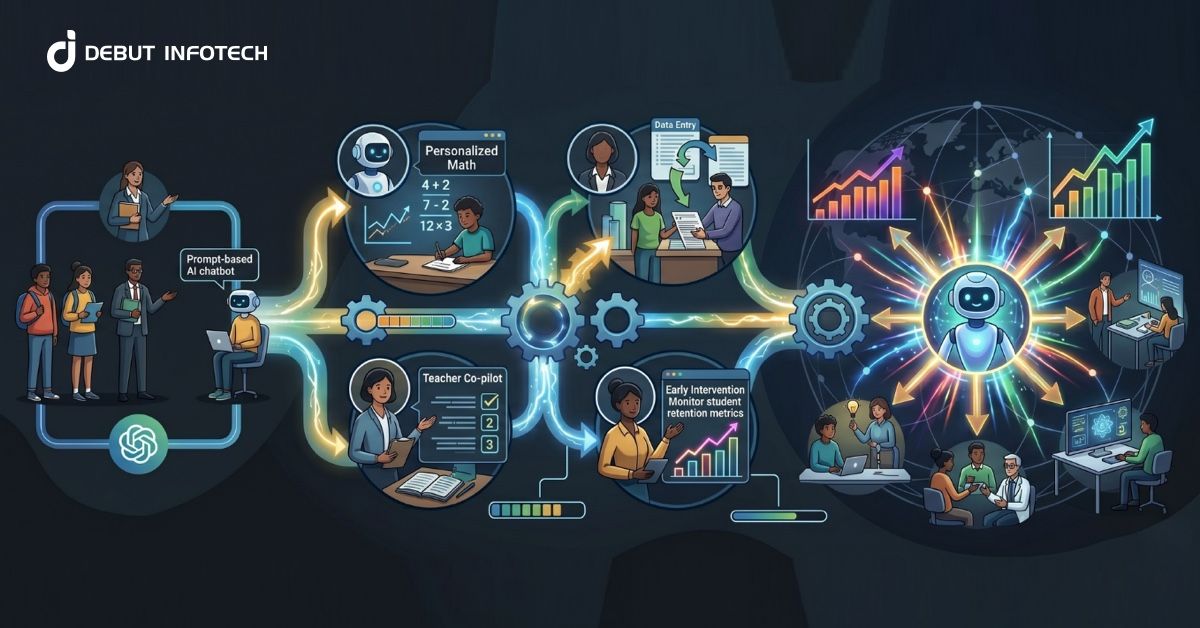
Education today stands at a pivotal moment. Institutions are under immense pressure to personalize learning, optimize administrative processes, and prepare students for a future driven by technology. Traditional tools often fall short, leaving educators with limited visibility into student progress, engagement gaps, and evolving workforce needs. The challenge isn’t just delivering knowledge but creating adaptive, meaningful learning experiences.
This is where Agentic AI in education comes into play—an advanced form of AI that goes beyond automation, enabling systems to act proactively, reason, and adapt to dynamic contexts. Agentic AI doesn’t just process information; it makes autonomous decisions to enhance both teaching and learning outcomes. From tailoring lesson plans to individual students’ learning styles to predicting at-risk learners before they fall behind, agentic AI empowers institutions to shift from reactive teaching to proactive, student-centered strategies.
The applications are vast. Intelligent tutoring systems can deliver real-time feedback, AI-driven agents can automate grading and assessments, and adaptive platforms can evolve with student performance to maximize outcomes. Beyond classrooms, agentic AI streamlines administrative tasks like enrollment management, resource allocation, and curriculum planning, freeing educators to focus on pedagogy rather than paperwork.
Looking ahead, the integration of agentic AI is poised to reshape education globally. As adoption grows, institutions will benefit from scalable personalization, data-informed insights, and more inclusive access to learning. This article explores the strategic use cases, emerging market trends, and future outlook of agentic AI in education—highlighting how it transforms operations, enhances engagement, and drives long-term growth.
Transformative Use Cases of Agentic AI in Education: Key Statistics and Insights
Agentic AI is redefining how institutions deliver education, manage operations, and improve student outcomes. Unlike conventional EdTech platforms, AI agents for education act autonomously—analyzing student performance, adapting content, and supporting both learners and administrators with real-time intelligence. Through AI agent development, schools and universities are building smart systems that personalize learning, predict challenges, and optimize resource allocation.
This shift represents a major transformation, enabling institutions to move beyond standardized models and toward adaptive, student-centered ecosystems. The following insights highlight how AI trends are shaping education globally:
- HolonIQ says that in Q1 2025, over U$500 billion in up-skilling and re-skilling initiatives have been announced globally, with about U$470 billion of that focused on digital & AI skills.
- A MarketsandMarkets report projects that the AI in education market will reach USD 5.82 billion by 2030, growing at a compound annual growth rate (CAGR) of 17.5 % through the forecast period.
- A Salesforce study reveals that 77% of higher education students would use AI agents to assist with school processes, including time management, academic advising, and course registration.
- The Springs report states that 58% of university instructors use generative AI in their daily practice — a trend likely to deepen in the coming years.
- A Microsoft report finds that 86% of education organizations are already using generative AI, highlighting rapid adoption and signaling continued growth in AI-driven teaching and learning initiatives in the coming years.
- The same Microsoft report states that over one in three students (37%) now rely on AI to kickstart and brainstorm assignments — a shift signaling how deeply AI is embedding itself into students’ daily learning workflows.
These statistics show that organizations adopting AI agents for education gain a competitive edge. From predictive analytics and curriculum optimization to automated assessments and student engagement strategies, agentic AI is transforming education into a more adaptive, scalable, and insight-driven domain.
What Is the Role Of Agentic AI In Education?
Agentic AI is redefining how schools, colleges, and universities deliver instruction, manage operations, and personalize the student journey. By autonomously perceiving goals, planning actions, and executing tasks, agentic AI systems go beyond traditional automation to act as collaborative digital partners for educators and learners. These AI agents can monitor student performance in real time, adapt learning pathways, and even initiate interventions—offering a dynamic, responsive approach to education that supports both academic and administrative needs.
Modern agentic AI tools in education can analyze vast datasets of student interactions, assessment results, and resource usage far more efficiently than conventional methods. This capability allows institutions to enhance student outcomes, reduce administrative overhead, and maintain agility in an evolving educational landscape. By applying multi-step reasoning and self-directed actions, agentic AI can anticipate challenges, recommend solutions, and continuously improve teaching strategies and operational processes.
Role of Agentic AI in Education
- Personalized Learning Journeys: Create adaptive lesson plans and individualized study paths based on each learner’s strengths, weaknesses, and pace.
- Intelligent Tutoring & Assessment: Provide real-time tutoring, automate grading, and generate immediate, detailed feedback.
- Autonomous Administrative Support: Handle scheduling, enrollment, resource allocation, and other back-office tasks with minimal human input.
- Predictive Student Success Analytics: Use predictive modeling to flag at-risk students, forecast enrollment trends, and guide early interventions.
- Curriculum Optimization: Continuously refine curricula by analyzing outcomes, market needs, and evolving workforce skills.
- Seamless System Integration: Connect with existing LMS, SIS, and analytics platforms to ensure smooth, scalable adoption across departments.
By partnering with an experienced AI development company, educational institutions can design agentic AI solutions tailored to their specific workflows and compliance requirements. Deploying these intelligent agents empowers educators to focus on high-value teaching and mentorship while providing students with a more engaging, responsive, and effective learning experience.
Transform Learning with Intelligent Agents
Empower your institution with AI agents that streamline workflows, personalize student experiences, and optimize decision-making across departments.
Top 15 Use Cases Of Agentic AI in Education
Agentic AI is revolutionizing education by enabling institutions to make data-driven decisions, personalize learning, and optimize operational efficiency. Instead of relying solely on traditional teaching methods or manual administrative processes, schools and universities are leveraging AI agents for education to automate routine tasks, monitor student progress, and forecast learning outcomes with precision.
From adaptive curriculum planning and intelligent tutoring to predictive student engagement analysis and skill gap identification, agentic AI allows educators to act proactively. These systems can personalize learning pathways, recommend targeted resources, and provide early interventions for at-risk students—ensuring that teaching strategies align with individual needs and institutional goals.
Advanced agentic AI algorithms help administrators anticipate enrollment trends, allocate resources efficiently, and optimize course offerings based on real-time insights. By embedding these autonomous capabilities into academic and administrative workflows, institutions gain improved operational efficiency, data-informed decision-making, and a stronger competitive advantage.
Ultimately, agentic AI in education empowers both educators and learners. It transforms teaching from reactive to proactive, enhances student outcomes, and equips institutions with the strategic intelligence needed to navigate a rapidly evolving educational landscape.
1. Intelligent Tutoring Systems
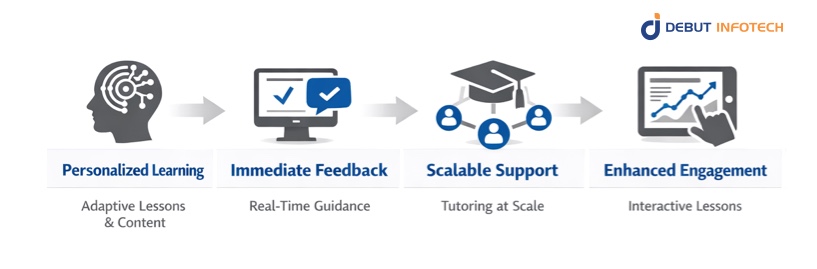
Intelligent Tutoring Systems leverage AI agents for education to deliver highly personalized, one-on-one learning experiences that adapt dynamically to each student’s progress. Unlike traditional classrooms where instruction is uniform, these systems continuously analyze performance metrics, detect learning gaps, and recommend tailored exercises or explanations. This allows educators to address individual needs at scale while fostering independent learning among students.
Key Benefits:
- Personalized Learning: Dynamically adjusts lesson difficulty, pace, and content based on student progress and learning style.
- Immediate Feedback: Provides real-time guidance and hints to improve comprehension and retention.
- Scalable Support: Enables institutions to provide high-quality individualized tutoring to large numbers of students without increasing faculty workload.
- Enhanced Engagement: Students remain motivated with interactive, adaptive lessons designed for their skill level.
Real-Life Example:
Platforms like Carnegie Learning and Squirrel AI utilize AI Algorithms to continuously monitor student activity, adapt instruction in real time, and optimize learning outcomes based on performance patterns and behavioral analytics.
Business Impact:
By adopting intelligent tutoring systems, educational institutions can significantly enhance student success rates, improve retention, and provide scalable, high-quality education. Educators benefit from data-driven insights, allowing them to focus on mentoring and curriculum refinement rather than repetitive instructional tasks.
2. Automated Grading and Assessment
Automated grading leverages AI models to evaluate tests, assignments, and essays with high speed and precision. These systems go beyond simple multiple-choice evaluation by using advanced machine learning techniques to assess written responses, code, and complex problem-solving tasks. Automated grading ensures consistency, reduces human error, and allows educators to focus on instructional improvement rather than administrative grading burdens.
Key Benefits:
- Time Efficiency: Processes large volumes of student assessments quickly, saving significant faculty time.
- Objective Evaluation: Eliminates subjective bias in scoring, ensuring fairness and reliability.
- Instant Insights: Highlights student strengths and areas for improvement in real time, enabling targeted interventions.
- Data-Driven Decisions: Generates actionable reports for educators and administrators on overall class performance trends.
Real-Life Example:
Platforms such as Gradescope and Turnitin utilize AI agents to automatically evaluate essays, code submissions, and problem sets, providing instant, consistent feedback and highlighting areas for instructional focus.
Business Impact:
Educational institutions adopting automated grading systems experience faster feedback loops, improved assessment accuracy, and reduced administrative overhead, enabling teachers to dedicate more time to instructional strategy, curriculum innovation, and student mentoring.
3. AI-Powered Chatbots and Virtual Assistants
AI-powered chatbots and virtual assistants employ digital solutions for education to provide personalized support for students and administrative staff. These systems can answer frequently asked questions, assist with scheduling, provide academic guidance, and even recommend learning resources. By automating routine interactions, chatbots reduce faculty workload and improve the overall educational experience.
Key Benefits:
- 24/7 Student Support: Delivers assistance at any time, improving accessibility and responsiveness.
- Workflow Automation: Handles repetitive administrative tasks such as enrollment queries, timetable coordination, and FAQ management.
- Enhanced Engagement: Maintains consistent communication with students, boosting satisfaction and retention.
- Data Insights: Tracks common inquiries and engagement trends, helping institutions refine services.
Real-Life Example:
Platforms like AdmitHub and Ivy.ai integrate chatbots built by AI agents companies to support admissions, student advising, and learning navigation, ensuring timely, accurate, and personalized assistance.
Business Impact:
Implementing AI-powered virtual assistants reduces operational costs, increases student satisfaction, and streamlines institutional processes. Institutions gain a scalable support solution that enhances both administrative efficiency and student engagement simultaneously.
4. Curriculum Planning and Optimization
Curriculum planning tools driven by AI consultants utilize predictive analytics and intelligent decision-making to design efficient, industry-aligned course structures. These systems assess historical enrollment data, student performance metrics, and emerging workforce skill requirements to recommend optimal curricula. This ensures courses remain relevant and institutions can adapt quickly to market and technology shifts.
Key Benefits:
- Strategic Alignment: Ensures curricula meet current industry standards and workforce demands.
- Resource Optimization: Efficiently schedules instructors, classrooms, and course materials to minimize costs and maximize outcomes.
- Data-Driven Decision Making: Uses performance and trend data to plan course sequences and prerequisites.
- Continuous Improvement: Provides ongoing recommendations as student outcomes and external trends evolve.
Real-Life Example:
Tools like CourseTune and Chalk leverage AI agent development to dynamically suggest course sequences, optimize resource allocation, and monitor program effectiveness over time.
Business Impact:
AI-driven curriculum planning improves the relevance and quality of educational offerings, enhances employability outcomes for students, and allows institutions to allocate faculty and resources more strategically, increasing overall operational efficiency.
5. Adaptive Learning Pathways
Adaptive learning pathways utilize AI tools to create personalized educational journeys that evolve with the learner. These systems continuously monitor student interactions, engagement, and assessment performance to adjust content, pace, and difficulty, ensuring optimal learning experiences. By tailoring education to individual needs, adaptive learning helps close knowledge gaps and supports lifelong learning objectives.
Key Benefits:
- Personalized Progression: Students follow a customized learning path that matches their skills, pace, and interests.
- Real-Time Adaptation: Content and recommendations update continuously based on learner performance.
- Enhanced Engagement: Students remain motivated as lessons are appropriately challenging and relevant.
- Actionable Insights: Provides educators with data to identify struggling students and adjust instructional strategies.
Real-Life Example:
Platforms such as DreamBox Learning and Smart Sparrow deploy adaptive learning technologies designed with future of AI agents to dynamically adjust curricula, recommend exercises, and support individualized student progress tracking.
Business Impact:
Adopting adaptive learning pathways improves student performance, reduces dropout rates, and enables institutions to provide truly personalized education at scale. Teachers gain actionable insights for intervention, while students benefit from a learning experience that responds directly to their unique needs.
6. Personalized Content Recommendations
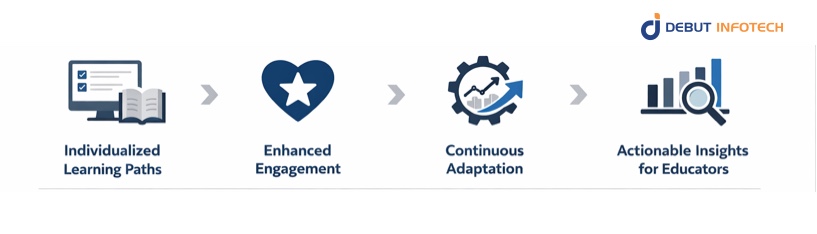
Personalized content recommendation systems rely on advanced AI agent development to analyze a student’s learning behavior, prior performance, and engagement patterns. Instead of presenting all students with the same materials, these systems curate and deliver content that aligns with individual learning styles, knowledge gaps, and skill levels. This approach ensures that learners interact with resources that are not only relevant but also optimally challenging, helping them progress more efficiently and retain information better over time. The technology continuously learns from each student’s responses, making recommendations increasingly accurate and effective as learning continues.
Key Benefits:
- Individualized Learning Paths: Tailors exercises, readings, videos, and practice problems to each student’s current knowledge and learning pace.
- Enhanced Engagement: Students remain motivated because the content aligns with their interests and ability levels, reducing frustration or boredom.
- Continuous Adaptation: The system adjusts suggestions dynamically based on real-time performance analytics, ensuring ongoing relevance.
- Actionable Insights for Educators: Teachers can see which resources are most effective for each learner, enabling data-driven instructional planning.
Real-Life Example:
Platforms such as Coursera and Khan Academy implement solutions from a Custom AI Agent Development Company to provide content recommendations that adapt in real time, helping students focus on areas that require improvement and accelerate learning in subjects where they excel.
Business Impact:
Institutions adopting personalized content recommendation systems can significantly improve learning outcomes, reduce dropout rates, and enhance overall student satisfaction. Educators gain actionable insights to refine curricula and teaching strategies, while students benefit from an engaging, adaptive, and tailored learning experience.
Redefine Student Success with Predictive Intelligence
Use AI-powered analytics to forecast learning outcomes, identify at-risk students, and improve retention through proactive intervention.
7. Task Automation for Educators
Task automation for educators leverages AI Agents Companies’ solutions to handle repetitive administrative and instructional responsibilities, allowing teachers to dedicate more time to pedagogy and student interaction. This includes automating grading, attendance tracking, report generation, scheduling parent-teacher meetings, and even sending reminders or notifications. By removing repetitive tasks, AI enhances the efficiency of school operations while reducing human error and inconsistencies. Automation tools also ensure that critical deadlines and follow-ups are met, improving the overall quality of educational administration.
Key Benefits:
- Time Efficiency: Educators save hours previously spent on manual data entry, grading, and routine communications.
- Reliability: Ensures accuracy and consistency in grading and administrative processes.
- Focus on Instruction: Teachers can spend more time on lesson planning, mentoring, and one-on-one student engagement.
- Operational Transparency: Administrators can monitor workflows and track completion rates efficiently.
Real-Life Example:
Platforms like TeacherEase and Frontline Education incorporate task automation powered by AI-powered content creation to streamline grading, attendance management, and other administrative duties. These solutions free educators from repetitive processes, enabling more meaningful engagement with students.
Business Impact:
AI-driven task automation improves operational efficiency, reduces administrative overhead, and allows educational institutions to focus resources on teaching quality, professional development, and strategic initiatives that enhance learning outcomes.
8. Smart Content Creation and Summarization
Smart content creation and summarization harness AI-powered content creation to develop educational materials, lesson plans, summaries, quizzes, and interactive learning resources automatically. These AI systems analyze large volumes of academic content, extract key concepts, and generate structured learning materials that are aligned with course objectives. The technology can also produce multimedia content such as videos, slides, or interactive exercises, ensuring that students receive diverse and engaging materials. By automating content development, institutions can keep learning materials up-to-date with minimal manual effort.
Key Benefits:
- Rapid Production: Speeds up the creation of lesson plans, study guides, and assessments.
- Consistent Quality: Ensures all content meets instructional standards and curriculum requirements.
- Engaging Materials: Generates multimedia and interactive exercises that improve student engagement.
- Scalable Learning: Supports large student populations with consistent, high-quality educational content.
Real-Life Example:
Platforms like ScribeSense and Content Technologies, Inc. use AI agent development to produce summaries, lesson plans, and adaptive content, allowing educators to focus on instructional improvement while students access high-quality resources.
Business Impact:
Smart content creation enables institutions to deliver fresh, interactive, and personalized learning materials at scale, improving student engagement, learning outcomes, and teacher efficiency while reducing content development time and costs.
9. Exam Proctoring and Cheating Prevention
Exam proctoring systems employ AI Agent development Company solutions to ensure the integrity and security of assessments. Using facial recognition, eye tracking, and behavioral analytics, these systems monitor students during online or in-person exams, identifying potential cheating or suspicious activity. AI proctoring allows educators to uphold rigorous academic standards without requiring constant human supervision. It also generates detailed reports that educators can review for compliance and fairness, helping maintain institutional credibility.
Key Benefits:
- Enhanced Security: Monitors exams for cheating, impersonation, or unauthorized access.
- Reduced Human Effort: Eliminates the need for multiple invigilators in large-scale assessments.
- Objective Evaluation: Ensures all students are assessed fairly, maintaining academic standards.
- Detailed Analytics: Provides insights into exam behavior and patterns for quality control.
Real-Life Example:
Platforms like ProctorU and Examity implement AI-driven proctoring using AI-powered content creation and advanced monitoring algorithms to ensure exam integrity while reducing administrative workload.
Business Impact:
AI-based proctoring improves assessment reliability, supports remote learning environments, and reduces costs associated with manual invigilation, allowing institutions to focus on improving educational quality and student outcomes.
10. Language Learning Assistance
Language learning platforms powered by an AI agent for education provide real-time practice, feedback, and instruction tailored to individual proficiency levels. These systems use natural language processing to detect pronunciation errors, grammar mistakes, and comprehension gaps while offering interactive exercises for speaking, listening, reading, and writing. AI-assisted language learning supports both classroom and self-paced learning, making it scalable across large student populations and adaptable to different learning speeds and styles.
Key Benefits:
- Adaptive Learning: Lessons adjust dynamically based on the learner’s performance and progress.
- Immediate Feedback: Provides corrective guidance instantly, helping learners improve efficiently.
- Interactive Practice: Includes exercises for pronunciation, vocabulary, conversation, and grammar.
- Data Insights for Educators: Tracks performance trends to identify student strengths and areas needing reinforcement.
Real-Life Example:
Applications like Duolingo and Rosetta Stone use AI-powered content creation to generate exercises, quizzes, and conversational simulations that adapt to individual learners’ performance, promoting faster skill acquisition.
Business Impact:
AI-driven language learning enhances student outcomes, accelerates fluency development, and allows institutions to provide scalable, engaging, and personalized language education for diverse student populations. Educators gain insights that enable better intervention and support.
11. Skill Gap Analysis and Career Guidance
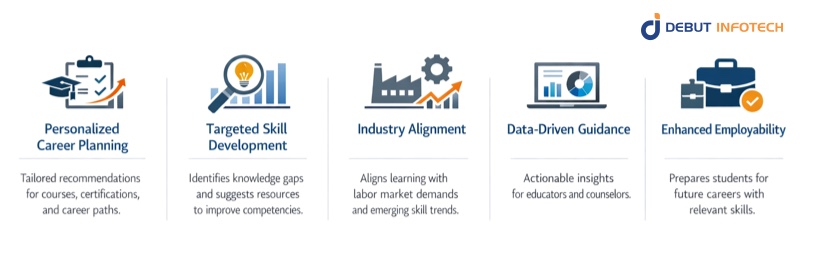
AI-driven skill gap analysis platforms leverage AI agent development to assess students’ competencies against industry and workforce requirements. By analyzing assessment results, course performance, and extracurricular engagement, these systems identify areas where learners need improvement and recommend personalized learning pathways. Beyond academic skills, AI can guide students on career options, helping them choose programs aligned with their strengths and future job market trends.
Key Benefits:
- Personalized Career Planning: Students receive tailored recommendations for courses, certifications, and career paths.
- Targeted Skill Development: Identifies knowledge gaps and suggests resources or exercises to improve competencies.
- Industry Alignment: Aligns student learning with current labor market demands and emerging skill trends.
- Data-Driven Guidance: Provides actionable insights to educators and counselors for mentoring.
- Enhanced Employability: Prepares students for future careers with relevant skills.
Real-Life Example:
- Handshake uses AI algorithms to assess student skills and suggest internships or career opportunities.
- Seek Learning Analytics provides institutions with skill gap insights to guide students toward in-demand roles.
Business Impact:
Institutions adopting skill gap analysis and career guidance solutions improve student readiness for the workforce, increase graduation-to-employment success rates, and strengthen their reputation as career-focused learning providers.
12. Dyslexia and Learning Difficulty Detection
AI-powered learning difficulty detection uses Custom AI Agent Development Company solutions to identify students with dyslexia, ADHD, or other learning challenges early. By analyzing reading patterns, typing behavior, eye movement, and performance data, AI detects subtle indicators of learning difficulties that may go unnoticed in traditional assessments. Early detection allows educators to provide targeted interventions, personalized lesson adjustments, and additional support.
Key Benefits:
- Early Identification: Flags potential learning difficulties before they significantly impact progress.
- Personalized Intervention: Suggests adapted exercises, assistive technologies, and specialized instruction.
- Improved Student Outcomes: Supports learners in overcoming challenges and achieving academic goals.
- Educator Insights: Provides detailed reports to teachers, enabling informed instructional decisions.
- Inclusive Learning Environment: Ensures students with learning difficulties receive equitable support.
Real-Life Example:
- Nessy Learning implements AI-driven tools to identify dyslexia indicators and recommend targeted interventions.
- Lexia Learning uses AI to detect reading difficulties and adapt learning exercises for K–12 students.
Business Impact:
AI-based learning difficulty detection empowers institutions to provide inclusive, accessible education, reduce learning gaps, and improve student confidence and performance through timely, personalized support.
13. Edutainment and Gamified Learning
AI-powered content creation tools enable gamified learning experiences that combine education and entertainment to boost engagement. By integrating interactive games, quizzes, simulations, and reward systems, AI creates immersive learning environments. These platforms analyze student interaction patterns to adjust difficulty levels and provide personalized challenges, keeping learners motivated and enhancing retention.
Key Benefits:
- Increased Engagement: Gamified experiences make learning fun, motivating students to participate actively.
- Adaptive Challenges: Adjusts difficulty to maintain an optimal balance of challenge and skill.
- Reinforced Learning: Combines practice and repetition in a rewarding, interactive environment.
- Performance Analytics: Tracks progress and learning outcomes through AI-generated insights.
- Encourages Collaboration: Multiplayer or team-based games promote social learning and problem-solving skills.
Real-Life Example:
- Kahoot! leverages AI to personalize quizzes and gamified activities for K–12 and higher education students.
- Mangahigh uses AI to deliver interactive math games that adapt to individual learner performance.
Business Impact:
Institutions using gamified learning increase student motivation, engagement, and content retention. AI-driven edutainment allows teachers to monitor performance and deliver more effective, interactive instruction.
14. Administrative Workflow Automation
Administrative workflow automation platforms use AI Agents Companies solutions to streamline routine tasks such as enrollment processing, timetable scheduling, fee management, and reporting. By automating these processes, schools and universities reduce errors, save time, and optimize resource allocation. AI systems can also provide predictive analytics for resource planning and identify bottlenecks in administrative workflows.
Key Benefits:
- Efficiency and Speed: Automates repetitive processes, reducing manual workload.
- Error Reduction: Ensures data consistency and eliminates human mistakes.
- Resource Optimization: Allocates classrooms, staff, and materials more effectively.
- Real-Time Monitoring: Administrators can track workflow performance and outcomes instantly.
- Enhanced Student Experience: Students receive timely notifications, schedules, and updates without delays.
Real-Life Example:
- GEMS Education uses AI to automate administrative processes across multiple schools, enhancing operational efficiency.
- SIMS by Capita integrates AI to handle student records, timetables, and communication tasks efficiently.
Business Impact:
Workflow automation reduces administrative overhead, improves operational transparency, and allows staff to focus on strategic initiatives and student support rather than repetitive manual tasks.
Accelerate Digital Transformation in Education
Partner with experts in enterprise AI development to design scalable, secure, and compliant systems for your academic ecosystem.
15. Early Intervention for At-Risk Students
AI systems designed for early intervention leverage AI-powered content creation and analytics to monitor student engagement, attendance, grades, and behavior patterns. These systems flag students who may be at risk of falling behind, providing teachers and counselors with actionable insights. Personalized interventions, such as tutoring, mentoring, or additional learning resources, can then be deployed promptly to improve outcomes.
Key Benefits:
- Early Detection: Identifies students showing signs of disengagement or academic struggles.
- Targeted Support: Recommends personalized interventions to help students succeed.
- Improved Retention: Reduces dropout rates and increases course completion.
- Data-Driven Decisions: Provides educators with actionable insights for intervention planning.
- Holistic Student Support: Tracks academic, behavioral, and engagement metrics for a comprehensive understanding.
Real-Life Example:
- BrightBytes uses AI to monitor K–12 student performance and engagement, flagging at-risk learners for timely intervention.
- Sentral Education implements AI-driven analytics to provide alerts and recommendations for at-risk students.
Business Impact:
Institutions adopting early intervention AI solutions improve student retention, performance, and overall well-being. Teachers can intervene strategically and proactively, ensuring learners receive the support they need before challenges escalate.
16. Predictive Enrollment and Course Demand Forecasting
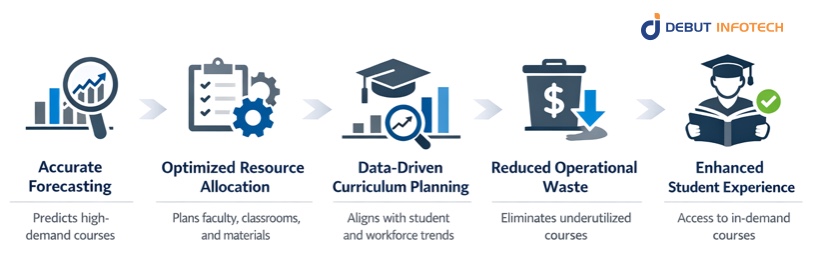
AI-driven predictive enrollment and course demand forecasting platforms leverage AI agents for education to analyze historical enrollment data, student preferences, demographic trends, and industry workforce needs. By identifying patterns and forecasting future demand, institutions can optimize course offerings, faculty allocation, and resource planning. This allows universities and training centers to proactively align programs with student interests and labor market requirements.
Key Benefits:
- Accurate Forecasting: Anticipates which courses or programs will experience high demand in upcoming semesters.
- Optimized Resource Allocation: Helps institutions plan faculty, classrooms, and materials efficiently.
- Data-Driven Curriculum Planning: Ensures programs align with student interests and workforce trends.
- Reduced Operational Waste: Prevents underutilized courses and improves budget management.
- Enhanced Student Experience: Students have access to high-demand courses without overbooking issues.
Real-Life Example:
- Georgia State University uses AI analytics to predict student enrollment trends and optimize course offerings, improving graduation rates.
- RMIT University applies predictive AI models to forecast student enrollment and resource requirements for multiple programs.
Business Impact:
Predictive enrollment and course demand forecasting help institutions make strategic decisions, optimize operational costs, and enhance the student experience by ensuring popular courses are adequately staffed and resourced.
17. Collaborative Learning Support
Overview:
AI-powered collaborative learning support systems leverage AI agent development to facilitate teamwork, peer interaction, and project-based learning. These systems use AI to group students based on complementary skills, monitor group progress, suggest discussion topics, and provide guidance during collaborative exercises. By analyzing participation and interaction patterns, AI ensures equitable engagement and enhances group performance.
Key Benefits:
- Optimized Team Formation: Creates balanced groups for projects or discussions based on skills and learning styles.
- Enhanced Collaboration: Provides AI-driven prompts and guidance to keep discussions productive.
- Equitable Participation: Monitors individual contribution levels and flags disengaged members.
- Instructor Insights: Educators receive data on group performance, participation, and dynamics.
- Improved Learning Outcomes: Encourages knowledge sharing, problem-solving, and critical thinking.
Real-Life Example:
- CENTURY Tech integrates AI to support collaborative learning in classrooms, optimizing group assignments and enhancing teamwork skills.
- Piazza uses AI-driven analytics to facilitate collaborative student discussions and track participation in online courses.
Business Impact:
AI-supported collaborative learning boosts engagement, strengthens soft skills, and enables educators to manage group dynamics effectively. Students gain hands-on experience working in teams while institutions ensure productive and equitable collaboration.
18. Student Engagement Analytics
Student engagement analytics platforms utilize AI-powered content creation and AI agents to monitor how students interact with learning materials, virtual classrooms, and online platforms. By analyzing clicks, login frequency, time spent on activities, and performance metrics, AI can identify engagement patterns, predict at-risk students, and suggest interventions to improve learning outcomes.
Key Benefits:
- Real-Time Insights: Tracks student interactions continuously, highlighting areas of low engagement.
- Early Intervention: Flags disengaged or struggling students for timely support.
- Performance Correlation: Links engagement patterns with academic performance for better decision-making.
- Optimized Instruction: Guides educators on adjusting teaching methods and materials.
- Data-Driven Resource Allocation: Helps prioritize support for courses or students needing attention.
Real-Life Example:
- Blackboard Analytics employs AI to monitor engagement in online and blended learning environments.
- Abu Dhabi Department of Education uses AI-driven engagement dashboards to track student participation and provide targeted interventions.
Business Impact:
Institutions adopting AI-powered student engagement analytics can proactively address learning gaps, improve retention rates, and enhance overall academic outcomes. Educators gain actionable insights to refine teaching strategies, while students benefit from personalized, responsive support.
Technologies Used in the Implementation of Agentic AI in the Education Industry
The integration of Agentic AI in education relies on a sophisticated ecosystem of technologies that enable intelligent automation, personalized learning, and predictive analytics. These technologies work together to create adaptive, scalable, and data-driven educational environments.
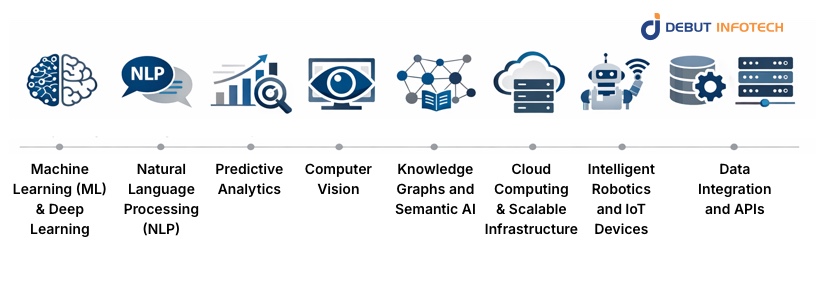
1. Machine Learning (ML) & Deep Learning
Machine learning algorithms form the backbone of Agentic AI, enabling systems to learn from historical data and student interactions. Deep learning models, including neural networks, support complex tasks such as natural language understanding, pattern recognition, and predictive performance analytics. These technologies power applications such as personalized learning recommendations, predictive enrollment, and early intervention for at-risk students.
2. Natural Language Processing (NLP)
NLP enables AI agents to understand, interpret, and generate human language. In education, NLP supports intelligent tutoring systems, AI-powered chatbots, essay grading, and language learning assistance. It allows virtual assistants to answer student queries, provide explanations, and deliver feedback in real time, enhancing engagement and accessibility.
3. Predictive Analytics
Predictive analytics uses historical and real-time data to forecast trends such as course demand, student performance, and potential dropout risks. These insights help institutions optimize curriculum planning, resource allocation, and career guidance services. Predictive models enhance strategic decision-making and improve overall learning outcomes.
4. Computer Vision
Computer vision technologies enable AI systems to analyze visual data, supporting applications like automated proctoring, dyslexia and learning difficulty detection, and interactive learning games. Facial recognition and gesture tracking help ensure secure assessments and monitor student engagement in both physical and virtual classrooms.
5. Knowledge Graphs and Semantic AI
Knowledge graphs create interconnected maps of educational content, student progress, and competency frameworks. They allow AI agents to provide contextualized recommendations, adaptive learning paths, and skill gap analysis, connecting students with relevant learning materials and career opportunities.
6. Cloud Computing & Scalable Infrastructure
Cloud-based platforms support the large-scale deployment of AI agents, enabling real-time data processing, storage, and collaboration across multiple institutions. Cloud infrastructure ensures high availability, scalability, and accessibility for AI-powered education solutions.
7. Intelligent Robotics and IoT Devices
In advanced classrooms, AI-powered robots and IoT devices enhance interactive learning, gamification, and experiential education. These technologies can provide real-time feedback, facilitate collaborative exercises, and monitor environmental factors to optimize the learning experience.
8. Data Integration and APIs
Seamless integration of student information systems (SIS), learning management systems (LMS), and third-party educational tools is critical. APIs allow AI agents to access and process comprehensive datasets, enabling personalized recommendations, engagement tracking, and predictive insights.
Ensure Ethical and Transparent AI Adoption
Establish governance frameworks and responsible AI policies that align technology with institutional values and educational equity.
Traditional Classrooms vs. AI-Powered Classrooms: A Transformative Shift
The education landscape is undergoing a major transformation with the rise of AI-powered classrooms. Unlike traditional setups that rely on fixed curricula, manual grading, and one-size-fits-all teaching methods, AI-driven classrooms leverage intelligent agents, adaptive learning, and predictive analytics. This shift not only personalizes learning but also improves efficiency, engagement, and outcomes for students and educators alike.
| Aspect | Traditional Classroom | AI-Powered Classroom |
| Teaching Method | Teacher-centered, standardized instruction | AI agents enable adaptive, student-centered learning |
| Assessment | Manual grading, periodic exams | Automated grading with real-time feedback |
| Learning Pace | One-size-fits-all approach | Personalized learning pathways tailored to individual needs |
| Engagement | Limited interactivity | AI-powered gamification, simulations, and intelligent tutoring |
| Administrative Tasks | Manual and time-consuming | Automated workflows, scheduling, and reporting |
| Support for Students | Generalized guidance | Intelligent chatbots, career guidance, and early intervention for at-risk students |
| Content Delivery | Static textbooks and lectures | AI-powered content creation, digital resources, and smart recommendations |
Strengths and Weaknesses of AI Agents in Education
The rise of AI agents for education is redefining how institutions operate, teach, and engage students. From personalized tutoring to administrative automation, these agents introduce opportunities as well as challenges. To make the most of these systems, it’s important to weigh their strengths against the potential risks.
Strengths of Agentic AI in Education
- Personalized Learning Journeys
Agentic AI in higher education delivers adaptive and dynamic learning experiences tailored to each student’s pace and style. Intelligent tutoring agents can analyze progress in real time, recommend supplementary resources, and adjust lesson plans, ensuring deeper comprehension and stronger outcomes.
- Efficiency and Reduced Workload
AI agents automate grading, scheduling, and record management—tasks that traditionally consume hours of faculty time. This allows educators to focus on mentoring, research, and building student relationships, strengthening the overall academic experience.
- Real-Time Performance Feedback
Students benefit from instant evaluations of quizzes, essays, and interactive tasks. Immediate feedback accelerates knowledge retention, helps identify weak areas, and reduces the delay in learning corrections.
- Inclusive and Accessible Education
AI-powered classrooms can cater to learners with disabilities using tools like real-time captioning, text-to-speech, and dyslexia detection. These solutions make education more equitable and foster inclusivity across diverse learning environments.
- Scalability Across Institutions
AI agents enable universities and schools to scale quality education without increasing faculty workload proportionally. For example, adaptive learning systems can simultaneously support thousands of learners while maintaining personalization.
- Data-Driven Insights for Educators
Agentic AI doesn’t just support students—it empowers teachers and administrators by surfacing actionable insights into learning patterns, course demand, and student engagement. This improves curriculum planning and institutional decision-making.
Weaknesses of Agentic AI in Education
- Data Privacy and Security Concerns
Since AI agents depend on vast amounts of student data, institutions face heightened risks around storage, misuse, and breaches. Protecting sensitive academic and personal information requires strong governance, encryption, and compliance with international regulations like GDPR and FERPA.
- The Digital Divide
Agentic AI in higher education can inadvertently widen inequality. Students in underfunded schools or rural regions may lack access to stable internet or advanced devices, preventing them from reaping the benefits of digital education solutions.
- Over-Reliance on Technology
While intelligent tutoring agents are powerful, excessive dependence may weaken critical thinking, creativity, and interpersonal development. Striking a balance between agentic AI and human guidance remains vital.
- Algorithmic Bias and Fairness Issues
If AI models are trained on narrow datasets, they may replicate or amplify existing systemic biases, such as favoring certain demographics. Transparent auditing and diverse datasets are necessary to maintain fairness in educational outcomes.
- High Implementation and Maintenance Costs
AI-powered classrooms and agentic AI systems require substantial investment in infrastructure, training, and ongoing updates. For underfunded institutions, especially in developing regions, the financial burden can outweigh the benefits.
- Resistance to Adoption
Educators, students, and administrators may be hesitant to trust or adopt AI agents for education due to concerns over job displacement, loss of human connection, or skepticism about accuracy. Proper training and change management strategies are essential to build trust.
Deploy AI-as-a-Service for Education at Scale
Adopt modular, cloud-based AI solutions that evolve with your institution — from pilot programs to enterprise-wide rollouts.
Challenges and Strategic Applications of Agentic AI in Education
The integration of agentic AI is transforming educational institutions by enhancing efficiency, personalization, and decision-making across operations. From admissions to alumni engagement, autonomous AI agents streamline workflows, provide actionable insights, and support student-centric outcomes. However, deploying these systems at scale introduces complex challenges and ethical considerations that require governance, transparency, and careful planning.
Below is an overview of key challenges, practical applications, and solutions for B2B decision-makers:
| Challenge | Description | AI-Powered Solution / Strategic Consideration |
| Data Privacy and Security | AI agents access sensitive student data, including academic records, financial details, and behavioral metrics. Mismanagement can create compliance and security risks. | Implement encrypted data pipelines, decentralized storage, and strict access controls. Ensure compliance with FERPA, GDPR, KHDA, and maintain transparency in data usage. Agents can also automate record validation and secure reporting. |
| Equity and Accessibility | Unequal access to devices, connectivity, or digital literacy limits participation, particularly in underserved regions. | Partner with tech providers and public authorities to provide subsidized access programs. Use cloud-hosted AI-as-a-Service platforms and adaptive learning agents that adjust to device or connectivity limitations. |
| Algorithmic Bias | AI models trained on biased or incomplete datasets may reinforce inequalities in grading, admissions, or career guidance. | Conduct proactive algorithmic audits, integrate diverse datasets, and implement independent oversight. Admissions agents, for example, can combine automated scoring with human review to minimize bias. |
| Human-Centric Balance | Over-reliance on AI risks reducing mentorship, peer collaboration, and emotional engagement. | Adopt hybrid models: AI handles repetitive administrative tasks while educators focus on interpersonal guidance, critical thinking, and creativity. For instance, digital tutoring agents can provide real-time assistance while human mentors focus on counseling. |
| Ethical Governance and Accountability | Responsibility for AI-driven errors (grading, recommendations, admissions) can be unclear. | Establish ethical frameworks and decision-making boundaries. Implement reporting structures and third-party audits. Progress-tracking agents can notify students while keeping human oversight in place. |
| Intellectual Property & Content Ownership | AI-assisted content creation (curricula, assessments) may complicate rights among faculty, institutions, and vendors. | Develop clear licensing agreements, policies, and contractual frameworks. Adaptive learning agents can suggest content while ownership remains clearly defined. |
| Cost and Scalability | High upfront investment, workforce training, and ongoing maintenance can strain budgets, particularly for large institutions. | Implement phased AI deployment strategies, partner with experienced developers, and use scalable AI platforms. Facility management agents can reduce operational costs by optimizing energy use and predicting maintenance needs. |
Practical Applications Across the Education Lifecycle
- Admissions & Enrollment – AI agents evaluate thousands of applications, predict student success, and recommend candidates aligned with program goals, accelerating decision-making.
- Registration & Scheduling – Intelligent agents optimize class schedules considering student preferences, faculty availability, and classroom capacity.
- Personalized Learning – Adaptive agents create tailored learning pathways, adjusting lessons in real time to improve engagement and outcomes.
- Grading & Assessment – AI-assisted grading ensures fairness, consistency, and timely feedback, while analytics help educators track student performance.
- Student Support & Well-being – Conversational AI provides 24/7 guidance, proactively identifying at-risk students and escalating cases to counselors.
- Financial Services – Virtual advisors streamline financial aid applications, billing queries, and scholarship eligibility, reducing administrative overhead.
- Record Management & Compliance – Autonomous record agents ensure accurate, up-to-date academic records while maintaining regulatory compliance.
- Campus Operations – Facility agents optimize energy usage, predict equipment failures, and support sustainable campus management.
- Research & Innovation – Research agents analyze large datasets, summarize literature, and identify novel insights, enhancing institutional research capacity.
What Is the Best Approach for Implementing AI in Education and Campus Operations?
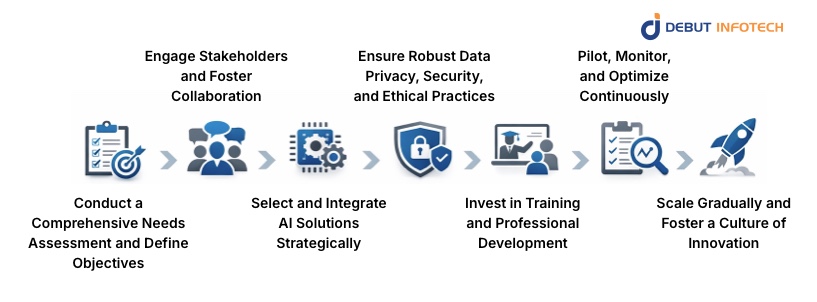
Implementing AI in education is no longer optional—it is a strategic necessity for institutions looking to enhance learning outcomes, streamline operations, and remain competitive in a rapidly evolving educational landscape. Successful AI adoption requires a holistic, structured approach that balances technological innovation, ethical considerations, and human-centered pedagogy. The following framework provides a detailed roadmap for B2B decision-makers to implement AI effectively.
1. Conduct a Comprehensive Needs Assessment and Define Objectives
Before adopting AI, institutions must evaluate their operational and educational landscape to identify specific challenges and opportunities. Key focus areas include:
- Personalizing curriculum for diverse student learning styles.
- Automating grading, attendance tracking, and administrative workflows.
- Predicting student performance to proactively address learning gaps.
- Optimizing scheduling, resource allocation, and campus operations.
Once needs are identified, clearly define measurable objectives and KPIs, such as increasing student engagement, improving retention rates, or reducing administrative processing times. Establishing concrete goals ensures that AI initiatives address real challenges and provide quantifiable outcomes rather than serving as experimental technology deployments.
2. Engage Stakeholders and Foster Collaboration
Successful AI adoption requires buy-in from educators, administrators, IT teams, students, and parents. Engagement strategies include:
- Organizing workshops and discussion forums to explain AI benefits and limitations.
- Collaborating with IT teams to ensure technical feasibility and integration support.
- Involving students and parents in pilot programs to align AI tools with learning preferences.
- Creating feedback mechanisms to continuously refine AI strategies.
Stakeholder engagement promotes trust, reduces resistance, and ensures that AI aligns with institutional goals and user expectations.
3. Select and Integrate AI Solutions Strategically
Choosing the right AI platforms is critical for long-term success. Evaluate solutions for scalability, integration capability, vendor reliability, and regulatory compliance. Core applications may include:
- Intelligent Tutoring Systems: Deliver adaptive learning experiences based on real-time student progress.
- Predictive Analytics Tools: Identify at-risk students, forecast performance trends, and optimize interventions.
- Automated Administrative Platforms: Streamline tasks like grading, admissions, scheduling, and reporting.
- AI-driven Chatbots: Provide instant support for students and staff.
Integration with existing Learning Management Systems (LMS), student information systems, and administrative software ensures smooth adoption, minimizes disruption, and maximizes return on investment.
4. Ensure Robust Data Privacy, Security, and Ethical Practices
AI implementation involves handling sensitive student and institutional data, making security and ethics essential. Key measures include:
- Encrypting data pipelines, implementing secure storage, and applying multi-level access controls.
- Complying with GDPR, FERPA, and local data protection regulations.
- Monitoring algorithms for bias, ensuring fairness and inclusivity in AI-driven decisions.
- Maintaining transparency about data usage and AI decision-making processes.
A strong focus on privacy, ethics, and compliance builds trust with students, parents, and regulatory authorities, while safeguarding institutional credibility.
5. Invest in Training and Professional Development
Educators and administrative staff are critical to the success of AI initiatives. Professional development ensures they can leverage technology effectively. This includes:
- Conducting hands-on workshops for educators on AI-assisted learning.
- Offering IT training for system integration, maintenance, and troubleshooting.
- Encouraging continuous learning to stay current with emerging AI applications.
- Providing certification programs to standardize competencies.
Investing in training fosters confidence, enables staff to maximize AI potential, and enhances operational and educational outcomes.
6. Pilot, Monitor, and Optimize Continuously
Launching AI initiatives through pilot programs allows institutions to validate effectiveness and minimize risk. Best practices include:
- Implementing AI solutions in select departments, courses, or administrative units.
- Collecting feedback from users to identify areas of improvement.
- Monitoring performance metrics, such as learning outcomes, engagement, and efficiency gains.
- Iteratively refining AI models and workflows based on data-driven insights.
Continuous evaluation ensures that AI adoption remains aligned with institutional goals and delivers measurable value over time.
7. Scale Gradually and Foster a Culture of Innovation
Once pilots demonstrate success, AI adoption can be expanded strategically across the institution. Key considerations include:
- Gradually rolling out AI tools to additional departments, campuses, or student cohorts.
- Leveraging lessons learned to improve deployment strategy, integration, and training.
- Encouraging experimentation, cross-department collaboration, and knowledge sharing.
- Recognizing and rewarding innovative uses of AI in teaching, learning, and administration.
By scaling thoughtfully and cultivating an innovation-oriented culture, institutions ensure sustainable, long-term impact while remaining adaptable to emerging technologies and evolving educational needs.
Automate Administration with Agentic AI
Streamline admissions, compliance, and reporting through intelligent automation that reduces workload and improves operational agility.
Benefits Of Integrating Agentic AI in Education
Integrating Agentic AI into education empowers institutions to enhance learning outcomes, streamline operations, and deliver personalized academic experiences. By automating routine tasks and enabling adaptive learning, AI agents help educators and administrators focus on value-driven initiatives. Key benefits include:
- Personalized Learning Experiences: AI agents tailor content, pace, and learning paths based on each student’s strengths, challenges, and preferences.
- Operational Efficiency: Automating admissions, scheduling, grading, and reporting reduces administrative overhead and enhances accuracy.
- Data-Driven Insights: Real-time analytics help educators identify at-risk students, measure engagement, and refine teaching strategies.
- Enhanced Student Engagement: Interactive and conversational AI agents foster continuous feedback, motivation, and curiosity-driven learning.
- Equitable Access: Cloud-based AI tools democratize access to quality education, bridging gaps for remote or underserved learners.
- Educator Empowerment: With administrative burdens reduced, teachers can dedicate more time to mentorship, creativity, and student development.
How Debut Infotech Can Assist You With The Implementation Of AI in Education
Adopting AI in education requires a strategic partner with technical expertise, industry insight, and the ability to deliver scalable, secure, and customized solutions. Debut Infotech helps educational institutions harness AI to enhance learning experiences, automate operations, and drive measurable outcomes. Our approach is tailored to your institution’s unique goals, infrastructure, and challenges.
1. AI Consulting and Strategy
Our AI consulting services guide institutions through every step of AI adoption:
- Assessing institutional needs and identifying areas where AI can provide tangible improvements.
- Defining clear goals, KPIs, and measurable success metrics for AI projects.
- Advising on ethical, inclusive, and regulatory-compliant AI implementation strategies.
- Creating a roadmap for phased adoption, ensuring minimal disruption and optimal ROI.
Our consulting ensures AI initiatives are strategically aligned, sustainable, and scalable.
2. AI Agent Development for Personalized Learning
We specialize in developing autonomous AI agents that personalize the learning experience:
- Providing real-time tutoring and adaptive feedback.
- Analyzing student performance to optimize learning paths.
- Assisting administrative workflows to reduce manual effort.
- Integrating seamlessly with existing LMS platforms and IT infrastructure.
AI agents enhance both teaching and operational efficiency by automating tasks while maintaining personalized student engagement.
3. Adaptive Learning Platforms
We create AI-powered platforms that tailor content delivery based on student progress and engagement:
- Enhancing engagement with personalized curriculum recommendations.
- Delivering insights into student learning patterns for targeted interventions.
- Supporting diverse learning styles and abilities for inclusive education.
- Leveraging AI to create a continuous, data-driven learning ecosystem.
These platforms ensure every learner receives a customized, effective educational experience.
4. AI-Powered Administrative Automation
Our AI solutions streamline core administrative processes, improving operational efficiency:
- Automating admissions processing, grading, and attendance tracking.
- Optimizing scheduling and resource allocation across departments and campuses.
- Generate reports and analytics automatically for faster decision-making.
- Reducing manual workload while improving accuracy and consistency.
By automating administrative tasks, institutions can focus more on pedagogy and student support.
5. Data Privacy, Security, and Compliance
Debut Infotech ensures that AI solutions are secure, ethical, and compliant:
- Implementing encrypted data pipelines and secure storage protocols.
- Adhering to GDPR, FERPA, and local regulatory standards.
- Conducting regular audits and updates to maintain data integrity.
- Ensuring transparency and fairness in AI-driven decision-making.
Robust governance builds trust with students, parents, and regulators.
6. Pilot Programs, Deployment, & Continuous Optimization
We implement AI solutions in phased, scalable approaches to ensure success:
- Designing pilot programs to validate AI effectiveness in selected departments or courses.
- Gradually scaling deployment across campuses based on insights and feedback.
- Continuous monitoring, system optimization, and updates to maintain performance.
- Encouraging innovation and knowledge sharing across faculty and administrative teams.
This structured approach ensures AI delivers measurable impact while allowing institutions to adapt and evolve.
Conclusion
Artificial Intelligence (AI) is transforming the education sector, enabling institutions to deliver personalized learning experiences, optimize administrative workflows, and uphold data security and compliance. Debut Infotech provides a comprehensive suite of AI services designed specifically for educational institutions, helping them adopt innovative technologies that drive measurable outcomes and long-term growth.
Through strategic AI consulting, our team guides institutions in identifying areas where AI can deliver tangible benefits, aligning technology adoption with institutional goals. Their AI agent development services create intelligent systems capable of adapting to individual student needs, automating administrative tasks, and providing real-time feedback, which collectively enhance operational efficiency while allowing educators to focus on high-value teaching and mentoring.
We also develop adaptive learning platforms that leverage student data to refine teaching methods, monitor engagement, and support diverse learning styles. By embedding robust security measures and ensuring regulatory compliance with standards such as GDPR and FERPA, they maintain the integrity and confidentiality of sensitive student information.
Partnering with Debut Infotech enables institutions to implement AI in a phased, scalable manner, starting with pilot programs, optimizing performance continuously, and gradually expanding across campuses. Their solutions empower institutions to not only address current educational challenges but also stay ahead of technological trends, fostering a culture of innovation, efficiency, and excellence. With our dedicated development team’s expertise, educational organizations can confidently transform their teaching, learning, and administrative capabilities, achieving a future-ready, AI-powered campus ecosystem.
Ready To Redefine Education with Agentic AI?
Empower your institution with intelligent automation, data-driven decision-making, and scalable AI solutions designed for modern academic ecosystems. Unlock new levels of efficiency, personalization, and insight.
FAQs
1. What is agentic AI in education and how does it work?
Agentic AI refers to autonomous systems capable of performing tasks, making intelligent decisions, and interacting independently in educational environments. AI agents for education provide personalized learning experiences, automate routine administrative workflows, deliver actionable insights, and help educators make data-driven decisions, enabling institutions to improve operational efficiency, student engagement, and overall academic performance at scale.
2. How can agentic AI improve student learning outcomes?
AI agents continuously analyze student performance, engagement, and comprehension patterns to deliver personalized content and real-time feedback. By applying adaptive strategies and predictive insights, these systems help students master concepts faster, retain knowledge longer, and develop critical skills. They also allow educators to identify struggling learners early and implement targeted interventions for improved outcomes.
3. What are the benefits of agentic AI for universities and schools?
Implementing digital solutions for education enables institutions to streamline administrative tasks, personalize learning pathways, reduce operational inefficiencies, and provide real-time actionable insights. Agentic AI supports resource optimization, predictive decision-making, and data-driven governance while allowing educators to focus on student engagement, curriculum enhancement, and long-term academic planning for sustainable institutional growth.
4. How do AI agents reduce administrative workload in education?
AI agents automate repetitive tasks such as grading, attendance tracking, admissions processing, scheduling, and report generation. By handling operational workflows independently, they allow administrators and educators to focus on strategic initiatives, teaching quality, student mentoring, and long-term planning, significantly improving institutional efficiency, reducing errors, and optimizing the use of resources across departments.
5. What is the cost of implementing agentic AI in schools?
The cost depends on solution complexity, integration requirements, scalability, and institutional size. Engaging a Custom AI Agent Development Company ensures cost-effective deployment, combining technology, professional consulting, and staff training. Phased adoption models and pilot projects help institutions manage expenses while delivering measurable ROI, demonstrating both operational and academic benefits from AI investment.
6. How is agentic AI different from traditional AI tools in education?
Unlike conventional AI, which mainly assists with analytics or limited automation, agentic AI operates autonomously, uses AI algorithms for decision-making, adapts to real-time educational environments, and interacts independently with students and staff. It provides dynamic personalization, predictive insights, and actionable recommendations that traditional AI tools cannot deliver, creating more impactful learning and operational outcomes.
7. What are the key use cases of agentic AI in higher education?
Agentic AI is widely applied in personalized tutoring, predictive student performance analytics, intelligent administrative automation, adaptive learning platforms, and virtual counseling. These AI tools help institutions optimize operational workflows, improve engagement, enhance learning outcomes, support student retention strategies, and provide real-time insights that inform academic planning and strategic decision-making at scale.
8. How do AI agents support personalized learning for students?
AI agents continuously monitor individual performance, engagement levels, and learning preferences to recommend tailored content, exercises, and interventions. They adjust pacing and teaching methods for each learner, ensuring students receive instruction aligned with their abilities and interests. Personalized AI-driven support enhances comprehension, retention, motivation, and overall academic achievement across diverse student populations.
9. What challenges do institutions face with agentic AI adoption?
Challenges include ensuring compliance, maintaining data privacy, mitigating algorithmic bias in AI models, integrating with legacy systems, and providing adequate staff training. Engaging AI consultants helps institutions navigate technical, ethical, and operational complexities, ensuring responsible deployment while minimizing disruption and maintaining high-quality teaching, administrative efficiency, and long-term adoption success.
10. How does agentic AI ensure data privacy in education?
AI agents use encrypted data pipelines, secure storage, and controlled access protocols to safeguard sensitive student and institutional data. Compliance with regulations like GDPR, FERPA, and other local laws is enforced, while ethical frameworks and transparent reporting maintain accountability. These measures build trust and ensure AI-driven insights remain secure and reliable.
11. Can agentic AI integrate with existing LMS or ERP systems?
Yes, modern AI agents are designed to integrate seamlessly with Learning Management Systems, Student Information Systems, and ERP platforms. IT solutions for education industry use API-based modular architecture to connect with existing software, enabling institutions to leverage AI capabilities without disrupting current workflows or requiring significant infrastructure changes, ensuring smooth adoption and operational continuity.
12. What ethical issues are linked to AI agents in education?
Ethical concerns include algorithmic bias, lack of transparency, accountability gaps, and unequal access to AI-driven resources. Institutions must define clear governance frameworks, conduct regular audits, and maintain human oversight to ensure AI agents operate fairly, inclusively, and responsibly, preventing unintended consequences while enhancing student learning and supporting institutional integrity.
13. How can AI agents predict and prevent student dropouts?
By analyzing historical academic performance, engagement patterns, and attendance data, AI agents identify at-risk students early. They trigger personalized interventions such as adaptive content, tutoring, mentorship, and resource allocation. This proactive approach improves retention rates, ensures timely support, and strengthens student outcomes while enabling administrators to make informed, data-driven decisions.
14. What infrastructure is needed to deploy agentic AI in campuses?
Successful deployment requires scalable IT infrastructure, secure storage solutions, high-speed connectivity, and trained personnel. Leveraging custom software development services ensures AI agents are fully integrated, maintainable, and scalable. Adequate training and monitoring tools allow institutions to sustain performance, ensure compliance, and adapt AI solutions as educational needs evolve.
15. Which company provides the best AI agent development for education?
Partnering with leading AI Agents Companies or hiring AI agent developers for hire ensures tailored solutions aligned with institutional goals. Experienced providers like Debut Infotech deliver end-to-end services including AI consulting, agentic AI development, deployment, and optimization, helping institutions embrace the future of AI agents while improving operational efficiency and student learning outcomes.
Talk With Our Expert
Free 30-min consultation. No commitment.
Our Related Insights


Talk With Our Expert
LET'S WORK TOGETHER
Your Vision.
Our Engineering.
Debut Infotech works as a strategic co-creator — from concept to production-ready platform. We deliver blockchain, AI, enterprise, & mobile solutions that scale.

15+ Years · 500+ Platforms Delivered
Across blockchain, AI, fintech, mobile, and enterprise verticals

NDA Signed on Day One
Your IP and project details are protected before any conversation begins

48-Hour Scoped Estimate
A real technical estimate — not a generic template or sales pitch

Dedicated Account Managers
Available across key global time zones
 +1 708-515-4004 (USA)


