



Table of Contents
Home / Use Case / AI
AI in Accounting: Strategies, Use Cases, Emerging Trends, and Future Outlook


Accounting is one of the most crucial functions in business, yet it often struggles with challenges such as manual data entry, compliance risks, error-prone reporting, and time-intensive audits. Finance teams are expected to deliver real-time insights, maintain accuracy, and meet evolving regulatory demands—all while managing increasing volumes of transactions. Traditional methods simply can’t keep pace with these pressures, creating the need for smarter, automated solutions.
This is where AI in accounting is redefining the financial landscape. AI-powered systems can process vast amounts of financial data, identify anomalies, and generate accurate reports in a fraction of the time. From handling routine bookkeeping tasks to powering predictive forecasting, these systems bring unmatched efficiency and intelligence to accounting workflows.
Leveraging technologies like machine learning, natural language processing, and predictive analytics, the top AI use cases in accounting include automated invoice processing, fraud detection, tax compliance, financial planning, and real-time auditing. These capabilities not only streamline workflows but also minimize errors and ensure transparency in financial operations.
Partnering with a Custom AI Development Company enables organizations to design tailored AI solutions that seamlessly integrate with existing ERP and accounting platforms, adapt to industry-specific compliance requirements, and provide actionable insights for better decision-making. By reducing manual workload, enhancing accuracy, and delivering real-time intelligence, AI empowers accounting teams to shift from transactional tasks to strategic business roles.
This article explores the strategies, applications, and future impact of deploying AI solutions in accounting.
Transformative Use Cases of AI in Accounting: Key Statistics and Insights
AI use cases in finance and accounting are reshaping how organizations manage risk, automate workflows, and generate strategic insights. Powered by advances in machine learning, generative models, and agents, these technologies are moving beyond basic automation to become decision companions that help finance teams scale, improve accuracy, and stay compliant. AI-driven accounting trends are prompting firms to reassess their controls, reporting, forecasting, and what constitutes “value-added” in finance roles.
Here are some key insights and statistics that highlight the adoption and business value of AI use cases in finance and accounting, particularly when organizations engage AI development services to build tailored solutions:
- According to a Deloitte poll of finance and accounting professionals, 80.5% believe that AI-powered tools like AI agents and generative AI chatbots will become standard in finance and accounting within the next five years.
- In that same survey, 42.7% of respondents said that increased efficiency and productivity are the greatest benefit from using AI in accounting/finance; among those already using agentic AI, that rises to 56.1%.
- From PwC’s “AI Agents for Finance” analysis: Up to 90% time savings can be achieved in key processes, with up to 40% improvement in forecasting accuracy and speed; plus, up to 60% of team time can be redirected toward insight work.
These trends demonstrate that organizations using AI development services, whether via internal development or with specialist vendors, are able to deploy AI systems that go beyond routine bookkeeping or transaction processing. They are transforming forecasting, compliance, financial reporting, strategic planning, and even AI powered market research to gain deeper insights and a competitive advantage.
Understanding the Role Of AI in Accounting & Finance
AI in accounting is transforming how organizations handle financial operations by automating routine tasks and providing deeper insights. Modern AI accounting software can process large volumes of transactions, detect errors, and generate accurate reports faster than traditional systems. It also helps improve compliance, ensures data consistency, and reduces the risk of human error in complex financial processes.
Many AI use cases in accounting include automated invoice processing, fraud detection, expense categorization, and predictive forecasting. These systems help finance teams save time, reduce errors, and focus on strategic decision-making. By leveraging predictive analytics, organizations can better anticipate cash flow needs, optimize budgets, and improve financial planning. AI can also provide actionable insights from historical data, helping management make informed decisions and identify cost-saving opportunities.
Partnering with a trusted AI development services provider allows companies to implement solutions tailored to their workflows, ensuring seamless integration with ERP systems and compliance requirements. Enterprise AI development projects can further scale these solutions across departments, enabling consistent, intelligent financial management at an organizational level. The adoption of AI in accounting is not just about automation; it empowers finance teams to take on a more proactive, strategic role within the organization.
The Role of AI in Accounting
- Automate repetitive accounting tasks like data entry, reconciliation, and reporting.
- Analyze financial transactions to detect anomalies and minimize errors.
- Use NLP to extract insights from unstructured data, such as invoices or contracts.
- Apply predictive analytics for forecasting and strategic planning.
- Integrate with existing ERP and accounting platforms for seamless workflow management.
- Continuously learn and improve, adapting to new patterns and organizational needs.
Reimagine Finance With Intelligent Automation
Boost efficiency in bookkeeping, forecasting, and auditing by integrating AI into your accounting workflows. Reduce costs, enhance compliance, and scale with confidence.
How Can Artificial Intelligence Be Used in Accounting?
For businesses, AI in accounting has become a strategic enabler, transforming traditional finance operations into data-driven, efficient, and scalable processes. Modern AI accounting solutions leverage advanced algorithms and AI models to analyze financial transactions, detect anomalies, and provide actionable insights, helping organizations maintain accuracy and compliance across complex operations.
Proactive Financial Analysis
AI tools go beyond basic bookkeeping by identifying patterns, highlighting risks, and providing early warnings of potential discrepancies. Using predictive analytics, finance teams can anticipate cash flow challenges, optimize working capital, and improve forecasting for product demand, enabling smarter, forward-looking decision-making.
Automated and Streamlined Workflows
Through accounting and automation, businesses can reduce manual workloads by automating tasks such as invoice processing, reconciliation, and payroll. These intelligent systems gather necessary data, validate it, and ensure adherence to regulatory standards, improving operational efficiency and minimizing human error.
Integration Across Enterprise Systems
AI agents designed for accounting can seamlessly connect with ERP systems, CRM platforms, and cloud-based finance software. This ensures a unified view of financial data across departments, delivering consistent insights and facilitating informed decision-making at every organizational level.
Intelligent Decision Support
Beyond reporting, AI can guide strategic planning by providing scenario-based analysis and forecasting. Companies can leverage these insights to make investment decisions, plan budgets, and assess market trends with greater confidence. Advanced AI models enable finance leaders to move from reactive bookkeeping to proactive strategy execution.
Data Security and Compliance
AI in accounting supports real-time compliance monitoring and safeguards sensitive financial information. Systems powered by AI data security continuously track transactions, enforce governance policies, and generate audit-ready reports, reducing risk and ensuring regulatory adherence.
Continuous Learning and Improvement
Modern AI tools evolve with each interaction and transaction, learning from historical data to improve accuracy and operational efficiency. Over time, these systems optimize workflows, refine predictive models, and allow finance teams to focus on strategic, high-value initiatives rather than routine, repetitive tasks.
What Are The Various Benefits Of AI In Accounting & Finance?
AI is revolutionizing how enterprises manage finance and accounting functions. Unlike traditional systems, AI solutions combine automation, intelligence, and predictive capabilities to create scalable, accurate, and efficient accounting workflows. By partnering with AI development services or leveraging enterprise AI development, businesses can implement tools that optimize operations, reduce risk, and free finance teams to focus on strategic decision-making.
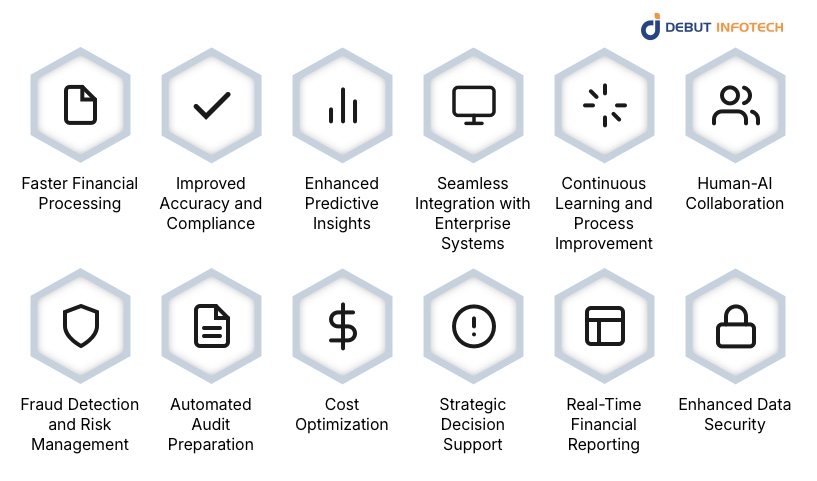
- Faster Financial Processing
AI accounting software automates routine tasks like invoice processing, expense categorization, and reconciliation. This accelerates month-end closing, ensures timely reporting, and improves overall operational efficiency.
- Improved Accuracy and Compliance
AI algorithms detect anomalies in real time and enforce regulatory compliance. Using natural language processing (NLP), AI interprets unstructured data from invoices, contracts, and emails, minimizing human errors.
- Enhanced Predictive Insights
Through predictive analytics, organizations can forecast cash flows, anticipate product demand, and optimize budgets, enabling proactive financial planning and risk mitigation.
- Seamless Integration with Enterprise Systems
AI tools for accounting integrate with ERP, CRM, and cloud accounting platforms, ensuring real-time data consolidation, consistent reporting, and smooth workflows across departments.
- Continuous Learning and Process Improvement
AI models adapt to new patterns and learn from historical transactions, improving accuracy, operational efficiency, and the quality of financial insights over time.
- Human-AI Collaboration
AI complements finance teams by handling repetitive tasks, allowing professionals to focus on strategic analysis, planning, and decision-making. AI systems provide context and actionable insights to improve collaboration and outcomes.
- Fraud Detection and Risk Management
AI algorithms monitor transactions for unusual patterns, helping organizations detect potential fraud or financial irregularities quickly, reducing exposure to financial loss.
- Automated Audit Preparation
AI systems can organize and verify financial data for audits, generating audit-ready reports with minimal manual intervention, reducing time and effort for both internal and external audits.
- Cost Optimization
By automating routine finance tasks and improving efficiency, AI helps reduce operational costs while maintaining accuracy and compliance, improving overall ROI for accounting operations.
- Strategic Decision Support
AI tools for accounting analyze historical and real-time data to provide insights on financial trends, investment opportunities, and resource allocation, enabling enterprise leaders to make informed, data-driven decisions.
- Real-Time Financial Reporting
AI accounting systems generate instant financial reports, dashboards, and KPIs, giving management immediate visibility into company performance and supporting agile business strategies.
- Enhanced Data Security
With AI data security features, sensitive financial information is continuously monitored and protected against unauthorized access, ensuring regulatory compliance and safeguarding corporate data.
Streamline Compliance Without Complexity
Stay ahead of tax laws and regulatory demands using AI-driven compliance and reporting systems designed for enterprises.
Various AI Technologies Used in Accounting and Auditing
The adoption of AI in accounting and auditing is reshaping financial operations by introducing automation, intelligence, and predictive capabilities. These technologies not only enhance accuracy but also free finance teams to focus on value-driven decision-making. Below are the leading AI technologies transforming the sector, with clear applications for enterprises:
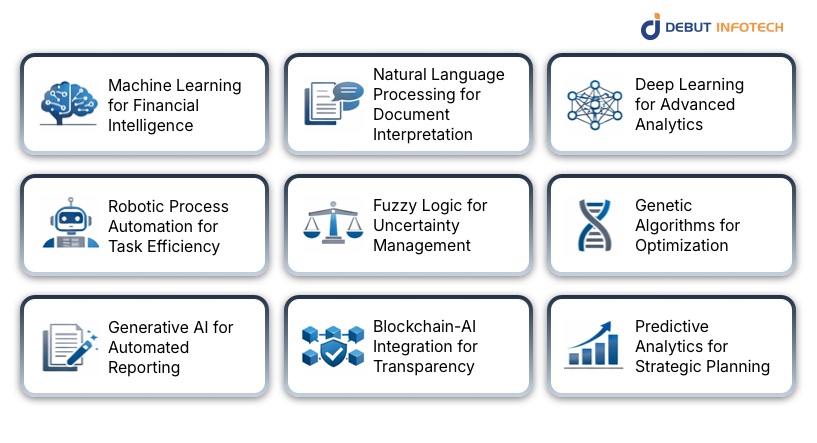
1. Machine Learning for Financial Intelligence
Machine learning enables accountants and auditors to move beyond rule-based reporting by analyzing massive datasets to uncover patterns and make predictions.
- Automated Classification of transactions into correct categories reduces manual work.
- Anomaly Detection flags unusual activity in ledgers, enhancing fraud prevention.
- Predictive Forecasting projects cash flow and revenue, supporting strategic planning.
For B2B finance leaders, ML helps strengthen oversight, improve agility, and reduce the risk of error in decision-critical reports.
2. Natural Language Processing for Document Interpretation
NLP streamlines unstructured data handling in finance, especially where compliance and documentation are heavy.
- Document Extraction pulls key details from contracts, invoices, and audit reports.
- Regulatory Compliance Review checks filings and policies for risk indicators.
- Market Sentiment Analysis supports investment strategies using external news or commentary.
This capability saves enterprises thousands of hours in document review while improving regulatory compliance.
3. Deep Learning for Advanced Analytics
Deep learning handles high-volume and complex financial data at scale.
- Fraud Detection via neural networks monitors transactions for anomalies.
- Sequential Data Analysis enhances revenue and expense forecasting with time-series modeling.
- Document Recognition converts scanned or image-based financial records into structured data.
For enterprises, deep learning ensures greater precision in compliance audits and risk assessments.
4. Robotic Process Automation for Task Efficiency
RPA bots are crucial for automating high-volume, repetitive finance processes.
- Invoice Processing ensures faster data entry and reconciliation.
- ERP Data Migration eliminates human error in transferring financial records.
- Audit Preparation automates the collation of evidence and documents.
By reducing manual effort, RPA lowers costs and enables finance teams to focus on advisory work.
5. Fuzzy Logic for Uncertainty Management
Accounting often involves ambiguity, where binary models fall short. Fuzzy logic provides nuanced, context-aware insights.
- Credit Risk Assessment blends qualitative and quantitative inputs.
- Scenario Modeling assigns probabilistic risk categories for planning.
- Decision Support enables smarter choices in uncertain financial environments.
This helps businesses evaluate risks more holistically, especially in lending and investment decisions.
6. Genetic Algorithms for Optimization
Genetic algorithms deliver enterprise-level optimization for resource allocation and strategy design.
- Portfolio Management identifies optimal investment mixes.
- Audit Testing strategies are optimized for efficiency and accuracy.
- Cost Allocation improves the utilization of financial and operational resources.
These techniques empower finance executives to achieve better ROI with data-driven optimization.
7. Generative AI for Automated Reporting
Generative AI is emerging as a powerful tool in modern finance functions.
- Report Drafting automates narrative generation for financial statements.
- Scenario Simulation creates hypothetical models for strategic planning.
- Custom Insights provide executives with tailored summaries of key financial metrics.
For enterprises, this reduces reporting cycles and enables leadership to make faster, data-informed decisions.
8. Blockchain-AI Integration for Transparency
When combined with AI, blockchain enhances trust and auditability in financial systems.
- Smart Auditing verifies transactions against immutable ledgers.
- Fraud Mitigation ensures secure validation of financial flows.
- Automated Compliance leverages blockchain records to simplify regulatory checks.
This hybrid approach provides enterprises with stronger controls, especially in industries with high compliance demands.
9. Predictive Analytics for Strategic Planning
Predictive analytics equips finance leaders with forward-looking insights for growth.
- Revenue Forecasting uses historical patterns to project sales and income.
- Expense Planning anticipates cost drivers and allocates resources effectively.
- Cash Flow Projections improve liquidity management and working capital optimization.
For enterprises, predictive analytics shifts finance from reactive reporting to proactive strategy-making.
Responsible AI in Accounting: Managing Limitations Effectively
AI is transforming accounting and auditing by improving speed, accuracy, and decision-making. Yet, these gains must be balanced with a clear understanding of its constraints. Issues such as data quality, ethical concerns, and regulatory compliance demand attention from enterprises deploying AI solutions. By recognizing limitations early and applying responsible strategies, organizations can ensure AI strengthens financial operations while maintaining trust, transparency, and professional accountability.
1. Risk of Errors and Bias
AI systems are only as reliable as the data they process. Inaccurate or biased training data can produce misleading financial reports, skewed risk assessments, and unfair recommendations. To minimize these risks, accounting teams should invest in high-quality datasets, implement bias detection frameworks, and validate outputs through continuous monitoring and professional oversight.
2. Lack of Transparency in Decision-Making
Many AI systems function as “black boxes,” making it difficult to trace how specific financial conclusions are reached. This lack of explainability can undermine trust and complicate auditing processes. Businesses should prioritize explainable AI solutions, require clear documentation, and encourage professionals to critically evaluate AI-driven outputs rather than accepting them at face value.
3. Data Privacy and Security Risks
Accounting functions involve handling sensitive information such as payroll, tax filings, and corporate records. Unauthorized access or data breaches could lead to financial loss and reputational damage. Organizations should adopt robust security protocols, including encryption, access control, and regular system audits, while also training employees on best practices for responsible data handling.
4. Overdependence on Automation
Relying too heavily on AI can result in reduced critical thinking and diminished professional judgment within finance teams. While automation improves speed, it should not replace human expertise. A balanced approach is essential, where AI systems handle repetitive tasks, and accounting professionals focus on strategic decision-making, analysis, and complex financial problem-solving.
5. Ethical Implications of AI Use
The application of AI in financial reporting and auditing raises ethical questions around fairness, integrity, and accountability. Enterprises should develop clear internal policies that define acceptable use cases, ensure transparency in client-facing outputs, and establish oversight mechanisms. Maintaining ethical standards helps protect both organizational credibility and stakeholder trust in financial practices.
6. Legal and Regulatory Uncertainty
The legal framework surrounding AI in accounting is still evolving, creating uncertainty around accountability and liability in case of system errors or misconduct. Enterprises should proactively address this by drafting clear contractual agreements, clarifying responsibilities with technology providers, and staying updated on regulatory changes to reduce exposure to legal risks.
Stay Audit-Ready at All Times
From automated reconciliations to intelligent audit trails, AI ensures accuracy and transparency across financial operations.
Practical Use Cases of AI in Modern Accounting and Auditing
Artificial intelligence is reshaping accounting and auditing by enabling firms to streamline operations, enhance accuracy, and extract deeper insights from complex financial datasets. Instead of relying solely on manual processes, businesses are adopting AI-driven solutions that automate repetitive tasks, detect anomalies, and provide predictive intelligence for strategic decision-making.
From real-time transaction classification and smart reconciliation to risk assessment and compliance monitoring, AI is making financial management more efficient and reliable. For auditors, advanced algorithms reduce the time spent on routine checks while improving fraud detection and reporting quality. By integrating these capabilities into core workflows, enterprises gain greater transparency, agility, and confidence in their financial operations while meeting evolving regulatory standards.
- Automated Data Entry and Transaction Processing
AI in accounting has completely transformed how businesses handle data-heavy operations such as bookkeeping, invoice processing, and transaction entry. Traditionally, accountants spent hours manually inputting figures, reconciling receipts, and validating entries. Today, AI accounting software can automate these processes end-to-end, reducing both time and costs.
Key Benefits:
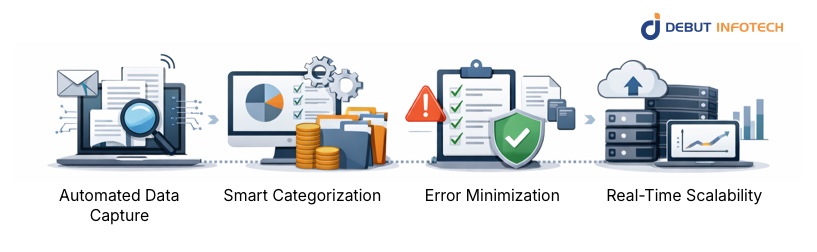
- Automated Data Capture: Reads invoices, receipts, and bank feeds with OCR and NLP.
- Smart Categorization: Automatically classifies transactions under the correct accounts.
- Error Minimization: Reduces the chances of duplicate entries or oversight.
- Real-Time Scalability: Processes thousands of records with consistent accuracy.
Real-Life Example:
Software platforms like QuickBooks and Xero integrate artificial intelligence in accounting to streamline repetitive bookkeeping tasks. They extract, validate, and sync data in real time, giving accountants clean, ready-to-use financial information.
Business Impact:
By combining accounting and automation, enterprises unlock efficiency gains, maintain compliance, and empower finance teams to focus on advisory roles rather than clerical work. This creates a solid foundation for data-driven decision-making and boosts overall financial agility.
- Fraud Detection and Prevention
Fraud continues to be a major challenge in modern accounting, making AI in accounting a critical safeguard. Unlike traditional rule-based systems, AI tools monitor vast volumes of data, spotting anomalies faster than humans ever could.
Key Capabilities:
- Anomaly Detection: Flags unusual spending behaviors or irregular entries.
- Pattern Recognition: Learns transaction trends and identifies deviations.
- Regulatory Compliance: Helps enterprises meet internal and external audit standards.
- High-Speed Oversight: Monitors global transactions instantly with accuracy.
Real-Life Example:
Financial institutions like PayPal and Mastercard leverage AI accounting software for fraud detection, scanning billions of transactions per second. This ensures real-time fraud alerts and prevents unauthorized activities before they escalate.
Business Impact:
Adopting artificial intelligence in accounting strengthens financial controls, enhances compliance, and mitigates risks. When integrated with accounting and automation, businesses significantly lower losses, improve trust with stakeholders, and maintain a secure financial ecosystem. For enterprises managing high transaction volumes, AI-driven fraud prevention is no longer optional—it’s a necessity for long-term resilience.
- Predictive Analytics for Financial Forecasting
Financial forecasting is becoming smarter and more reliable with artificial intelligence in accounting. Predictive analytics uses machine learning algorithms to anticipate revenue, expenses, and cash flow, helping businesses stay agile in volatile markets.
Key Applications:
- Revenue Forecasting: Projects future income using historical performance and market data.
- Expense Management: Predicts operational costs, improving budget allocation.
- Cash Flow Analysis: Identifies upcoming liquidity gaps for proactive action.
- Product Demand Forecasting: Helps align financial strategies with customer demand cycles.
Real-Life Example:
Companies like Unilever and Coca-Cola deploy AI accounting software to forecast sales demand and optimize production. By linking financial insights with market behavior, they avoid overstocking or underproduction.
Business Impact:
When enterprises integrate predictive analytics with accounting and automation, they gain agility, minimize risks, and optimize capital usage. Accurate forecasting enables leadership to make better strategic decisions, improve investor confidence, and maintain long-term growth. Predictive AI accounting empowers businesses to move from reactive planning to proactive financial management.
- Risk Assessment
Modern enterprises face complex financial uncertainties, making AI for risk management essential in accounting. AI-powered tools can evaluate exposure by analyzing diverse datasets ranging from historical performance to external market variables. This allows businesses to mitigate threats before they escalate.
Key Capabilities:
- Early Risk Detection: Identifies potential defaults, liquidity gaps, or regulatory risks.
- Scenario Modeling: Simulates “what-if” cases to evaluate financial outcomes.
- Continuous Monitoring: Tracks real-time market shifts that may impact business stability.
- Data-Driven Insights: Uses advanced data analysis techniques for accurate projections.
Real-Life Example:
Banks and financial firms rely on AI tools for risk management to evaluate creditworthiness and forecast default probabilities. JPMorgan Chase, for instance, uses machine learning to enhance portfolio risk assessments.
Business Impact:
With AI-powered productivity tools, finance leaders can proactively align strategies, reduce uncertainty, and strengthen compliance. These applications of artificial intelligence not only safeguard assets but also build resilience against sudden market disruptions, enabling sustainable long-term growth.
- Data Analytics for Auditing
Auditing is traditionally labor-intensive, but engineering applications of artificial intelligence have transformed it into a faster, more precise discipline. AI-driven auditing systems leverage advanced data analysis techniques to evaluate transactions, detect anomalies, and ensure compliance.
Key Applications:
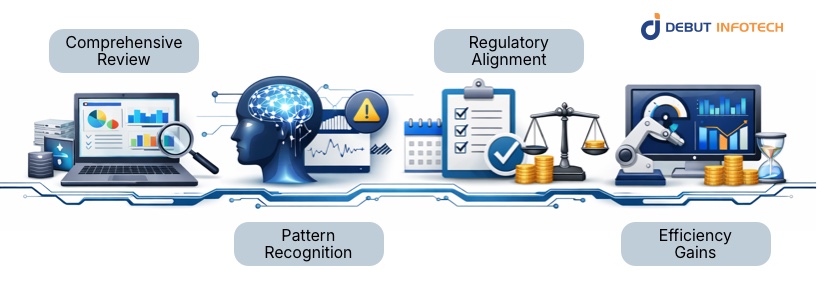
- Comprehensive Review: Analyzes all transactions, not just samples.
- Pattern Recognition: Identifies unusual or suspicious activity quickly.
- Regulatory Alignment: Ensures adherence to accounting and tax laws.
- Efficiency Gains: Reduces manual oversight, saving time and costs.
Real-Life Example:
Deloitte and KPMG deploy AI-powered tools to perform continuous auditing. These systems evaluate millions of entries simultaneously, giving auditors deeper visibility into financial processes.
Business Impact:
By adopting applications of artificial intelligence in auditing, enterprises achieve higher accuracy, faster turnaround, and improved compliance reporting. This approach strengthens governance while minimizing risks, positioning AI as a cornerstone of future-ready audit practices.
- Automation of Reconciliation
Financial reconciliation often consumes hours of manual effort, but AI-powered productivity tools simplify the process by automating data matching and error detection. These systems align internal records with external statements in real time.
Key Benefits:
- Transaction Matching: Automatically aligns ledgers with bank feeds.
- Error Reduction: Detects mismatched entries or missing records instantly.
- Scalability: Handles high transaction volumes without delays.
- Real-Time Monitoring: Provides continuous oversight of account balances.
Real-Life Example:
Global enterprises using BlackLine integrate AI-powered tools for reconciliation, drastically reducing close-cycle times while maintaining accuracy.
Business Impact:
When paired with AI for risk management, reconciliation automation strengthens financial integrity, minimizes human error, and accelerates reporting cycles. These applications of artificial intelligence ensure businesses maintain compliance, avoid penalties, and free accounting staff for more strategic work. Reconciliation shifts from being a bottleneck to a streamlined, insight-driven process.
- Tax Compliance and Optimization
Tax regulations are complex and constantly evolving, making AI in tax compliance a powerful ally for businesses. By leveraging machine learning and Natural Language Processing (NLP), enterprises can automatically analyze tax codes, identify applicable deductions, and ensure adherence to international regulations. This reduces the risk of errors, lowers penalty exposure, and improves overall financial efficiency across global operations.
Key Capabilities:
- Automated Compliance Checks: AI systems scan tax filings to flag inconsistencies.
- Optimization Opportunities: Identifies tax-saving strategies through real-time data analysis.
- Regulatory Updates: Tracks changing tax laws across jurisdictions.
- Data Accuracy: Ensures filings are precise and audit-ready.
Real-Life Example:
PwC has developed AI-driven tax solutions that use NLP to interpret regulatory changes quickly, ensuring corporate clients stay compliant and competitive.
Business Impact:
With AI in tax compliance, organizations reduce manual workloads, lower audit risks, and unlock hidden tax-saving opportunities. Finance leaders gain agility, compliance confidence, and the ability to proactively adapt, making tax departments strategic partners rather than simple reporting units.
- Financial Reporting and Visualization
Enterprises require transparent, timely reports to guide decision-making. With AI and financial reporting, organizations streamline report generation and gain deeper insights into performance. An AI financial report generator automates complex reporting workflows, while AI data visualization tools transform numbers into interactive dashboards, offering stakeholders a clearer and more engaging perspective.
Key Capabilities:
- Automated Report Generation: Produces structured reports from raw financial data.
- Advanced Visualization: Uses AI data visualization to present insights in charts and graphs.
- Error Minimization: Ensures higher accuracy by reducing manual intervention.
- Dynamic Analysis: Adjusts reports in real time based on new inputs.
Real-Life Example:
Companies like Oracle and SAP integrate AI tools for financial reporting to automate monthly close, reduce bottlenecks, and deliver instant performance insights.
Business Impact:
By adopting AI financial reporting systems, organizations achieve faster turnaround, better transparency, and improved communication with investors. Combining AI financial report generator platforms with intelligent visualization creates actionable insights that drive confident decision-making, ensuring reporting becomes a growth enabler rather than just a compliance requirement.
Shape the Future of Your Finance Function
Partner with AI development experts to design custom solutions that modernize accounting and deliver long-term value.
- Audit Sampling Optimization
Traditional audits rely on sample-based testing, which may miss irregularities or critical risks. With applications of artificial intelligence, auditors can move beyond limited sampling and analyze full datasets at scale. AI tools for financial reporting combined with anomaly detection models enable highly targeted, risk-adjusted audit sampling strategies.
Key Capabilities:
- Risk-Based Sampling: Focuses on high-risk transactions instead of random selections.
- Full Dataset Analysis: Examines 100% of financial entries where needed.
- Pattern Recognition: Identifies unusual or suspicious activity.
- Efficiency Gains: Reduces manual testing time while improving audit quality.
Real-Life Example:
KPMG employs Natural Language Processing (NLP) and machine learning models to enhance audit sampling, ensuring auditors concentrate efforts on areas with the greatest risk exposure.
Business Impact:
By integrating AI and financial reporting, auditors achieve stronger confidence levels while reducing time and costs. Optimized audit sampling improves compliance, strengthens trust with stakeholders, and minimizes audit fatigue, making it one of the most practical and impactful applications of artificial intelligence in accounting and assurance services.
- Financial Planning and Advisory Services
Financial planning has evolved from static reporting into a proactive, insight-driven function. With AI for financial planning, companies are adopting machine learning development techniques to model cash flows, optimize investments, and align resources with business goals. Advanced AI financial planning software transforms large datasets into actionable insights, allowing CFOs and advisory firms to make informed decisions faster.
Key Capabilities:
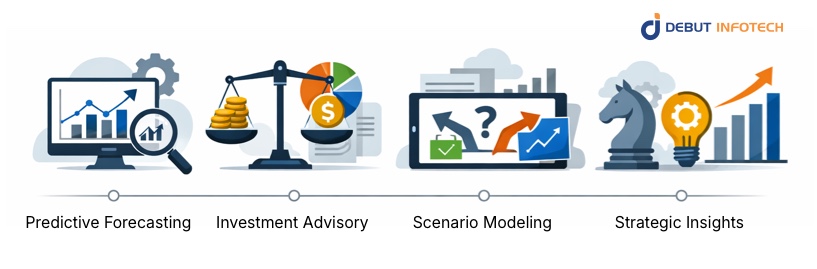
- Predictive Forecasting: Uses machine learning techniques for accurate revenue and expense projections.
- Investment Advisory: Balances risk-return trade-offs for portfolio optimization.
- Scenario Modeling: Tests multiple market or operational conditions.
- Strategic Insights: Guides cost management and growth planning.
Real-Life Example:
Deloitte leverages AI financial planning software to help global clients run scenario-based forecasting, while Betterment uses AI for financial planning to provide hyper-personalized robo-advisory services to investors.
Business Impact:
By using AI for financial planning, enterprises gain agility, proactive insights, and smarter decision-making. Planning becomes a driver of growth, not just a compliance task.
- Regulatory Compliance
In financial services, compliance failures result in heavy fines and reputational harm. AI for regulatory compliance enables enterprises to manage evolving rules, detect risks, and maintain audit readiness. By integrating AI with reporting workflows, firms strengthen governance while reducing manual overhead.
Key Capabilities:
- Automated Monitoring: Scans global regulatory updates in real time.
- Risk Detection: Flags compliance gaps before audits occur.
- Smart Document Review: Uses applications of artificial intelligence to interpret filings.
- Audit Preparedness: Generates compliance-ready reports for regulators.
Real-Life Example:
HSBC applies AI for regulatory compliance to monitor global anti-money laundering (AML) regulations, while PwC uses AI-driven tools to assess client reports for alignment with financial conduct standards.
Business Impact:
Organizations implementing AI in compliance minimize financial risk and ensure trust. With real-time monitoring and AI-powered audits, compliance shifts from being reactive to a proactive assurance function.
- Continuous Monitoring
Accounting and auditing demand constant oversight, not just periodic reviews. Continuous monitoring with AI systems ensure ongoing visibility into financial data, reducing fraud and operational risks. By applying automation and anomaly detection, enterprises establish real-time control over reporting and transactions.
Key Capabilities:
- Real-Time Alerts: Detects suspicious transactions instantly.
- Fraud Prevention: Identifies hidden anomalies within massive datasets.
- Control Validation: Monitors compliance with governance frameworks.
- Security Oversight: Leverages AI-based continuous security monitoring for financial data protection.
Real-Life Example:
Ernst & Young (EY) deploys AI systems to track high-volume financial transactions, while Mastercard uses AI-based continuous security monitoring to prevent fraud in global payment networks.
Business Impact:
With continuous monitoring, enterprises transition from periodic audits to constant assurance. AI-driven systems deliver accuracy, efficiency, and trust, enhancing financial resilience and safeguarding stakeholder interests.
- Automated Data Entry and Bookkeeping
Managing financial records manually is tedious and prone to costly errors. AI-based accounting software eliminates inefficiencies by automating data entry, reconciliation, and ledger updates. Intelligent AI bookkeeping software reduces time spent on transactional activities and ensures accurate reporting.
Key Capabilities:
- Smart Data Capture: Uses advanced optical character recognition (OCR) to scan receipts, bills, and statements instantly.
- Intelligent Categorization: Employs advanced machine learning algorithms to classify transactions correctly.
- Error Reduction: Cross-checks entries against historical data for accuracy.
- Scalable Solutions: Designed for both startups and growing enterprises.
Real-Life Example:
QuickBooks Online offers AI bookkeeping features that automate bank reconciliations, while Xero uses AI-powered systems for seamless expense categorization. Both platforms show how digital-first solutions empower accountants to focus on advisory roles.
Business Impact:
By leveraging accounting software services from trusted companies, businesses reduce operational overhead, maintain compliance, and accelerate financial closing cycles. Automated bookkeeping increases reliability, boosts productivity, and positions finance teams as strategic contributors rather than record keepers.
- Invoice Processing
Invoice workflows traditionally demand heavy manual effort and often suffer from bottlenecks. With AI invoice processing and automation, organizations accelerate accounts payable operations while reducing fraud and duplicate entries.
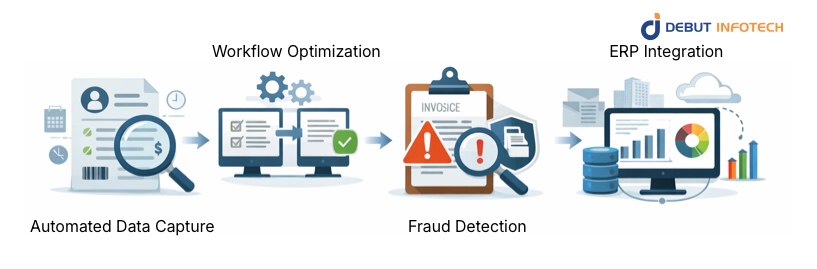
Key Capabilities:
- Automated Data Capture: Extracts supplier names, payment terms, and invoice amounts with unmatched accuracy.
- Workflow Optimization: AI invoice management software routes approvals through intelligent rules.
- Fraud Detection: Identifies suspicious or duplicate invoices before payment.
- ERP Integration: Updates ledgers instantly, improving visibility across finance teams.
Real-Life Example:
SAP Concur enables global businesses to automate AI in accounts payable, while Tipalti provides AI invoice management software that simplifies cross-border supplier payments. These solutions reduce manual workloads and improve vendor relationships.
Business Impact:
Implementing AI-powered systems for invoices enhances transparency, strengthens compliance, and supports real-time decision-making. Finance departments adopting this approach benefit from faster processing times, cost savings, and improved cash flow predictability, ultimately boosting financial agility.
- Expense Management
Expense reporting is often one of the most time-consuming aspects of finance. Intelligent AI-powered expense management software transforms outdated processes by automating submissions, approvals, and reporting. This approach allows finance leaders to gain greater visibility into spending while ensuring strict compliance.
Key Capabilities:
- Receipt Scanning: Employees upload images, which are read and categorized instantly.
- Policy Enforcement: Detects non-compliant claims using built-in rule engines.
- Fraud Detection: Identifies abnormal expense patterns.
- Insightful Reporting: Links seamlessly with AI financial reporting tools for strategic analysis.
Real-Life Example:
Expensify automates approvals with AI expense management capabilities, while Zoho Expense offers intelligent reporting features that optimize employee reimbursements. Both demonstrate how technology streamlines workflows at scale.
Business Impact:
Adopting AI for accounting in expense management reduces administrative costs, improves employee satisfaction, and enhances compliance. The resulting visibility into company-wide spending enables CFOs to allocate resources effectively, cut waste, and strengthen financial governance, driving smarter business growth.
- Audit Trail Analysis
Maintaining a clear and reliable audit trail is critical for compliance, fraud prevention, and accurate financial reporting. Modern AI-powered automated accounting software helps finance teams track all transactions in real time, flagging anomalies and ensuring full traceability. By eliminating manual review of entries, organizations reduce errors and strengthen internal controls, while enhancing accountability across all accounting processes.
Key Capabilities:
- Comprehensive Tracking: Monitors every transaction from initiation to reconciliation.
- Anomaly Detection: Uses intelligent algorithms to identify unusual patterns or suspicious activity.
- Regulatory Compliance: Provides timestamped records for audits and ensures adherence to reporting standards.
- Actionable Insights: Generates analytics for management and auditors to make informed decisions.
Real-Life Example:
KPMG deploys AI-driven audit trail monitoring for enterprise clients, while Oracle’s financial platform leverages intelligent systems to detect discrepancies and improve audit efficiency.
Business Impact:
With guidance from AI Consultants, enterprises using accounting software services can streamline audits, reduce operational workload, and improve transparency. The result is enhanced trust with stakeholders, faster audit cycles, and more strategic finance operations.
- AI-powered Chatbots
Intelligent AI chatbots are revolutionizing accounting communications by automating routine queries and providing instant support to internal teams and clients. AI-powered accounting platforms integrate chat interfaces that deliver real-time responses, allowing finance staff to focus on high-value strategic tasks while improving overall operational efficiency.
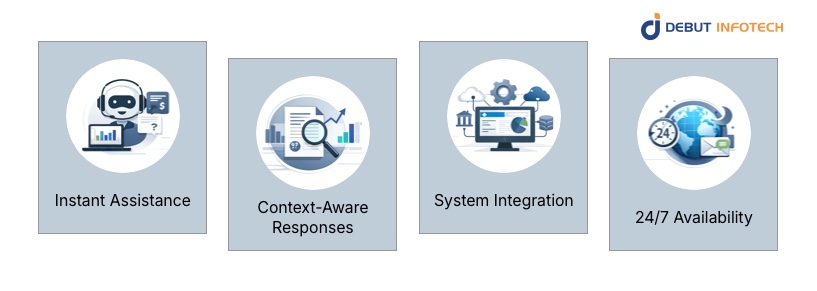
Key Capabilities:
- Instant Assistance: Resolves questions about invoices, payments, or account balances promptly.
- Context-Aware Responses: Offers recommendations based on historical data and prior transactions.
- System Integration: Connects seamlessly with enterprise financial platforms for up-to-date information.
- 24/7 Availability: Ensures round-the-clock support across time zones for global operations.
Real-Life Example:
QuickBooks uses AI-powered chatbots to guide small business users through bookkeeping and tax tasks, while Sage Intacct provides internal finance teams with conversational AI for faster issue resolution.
Business Impact:
By partnering with the best AI development firm, organizations deploying chatbots through accounting software services enhance productivity, reduce response times, and improve client and employee satisfaction. These intelligent tools make finance operations more agile, proactive, and data-driven.
Reduce Risks, Improve Decision-Making
Adopt AI-powered risk management solutions to detect anomalies, assess credit, and strengthen financial governance.
- Contract Analysis
Contracts contain critical financial obligations and compliance clauses, but manual review is time-consuming and error-prone. AI-powered contract analysis tools help finance and legal teams extract relevant terms, identify risks, and ensure adherence to agreements, reducing errors and accelerating decision-making.
Key Capabilities:
- Automated Clause Extraction: Scans contracts to highlight key clauses such as payment terms, renewal dates, and penalties.
- Risk Identification: Uses intelligent algorithms to flag non-compliant or high-risk clauses.
- Integration with Accounting Systems: Connects with financial platforms to update obligations, ensuring accurate reporting.
- Enhanced Review Efficiency: Reduces manual effort while improving accuracy and compliance.
Real-Life Example:
Companies like Kira Systems and LawGeex employ AI-based software to automate contract review for enterprise clients, allowing accounting teams to focus on strategic tasks.
Business Impact:
By getting AI consulting services from renowned companies, organizations can improve compliance, accelerate contract processing, and mitigate financial and legal risks. Integrating AI-powered accounting software for contract analysis enhances productivity and strengthens governance in financial operations.
- Payroll Management
Processing payroll accurately and on time is a critical function for organizations. AI-powered payroll platforms streamline calculations, tax deductions, benefits, and compliance, reducing errors and administrative workload.
Key Capabilities:
- Automated Salary Calculations: Accounts for hours worked, overtime, bonuses, and deductions.
- Tax Compliance: Ensures adherence to local regulations with AI-driven guidance.
- Integration with HR and Finance: Syncs payroll with accounting ledgers for accurate reporting.
- Fraud Prevention: Detects anomalies like duplicate or incorrect payments.
Real-Life Example:
ADP and Gusto leverage AI-powered payroll solutions to automate complex payroll processes for businesses globally, enhancing speed and accuracy.
Business Impact:
With the assistance of AI development agencies, organizations implementing AI-based accounting software for payroll management improve accuracy, reduce operational costs, and ensure timely employee payments. AI-driven payroll platforms provide finance teams with actionable insights for better workforce and financial planning.
- Revenue Recognition
Revenue recognition is complex, especially for organizations with subscription models, multi-element contracts, or global operations. AI-powered financial platforms help automate revenue classification, timing, and reporting, ensuring compliance with accounting standards.
Key Capabilities:
- Automated Classification: Recognizes revenue streams according to GAAP or IFRS rules.
- Predictive Analysis: Forecasts revenue based on historical contracts, subscriptions, and trends.
- Audit-Ready Reporting: Generates accurate, traceable revenue reports for auditors and regulators.
- Integration with Accounting Systems: Syncs revenue entries with ledgers, improving accuracy and efficiency.
Real-Life Example:
Zuora Revenue leverages AI-powered systems to automate complex revenue recognition for subscription-based companies, while NetSuite uses intelligent algorithms to streamline compliance reporting.
Business Impact:
Partnering with one of the best AI development companies like Debut Infotech enables businesses to adopt AI-based accounting software that reduces errors, ensures regulatory compliance, and accelerates financial reporting cycles. AI-driven revenue recognition allows finance teams to focus on analysis and strategic growth rather than manual reconciliation.
Best Practices for Implementing AI in Accounting and Auditing
Adopting AI in accounting is not just about implementing new technology; it is about reshaping financial operations to improve efficiency, ensure compliance, and enhance decision-making. Enterprises that follow structured best practices are better equipped to realize measurable outcomes such as higher accuracy in reporting, stronger fraud detection, and streamlined audits. A strategic approach ensures long-term value creation while minimizing risks during AI adoption.
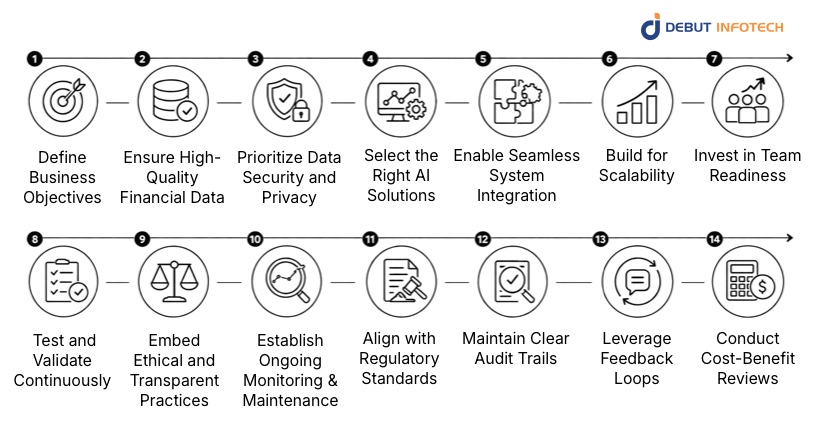
1. Define Business Objectives
AI projects succeed when aligned with strategic goals. Enterprises should begin by identifying measurable outcomes such as improving forecasting accuracy, reducing reconciliation errors, or automating audit preparation. Clearly defined objectives ensure that AI initiatives stay focused on solving business-critical challenges rather than becoming experimental or misaligned with long-term finance strategies.
2. Ensure High-Quality Financial Data
The accuracy of AI models depends on the quality of the underlying data. Businesses should implement strong governance practices such as data cleansing, validation, and normalization. Structured and accurate datasets reduce reporting discrepancies, enhance compliance, and enable AI tools to produce reliable forecasts and analyses that auditors and executives can trust for informed financial decisions.
3. Prioritize Data Security and Privacy
Handling sensitive financial information requires a focus on data security and regulatory compliance. Organizations should adopt encryption, multifactor authentication, and role-based access to safeguard records. Strong security controls not only prevent breaches but also strengthen stakeholder confidence, ensuring that AI systems operate within strict privacy requirements and meet regional financial regulations.
4. Select the Right AI Solutions
Enterprises should carefully evaluate whether ready-to-use AI software or custom-built solutions suit their needs. Selection must consider integration capabilities, industry regulations, and organizational scale. Choosing the right tool helps avoid implementation delays, reduces compatibility issues, and ensures that AI systems provide measurable improvements in efficiency, transparency, and decision-making across accounting functions.
5. Enable Seamless System Integration
AI tools deliver maximum value when they connect seamlessly with existing ERP, payroll, and auditing platforms. Enterprises should prioritize solutions that integrate easily with core finance systems to prevent silos. Unified workflows enable real-time updates, reduce manual errors, and create a single source of truth, allowing decision-makers to access accurate financial insights instantly.
6. Build for Scalability
Financial data and compliance demands grow as businesses expand. AI solutions must be capable of handling increased data volumes, multi-jurisdictional requirements, and complex reporting structures. Scalable systems ensure consistent performance without bottlenecks, enabling enterprises to maintain operational efficiency and regulatory compliance while supporting continuous growth across multiple markets and business units.
7. Invest in Team Readiness
The success of AI in accounting depends on the people using it. Organizations should invest in training programs to help finance teams understand AI-driven processes and adapt to new workflows. Empowering employees with technical and analytical skills not only builds confidence but also accelerates adoption, creating a culture where AI enhances productivity and collaboration.
8. Test and Validate Continuously
AI models require ongoing validation to maintain accuracy and reliability. Enterprises should conduct regular testing to identify errors, refine algorithms, and ensure consistent outcomes. This practice prevents faulty predictions from influencing reports, safeguards audit quality, and reinforces confidence in AI-enabled accounting by keeping models aligned with evolving financial standards and business realities.
9. Embed Ethical and Transparent Practices
Transparency in AI decision-making is essential for building trust among stakeholders. Enterprises should prioritize explainability in AI outputs, making sure financial reports and recommendations can be justified. Addressing bias, ensuring fairness, and embedding accountability into AI use not only meet ethical standards but also strengthen long-term credibility in financial decision-making and auditing.
10. Establish Ongoing Monitoring and Maintenance
AI in finance is not a one-time deployment but a continuous process. Enterprises should monitor performance metrics, track accuracy levels, and update models as regulations or data patterns change. Regular maintenance ensures sustained system efficiency, minimizes downtime, and enables organizations to keep pace with technological advancements while preserving compliance with accounting standards.
11. Align with Regulatory Standards
Accounting and auditing operate in heavily regulated environments, making compliance a top priority. Organizations should design AI systems that adapt to international accounting standards and evolving local requirements. Proactive alignment prevents penalties, reduces compliance risks, and ensures that financial reporting and audits meet both legal obligations and stakeholder expectations across diverse markets.
12. Maintain Clear Audit Trails
AI-driven financial processes must remain accountable and traceable. Enterprises should implement audit trails that capture every system input, decision, and output. These detailed logs enhance transparency, support external reviews, and simplify compliance reporting. Maintaining records of AI-driven actions helps auditors validate processes while giving leadership the confidence to rely on AI-assisted accounting insights.
13. Leverage Feedback Loops
Continuous improvement is key to long-term success with AI. Enterprises should establish structured feedback loops that capture user input and system performance data. This feedback helps refine models, adapt workflows, and correct errors quickly. By integrating business insights into AI learning cycles, organizations enhance accuracy, strengthen reliability, and align AI systems with evolving financial needs.
14. Conduct Cost-Benefit Reviews
AI implementations should be assessed regularly to measure performance against costs. Enterprises must evaluate factors such as efficiency gains, compliance improvements, and return on investment. Ongoing cost-benefit analysis ensures resources are allocated effectively and prevents overspending on underperforming tools. This practice enables finance leaders to adapt strategies and optimize AI adoption over time.
Ready to Transform Your Accounting with AI?
Adopt advanced AI solutions for forecasting, compliance, and financial intelligence. Future-proof your enterprise with smarter, faster, and more accurate accounting.
Future Outlook of AI in Accounting and Finance
Accounting and finance are undergoing a transformative shift as AI moves beyond routine bookkeeping and data entry. Intelligent systems are now capable of analyzing vast datasets, predicting financial trends, and automating complex workflows, enabling finance teams to focus on strategic decision-making. The following developments highlight how AI in accounting and finance is evolving into a critical business advantage for enterprises globally.
- Predictive and Prescriptive Financial Planning
AI models are advancing to forecast cash flows, revenue, and market trends with high accuracy. By using predictive analytics, finance teams can make proactive decisions, optimize budgets, and plan for future uncertainties, improving organizational agility.
- Automated Compliance and Regulatory Monitoring
Next-generation AI systems continuously scan transactions, contracts, and filings to ensure adherence to tax regulations and financial standards. Automated alerts and audit-ready records reduce human error, streamline compliance, and mitigate regulatory risks.
- AI-Augmented Advisory Services
Intelligent platforms now assist CFOs and finance managers by suggesting investment strategies, cost optimization opportunities, and risk mitigation approaches. These AI copilots provide actionable insights, transforming advisory functions into data-driven decision engines.
- Advanced Fraud Detection and Risk Management
Machine learning algorithms detect unusual patterns and potential fraud in real time. By continuously analyzing transactional data, AI empowers finance teams to prevent financial losses and improve internal controls without disrupting daily operations.
- Enhanced Financial Reporting and Visualization
AI-powered reporting tools automatically consolidate and visualize financial data, making complex metrics accessible and actionable. Dynamic dashboards, anomaly alerts, and predictive insights help management make informed decisions faster.
- Intelligent Automation of Repetitive Processes
Routine tasks such as invoice processing, reconciliation, and payroll management are increasingly handled by AI systems. This reduces manual workload, improves accuracy, and allows teams to allocate resources to higher-value strategic initiatives.
- Self-Learning and Adaptive AI Frameworks
Modern AI platforms continuously evolve by learning from new financial data and business scenarios. Over time, these systems refine predictive models, optimize workflows, and enhance decision-making, enabling scalable and sustainable finance operations.
At Debut Infotech, we help enterprises harness these emerging AI capabilities through Adaptive AI development to future-proof finance functions. From predictive analytics and automated compliance to intelligent reporting and fraud prevention, our solutions enable organizations to drive efficiency, strategic insight, and measurable business growth in a rapidly evolving financial landscape.
Conclusion
AI is reshaping accounting and finance by moving beyond routine tasks to become a strategic enabler for enterprises. From automated bookkeeping and invoice processing to advanced predictive analytics and risk assessment, AI-powered systems are transforming how finance teams operate. Businesses can now achieve higher accuracy, faster processing, and improved compliance while freeing human resources for strategic decision-making.
The integration of machine learning, natural language processing, robotic process automation, and AI-powered reporting tools allows organizations to extract actionable insights from vast datasets, optimize workflows, and proactively manage risk. Applications such as automated revenue recognition, contract analysis, payroll management, and expense tracking demonstrate the breadth of AI’s impact across financial functions.
Looking ahead, AI in accounting will continue evolving toward predictive, adaptive, and autonomous capabilities. Self-learning models, AI copilots for financial planning, and intelligent compliance monitoring will enable enterprises to anticipate challenges, optimize financial performance, and make data-driven decisions with confidence.
Partnering with an AI development company ensures organizations can deploy tailored solutions that align with their operational goals. By embracing AI responsibly, enterprises not only enhance efficiency and accuracy but also unlock new opportunities for growth, innovation, and competitive advantage in the rapidly changing financial landscape.
FAQs
Q. What Is The Best AI Accounting Software For Taxes?
A. The best AI accounting software for taxes depends on your business size, industry, and reporting requirements. Leading solutions like Avalara, Vertex, and Thomson Reuters ONESOURCE leverage AI to automate tax calculations, manage multi-jurisdiction compliance, and optimize filing processes. These platforms integrate with ERP systems and provide real-time updates for changing regulations, reducing errors and improving efficiency. Choosing the right software involves evaluating features, scalability, and the ability to customize workflows according to your organization’s tax strategy.
Q. Will AI Replace Accountants?
A. AI is not designed to replace accountants but to augment their capabilities. AI handles repetitive, rule-based tasks such as data entry, reconciliations, and basic reporting, allowing finance teams to focus on high-value activities like analysis, strategy, and advisory services. Accountants using AI, with ChatGPT integration, can deliver faster insights, reduce errors, and improve decision-making. In B2B environments, AI acts as a productivity tool, creating a collaborative model where human expertise and AI automation complement each other rather than compete.
Q. How can accountants prepare for an AI-driven future?
A. Accountants should focus on developing analytical, strategic, and technology skills. Learning to work with AI-powered systems, understanding machine learning insights, and mastering financial analytics tools are critical. Upskilling in areas like predictive forecasting, AI-driven compliance checks, and automated reporting enables accountants to leverage AI for efficiency and advisory roles. Continuous learning, staying updated on AI trends, and collaborating with AI consultants ensure accountants remain indispensable in an AI-enhanced finance ecosystem.
Q. How can AI automate complex reconciliation processes efficiently?
A. AI-powered systems streamline reconciliation by automatically matching transactions across multiple accounts, identifying discrepancies, and flagging exceptions. Advanced machine learning algorithms reduce manual intervention, shorten cycle times, and enhance accuracy. Finance teams can focus on resolving exceptions rather than routine matching, improving productivity and ensuring error-free accounting operations.
Q. What is the timeline for implementing AI forecasting?
A. The timeline varies depending on data quality, scope, and customization needs. Small-scale AI forecasting can be deployed in 6–8 weeks, while enterprise-level solutions may take 4–6 months. Initial setup includes data integration, data engineering, model training, and testing. Additionally, configuring dashboards, validating historical data, and aligning the system with existing financial processes may require extra time. Continuous learning ensures forecasts improve over time, supporting proactive decision-making in finance teams and helping organizations respond quickly to market changes.
Q. Can AI handle multi-entity global financial reporting?
A. Yes, AI tools can consolidate data from multiple subsidiaries, currencies, and jurisdictions. They automate intercompany eliminations, compliance checks, and reporting formats. By leveraging AI-powered reporting software, organizations ensure consistent, accurate financial statements, reduce manual consolidation efforts, and maintain compliance with local and international accounting standards.
Q. How much customization is required for AI bookkeeping software?
A. Customization depends on the complexity of financial processes, ERP systems, and industry regulations. AI bookkeeping software can be tailored for specific transaction types, a chart of accounts, and reporting requirements. When you hire AI developers for your project from experienced companies, it ensures the solution aligns with operational workflows while maintaining scalability and compliance.
Q. Which AI algorithms best detect fraud in accounting?
A. Machine learning techniques such as anomaly detection, clustering, and supervised classification are widely used. These algorithms analyze historical transactions, identify unusual patterns, and flag suspicious activity. Advanced AI systems continuously learn from new data, improving detection accuracy and reducing false positives, which strengthens internal controls and fraud prevention.
Q. How do AI expense management systems integrate with ERP?
A. AI-powered expense management software can connect with ERP platforms via APIs or middleware. Key benefits include:
– Automated data synchronization
– Streamlined approval workflows
– Real-time reporting and analytics
Seamless integration reduces manual entry errors, accelerates reimbursement processes, and ensures consistent financial records across all systems.
Q. What are the hidden costs of adopting AI in finance?
A. Beyond licensing and development fees, adopting AI in finance can involve several often-overlooked expenses. These include extensive data cleaning, preparation, and validation, system integration with existing ERP or accounting platforms, staff training, and ongoing maintenance. Businesses should also account for periodic model retraining, cloud infrastructure costs, cybersecurity measures, and monitoring AI performance to ensure accuracy. Additional considerations may include consulting fees, software updates, and change management efforts. Careful planning, a phased implementation approach, and realistic budgeting help mitigate unexpected expenses while ensuring maximum ROI and long-term value from AI investments.
Q. Can AI manage multi-jurisdiction tax compliance automatically?
A. AI systems equipped with natural language processing and rule-based algorithms can track tax regulations across multiple jurisdictions and continuously adapt to updates. Using AI as a service, organizations can automatically calculate liabilities, generate reports, and flag compliance risks while maintaining detailed audit trails for regulatory purposes. Although human oversight is still required for complex or exceptional cases, AI significantly reduces errors, speeds up tax management, and allows finance teams to focus on strategic planning and minimizing exposure to penalties.
Q. How do AI models adapt to changing reporting standards?
A. Modern AI frameworks, including LLM models, are designed to learn continuously from updated datasets, accounting rules, and evolving industry standards. By incorporating regulatory changes into model training, AI systems automatically adjust calculations, reporting formats, and compliance checks. This minimizes the need for manual intervention, ensures accurate financial reporting, and enhances audit readiness. Additionally, AI models can provide predictive insights, highlight anomalies, and support finance teams in staying ahead of regulatory updates efficiently.
Q. Which KPIs measure ROI for AI in accounting?
A. Common KPIs include processing time reduction, error rate decrease, cost savings, reconciliation cycle improvements, and employee productivity gains. Tracking forecast accuracy, audit efficiency, compliance adherence, and reduction in manual intervention also helps quantify the financial and operational benefits of AI adoption. Additionally, monitoring the speed of report generation, the quality of insights provided, and the level of automation achieved can provide a more comprehensive view of the return on investment and overall impact of AI on accounting operations.
Talk With Our Expert
Free 30-min consultation. No commitment.
Our Related Insights


Talk With Our Expert
LET'S WORK TOGETHER
Your Vision.
Our Engineering.
Debut Infotech works as a strategic co-creator — from concept to production-ready platform. We deliver blockchain, AI, enterprise, & mobile solutions that scale.

15+ Years · 500+ Platforms Delivered
Across blockchain, AI, fintech, mobile, and enterprise verticals

NDA Signed on Day One
Your IP and project details are protected before any conversation begins

48-Hour Scoped Estimate
A real technical estimate — not a generic template or sales pitch

Dedicated Account Managers
Available across key global time zones
 +1 708-515-4004 (USA)


