



Table of Contents
Home / Use Case / AI
AI in Gaming Explained: How Artificial Intelligence Is Changing Video Games


Video games are no longer what they used to be when all enemies used to have the same, easy-to-follow pattern. In traditional games such as Pac-man or Super Mario Bros., the movement of the characters was fixed rules. Today, AI in gaming has enabled the enemies, environments, and NPCs to respond dynamically to player actions, making it much more immersive.
Modern games like The Last of Us Part II have enemies that can communicate, adjust their tactics, and pursue the player, which makes them look more realistic. In the industry itself, this rising use of artificial intelligence is also seen as the AI in gaming market was estimated to be approximately $3.28 million in 2024 and is expected to reach $51 million by 2033 as developers push towards more intelligent and interactive games, reported by GrandViewResearch.
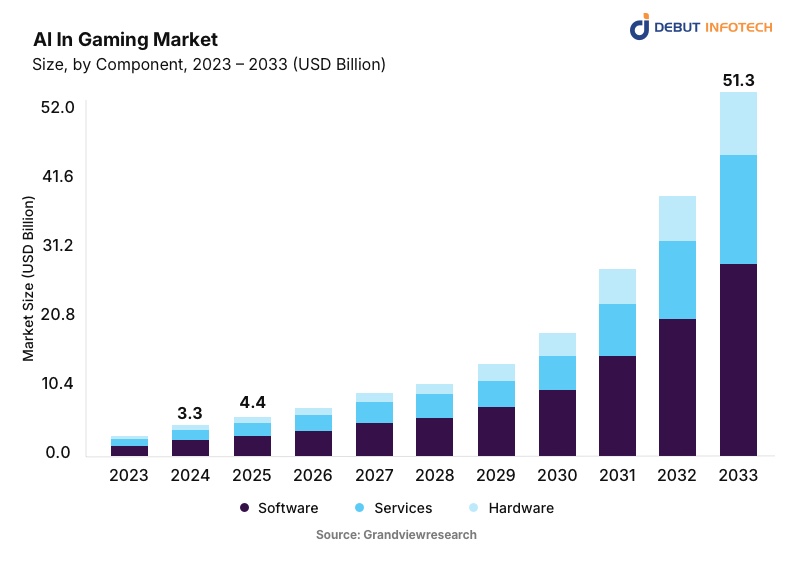
This guide will cover the mechanics of AI in gaming, and how it has changed since the early video games, and what it can bring to the future of game design and players’ experiences.
What Is Artificial Intelligence in Gaming?
In simple terms, artificial intelligence in computer games is a technology that enables characters, enemies, and game environments to act intelligently and react to the actions of players. Rather than all moves being pre-programmed by developers, AI assists games to take real-time decisions to generate more natural and less predictable gameplay.
An example of this is the popular Middle-earth: Shadow of Mordor, which presented the popular Nemesis System. In this game, enemy captains are aware of previous experiences with the player. Should you overcome a foe and he still lives, he might turn up against you later, injured, endowed with new abilities, or with a score to settle with the person who defeated him. There are enemies who can ridicule the player about a previous loss, others can become stronger when they survived a battle. This system brings about special competition that evolves in different ways among the players.
In old video games, the enemies tended to use the same routine each time you played it. As soon as you discovered their pattern, it was hardly ever difficult. However, with the development of artificial intelligence, games have now been able to create more interactive experiences. Characters are able to respond to player actions, change their tactics, and even develop with time.
Due to this change, artificial intelligence in computer games has become an important tool among developers who wish to create more enriched, more immersive game worlds, where the experience of each player can be made unique.
How AI Is Used in Gaming
With video games continuing to change, developers are applying AI in the innovations of the gaming industry to build deeper worlds, smarter characters, and more personalized player experience. To avoid solely adhering to scripts and manual design, modern games turn more towards AI to help with the development, storytelling, and gameplay systems. The following are some of the main ways AI is influencing the creation and experience of games today.
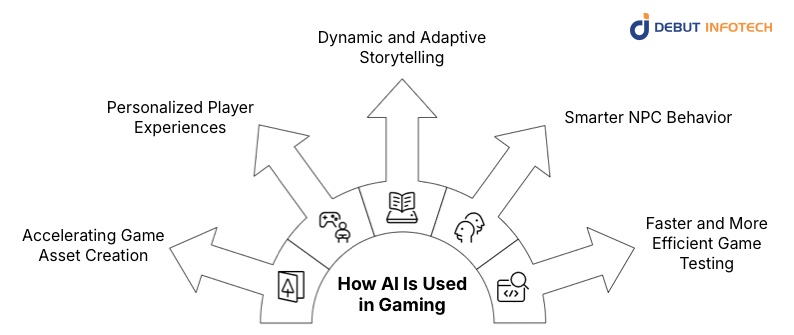
Accelerating Game Asset Creation
The environment in games consists of thousands of small details, such as roads, textures, trees, lighting effects, and environmental details. Previously, most of these aspects were done manually, a process that took enormous time and effort on the part of the artists.
Now, AI-based development tools can be used to automatically create environmental assets and variations. This enables the designers to devote more time to creative world-building and less time to repetitive technical work. Practically, AI can be used as a productivity tool to help artists and not to displace them.
Personalized Player Experiences
The analysis of player behavior is another strong AI application. AI systems can be used by the developers to customize gameplay experiences by observing how players explore environments, approach challenges, or communicate with characters.
As an illustration, when a player likes to discover the hidden details within the environments, the game could add more interactive features. Likewise, game difficulty can also be adjusted to the skill level of a player to provide a more balanced and enjoyable experience.
Dynamic and Adaptive Storytelling
Video game storytelling was characterized by rather set paths that developers had created. Players were allowed to make various choices, however, most of them ended up making decisions that resulted in the same outcome.
This model is beginning to be altered by AI-based systems. Games can produce more adaptable storylines with player decisions shaping the development of events as they happen or as they create alternative paths in the story. This enables developers to test games in which every time they play it feels different.
Smarter NPC Behavior
The non-player characters (NPCs) in earlier generations of games generally had predetermined scripts. They replicated the same conversation or responded to players in foreseeable manners. AI systems are more dynamic and enable NPCs to act in modern times. Characters are now capable of responding to player actions, talking to other NPCs, and changing their tactics during the game.
This change is indicative of a larger industry philosophy. Legendary game designer Sid Meier (designer of the Civilization series) once described game design as:
“A series of interesting choices.”
AI is used to make those decisions more significant as it enables the game world and its characters to react intelligently to the decisions made by the players instead of merely reacting to the pre-written scripts.
Faster and More Efficient Game Testing
One of the most time-consuming steps of game development is testing. Traditionally, game testing teams would repeatedly play the game to find bugs, issues with the game or balancing concerns.
The ability of AI-driven playtesting tools to recreate thousands of game situations within a limited period can be used to assist developers in detecting issues earlier in the development process. This does not only enhance the quality of games but can also save a lot of time in production.
Turn Ideas Into Immersive Gaming Experiences
Let Debut Infotech’s expert team craft your ideas for smarter NPCs and dynamic worlds players love.
What Are the Main Types of AI in Gaming?
Artificial intelligence is a key component in the operation of modern games. Over the years, developers have implemented various AI approaches to manage characters, make real-life environments, and enhance gameplay mechanisms. These technologies are commonly used together in the AI in gaming industry to produce more intelligent NPCs, intelligent difficulty systems, and dynamic game worlds.
The following AI methods are considered to be the most popular techniques in modern game development according to the International Game Developers Association (IGDA) and popular development engines, such as Unity and Unreal Engine.
| AI Type | Role in Games |
| Rule-based AI | Uses predefined rules to control NPC actions and events |
| Pathfinding AI | Enables characters to navigate complex environments |
| Behavior Trees | Structures decision-making processes for NPC behavior |
| Finite State Machines (FSM) | Switches character behavior between different states |
| Machine Learning AI | Analyzes player data and adapts gameplay experiences |
| Reinforcement Learning AI | Trains AI agents to improve strategies through trial and error |
Below is a closer look at how each of these AI systems works in real-world game development.
Rule-Based AI
One of the oldest and most popular ways of using AI in game design is rule-based AI. In this system, developers create a system of logical rules that stipulates the reaction of characters to certain situations.
For example, an enemy may attack when the player gets within a specific range or withdraw when its health gets low. Most older games, such as early arcade and strategy games, were based on rule systems since they are predictable and can be controlled easily.
Rule-based AI is still employed even in the current day when playing simple games that require consistency in their behaviors.
Pathfinding AI
Pathfinding AI allows characters to move intelligently through complex environments. Among the most common algorithms in games is the A-star (also known as A*) pathfinding algorithm that takes into consideration the distance between two points and obstacles to find the shortest and most efficient route.
The technology is necessary in open-world and strategy games in which NPCs are required to navigate buildings, terrain, or high-density settings. In absence of pathfinding systems characters would move in an unrealistic manner or get stuck in obstacles.
Behavior Trees
Behavior trees are a modern AI structure adopted by most AAA studios as a way of organizing complex NPC behavior. Rather than using strict policies, behavior trees arrange decisions in hierarchical nodes used to determine how characters respond to various situations.
For example, an enemy NPC might follow a sequence like:
- Detect the player
- Choose to either attack or to hide.
- Search the area if the player disappears
Due to the modular and flexible nature of behavior trees, character developers can come up with more realistic and scalable character behavior.
Finite State Machines (FSM)
Another system that is considered foundational to game AI is Finite State Machines. Under this model, the characters exist in specified behavioral states and change between them based on conditions in the game.
Common states include:
- Patrol
- Chase
- Attack
- Defend
- Retreat
For example, a guard in a stealth game might patrol an area until the player is detected. After the player is spotted, the guard will change into a chase state, followed by an attack state when within close proximity.
FSMs have remained very popular due to their stability and simplicity in implementing them.
Machine Learning AI
Machine learning is a more sophisticated type of AI that enables the system to learn based on the data instead of depending on merely established rules. It is becoming more common in AI in the gaming sector as it is being applied to understand human behaviour in games and enhance their experiences.
As an example, machine learning systems can analyze the interactions between players and a game, like the routes they follow, the choices they decide, or the obstacles they are unable to overcome. Based on these findings, developers can fine-tune difficulty, create a game that is better balanced or create custom experiences.
Ubisoft and Electronic Arts are companies that have tried to use machine learning tools to analyze player data and improve gameplay.
Reinforcement Learning AI
Reinforcement learning is a subdivision of machine learning in which AI agents are taught by trial and error. The system is rewarded when good acts are performed and punished when wrong acts are done, gradually its strategy is enhanced with time.
Reinforcement learning is also common in game development and testing. AI agents are able to simulate thousands of scenarios in a game, assisting developers to identify balance, test gameplay, and learn how to train smarter in-game opponents.
Organizations like DeepMind have also shown how reinforcement learning can be used to learn to play complex video games by learning gameplay strategies by using gameplay data.
How Is AI Used in the Gaming Industry Today?
Modern video games now use artificial intelligence as a central technology. Through AI-driven development, studios are able to generate more intelligent characters, worlds, and more gameplay that responds to how the players engage with the game. Some of the most significant applications of AI in the gaming industry today are listed below:
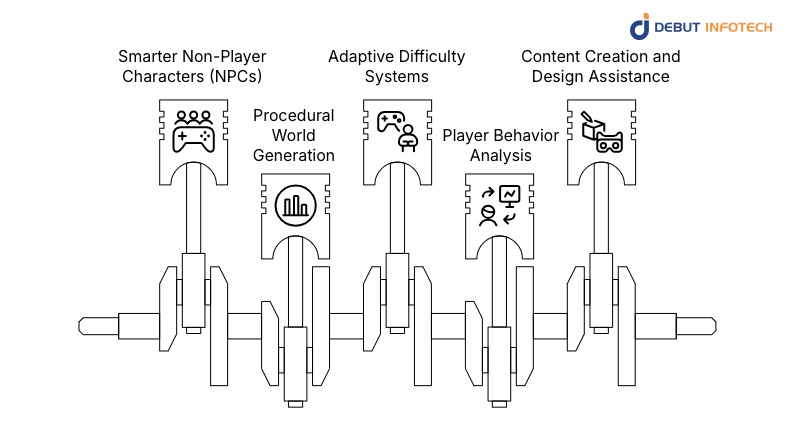
1. Smarter Non-Player Characters (NPCs)
AI makes the non-player characters act in a more realistic way rather than using pre-written scripts. Modern NPCs are capable of responding to player behavior, changing their tactics, and even collaborating with other characters in the game.
As an illustration, enemies can either hunt the player, seek safety in the middle of a fight, or request support by fellow players. This increases the difficulty and immersion of the gameplay since players cannot count on predictable behavior of enemies.
2. Procedural World Generation
AI enables the developers to create vast game worlds in an automatic way. Rather than coming up with all the environments manually, AI systems generate landscapes, maps, and buildings following particular rules.
Through this method, it is feasible to create large or even unlimited worlds and save on time development. Games such as Minecraft or No Man’s Sky implement this method to generate new space every time a player goes on an adventure.
3. Adaptive Difficulty Systems
AI has the ability to track the performance of players and adjust the level of difficulty. The game can adjust the strength of the enemy slightly or give a player more resources in case they have trouble with certain challenges.
Conversely, the more experienced players might have tougher opponents or more challenging missions. This makes the game fun to players of various skill levels.
4. Player Behavior Analysis
Based on gameplay patterns and player choices, AI could study the interaction between players and a game. This data is used by developers to know what players like, what they find difficult and what features are the most captivating.
These insights are used to enhance the game design, balance, and develop the updates that are more aligned to the expectations of players.
5. Content Creation and Design Assistance
AI also assists developers to make game contents more easily. With the use of AI-based technology, AI tools can aid in the creation of environmental specifics, animations, and initial concepts.
Although the human developers continue to direct the creative process, AI assists in minimizing repetitive tasks and accelerates the overall development process.
Why Is AI in Gaming Beneficial for Players?
Among the largest contributors to the importance of AI in gaming, there is the fact that it enhances the player experience. With the help of the latest AI algorithms, the contemporary games can respond to the actions of the players, which makes the gameplay experience even more captivating, difficult, and intimate.
The following are some of the benefits of playing an AI-powered game:
- More realistic NPC behavior – Non-player characters (NPCs) are able to act in a natural way, interact with one another, and respond to player actions rather than behave predictably.
- Personalized gameplay – AI can examine your playing structure and change the game to suit your individual preferences, be it exploration, a tactical approach, or a faster-paced game.
- Smarter enemies – Enemies can change their strategies, rather than act according to a set pattern, which makes the battles more engaging and enjoyable.
- Dynamic storylines – Certain games implement AI systems to affect the development of stories, such that the decisions made by players may contribute to a variety of stories and experiences.
This combination of enhancements makes modern games seem less like programs and more like real worlds that are alive and react to the player in real time.
What Challenges and Ethical Issues Come with AI in Gaming?
Although AI is being used to develop smarter and more realistic games, it also presents a number of challenges that developers have to handle. Most of these problems are associated with the behavior of AI algorithms within the context of complex games.
Technical Challenges Developers Face
The development of AI systems in games does not necessarily go smoothly. Developers often have to deal with:
- Unpredictable behavior: Sometimes AI may behave in manners that developers never wanted them to behave, disrupting the balance of gameplay, or posing annoying experiences to the players.
- High computational demands: Advanced AI systems need high processing power, particularly in large open-world games when a large number of characters and systems are running at once.
- Balancing fairness: AI needs to be challenging but not unfair. When enemies prove to be too strong or too smart, players might feel cheated by a game.
Ethical Considerations
In addition to technical issues, the increased application of AI also brings up significant ethical concerns.
- Ownership of AI-generated content: When AI is used to create characters, dialogue, and game environments, the question of ownership of that content may arise, be it the developer, the company or the AI itself.
- Player data privacy: A large number of AI systems examine player behavior in order to customize the gameplay. Developers should make sure that this data is gathered and utilized in a responsible manner.
To developers and studios, these issues must be resolved to make sure that AI can provide a better gaming experience without making the process unfair, unclear, and irresponsible to the players.
The Future of AI in Gaming
The future of gaming is being shaped by powerful AI models that allow games to become more dynamic and responsive to players.
AI-Generated Game Worlds
AI models can assist in the creation of game content such as:
- quests
- storylines
- characters
This implies that each time a player plays a game, they will encounter new stories and missions, and thus games will be more unpredictable and engaging.
Smarter NPC Conversations
In most older games, NPC dialogues consist of predetermined responses. Modern AI models can possibly allow NPCs to participate in more natural dialogue and respond to the player in a more lifelike and engaging manner.
Fully Adaptive Games
AI can also allow games to adapt in real time by adjusting:
- story progression
- difficulty levels
- environments and challenges
based on player choices. This brings about a more intimate gameplay experience whereby no two playthroughs would feel the same.
Ready to Build an AI-Powered Game?
Our experts turn concepts into player-centric reality fast.
Final Thoughts
The concept of artificial intelligence is transforming the gaming landscape of today, allowing smarter gaming enemies, adaptive gameplay and more intricate virtual worlds.
To companies that want to take advantage of such opportunities, collaboration with the appropriate AI consulting company can assist in catalyzing innovation. Debut Infotech collaborates with companies to use advanced AI with the aim of making digital products smarter and more scalable.
With the ongoing development of AI technology, the gaming possibilities will only expand, bringing a new world of thrilling experiences to players everywhere.
Frequently Asked Questions (FAQs)
Q. Which AI Is Better for Gaming?
A. The ideal AI in gaming relies on how you apply it in game development and gameplay.
Developers often use such tools as Genie 2 (creating a 3D world), Rosebud AI (prototyping a game), or Scenario (generating assets).
On the player side, technologies such as Microsoft Edge AI coaching and Inworld AI-powered NPCs assist in making gameplay experience smarter and more interactive.
Q. Is AI Good for Gaming?
A. Yes, AI is making gaming better in a number of ways. It allows developers to create games more quickly with the aid of generative tools and allows more advanced procedural content, such as dynamic maps and quests.
AI also enhances graphics through technologies such as NVIDIA DLSS, which uses neural rendering to improve performance and visual quality. Moreover, AI develops wiser, more interactive NPCs to make the gameplay seem more vivid and real.
Talk With Our Expert
Free 30-min consultation. No commitment.
Our Related Insights

Talk With Our Expert
LET'S WORK TOGETHER
Your Vision.
Our Engineering.
Debut Infotech works as a strategic co-creator — from concept to production-ready platform. We deliver blockchain, AI, enterprise, & mobile solutions that scale.

15+ Years · 500+ Platforms Delivered
Across blockchain, AI, fintech, mobile, and enterprise verticals

NDA Signed on Day One
Your IP and project details are protected before any conversation begins

48-Hour Scoped Estimate
A real technical estimate — not a generic template or sales pitch

Dedicated Account Managers
Available across key global time zones
 +1 708-515-4004 (USA)


