



Table of Contents
Home / Use Case / AI
AI-Driven Fuel Distribution: Practical Use Cases, Advantages, and Emerging Trends


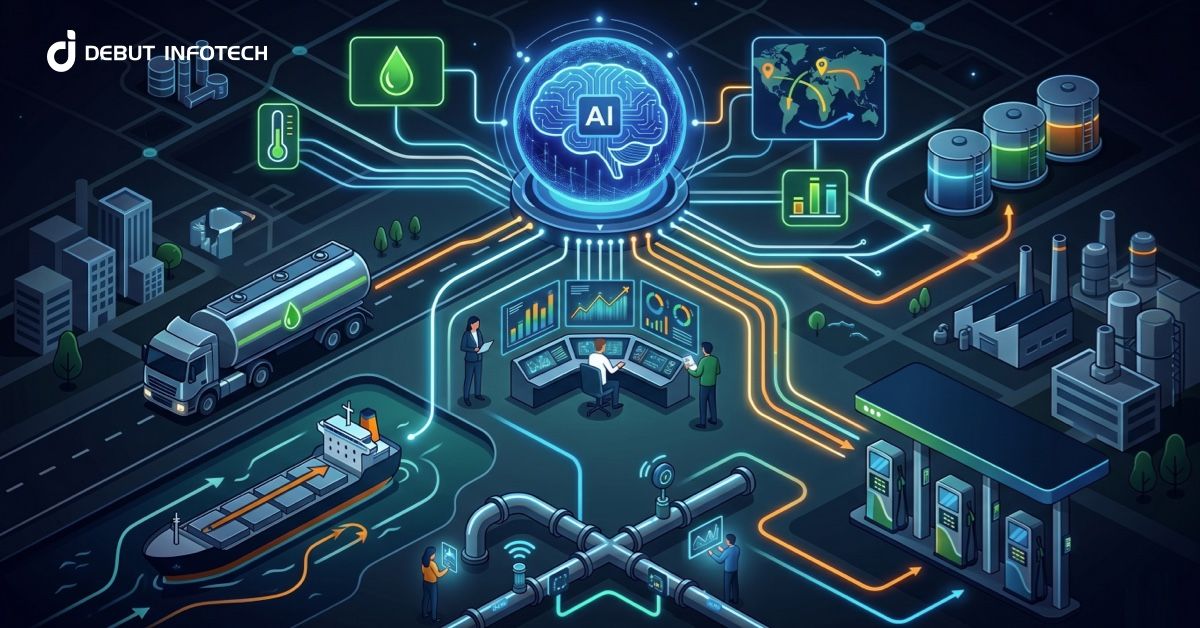
The fuel distribution industry is at a critical juncture. Volatile demand patterns, fluctuating fuel prices, and complex logistics networks make it increasingly difficult for companies to maintain operational efficiency and cost control. Traditional systems often rely on manual decision-making and reactive planning, resulting in waste, supply-demand mismatches, and inefficient route management. The need of the hour is a data-driven, intelligent approach that ensures timely delivery, optimal inventory levels, and real-time visibility across the supply chain.
This is where AI-driven fuel distribution steps in, leveraging predictive analytics, agentic AI, and machine learning to revolutionize how energy logistics operate. These intelligent systems don’t just automate tasks but also analyze demand, optimize routing, and autonomously make supply chain decisions to improve accuracy, minimize losses, and enhance sustainability. By anticipating consumption trends, forecasting market fluctuations, and dynamically allocating resources, AI enables fuel distributors to transition from reactive operations to proactive, data-driven decision-making.
The use cases are wide-ranging. AI-powered demand forecasting helps maintain optimal stock levels across depots, while smart routing systems reduce fuel delivery times and emissions. Predictive maintenance agents monitor vehicle health and prevent costly breakdowns, and intelligent pricing engines adjust rates based on market conditions in real time. Moreover, AI-driven compliance monitoring ensures adherence to environmental and safety regulations, minimizing risks and enhancing transparency.
Looking forward, AI in fuel distribution is set to redefine how energy logistics are managed globally. As adoption scales, distributors will experience improved supply chain resilience, reduced operational costs, and enhanced sustainability outcomes.
This article explores the practical use cases, advantages, and emerging trends shaping the future of AI in fuel distribution, highlighting how intelligent automation is driving smarter, greener, and more profitable operations.
Transformative Use Cases of AI in Fuel Distribution Control: Key Statistics and Insights
AI is revolutionizing how fuel distribution networks operate, monitor performance, and maintain efficiency. Unlike traditional logistics systems, AI-driven fuel distribution control platforms function autonomously, analyzing demand fluctuations, predicting supply bottlenecks, and optimizing fleet routing in real time. Through AI implementation, energy providers and distributors are building intelligent systems that ensure continuous supply, reduce operational waste, and enhance decision-making with predictive insights.
This evolution marks a major step forward for the energy and logistics sectors, allowing companies to shift from reactive operations toward smart, data-led, and sustainable fuel management ecosystems. The following insights highlight how AI trends are reshaping global fuel distribution and logistics:
Allied Market Research projects that the AI in the Oil & Gas market is expected to grow to USD 7.99 billion by 2031, at a CAGR of 13.5 % from 2022 to 2031.
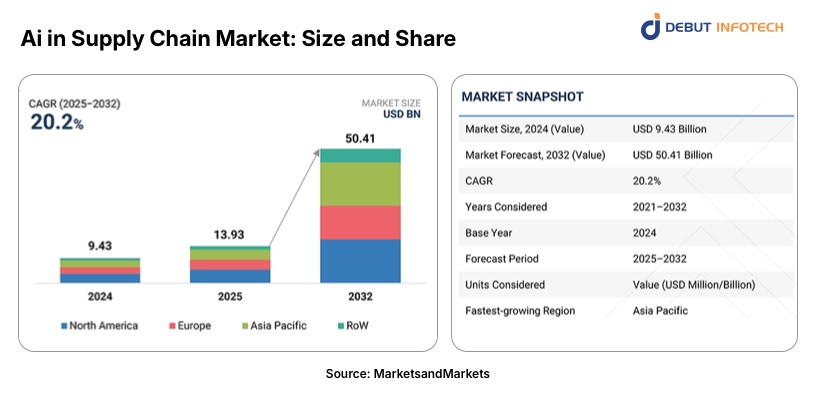
According to MarketsandMarkets, the AI in Supply Chain market is projected to grow to USD 50.01 billion by 2031, at a CAGR of 22.9 % during the forecast period.
According to a Capgemini survey published in 2025, 68% of supply chain organizations have integrated AI for enhanced traceability and visibility, which has led to improved operational efficiency by about 22%.
A research study published on arXiv reveals that applying an explainable AI model to analyze driver behavior led to 12–15% reductions in fuel consumption across large vehicle fleets, highlighting the impact of AI-driven behavioral optimization on operational efficiency.
What Is the Role of AI in Fuel Distribution Control?
AI is transforming how fuel distribution companies plan deliveries, manage resources, and respond to shifting market conditions. By autonomously analyzing data, forecasting demand, and optimizing routing, AI in fuel distribution control goes beyond automation to serve as an intelligent co-pilot for energy enterprises. These systems use multi-agent reasoning, predictive analytics, and adaptive decision-making to improve supply accuracy, enhance profitability, and reduce operational inefficiencies across the entire fuel supply chain management ecosystem.
Modern AI-driven solutions combine Enterprise AI development with AI-powered market research, enabling organizations to anticipate fluctuations in demand, fuel prices, and regulatory shifts. By integrating AI into daily operations, companies gain real-time visibility, ensure on-time fuel delivery, and improve safety compliance. These intelligent systems support end-to-end product management—from refining and storage to last-mile delivery—allowing enterprises to operate more strategically in volatile markets.
Role of AI in Fuel Distribution Control
- Predictive Demand Forecasting: Analyze historical consumption, weather data, and market trends to forecast demand accurately and maintain optimal inventory levels.
- Smart Routing & Fleet Optimization: Plan the most efficient routes using AI algorithms to minimize fuel costs, reduce delivery times, and lower carbon emissions.
- Autonomous Supply Chain Management: Monitor and adjust supply flows in real time, automating restocking and resource allocation across depots.
- AI-Powered Market Research: Leverage AI to study pricing trends, competitor activities, and geopolitical factors that influence fuel supply and pricing decisions.
- Operational Risk & Compliance Management: Use intelligent monitoring to detect anomalies, prevent pilferage, and ensure adherence to environmental and safety regulations.
- Product Lifecycle Optimization: Employ AI-driven product management techniques to enhance decision-making across refining, storage, and distribution cycles.
- Enterprise AI Integration: Seamlessly connect with ERP, IoT, and analytics platforms to enable scalable, data-driven decision-making across departments.
By collaborating with an experienced AI development company, fuel distributors can build custom AI solutions that align with their operational goals and compliance frameworks. Implementing AI in fuel distribution control empowers organizations to achieve real-time intelligence, improve efficiency, and drive long-term sustainability in a competitive energy landscape.
Drive Strategic Control Over Fuel Operations
Transform fragmented workflows into connected, insight-driven processes with AI-based automation tailored for enterprise-scale fuel networks.
AI-Powered Transformation Across the Fuel Extraction and Distribution Lifecycle
The global fuel industry is moving beyond traditional linear operations toward a dynamic, data-intelligent ecosystem. By integrating agentic AI, autonomous decision-making, and predictive analytics, energy enterprises can now monitor, forecast, and manage every phase of the fuel extraction and distribution process with unprecedented precision, efficiency, and control. From locating underground reserves to anticipating retail demand, AI delivers continuous intelligence that optimizes every operational layer.
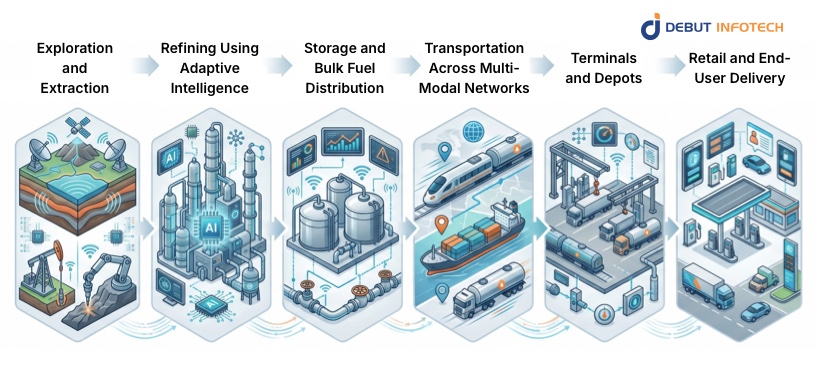
Exploration and Extraction
Exploration begins with advanced geological surveys, where AI algorithms analyze seismic data, rock formations, and sensor feedback to identify high-potential reserves more quickly and accurately.
- Predictive Reservoir Modeling: Forecasts subsurface pressure dynamics for optimal drilling plans and lower operational risks.
- Real-Time Anomaly Detection: Detects unexpected deviations in reservoir conditions to improve safety and yield.
- Autonomous Drilling Support: Dynamically adjusts equipment parameters to maximize efficiency and extend asset life.
These capabilities reduce uncertainty and enhance extraction efficiency while maintaining safety standards.
Refining Using Adaptive Intelligence
In refineries, AI models monitor complex processes and fine-tune distillation, cracking, and molecular restructuring in real time.
- Dynamic Process Control: Continuously optimizes throughput and temperature to maintain product quality.
- Emission Reduction Intelligence: Automatically adjusts operations to minimize environmental impact.
- Feedstock Quality Analytics: Analyzes crude input to maximize output efficiency and minimize waste.
This enables refineries to operate as intelligent, self-learning environments with consistent, high-quality fuel production.
Storage and Bulk Fuel Distribution
Post-refining, fuels enter storage facilities where bulk fuel distribution and predictive systems ensure optimal inventory levels and timely dispatch.
- Predictive Inventory Balancing: Anticipates consumption trends to prevent shortages and overstock.
- Anomaly-Based Risk Alerts: Flags discrepancies in storage tanks for safety and operational integrity.
- Data Protection Frameworks: Implements AI data security to protect sensitive operational information.
This combination of intelligence and security strengthens supply chain resilience and operational transparency.
Transportation Across Multi-Modal Networks
Fuel transport is guided by AI agents that coordinate deliveries across pipelines, vessels, rail, and trucks.
- Route Optimization Intelligence: Determines the most efficient paths while adapting to real-time disruptions.
- Fleet Health Monitoring: Tracks performance and predicts maintenance needs to prevent downtime.
- Sustainability Planning: Reduces emissions and fuel consumption by simulating optimal logistics scenarios.
Intelligent orchestration enhances efficiency, lowers costs, and supports environmental objectives.
Terminals and Depots
Terminals and depots function as intelligent hubs, leveraging AI tools for operations management.
- Demand-Responsive Stocking: Adjusts inventory based on predictive consumption analytics.
- Automated Blending Systems: Ensures consistent fuel quality and compliance with industry standards.
- Smart Scheduling Agents: Coordinate shipments to minimize idle time and maximize throughput.
These hubs ensure fuels are available reliably, bridging national supply chains and regional markets.
Retail and End-User Delivery
Finally, at the consumer interface, AI Agents enable predictive demand management and market responsiveness.
- Dynamic Pricing Models: Balances profitability and market competitiveness.
- Predictive Replenishment: Guides delivery schedules to prevent stockouts.
- Customer Insights: Tracks patterns and feedback to optimize service offerings.
AI ensures that retail and industrial fuel delivery is efficient, precise, and aligned with evolving market needs.
Major Challenges of Deploying AI Solutions in the Oil and Gas Sector
The oil and gas industry stands to gain immensely from AI, including predictive maintenance, operational efficiency, and optimized fuel distribution. However, successful adoption requires navigating a complex landscape of technological, organizational, and regulatory hurdles. Below is a detailed overview of key challenges and actionable strategies to overcome them.
1. Demand Forecasting Uncertainty
Challenge: Fuel demand is inherently volatile, influenced by seasonal patterns, economic shifts, changing transportation trends, and sudden spikes in industrial activity. Traditional forecasting methods often fail to capture these fluctuations accurately, leading to either shortages or excess inventory, both of which increase operational costs.
Solution: Deploy AI-powered predictive models that integrate historical consumption data, real-time usage patterns, and external variables such as weather, economic indicators, and market trends. These models can continuously learn and adapt to changing conditions, enabling more precise demand forecasts, optimized inventory levels, and reduced risk of stockouts or oversupply.
2. Integration with Legacy Systems
Challenge: Many fuel distribution networks still rely on legacy IT and operational systems that were not designed to support AI technologies. Attempting to implement AI tools directly on these outdated platforms can cause data inconsistencies, operational disruptions, and system incompatibilities.
Solution: Develop customized APIs, middleware, and integration layers that allow AI systems to communicate seamlessly with existing infrastructure. A phased deployment approach, starting with pilot projects on select sites, ensures minimal disruption and provides a roadmap for scaling AI adoption across the entire network.
3. Data Quality and Management
Challenge: The effectiveness of AI depends on high-quality, accurate, and timely data. Fuel distribution operations generate vast amounts of information from sensors, pipelines, storage facilities, tanker trucks, and terminals. Inconsistent, incomplete, or erroneous data can compromise AI predictions, leading to operational inefficiencies.
Solution: Implement robust data governance frameworks, including standardized data collection protocols, validation checks, and cleaning processes. Collaboration between data scientists and field experts ensures that AI models receive reliable input, making predictive analytics and operational decision-making more accurate and actionable.
4. Cybersecurity and Operational Safety
Challenge: AI systems controlling fuel distribution networks are high-value targets for cyberattacks. Unauthorized access or system breaches can disrupt operations, compromise sensitive data, and even create safety hazards given the flammable nature of fuels.
Solution: Deploy multi-layered security measures, including encryption, multi-factor authentication, intrusion detection systems, and regular security audits. Employee training on cybersecurity best practices and incident response protocols is also crucial to safeguard operational continuity and protect both digital and physical assets.
5. Supply Chain Complexity
Challenge: Fuel distribution involves multiple interdependent stages—from extraction and refining to storage, transport, and retail delivery. Disruptions in any part of this chain can cascade across the network, affecting availability, operational efficiency, and profitability.
Solution: Use AI-driven supply chain management platforms to monitor every stage in real time. Predictive analytics can identify bottlenecks, anticipate disruptions, and optimize routes, schedules, and inventory allocation. AI enables coordinated, data-driven decision-making that ensures smooth operations across the entire supply chain.
6. Regulatory Compliance and Environmental Standards
Challenge: Fuel distribution companies must navigate complex and diverse regulations, including safety standards, environmental restrictions, and data privacy laws, which vary across countries and regions. Non-compliance can result in fines, operational delays, and reputational damage.
Solution: Embed compliance monitoring and reporting directly into AI systems. Maintain detailed audit trails and automate regulatory reporting to ensure transparency. Staying updated on evolving regulations and collaborating with legal and environmental experts helps companies proactively align AI operations with required standards.
7. Operational Scalability
Challenge: Scaling AI solutions across multiple depots, terminals, pipelines, and transport fleets can strain infrastructure, increase computational demand, and challenge the consistency of real-time monitoring. Ensuring system performance across a geographically dispersed network is a significant hurdle.
Solution: Leverage cloud-based AI platforms and edge computing technologies that distribute computational loads efficiently. Scalable architectures and modular deployment strategies enable companies to expand AI capabilities without compromising real-time responsiveness, accuracy, or system reliability.
8. High Capital and Implementation Costs
Challenge: The deployment of AI solutions, including predictive analytics platforms, IoT sensors, and specialized software, requires significant upfront investment. Budget constraints and uncertainty over ROI can slow adoption or limit the scale of implementation.
Solution: Begin with focused pilot projects to demonstrate measurable ROI and operational benefits. Conduct thorough cost-benefit analyses, explore public-private partnerships or government incentives, and adopt scalable, modular solutions to reduce initial expenditure while building confidence in broader deployment.
9. Market Volatility and Price Fluctuations
Challenge: Global fuel prices are influenced by geopolitical events, supply-demand imbalances, and market speculation. Sudden price swings can disrupt distribution planning, impact profit margins, and challenge inventory and pricing strategies.
Solution: Integrate AI-powered market intelligence and predictive analytics to monitor real-time market dynamics. AI models can adjust pricing strategies, optimize inventory levels, and guide distribution priorities, enabling companies to respond proactively to market volatility while maintaining operational efficiency.
10. Talent and Change Management
Challenge: The successful deployment of AI requires skilled professionals in data science, machine learning, and domain-specific fuel distribution knowledge. At the same time, employees may resist new technologies, slowing adoption and limiting AI’s potential impact.
Solution: Invest in continuous upskilling and professional development programs, hire domain-specific AI experts, and cultivate a culture of innovation. Transparent communication, involving employees in AI project planning, and showcasing early success stories can accelerate adoption and ensure long-term organizational alignment.
Minimize Downtime with Predictive AI Systems
Detect equipment issues, optimize maintenance schedules, and ensure continuous operations through intelligent monitoring.
Top 15 Use Cases of AI in the Fuel Distribution Control Sector
AI is transforming the fuel distribution sector by enabling companies to make smarter, data-driven decisions, optimize operations, and enhance overall efficiency. Rather than relying solely on manual monitoring or traditional forecasting methods, fuel distributors are leveraging AI to automate routine processes, predict demand, manage inventory, and monitor fleets in real time with high precision.
From demand forecasting and route optimization to predictive maintenance and safety monitoring, AI helps organizations anticipate issues before they occur, ensuring uninterrupted supply and minimizing operational risks. Advanced algorithms analyze large datasets, detect anomalies in consumption, optimize procurement strategies, and streamline the entire supply chain—from refineries and storage terminals to end-user delivery. These systems also evaluate market trends, competitor pricing, and regulatory compliance, allowing companies to adjust strategies proactively and reduce costs.
AI-powered insights enable fuel distributors to optimize fleet deployment, improve energy efficiency, and ensure environmental and emission compliance, all while maintaining consistent product quality. By embedding these intelligent capabilities into operational workflows, companies can reduce waste, improve safety, enhance customer satisfaction, and gain a competitive edge.
Ultimately, AI in fuel distribution shifts the industry from reactive management to proactive control, transforming how organizations plan, operate, and deliver fuel in a highly dynamic and demanding market.
1. Demand Forecasting
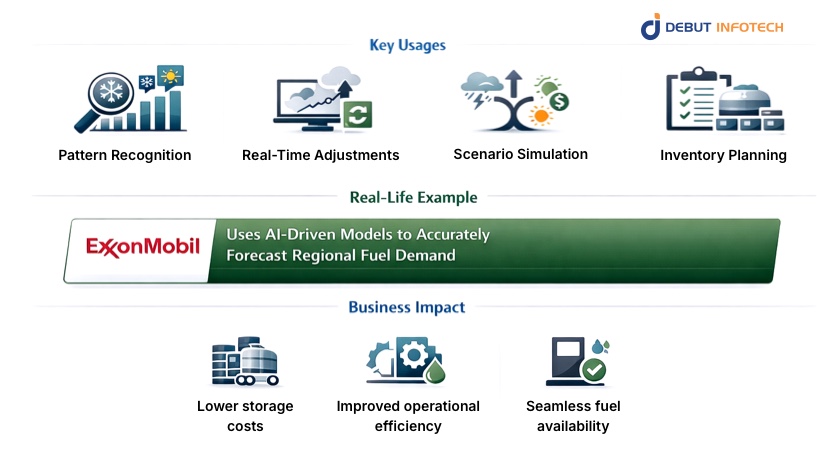
AI-driven demand forecasting leverages advanced algorithms and machine learning techniques to predict fuel consumption patterns across regions, seasons, and market conditions. By analyzing historical usage data, customer behavior, economic trends, and real-time market fluctuations, AI provides far more accurate predictions than traditional methods, enabling fuel distributors to make smarter supply chain decisions and avoid costly shortages or overstock situations.
Key Usages:
- Pattern Recognition: Detects recurring and seasonal demand trends across multiple regions and demographics.
- Real-Time Adjustments: Continuously updates forecasts as new market, weather, and consumption data become available.
- Scenario Simulation: Models potential market shifts, extreme weather events, or policy changes to prepare for uncertainties.
- Inventory Planning: Aligns storage and distribution plans with predicted demand to avoid shortages and surpluses.
Real-Life Example:
ExxonMobil uses AI-driven models to forecast regional fuel demand accurately, which has helped reduce both supply shortages and unnecessary inventory accumulation.
Business Impact:
Enhanced forecasting leads to lower storage costs, improved operational efficiency, and seamless fuel availability for end-users, ultimately boosting profitability.
2. Inventory Management
AI-powered inventory management ensures optimal fuel storage and distribution by continuously monitoring stock levels across depots, terminals, and storage tanks. Intelligent algorithms recommend replenishment schedules based on real-time consumption trends and predicted demand, reducing risks associated with both shortages and overstocking.
Key Usages:
- Stock Monitoring: Tracks fuel levels in storage tanks and depots in real time to prevent disruptions.
- Replenishment Alerts: Sends automated notifications when refills or adjustments are required.
- Waste Reduction: Reduces excess storage and prevents fuel degradation over time.
- Cost Optimization: Minimizes idle inventory, freeing capital for other operational needs.
Real-Life Example:
BP employs AI-enabled monitoring systems for automated inventory management across multiple depots, streamlining operations and preventing fuel shortages.
Business Impact:
Improved inventory efficiency translates into reduced operational costs, uninterrupted supply, and enhanced responsiveness to changing demand patterns.
3. Route Optimization
AI systems optimize fuel delivery routes for tankers, pipelines, and transport vehicles by factoring in traffic, weather, and road conditions. This approach reduces travel time, fuel consumption, and operational costs, ensuring timely deliveries even in dynamic environments.
Key Usages:
- Efficient Scheduling: Plans the fastest and safest delivery routes for each vehicle.
- Fuel Efficiency: Reduces fuel consumption during transit by selecting optimal paths.
- Delivery Prioritization: Prioritizes deliveries based on urgency or customer demand.
- Dynamic Adjustments: Continuously recalculates routes in response to traffic, accidents, or weather disruptions.
Real-Life Example:
Shell utilizes AI-based routing systems to streamline fuel distribution, cutting delivery times and reducing fuel costs.
Business Impact:
Optimized routes lower transportation expenses, enhance delivery reliability, and reduce carbon emissions, supporting sustainability initiatives.
4. Real-Time Monitoring
AI-powered monitoring systems provide a continuous view of fuel levels, equipment performance, and pipeline health. By analyzing data from IoT sensors and automated devices, these systems detect anomalies early and prevent operational disruptions.
Key Usages:
- Sensor Data Analysis: Continuously monitors storage tanks, pipelines, and transport vehicles.
- Anomaly Detection: Flags leaks, spills, or unusual fuel usage patterns promptly.
- Maintenance Alerts: Triggers proactive maintenance workflows before failures occur.
- Performance Dashboard: Centralizes operational metrics for quick and informed decision-making.
Real-Life Example:
ekTruck’s AI/IoT platform monitors mining fuel fleets in real time, helping prevent wastage and ensuring operational efficiency.
Business Impact:
Real-time monitoring minimizes operational risks, prevents fuel losses, improves safety compliance, and supports smooth day-to-day operations.
5. Market Analysis
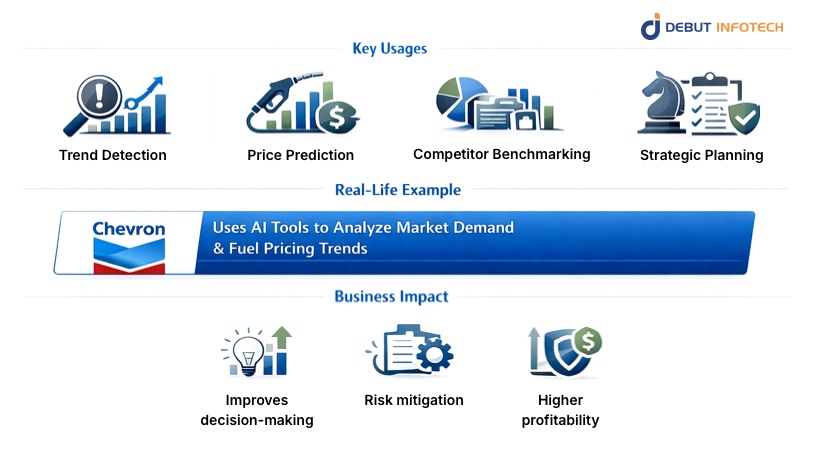
AI evaluates fuel market trends, competitor pricing, and consumer demand to guide distribution strategies and pricing decisions. By integrating large datasets from multiple sources, AI enables companies to make data-driven decisions and stay competitive.
Key Usages:
- Trend Detection: Identifies shifts in demand patterns and consumption behaviors.
- Price Prediction: Forecasts fuel price fluctuations to inform procurement strategies.
- Competitor Benchmarking: Compares regional performance with competitors to identify gaps.
- Strategic Planning: Supports supply, pricing, and inventory decisions with actionable insights.
Real-Life Example:
Chevron uses AI tools to analyze market demand and fuel pricing trends, optimizing inventory and maximizing profit margins.
Business Impact:
Enhanced market intelligence improves decision-making, mitigates risks from price volatility, and drives higher profitability.
6. Supply Chain Optimization
AI integrates and analyzes data across extraction, refining, storage, and distribution channels to optimize fuel supply chains. By identifying bottlenecks and simulating potential disruptions, AI enables proactive management and efficiency improvements.
Key Usages:
- Bottleneck Identification: Detects inefficiencies and delays across the supply chain network.
- Predictive Allocation: Dynamically assigns resources based on projected demand patterns.
- Scenario Modeling: Simulates disruptions to prepare contingency plans and minimize losses.
- Cost Minimization: Optimizes fuel flow from production to end-users for reduced operational costs.
Real-Life Example:
TotalEnergies leverages AI-driven supply chain optimization to improve fuel delivery efficiency and reduce operational delays.
Business Impact:
Optimized supply chains lead to lower costs, improved reliability, and faster response to market or operational changes.
7. Optimized Procurement
AI streamlines fuel procurement by analyzing historical price trends, supplier reliability, and projected demand. By automating purchase decisions, AI reduces operational costs and ensures a consistent supply.
Key Usages:
- Supplier Evaluation: Rates suppliers based on delivery performance, cost, and reliability.
- Price Forecasting: Predicts future fuel prices to schedule purchases optimally.
- Order Scheduling: Automates procurement in line with predicted inventory needs.
- Risk Mitigation: Minimizes overpayment, shortages, and supply chain disruptions.
Real-Life Example:
ConocoPhillips uses AI for dynamic procurement planning, balancing cost minimization with timely fuel deliveries.
Business Impact:
Efficient procurement lowers operational expenses, reduces supply risks, and aligns inventory with market demand.
8. Safety Enhancement
AI enhances operational safety by monitoring pipelines, storage facilities, and transport vehicles to prevent accidents, leaks, and environmental hazards. By combining predictive analytics with real-time monitoring, AI helps companies mitigate risks and ensures compliance with safety regulations across the fuel distribution ecosystem.
Key Usages:
- Leak Detection: Identifies early signs of leaks, ruptures, or pipeline weaknesses to prevent disasters.
- Predictive Maintenance: Anticipates equipment failures before they occur, reducing accident risk.
- Hazard Analysis: Continuously evaluates potential safety risks across storage, transport, and distribution points.
- Compliance Monitoring: Ensures that all operations meet local, national, and industry safety standards.
Real-Life Example:
ExxonMobil implements AI-powered safety monitoring systems in its refineries and pipelines to reduce accident risks and improve operational safety.
Business Impact:
Enhanced safety protocols protect employees, minimize environmental risks, and reduce potential liabilities, while also strengthening public and regulatory trust in the company.
9. Fuel Quality Prediction
AI models can predict fuel quality parameters such as Research Octane Number (RON) and Motor Octane Number (MON) in refineries, ensuring consistent fuel quality. By analyzing refinery inputs and process variables, AI allows precise control over fuel blending and minimizes off-spec production.
Key Usages:
- Property Prediction: Forecasts key fuel properties prior to blending or production.
- Process Optimization: Adjusts blending ratios in real time to meet quality standards.
- Waste Reduction: Minimizes the production of off-spec fuel and reduces reprocessing costs.
- Quality Compliance: Ensures that all fuel batches meet regulatory and customer requirements.
Real-Life Example:
AI blending systems using neural networks and genetic algorithms help refineries optimize fuel output with high accuracy and consistency.
Business Impact:
Improved fuel quality increases customer satisfaction, reduces waste, lowers production costs, and ensures compliance with industry standards.
10. Anomaly Detection in Consumption
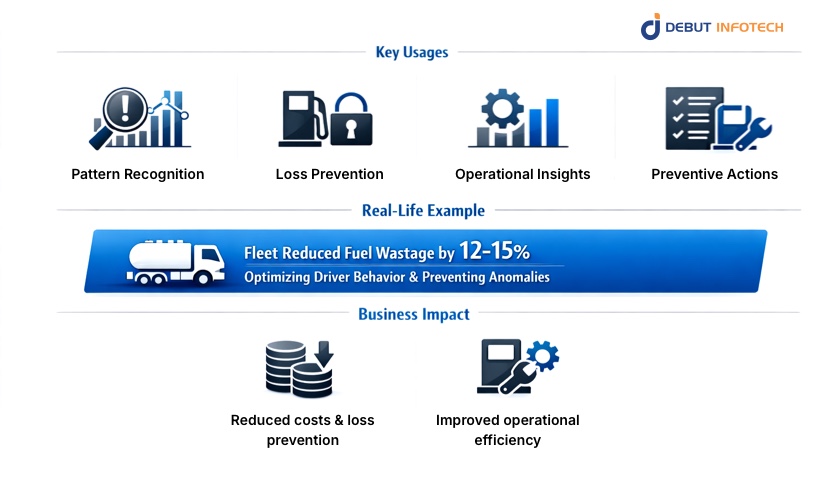
AI can detect unusual fuel usage patterns in fleets, depots, or storage facilities, helping prevent theft, pilferage, and inefficiencies. By analyzing historical consumption and usage trends, AI identifies deviations and triggers preventive actions.
Key Usages:
- Pattern Recognition: Detects abnormal consumption patterns compared to historical baselines.
- Loss Prevention: Flags potential fuel theft, diversion, or operational misuse.
- Operational Insights: Highlights inefficient usage behaviors for corrective action.
- Preventive Actions: Suggest interventions to correct deviations before they escalate.
Real-Life Example:
Fleets leveraging explainable AI models have reduced fuel wastage by 12–15% by optimizing driver behavior and preventing anomalies.
Business Impact:
Reduced losses and improved operational efficiency translate into significant cost savings and more transparent fuel usage management.
Reduce Distribution Costs Without Compromising Scale
Integrate AI-driven route optimization, load balancing, and fuel allocation to improve margins and delivery performance.
11. Predictive Maintenance
AI predicts potential failures in storage tanks, pipelines, and transport vehicles to prevent downtime and costly repairs. By analyzing sensor data, AI identifies wear patterns, operational stress, and failure probabilities, enabling preemptive maintenance.
Key Usages:
- Sensor Analytics: Monitors vibration, pressure, temperature, and flow metrics continuously.
- Failure Forecasting: Predicts equipment malfunctions before they occur to prevent interruptions.
- Maintenance Scheduling: Automates preventive maintenance planning for minimal operational impact.
- Resource Optimization: Ensures efficient allocation of maintenance personnel and materials.
Real-Life Example:
BP and Shell use AI-based predictive maintenance for pipelines and storage depots, significantly reducing unplanned downtime and repair costs.
Business Impact:
Predictive maintenance enhances operational reliability, extends equipment lifespan, reduces maintenance expenses, and ensures smooth fuel distribution.
12. Fleet Optimization
AI optimizes fleet management by analyzing vehicle availability, delivery demand, and route efficiency. This ensures that tankers, trucks, and other transport vehicles are used effectively while minimizing costs and delivery delays.
Key Usages:
- Dynamic Routing: Adjusts delivery routes in real time based on traffic, weather, and fuel demand.
- Load Optimization: Determines the optimal amount of fuel for each vehicle to maximize efficiency.
- Utilization Analysis: Evaluates fleet usage patterns to improve overall deployment.
- Cost Reduction: Reduces fuel consumption and maintenance expenses through smarter fleet management.
Real-Life Example:
Ekt Truck’s AI/IoT system increased fleet utilization by 35% while significantly reducing fuel wastage during transit.
Business Impact:
Optimized fleet deployment lowers transportation costs, improves on-time delivery, and reduces operational inefficiencies across fuel distribution networks.
13. Energy Usage Optimization
AI reduces energy consumption across the fuel supply chain by monitoring and optimizing operations at storage facilities, pumps, and transportation units. By identifying energy inefficiencies and automating adjustments, AI supports sustainability while lowering operational costs.
Key Usages:
- Consumption Monitoring: Tracks energy usage in storage tanks, refineries, and transport vehicles.
- Efficiency Modeling: Identifies areas where energy consumption can be reduced without affecting operations.
- Automation: Controls pumps, engines, and other machinery for optimal energy efficiency.
- Sustainability Reporting: Tracks and reports environmental impact, emissions, and energy savings.
Real-Life Example:
AI-driven energy management at TotalEnergies refineries reduced operational energy waste by analyzing inefficiencies and automating energy usage adjustments.
Business Impact:
Minimized energy costs, improved sustainability metrics, and compliance with environmental regulations support both profitability and corporate responsibility.
14. Market Segmentation Analysis
AI evaluates fuel consumption across various customer segments, including industrial, commercial, and retail users. This enables distributors to target high-value segments, optimize allocation, and tailor pricing strategies to maximize revenue.
Key Usages:
- Demand Profiling: Identifies high-volume or priority customers across different segments.
- Resource Allocation: Distributes fuel in alignment with segment-specific requirements.
- Customized Pricing: Adjusts pricing based on customer type, usage patterns, or demand sensitivity.
- Trend Identification: Detects emerging consumption trends for strategic planning.
Real-Life Example:
Chevron uses AI insights to distinguish industrial and retail deliveries, ensuring efficient resource allocation and prioritized service.
Business Impact:
Improved segmentation enhances customer satisfaction, maximizes revenue potential, and increases operational efficiency across distribution channels.
15. Environmental and Emission Compliance
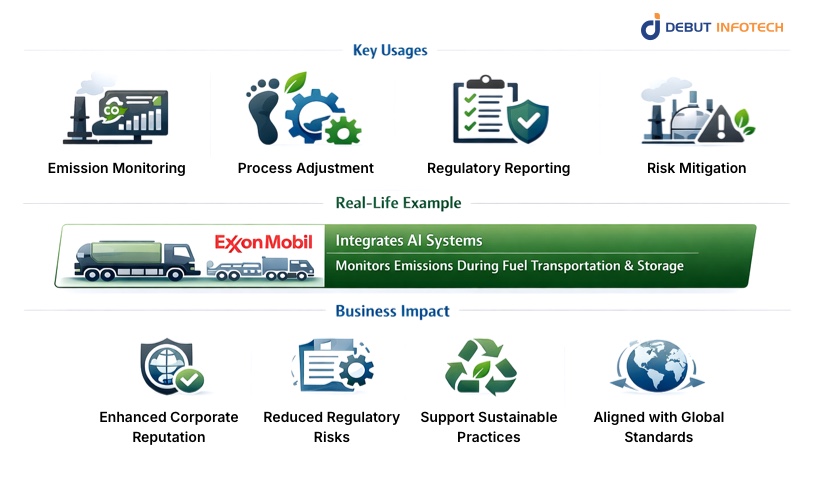
AI ensures that all fuel production, storage, and distribution processes comply with environmental regulations and emission standards. By continuously monitoring emissions and optimizing operations, AI helps companies minimize environmental risks while promoting sustainability.
Key Usages:
- Emission Monitoring: Tracks pollutants released during storage, transport, and refining.
- Process Adjustment: Optimizes operations to reduce carbon footprint and other environmental impacts.
- Regulatory Reporting: Automates compliance documentation and reporting for audits.
- Risk Mitigation: Predicts potential environmental incidents and enables preemptive action.
Real-Life Example:
ExxonMobil integrates AI systems to monitor emissions during fuel transportation and storage, supporting environmental compliance and sustainability goals.
Business Impact:
AI-driven compliance strengthens corporate reputation, minimizes regulatory risks, supports sustainable practices, and aligns fuel distribution operations with global environmental standards.
Benefits of AI Integration in Fuel Distribution Control
Integrating Artificial Intelligence (AI) into fuel distribution operations transforms traditional practices into highly efficient, safe, and data-driven processes. From predictive analytics to automated decision-making, AI enables companies to manage their fuel supply chains with unprecedented precision and responsiveness. The following are the key benefits of AI adoption in fuel distribution control:
1. Enhanced Operational Efficiency
AI streamlines the entire fuel distribution process by optimizing routes, schedules, and inventory management. Intelligent algorithms dynamically allocate resources, reduce idle time, and minimize redundancies, ensuring that fuel moves efficiently from depots to end-users. The result is faster operations, lower fuel wastage, and reduced operational costs.
2. Data-Driven Decision-Making
AI systems analyze vast volumes of data, including historical fuel consumption, market trends, weather patterns, and operational metrics. By transforming complex datasets into actionable insights, AI enables managers to make informed, strategic decisions that improve reliability and responsiveness across the supply chain.
3. Significant Cost Savings
Through predictive maintenance, optimized routing, and inventory control, AI reduces unnecessary fuel consumption, maintenance expenses, and operational inefficiencies. Companies can lower transportation costs, avoid overstocking, and reduce losses due to fuel spoilage, translating into substantial cost savings over time.
4. Proactive Risk Mitigation
AI identifies potential risks before they escalate into major issues. From detecting leaks in pipelines to forecasting supply chain disruptions, AI enables preemptive measures that prevent accidents, minimize environmental hazards, and reduce financial and operational risks.
5. Real-Time Monitoring and Responsiveness
AI-powered sensors and IoT devices provide continuous monitoring of fuel storage, pipelines, and vehicles. Real-time data allows rapid detection of anomalies, such as irregular consumption, equipment malfunctions, or safety breaches, ensuring timely intervention and maintaining smooth operations.
6. Environmental Sustainability
By optimizing routes, reducing fuel wastage, and improving energy efficiency across the distribution network, AI contributes significantly to reducing carbon emissions. These sustainability benefits help organizations comply with environmental regulations and demonstrate corporate responsibility.
7. Enhanced Safety Standards
AI improves workplace and operational safety through predictive maintenance, automated hazard detection, leak monitoring, and real-time alerts for emergency situations. Driver behavior analytics and automated emergency protocols further reduce accidents, ensuring safer distribution operations.
8. Improved Customer Satisfaction
Timely deliveries, accurate demand forecasting, and optimized inventory management ensure that customers experience fewer stockouts and delays. AI enables fuel distributors to consistently meet customer expectations, thereby increasing satisfaction, loyalty, and retention.
9. Continuous Process Improvement
AI generates insights into operational patterns, performance bottlenecks, and efficiency gaps. Organizations can use this information to continuously refine processes, optimize resources, and identify new growth opportunities in fuel distribution.
10. Regulatory Compliance and Risk Reduction
AI ensures adherence to safety standards, environmental regulations, and industry compliance requirements. Automated reporting and continuous monitoring reduce the risk of violations, helping organizations avoid penalties and maintain a positive reputation.
11. Strategic Competitive Advantage
Organizations that adopt AI gain a strategic edge by responding proactively to market changes, optimizing supply chains, and making evidence-based operational decisions. AI empowers companies to outperform competitors and adapt quickly in a dynamic fuel market.
12. Optimized Distribution Strategy
By analyzing historical consumption, real-time demand, and regional trends, AI helps design distribution strategies that reduce delivery times and fuel wastage. This optimization enhances logistics efficiency, reduces transport costs, and ensures a more reliable supply.
13. Accurate Demand Forecasting
AI algorithms predict fuel demand more accurately by incorporating multiple variables such as seasonal trends, local events, and economic indicators. This results in better inventory planning, minimizing both shortages and overstock situations.
14. Reduced Equipment Downtime
Predictive maintenance powered by AI monitors equipment health and predicts failures before they occur. Proactively scheduling maintenance reduces unplanned downtime, improves operational continuity, and extends the lifespan of critical assets.
15. Scalability and Flexibility
AI systems can scale effortlessly to accommodate growing fuel distribution networks and increasing operational complexity. As companies expand or enter new markets, AI continues to manage higher data volumes efficiently, maintaining consistent optimization.
16. Innovation Enablement
The integration of AI opens doors to technological innovations such as autonomous vehicles for fuel delivery, drone-assisted logistics, and advanced predictive analytics. These innovations enhance operational capabilities and position organizations as leaders in digital fuel distribution transformation.
17. Holistic Business Impact
Overall, AI integration results in a smarter, more reliable, and cost-efficient fuel distribution network. It simultaneously improves operational performance, environmental sustainability, safety, customer satisfaction, and competitive positioning, empowering companies to navigate the rapidly evolving energy landscape with confidence.
Get End-to-End Visibility Across Supply Chains
Implement centralized dashboards powered by AI to monitor fuel movement, optimize storage, and enhance distribution efficiency.
Advanced AI Technologies Empowering Fuel Distribution Control
AI technologies have revolutionized fuel distribution by enabling intelligent automation, predictive analytics, and real-time monitoring. By integrating multiple AI approaches, fuel distributors can enhance operational efficiency, safety, and decision-making. Key AI technologies used in fuel distribution include:
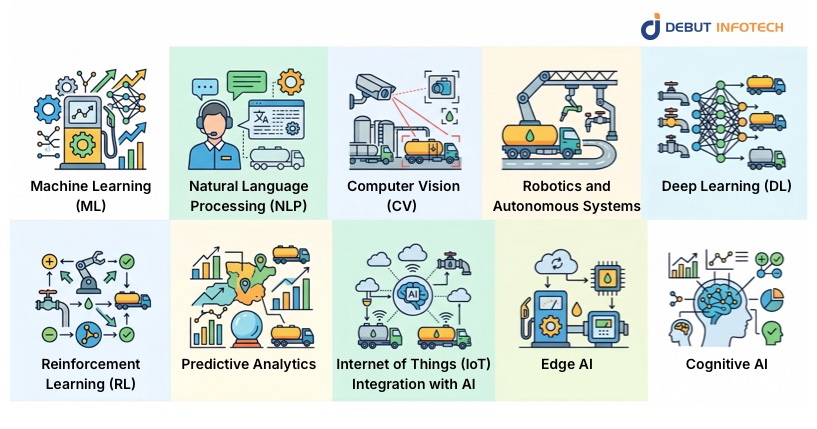
1. Machine Learning (ML)
Machine learning forms the backbone of predictive analytics in fuel distribution. Machine learning algorithms analyze historical consumption data, regional demand trends, weather patterns, and operational metrics to generate accurate forecasts. Over time, these algorithms continuously learn from new data, improving accuracy and adaptability. ML optimizes inventory levels, reduces stockouts, prevents overstocking, and enables smarter resource allocation across the supply chain.
Applications:
- Predictive demand forecasting across regions.
- Inventory optimization to minimize costs.
- Anomaly detection in fuel usage patterns.
2. Natural Language Processing (NLP)
NLP allows AI systems to understand, interpret, and analyze textual data from reports, news, regulatory updates, and social media. In fuel distribution, NLP extracts actionable insights from market trends, supplier communications, and policy changes, helping companies make informed decisions. By understanding external factors that affect fuel pricing and supply, NLP enhances strategic planning and procurement efficiency.
Applications:
- Real-time monitoring of market trends and news.
- Assessing supplier performance through textual data.
- Identifying potential supply chain risks from unstructured data.
3. Computer Vision (CV)
Computer vision enables AI systems to interpret visual information from cameras, drones, and IoT sensors. In fuel distribution, CV monitors storage tanks, pipelines, and delivery vehicles to detect leaks, spills, or operational anomalies. Real-time visual analysis allows immediate intervention, improving safety standards and reducing human error.
Applications:
- Leak and spill detection in storage and transport.
- Monitoring operational safety compliance.
- Automated inspection of infrastructure and equipment.
4. Robotics and Autonomous Systems
AI-powered robots and autonomous vehicles are increasingly used to perform routine, high-risk, or labor-intensive tasks in fuel distribution. These robots handle inventory management, equipment inspection, fueling, and monitoring tasks with precision, reducing human exposure to hazardous conditions. Autonomous systems, such as self-driving tankers, optimize delivery routes and schedules while improving operational efficiency.
Applications:
- Autonomous fuel delivery vehicles and drones.
- Automated maintenance and inspection of pipelines and storage tanks.
- High-risk task automation to enhance workforce safety.
5. Deep Learning (DL)
Deep learning leverages neural networks to detect complex patterns in large datasets, surpassing traditional ML methods in predictive accuracy. In fuel distribution, deep learning is applied to route optimization, demand forecasting, anomaly detection, and predictive maintenance. It is especially effective in identifying non-linear trends and correlations that human analysts might miss.
Applications:
- Optimizing fuel distribution routes in real time.
- Advanced demand forecasting with multi-factor analysis.
- Predicting equipment failures before breakdowns occur.
6. Reinforcement Learning (RL)
Reinforcement learning allows AI systems to learn optimal strategies through trial and error in simulated environments. In fuel distribution, RL can optimize complex operations such as dynamic pricing, fleet routing, and resource allocation under changing conditions. By continuously adapting strategies based on feedback, RL enhances operational efficiency and cost-effectiveness.
Applications:
- Real-time optimization of delivery schedules.
- Dynamic adjustment of fuel pricing strategies.
- Resource allocation under variable market conditions.
7. Predictive Analytics
Predictive analytics uses statistical modeling and AI algorithms to anticipate future trends, behaviors, and operational outcomes. In fuel distribution, it forecasts demand spikes, identifies potential supply chain disruptions, and anticipates maintenance needs. Integrating predictive analytics ensures proactive decision-making and reduces operational downtime.
Applications:
- Anticipating peak fuel demand periods.
- Predictive maintenance scheduling for tanks and vehicles.
- Forecasting regional supply chain bottlenecks.
8. Internet of Things (IoT) Integration with AI
IoT devices collect real-time data from tanks, pipelines, delivery trucks, and storage facilities. When combined with AI, IoT enables continuous monitoring, predictive insights, and automated actions. This integration ensures operational visibility, early anomaly detection, and precise resource control.
Applications:
- Real-time fuel level monitoring and leak detection.
- Optimizing pump and pipeline energy consumption.
- Fleet tracking and performance analytics.
9. Edge AI
Edge AI processes data locally on devices rather than sending it to central servers. In fuel distribution, Edge AI allows real-time decision-making for critical operations, reducing latency and improving responsiveness. It is particularly useful for autonomous vehicles, remote monitoring, and emergency response systems.
Applications:
- Instant detection of leaks or safety breaches on-site.
- Local optimization of vehicle routes and fuel delivery.
- Autonomous operational adjustments in remote or high-risk areas.
10. Cognitive AI
Cognitive AI mimics human reasoning and decision-making, integrating data from multiple sources to suggest optimal actions. In fuel distribution, it can prioritize deliveries, assess risk factors, and guide strategic planning by considering both quantitative and qualitative inputs.
Applications:
- Intelligent decision support for supply chain management.
- Risk assessment and mitigation in real time.
- Scenario planning for market or environmental changes.
How Debut Infotech Can Help You Implement AI in Fuel Distribution Control
Debut Infotech empowers fuel distribution companies to harness advanced AI technologies to transform operations into intelligent, safe, and highly efficient systems. By combining deep industry expertise with cutting-edge AI capabilities, we deliver solutions that optimize decision-making, reduce operational costs, and improve overall performance.
- Strategic AI Consulting & Adaptive AI: We assess your existing fuel distribution workflows and design a tailored AI roadmap. Using Adaptive AI, our solutions learn continuously from operational data, adjusting strategies in real time to maximize efficiency and minimize disruptions.
- Predictive Analytics & Machine Learning: We develop ML models and LLM (Large Language Models) that forecast fuel demand, optimize inventory, and detect anomalies. By analyzing historical and real-time data, these models reduce stockouts, prevent overstocking, and ensure seamless distribution.
- Route & Fleet Optimization: Leveraging AI Copilot systems, we implement dynamic route planning and fleet management solutions. AI Copilot guides logistics teams with real-time recommendations, reducing fuel consumption, delivery delays, and operational inefficiencies.
- Real-Time Monitoring & IoT Integration: Our AI-powered IoT solutions track pipelines, storage tanks, and vehicles. Combined with computer vision, predictive alerts, and Chatbot development for real-time operational reporting, these systems enhance safety, compliance, and issue resolution.
- Automation & Robotics: AI-driven robotics handle inspections, maintenance, and high-risk operations, minimizing human intervention while boosting accuracy and reliability.
- NLP Development & Market Intelligence: Through NLP development, AI systems interpret reports, news, and market trends to guide procurement decisions, pricing strategies, and supply chain planning.
- Scalable & Future-Ready AI Solutions: All our AI implementations are designed to scale with business growth, continuously optimized to meet evolving operational demands and market challenges.
Partnering with Debut Infotech allows fuel distribution companies to achieve enhanced operational efficiency, predictive decision-making, improved safety, and superior customer satisfaction, leveraging modern AI technologies like LLMs, Chatbots, Adaptive AI, and AI Copilot for next-level performance.
Ready to Modernize Your Fuel Operations?
Adopt AI-driven systems that bring precision forecasting, intelligent routing, and real-time visibility to every stage of your fuel distribution network. Build efficiency, cut waste, and stay ahead of market shifts with confidence.
Bottomline
AI plays a critical role in modern fuel distribution, moving operations from manual, reactive methods to data-driven decision-making. Through AI development services, companies can implement predictive analytics, agentic AI, NLP, computer vision, and AI-enabled IoT solutions to forecast demand, optimize routes, manage inventory, and maintain regulatory compliance efficiently. These systems help reduce operational costs, minimize fuel wastage, and improve safety, sustainability, and overall efficiency across the supply chain.
From refining and storage to transportation and retail delivery, AI provides real-time monitoring, predictive maintenance, and automated decision support, allowing businesses to respond quickly to market fluctuations and operational challenges. Fuel distributors using AI-driven solutions achieve better customer satisfaction, lower risks, and meet environmental standards consistently. Overall, adopting AI development services supports long-term operational efficiency, cost control, and strong competitive positioning in the evolving energy and fuel distribution sector.
FAQs
Q. How can AI optimize the overall fuel supply chain?
A. AI use cases help improve fuel supply chain management by analyzing consumption patterns, delivery schedules, and inventory data. Artificial intelligence technology provides insights that enhance operational efficiency, reduce delays, and streamline logistics. Companies can identify bottlenecks, optimize routes, and ensure fuel is available where and when it’s needed, improving overall distribution performance.
Q. Can AI accurately forecast regional fuel demand patterns?
A. Product demand forecasting powered by AI allows businesses to predict regional fuel needs based on historical data and market trends. By understanding patterns in consumption and seasonal variations, companies can plan deliveries more effectively. This approach reduces overstocking or shortages, ensures timely supply, and supports efficient allocation across multiple depots or regions.
Q. How does AI improve fleet routing efficiency and scheduling?
A. Fuel supply management benefits from AI-driven fleet optimization, which evaluates traffic conditions, vehicle capacities, and delivery priorities. This minimizes fuel consumption, reduces travel time, and lowers operational costs. AI/ML models provide actionable insights for scheduling, ensuring fleets operate efficiently while meeting deadlines and maintaining high service reliability.
Q. Can AI detect pipeline leaks or operational anomalies early?
A. Artificial intelligence technology can continuously monitor pipelines, storage tanks, and vehicles for irregularities. AI detects leaks, abnormal consumption, or potential equipment failures before they escalate, allowing proactive maintenance. This reduces downtime, prevents accidents, and supports safety compliance while keeping fuel supply chain operations running smoothly and reliably.
Q. How can NLP analyze market trends and competitor pricing?
A. AI-powered market research uses NLP development to scan news, reports, and social media for insights into fuel markets and competitor pricing. These insights help businesses adjust procurement strategies, optimize pricing, and stay ahead of market shifts. Fuel supply chain managers can make informed decisions with timely, data-driven guidance.
Q. Can AI manage inventory across multiple depots effectively?
A. Fuel supply chain management software integrated with AI can track stock levels across depots, predict future demand, and recommend restocking schedules. AI ensures balanced inventories, prevents shortages or overstock, and enhances operational efficiency. By analyzing data in real-time, companies gain better visibility and control over fuel resources across all locations.
Q. How does AI support predictive maintenance for critical equipment?
A. Predictive maintenance powered by AI monitors storage tanks, pipelines, and vehicles to anticipate failures. Early detection of potential problems reduces repair costs and downtime. By implementing AI solutions, companies can maintain operational reliability, enhance safety, and ensure uninterrupted fuel supply chain activities. AI Consultants can guide deployment for the best results.
Q. How can AI ensure full regulatory compliance and safety?
A. AI algorithms track operational data against industry regulations and safety standards, alerting managers to potential issues. With AI, companies can automate reporting, monitor compliance continuously, and reduce the risk of violations. This ensures safe, legal, and efficient fuel distribution while supporting long-term operational reliability.
Q. Can AI Copilot assist real-time operational decision-making?
A. AI Copilot tools provide real-time recommendations for fleet deployment, supply allocation, and inventory adjustments. Managers receive data-driven guidance to make timely decisions, improving responsiveness across the fuel supply chain. By collaborating with AI development services, companies can implement smart assistants that enhance operational visibility and reduce decision-making delays.
Q. How can AI reduce transportation costs and delivery delays?
A. AI algorithms optimize routing, vehicle deployment, and delivery scheduling to reduce travel time and fuel consumption. Intelligent planning ensures efficient resource allocation, minimizes delays, and lowers operational costs. Fuel distribution operations benefit from smoother logistics and higher service reliability, supporting consistent supply to all locations.
Q. Can AI predict refinery fuel quality and blending accuracy?
A. AI models analyze refinery inputs and operational variables to predict fuel quality and blending outcomes. Accurate predictions prevent off-spec production, reduce waste, and ensure compliance with quality standards. Integrating AI in fuel supply management helps maintain consistent product quality while improving refinery efficiency.
Q. How does AI guide pricing strategy and procurement planning?
A. AI-powered market analysis evaluates historical prices, consumption trends, and competitor behavior to optimize procurement strategies. Fuel supply chain managers can adjust pricing, plan purchases efficiently, and reduce risk. This data-driven approach enhances profitability, minimizes cost volatility, and strengthens operational planning across supply networks.
Q. Can AI integrate with existing ERP and IoT systems seamlessly?
A. AI development companies provide solutions that integrate seamlessly with ERP platforms and IoT devices. Real-time sensor data is analyzed to improve inventory tracking, operational efficiency, and fleet performance. Companies benefit from actionable insights, better resource allocation, and enhanced fuel supply chain management without disrupting existing systems.
Q. What is the typical timeline for developing fuel distribution management software?
A. The development timeline for fuel distribution management software depends on project scope, features, and integrations. Basic systems may take 3–4 months, while complex solutions with AI-powered analytics, fleet management, and inventory tracking can require 6–9 months or more. Engaging experienced AI Consultants and developers ensures realistic scheduling, efficient milestones, and timely delivery without compromising software quality.
Q. How much does it cost to develop fuel distribution management software?
A. Software development costs vary based on complexity, customization, and technology stack. Simple solutions can start at a moderate budget, whereas fully-featured platforms with AI modules, predictive analytics, and IoT integration may cost significantly more. Factors such as hiring AI Developers, security protocols, and deployment scale influence the final investment. Proper planning ensures a cost-effective solution aligned with operational needs.
Talk With Our Expert
Free 30-min consultation. No commitment.
Our Related Insights


Talk With Our Expert
LET'S WORK TOGETHER
Your Vision.
Our Engineering.
Debut Infotech works as a strategic co-creator — from concept to production-ready platform. We deliver blockchain, AI, enterprise, & mobile solutions that scale.

15+ Years · 500+ Platforms Delivered
Across blockchain, AI, fintech, mobile, and enterprise verticals

NDA Signed on Day One
Your IP and project details are protected before any conversation begins

48-Hour Scoped Estimate
A real technical estimate — not a generic template or sales pitch

Dedicated Account Managers
Available across key global time zones
 +1 708-515-4004 (USA)


