ON THIS PAGE
Progress0%





Our Global Presence :






In 2026, AI Agents for developers are redefining how software gets built, moving teams from manual execution toward autonomous workflows.
Around 84% of developers now use or plan to use AI tools in software work, showing deep integration into coding and delivery processes. These systems handle tasks such as code generation, testing, and documentation, accounting for roughly 41% of all code produced in real projects.
Productivity gains are significant: developers report increases of 25–39% when leveraging AI tools for routine work.
As a result, development teams spend less time on repetitive chores and more on design, architecture, and strategic decision-making. This shift is changing roles, expectations, and standards across engineering organizations worldwide.
In this guide, we will explain the impact of AI agents on developers’ experience, how they function, their use cases in daily developers’ workflows, their challenges and limitations, and their future outlook.
AI agents for developers are software systems designed to plan, act, and adapt with minimal human input. They go beyond code suggestions and handle tasks end-to-end. A developer sets a goal, constraints, and access rules. The agent then breaks work into steps, uses tools, checks outcomes, and iterates. This shift changes development from constant manual control to guided supervision. Teams spend more time reviewing decisions and less time executing repetitive tasks.
Early developer tools focused on autocomplete and linting. Then came coding assistants that explained errors and generated snippets on request. By 2026, agents coordinate multiple actions across repositories, services, and environments.
Advances in planning AI models, long-term memory, and tool orchestration made this possible. Agents now track project state, understand dependencies, and adapt to feedback. This evolution reflects a move from reactive help to proactive execution with guardrails.
AI agents operate through structured processes that translate intent into action, combining planning, execution, validation, and feedback to function reliably within real-world development environments.
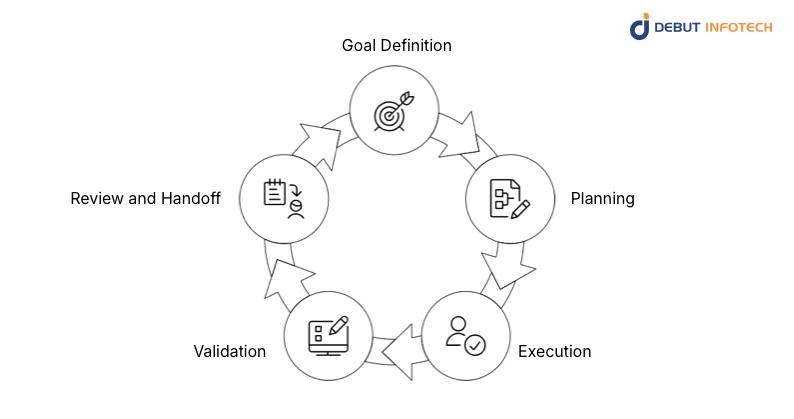
The most reliable AI agent developer for crm defines the goal, constraints, success criteria, and access limits. This context guides every decision the agent makes, prevents scope creep, and clarifies what trade-offs are acceptable before any planning or execution begins safely.
The agent breaks the objective into ordered tasks, evaluates dependencies, selects tools, and estimates outcomes. Planning remains adaptive, meaning the agent can revise steps when tests fail, inputs change, or new constraints appear during execution.
With permissions in place, the agent executes tasks by writing code, modifying files, running commands, calling APIs, and interacting with services. Actions follow predefined rules to reduce risk while maintaining speed and consistency across environments.
The agent validates results using tests, logs, static analysis, and monitoring feedback. When outcomes miss expectations, it diagnoses causes, retries solutions, or escalates issues, ensuring progress aligns with quality standards and project requirements defined earlier.
After execution, the best AI agent developer for crm reviews changes, decisions, and supporting evidence. They approve, reject, or redirect the agent’s work, creating a feedback loop that improves future performance and keeps human accountability central to the workflow process.
Read this blog: How AI Agents Are Transforming The Software Development Industry
As AI tools mature, clear distinctions are emerging between systems that assist developers and those that actively execute work with limited supervision.
AI Agents
AI agents operate with high autonomy, executing tasks independently once goals and constraints are defined. They plan actions, adjust strategies based on outcomes, and continue working without constant prompts, making them suitable for long-running or multi-step development workflows.
Coding Assistants
Coding assistants rely on direct developer input for every action. They respond to prompts, suggestions, or questions but do not initiate tasks on their own. Their role stays reactive, supporting developers moment by moment rather than driving work forward independently.
AI Agents
AI agents handle complex workflows involving multiple steps, tools, and dependencies. They can manage interconnected tasks across repositories, environments, and systems, maintaining context throughout execution while adapting plans as new information or constraints emerge during development.
Coding Assistants
Coding assistants focus on narrow, well-defined tasks, such as generating snippets or explaining errors. They work best within limited scopes and struggle with workflows that require coordination across files, tools, or extended timelines without repeated human guidance.
AI Agents
AI agents maintain long-term interaction by tracking project state, decisions, and progress over time. They engage in ongoing collaboration, using feedback loops to refine outputs and improve future actions without restarting context for each interaction.
Coding Assistants
Coding assistants interact in short, isolated exchanges. Each prompt often resets context, requiring developers to restate goals or background information. This limits their effectiveness for extended problem-solving or for tasks spanning multiple development sessions.
AI Agents
Specialized AI agents actively use tools such as version control systems, testing frameworks, CI pipelines, and cloud services. They execute commands, modify files, and interact with external systems directly, enabling real-world task completion beyond code generation alone.
Coding Assistants
Coding assistants have limited tool interaction. They typically generate code or explanations but do not run commands, deploy services, or modify systems directly. Tool usage remains indirect, with developers responsible for execution and integration.
AI Agents
AI agents make decisions based on goals, constraints, and observed outcomes. They evaluate options, choose next steps, and revise plans when results differ from expectations, enabling adaptive behavior across uncertain or evolving development conditions.
Coding Assistants
Coding assistants do not make independent decisions. They provide suggestions based on prompts but leave judgment entirely to the developer. Any prioritization, trade-off evaluation, or corrective action depends on explicit human direction.
AI Agents
AI agents are well-suited for automation-heavy use cases such as refactoring large codebases, managing releases, maintaining pipelines, and coordinating tasks across teams. Their strength lies in executing workflows that would otherwise demand sustained developer attention.
Coding Assistants
Coding assistants excel at individual productivity tasks, including writing functions, explaining errors, generating tests, or learning new APIs. They support developers during hands-on coding but are less effective for orchestration or end-to-end automation.
AI Agents
Examples of AI agents include automated release managers, refactoring bots, test maintenance agents, and infrastructure coordination agents. These systems operate continuously, tracking progress and executing tasks across multiple tools with minimal intervention.
Coding Assistants
Examples of coding assistants include autocomplete engines, inline code suggestion tools, and chat-based helpers. They assist during active development sessions, offering guidance and snippets while leaving execution, validation, and coordination to developers.
Related Reads: AI Agents Vs AI Assistants
The best AI agents for developers accelerate delivery by handling tasks in parallel, from code generation to testing and deployment checks. They reduce waiting time between steps, shorten feedback loops, and help teams ship features faster without sacrificing review quality or engineering discipline across complex projects.
By taking over repetitive and procedural tasks, AI agents free developers from constant context switching. Engineers spend less mental energy on setup, maintenance, and troubleshooting, allowing them to focus on design decisions, architecture, and solving problems that require human judgment and experience.
AI agents apply coding standards, formatting rules, and testing practices consistently across projects. This reduces variation caused by individual habits, improves readability, and lowers review friction. AI agent development companies for smbs benefit from cleaner codebases that are easier to maintain, audit, and scale over time.
Senior developers often spend time on tasks that do not require deep expertise. AI agents absorb much of this workload, allowing experienced engineers to focus on architecture, mentoring, and technical strategy, where their impact is higher and more complex to automate effectively.
AI agents help new AI Agents Companies ramp up faster by setting up environments, explaining codebases, and guiding early tasks. This shortens onboarding cycles, reduces dependency on teammates for basic help, and helps new hires contribute meaningfully sooner without slowing existing teams.
As teams and codebases grow, manual coordination becomes harder. Top AI agent for software development scales operational tasks across repositories and environments, supporting consistent processes without adding headcount. This makes it easier for organizations to manage complexity while maintaining predictable development workflows.
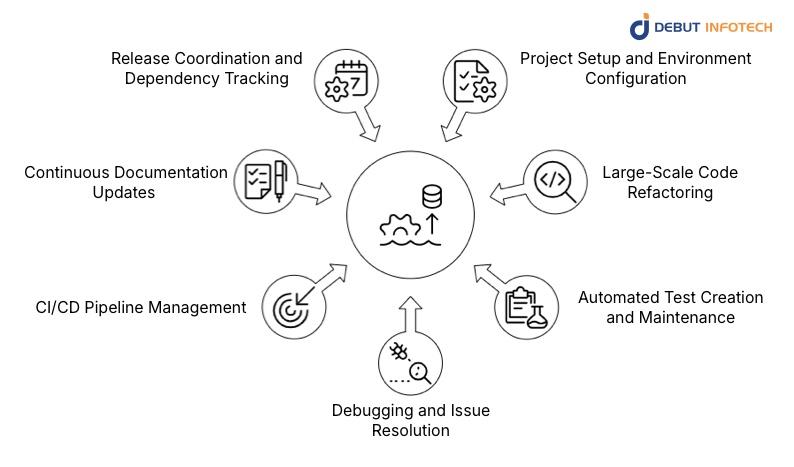
AI agents can initialize new projects by selecting frameworks, installing dependencies, configuring environments, and aligning settings with team standards. They reduce setup errors, save hours of manual work, and ensure consistency across development, staging, and production environments, especially for teams managing multiple repositories or onboarding new developers frequently.
AI agents handle complex refactoring across large codebases by analyzing dependencies, updating interfaces, and maintaining backward compatibility. Voice AI agents for developers apply changes consistently across files, run tests to validate outcomes, and flag risky modifications. This helps teams modernize legacy systems faster while minimizing regression risks and review overhead.
AI agents generate unit, integration, and regression tests based on code behavior and recent changes. As features evolve, they update outdated tests and identify coverage gaps. This keeps test suites relevant, reduces flaky tests, and supports continuous delivery without placing extra burden on developers during tight release cycles.
AI agents investigate bugs by reproducing issues, analyzing logs, tracing execution paths, and comparing expected versus actual behavior. They propose fixes, validate solutions through tests, and document findings. This reduces incident resolution time and allows developers to focus on complex logic rather than repetitive troubleshooting.
The best AI agents for developers monitor build pipelines, detect failures, and diagnose root causes across tools and environments. They adjust configurations, retry jobs, or suggest fixes when dependencies break. This keeps delivery pipelines stable, reduces downtime, and prevents minor configuration errors from blocking releases across teams and projects.
AI agents update documentation automatically as code changes. They revise API references, README files, and architectural notes to match current behavior. This keeps documentation accurate, improves knowledge sharing, and reduces the common gap between implementation and written guidance that often slows onboarding and maintenance work.
AI agents track feature readiness, dependency changes, and unresolved issues across repositories. They coordinate release steps, alert teams to conflicts, and verify that required checks are complete. This structured oversight reduces last-minute surprises and supports smoother, more predictable release cycles in complex software projects.
AI agents for developers can act quickly and broadly, which makes oversight critical. Without clear review checkpoints, small errors may scale across repositories or systems. Developers must design approval flows, monitoring, and rollback mechanisms to maintain trust and prevent silent failures over time in production environments at scale.
Agents rely on extensive tool access, including codebases, infrastructure, and external services. Poorly defined permissions increase security risk and operational damage. Teams need granular access control, auditing, and isolation to ensure agents operate safely within strict organizational boundaries across environments and teams over the long term.
AI agents often make decisions that are hard to trace step by step. When outcomes are wrong, understanding why an agent chose a path can be time-consuming. This lack of transparency complicates debugging, auditing, and compliance efforts in regulated environments and large organizations with complex systems.
Running the best AI agent for web development continuously across projects can increase compute, API, and infrastructure costs. Long-running tasks, retries, and monitoring add overhead. Without usage limits and AI agent development cost tracking, teams may struggle to justify return on investment at scale, especially in large, distributed engineering organizations with multiple active agents.
AI agents for application developers still depend on the quality of prompts, policies, and training data. Ambiguous goals or weak constraints lead to poor decisions. Human judgment remains necessary to define intent, resolve edge cases, and guide agents through complex product trade-offs during real-world development cycles over time.
Agentic AI for developers will integrate more tightly with planning tools, design systems, DevOps platforms, and monitoring services. This end-to-end visibility allows agents to make better decisions, align development with product goals, and coordinate work across engineering, operations, and product teams.
Future AI agents will operate under clearer governance frameworks, including policy enforcement, audit trails, and decision logs. This improves trust, supports compliance needs, and gives teams confidence that agent-driven actions align with organizational standards and regulatory requirements.
Instead of general-purpose tools, teams will adopt agents tailored to specific industries, architectures, and technology stacks. These agents understand domain rules and constraints, producing more reliable outcomes and reducing the need for constant correction or supervision by developers.
As AI agent platforms for developers handle execution and coordination, developer roles will shift toward oversight, system design, and strategic decision-making. Engineers will act more as conductors than operators, guiding intelligent systems while remaining accountable for outcomes and product direction.
Debut Infotech offers custom AI agent development services. We work closely with engineering teams to design AI agents that fit real development workflows. The focus stays on reliability, security, and measurable impact, not demos.
From planning systems to production-ready agent architectures, our team builds solutions that automate complex tasks while keeping developers firmly in control. This practical approach helps organizations adopt AI agents without disrupting existing processes or increasing operational risk across software delivery pipelines.
AI Agents for developers are moving from novelty to necessity, automating complex tasks and improving how software is built. Teams gain speed, consistency, and better resource allocation without surrendering oversight or quality.
As developers and organizations refine agent use, these systems will continue to shape workflows, responsibilities, and project outcomes, marking a significant evolution in software engineering practice heading beyond 2026.
A. Traditional automation follows fixed rules. AI agents adapt as conditions change. They reason through tasks, handle unexpected inputs, and learn from outcomes. For developers, this means fewer brittle workflows and more flexible systems that can adjust without constant manual reconfiguration.
A. Developers use AI agents to build coding assistants, autonomous testing tools, deployment bots, data analysis agents, and customer support systems. These agents can read documentation, write or review code, trigger actions across services, and manage multi-step processes without constant supervision.
A. Development time depends on complexity. A basic AI agent can take 4–6 weeks to develop. More advanced agents with integrations, memory, and decision logic often take 3–5 months to build. Custom workflows, security layers, and testing cycles usually extend timelines further.
A. The cost to develop AI agents typically ranges from $20,000 to $80,000 for production-ready solutions. Simple agents sit at the lower end. Advanced agents with custom models, integrations, and scalability requirements drive higher costs due to engineering and infrastructure requirements.
A. Building AI agents usually requires backend development skills, API integration experience, basic prompt engineering, and familiarity with AI models. Knowledge of Python, JavaScript, or similar languages helps. Understanding system design and data handling also makes agent behavior more reliable and predictable.

Our Latest Insights

USA
2501 Chatham, Rd Suite R Springfield, IL 62704
+1-708-515-4004
info@debutinfotech.com
UK
7 Pound Close, Yarnton, Oxfordshire, OX51QG
+44-770-304-0079
info@debutinfotech.com
Canada
154 Eden Oak Trail, Kitchener, ON N2A 0H9
+1-708-515-4004
info@debutinfotech.com
INDIA
Sector 101-A, Plot No: I-42, IT City Rd, JLPL Industrial Area, Mohali, PB 140306
9888402396
info@debutinfotech.com