ON THIS PAGE
Progress0%




Our Global Presence :





More and more businesses across all fields are using AI agents to automate processes, make better decisions, and grow without spending more money. AI agents are becoming an important part of modern digital systems. They can automate customer assistance and intelligently manage processes. As more and more companies start using AI agents, the question is no longer whether to employ them, but how to find the best AI agents development company in India that can provide solutions that are safe, dependable, and scalable.
India is becoming a global center for AI engineering talent. More and more AI agent development businesses are offering services in automation, analytics, and corporate AI. But not all providers have the same level of technical knowledge or strategic maturity. This book shows organizations how to choose the best AI agent development partner in India by identifying the most important technical and operational variables and how to avoid costly mistakes.
AI agents are becoming used for more than just experiments. They are currently being used to do tasks, make judgments based on context, and talk to systems and users in real time. AI agents can change their behavior based on new information, learn from feedback, and work in different settings. Traditional automation scripts can’t do these things.
Common AI use cases include:
As companies develop these use cases, they need more and more AI agents that are tailored for specific operational situations. This change makes it much more important to choose an AI agent development company that has demonstrated architecture knowledge, not just competence with AI tools on the surface.
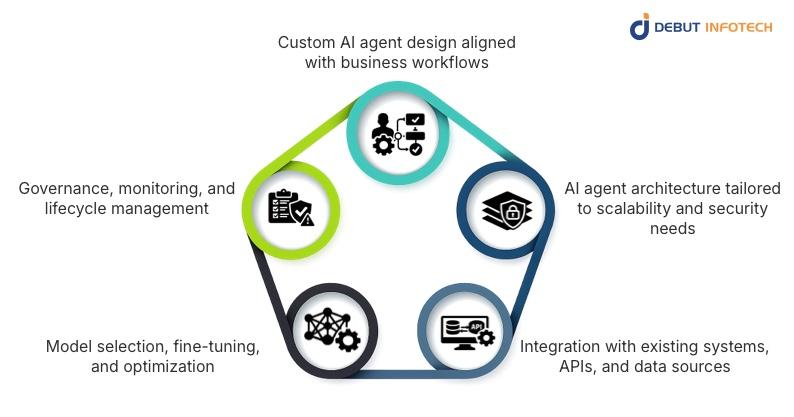
Before comparing vendors, it’s important to clarify what a professional AI agent development company in India should provide beyond basic implementation.
A capable provider typically delivers:
Effective AI agents are designed around business processes, not generic prompts or templates. A professional development partner begins by understanding how work flows across teams, systems, and decision points. This ensures agents support real operational goals, such as reducing manual effort, improving response accuracy, or accelerating internal processes.
Architecture defines whether an AI agent can scale safely over time. A competent provider designs modular AI agent architectures that separate logic, memory, models, and tool execution layers. This approach allows agents to evolve without disrupting the entire system.
AI agents rarely operate in isolation. They must interact with CRMs, ERPs, internal dashboards, databases, and third-party platforms. Strong integration capability ensures agents can access the right data at the right time while respecting access controls and data policies.
Choosing the right AI models is not a one-time decision. Skilled providers evaluate multiple model options based on accuracy, latency, cost, and deployment constraints. In some cases, fine-tuning or domain adaptation is required to achieve acceptable performance.
Production AI agents require continuous oversight. Governance mechanisms define how agents behave, what actions they are allowed to perform, and how decisions are audited. Monitoring systems track performance, detect anomalies, and surface issues before they affect users.
Many AI agents companies claim end-to-end capability, but in practice, their strengths may be limited to either model usage or frontend automation. Businesses should assess depth across the full AI agent lifecycle, from architecture to post-deployment support.
Choosing the best AI agents development company in India requires evaluating multiple dimensions simultaneously. Focusing on a single factor—such as cost or portfolio size—often leads to suboptimal outcomes.
| Evaluation Area | Why It Matters |
| Technical depth | Determines scalability and reliability |
| Architecture expertise | Ensures long-term maintainability |
| Security practices | Protects data and models |
| Industry experience | Reduces implementation risk |
| Team composition | Impacts execution quality |
Each of these areas should be assessed through evidence, not marketing claims.
AI agents are only as effective as the architecture supporting them. A strong development partner must demonstrate hands-on experience with AI agent architecture, not just AI model integration.
Key architectural considerations include:
Teams that lack architectural depth often build tightly coupled agents that are difficult to scale or adapt. When evaluating vendors, businesses should ask how their agents handle failure states, long-running tasks, and multi-agent coordination.
AI agent performance depends heavily on the selection and orchestration of AI models and AI algorithms. A capable partner should demonstrate flexibility across:
In addition, familiarity with modern AI tools and frameworks is essential for building production-ready agents. Companies that rely on a narrow toolset may struggle as requirements evolve.
As AI agents gain access to sensitive systems and data, security becomes a primary concern. Businesses should prioritize vendors that design secure AI agents by default, rather than treating security as an afterthought.
Key security and governance aspects include:
An experienced AI agent development company will also help businesses align agent behavior with internal policies and regulatory expectations.
Not all providers operate with the same business focus. Understanding vendor categories helps narrow the shortlist.
| Company Type | Typical Strengths | Limitations |
| AI-first startups | Innovation, speed | Limited enterprise scale |
| Large IT firms | Process maturity | Slower iteration |
| Specialized AI agents companies | Deep agent expertise | Narrow service scope |
| Full-service AI development services firms | End-to-end delivery | Requires careful vetting |
For most enterprises, top AI agent development firms for business automation balance technical depth with delivery maturity, offering both customization and operational stability.
AI agent development cost varies significantly based on complexity, autonomy level, and integration scope. Businesses should evaluate pricing in context, not isolation.
| Cost Factor | Impact on Pricing |
| Agent complexity | High |
| Number of integrations | Medium–High |
| Custom model work | High |
| Security requirements | Medium |
| Ongoing support | Variable |
Lower upfront costs may indicate limited scope or reusable templates. Businesses planning long-term automation should assess total cost of ownership, including monitoring, updates, and scaling.
The quality of an AI agent solution depends heavily on the team building it. Strong providers combine:
For organizations planning internal expansion, the option to hire AI agent developers or collaborate with a dedicated team can offer flexibility. Transparent communication and iterative delivery models are critical for success.
One of the most reliable ways to assess an AI agent development company in India is by examining how they’ve handled real-world deployments. Case studies, when done well, reveal far more than marketing claims.
Instead of focusing on surface-level metrics like “number of projects delivered,” businesses should look for evidence of:
Strong providers explain why certain design choices were made, not just what was delivered. This level of transparency signals architectural maturity and long-term thinking.
AI agents behave differently depending on industry context. An agent built for customer support automation differs significantly from one managing internal workflows or data analysis pipelines.
When reviewing vendors, businesses should evaluate alignment with relevant AI use cases, such as:
Providers with cross-industry exposure are often better equipped to anticipate edge cases and scalability challenges. However, depth in a specific domain can be equally valuable when requirements are highly specialized.
Enterprise adoption of artificial intelligence has accelerated sharply over the past few years. According to a McKinsey report, more than 75% of companies now use AI in at least one business function, marking a significant increase from the previous year. This rapid adoption reflects how AI—particularly AI agents—is moving from experimentation to real operational use.
At the same time, the AI agent market itself is expanding at a remarkable pace. Research from Grand View Research estimates the global AI agent market was valued at approximately $5.40 billion in 2024, with projections suggesting it could grow to over $50 billion by 2030. This growth highlights how autonomous and semi-autonomous agents are becoming foundational to business automation, customer engagement, and decision support.
However, increased adoption also brings higher risk. Gartner’s research offers a cautionary perspective, predicting that more than 40% of AI agent initiatives could fail by 2027, largely due to poor vendor selection, unclear expectations, and weak implementation planning. These figures underline an important reality: success with AI agents depends as much on choosing the right development partner as it does on the technology itself.
With so many AI agent development companies in India entering the market, businesses often struggle to separate proven expertise from surface-level claims. This makes a structured, criteria-driven approach to selecting the right AI agent development company essential for minimizing risk and maximizing long-term value.
Not all vendors who market AI agent services are equipped to deliver production-grade solutions. Certain warning signs consistently appear during failed engagements.
| Red Flag | Why It’s a Risk |
| Overreliance on a single model | Limits flexibility and optimization |
| No clear agent architecture | Leads to scalability issues |
| Vague security practices | Increases compliance risk |
| Fixed, inflexible scopes | Poor adaptability |
| No post-deployment support | Long-term instability |
Companies that cannot clearly explain how their agents handle failure states, updates, or monitoring often lack real deployment experience.
Many successful implementations involve AI consultants early in the process. Consultants help translate business objectives into technical requirements and ensure AI agents align with operational realities.
An AI agent development partner that offers consulting capabilities can:
This advisory layer is particularly important for enterprises adopting AI agents at scale or integrating them into mission-critical systems.
AI agents are not “build once and forget” systems. Over time, models evolve, tools change, and business processes shift. Vendors must demonstrate a clear approach to:
Businesses evaluating AI agent development companies in India should ask how agents are maintained post-launch and how updates are handled without disrupting operations.
Once businesses narrow down potential partners, a structured comparison helps support final decisions.
| Comparison Dimension | Questions to Ask |
| Architecture | How are agents designed and orchestrated? |
| Security | How is data access controlled and logged? |
| Flexibility | Can agents evolve with new tools or models? |
| Team | Who builds and maintains the agents? |
| Cost | What is the total cost of ownership? |
This comparison should prioritize alignment with long-term goals rather than short-term savings.
At Debut Infotech, AI agent development is approached as an engineering and strategy discipline—not just an implementation task. The focus is on building agents that are secure, scalable, and aligned with real business workflows.
Our teams design AI agents using modular architectures that support:
By combining AI development services with consulting-led discovery, we help businesses deploy AI agents that deliver measurable operational value while remaining adaptable to future change.
Choosing the best AI agents development company in India ultimately comes down to alignment. Technical skill, architectural thinking, security awareness, and collaboration models all play a role.
Businesses should prioritize partners who:
AI agents are becoming foundational to business automation strategies. Selecting the right development partner ensures these systems remain reliable, secure, and effective as organizations scale and evolve.
A. An AI agent development company in India designs, builds, and deploys intelligent agents that automate tasks, interact with systems, and make context-aware decisions. Services often include AI agent architecture design, model selection, system integration, and post-deployment support.
A. The best AI agents development company in India demonstrates strong architectural expertise, experience with real-world deployments, secure development practices, and the ability to scale and maintain AI agents over time—not just initial implementation skills.
A. AI agents are widely used across industries such as finance, healthcare, retail, logistics, SaaS, and manufacturing. Common applications include customer support automation, workflow orchestration, analytics, and developer productivity.
A. AI agent development cost depends on factors like agent complexity, number of integrations, custom model work, security requirements, and ongoing maintenance. Costs are typically higher for autonomous, enterprise-grade agents than for simple task-based implementations.
A. AI agent architecture determines how well agents scale, adapt, and integrate with other systems. Poor architecture can lead to brittle solutions, while well-designed architectures support flexibility, observability, and long-term maintainability.
A. Yes, when designed correctly. Secure AI agents include access controls, audit logging, controlled tool usage, and governance mechanisms. Choosing a development partner with strong security practices is critical for enterprise deployments.
A. Yes. Many companies choose to hire AI agent developers or work with a dedicated team model. This approach offers flexibility while still benefiting from expert guidance, architecture oversight, and AI development services.

Our Latest Insights
USA
2501 Chatham, Rd Suite R Springfield, IL 62704
+1-708-515-4004
info@debutinfotech.com
UK
7 Pound Close, Yarnton, Oxfordshire, OX51QG
+44-770-304-0079
info@debutinfotech.com
Canada
154 Eden Oak Trail, Kitchener, ON N2A 0H9
+1-708-515-4004
info@debutinfotech.com
INDIA
Sector 101-A, Plot No: I-42, IT City Rd, JLPL Industrial Area, Mohali, PB 140306
9888402396
info@debutinfotech.com