ON THIS PAGE
Progress0%






Our Global Presence :





Custom software has become a core driver of digital transformation for businesses across industries. As organizations move away from generic, off-the-shelf tools, one question consistently shapes decision-making: custom software development cost. Leaders want clarity before committing resources, yet pricing often feels complex, fragmented, and difficult to predict. That complexity is not accidental. Custom software is built around unique business needs, and its cost reflects that individuality.
Understanding the cost of custom software development requires more than a single price range. It involves analyzing scope, technology choices, development models, timelines, and long-term value. In this guide, we examine the typical cost of custom software, the factors that influence pricing, and how businesses can manage spending without compromising quality or scalability.
Custom software development cost refers to the total investment required to design, build, deploy, and maintain software tailored to specific business requirements. Unlike packaged software, custom solutions are not priced per user or on a subscription basis. Instead, they are calculated based on effort, expertise, and the complexity of the task.
Many organizations ask, how much does custom software development cost? The honest answer is that it depends. Costs vary widely depending on the type of software, the features involved, the development approach, and the geographic location of the development team. However, understanding the structure behind these costs makes budgeting more predictable and informed.
Custom software development costs should be viewed as a strategic investment. The goal is not simply to minimize spending, but to ensure that every dollar contributes to measurable business outcomes, such as increased efficiency, scalability, and a competitive advantage.
The average cost of custom software development can range significantly based on project size and complexity. While there is no universal price tag, most projects fall into three broad categories:
| Project Size | Typical Use Case | Estimated Cost Range | Complexity Level |
| Small-Scale Custom Software | Internal tools, basic web apps, simple automation solutions | Low to mid five figures | Low |
| Mid-Scale Custom Software | Business-critical apps with APIs, dashboards, and integrations | Mid to high five figures | Medium |
| Large-Scale / Enterprise Software | SaaS platforms, enterprise systems, complex multi-user applications | Six figures and above | High |
These include basic internal tools, simple web applications, or lightweight automation solutions.
These solutions often support core business operations and may include dashboards, APIs, third-party integrations, or role-based access control.
Enterprise platforms, SaaS products, or complex systems with advanced security, analytics, and integrations fall into this category.
While these ranges provide context, the true cost of building a custom solution for software development depends on deeper factors that go beyond size alone.
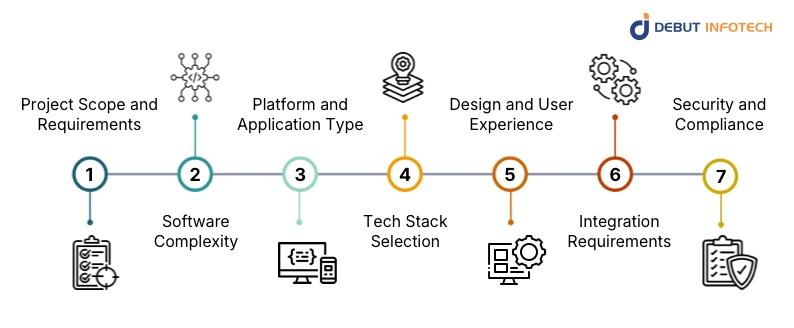
Several variables influence custom software development cost. Understanding these factors helps businesses estimate budgets more accurately and make informed trade-offs.
The number of features, user roles, workflows, and integrations directly impacts cost. Well-defined requirements reduce uncertainty and prevent scope creep, which is one of the biggest drivers of cost overruns.
Complexity is not solely determined by the number of features. It includes data processing logic, real-time capabilities, security requirements, and compliance needs. More complex systems require specialized expertise and additional testing.
The choice between web, mobile, desktop, or cross-platform solutions significantly impacts the development effort. For example, advanced web platforms or progressive applications may require specialized frameworks and performance optimization.
The chosen tech stack for web development plays a significant role in cost. Modern frameworks, cloud-native architectures, and scalable databases may increase upfront investment but reduce long-term operational expenses.
Custom UI and UX design adds value but also increases cost. Intuitive interfaces, accessibility considerations, and usability testing require dedicated design effort.
Connecting custom software with existing systems, third-party APIs, or external services adds complexity. Each integration point requires development, testing, and maintenance.
Industries such as finance, healthcare, and logistics require strong security measures and regulatory compliance. These requirements increase development time and testing efforts.
The development model chosen for a project has a direct impact on overall cost and flexibility.
| Development Model | Cost Predictability | Flexibility | Best Suited For |
| Fixed-Price Model | High | Low | Projects with clearly defined scope and minimal expected changes |
| Time and Material Model | Medium | High | Evolving projects requiring frequent adjustments and iterations |
| Dedicated Team Model | Medium | High | Long-term development, continuous improvement, and scaling needs |
This model works best for projects with clearly defined requirements and minimal expected changes.
This approach allows greater flexibility and is suitable for evolving projects.
In this model, businesses work with a dedicated software development team that functions as an extension of their internal staff.
Choosing the right model depends on project clarity, timeline, and long-term goals.
Team location plays a major role in determining the overall cost for custom software development. Hourly rates, availability of skilled talent, communication dynamics, and regulatory familiarity all vary by region. While geography alone does not define quality, it has a direct influence on pricing structures and project management requirements.
Onshore development teams are usually based in the same country as the client. They tend to have the highest hourly rates, but they also offer strong advantages in terms of real-time collaboration, shared business culture, and easier compliance with local regulations. For projects that require frequent stakeholder interaction, complex discovery phases, or strict data protection standards, onshore teams can justify the higher custom software development cost through reduced coordination overhead and faster decision-making.
Nearshore teams operate in neighboring or nearby countries, often within similar time zones. This model helps businesses reduce development costs while maintaining smooth communication and cultural alignment. Nearshore engagement is particularly effective for agile development models, where regular feedback and iteration are crucial. Many organizations see nearshore teams as a practical middle ground between cost savings and collaboration efficiency.
Offshore teams are located in distant regions with significantly lower labor costs. This approach can substantially reduce the average cost of custom software development, making it attractive for budget-sensitive or long-term projects. However, offshore development requires well-defined processes, detailed documentation, and strong project governance. Without these, communication gaps and time zone differences can offset initial cost savings.
To manage these trade-offs effectively, many companies partner with established custom software development companies that operate global delivery models. This structure allows businesses to combine strategic oversight from onshore or nearshore teams with the cost efficiency of offshore development, resulting in balanced custom software development costs without compromising quality or reliability.
Modern custom software often relies on a combination of backend systems, frontend interfaces, and cloud infrastructure. Web development services play a central role in building scalable, secure, and responsive applications.
Key cost considerations include:
For organizations building modern web applications, leveraging rapid web application development tools can reduce development time and cost while maintaining quality.
Progressive web applications combine the reach of web platforms with the functionality of native apps. Businesses increasingly invest in pwa development services to reduce development and maintenance costs.
Cost benefits of PWAs include:
While PWAs may not suit every use case, they offer a cost-effective option for many customer-facing applications.
Custom software development costs extend beyond the initial build. Long-term planning is essential to avoid unexpected expenses.
Considering these factors early ensures a more accurate understanding of the total cost of ownership.
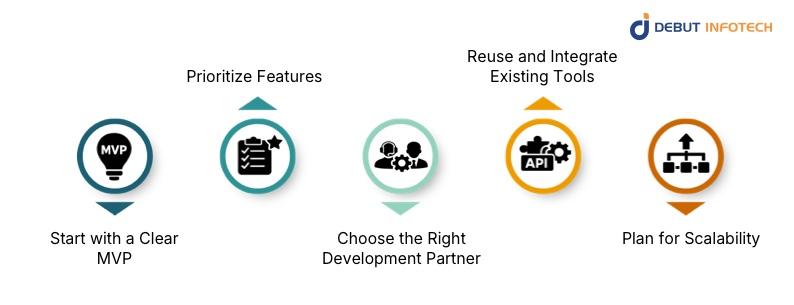
Reducing cost does not mean cutting corners. Strategic planning and execution can significantly lower expenses without sacrificing quality.
Understanding how to reduce cost of custom software development projects helps businesses maximize return on investment while maintaining flexibility.
Custom software typically costs more upfront than ready-made solutions. However, long-term value often justifies the investment.
When evaluating the cost of custom software development, businesses should consider total value rather than upfront expense alone.
Selecting the right custom software development company is one of the most important cost-related decisions. The right partner helps control budget, manage risk, and deliver long-term value.
Key evaluation criteria include:
Many organizations collaborate with established custom software development companies that provide comprehensive end-to-end services, encompassing strategy and design, deployment, and support.
Team composition influences both cost and outcomes. Businesses may choose to build internal teams or hire web developers through external partners.
Common roles include:
A well-balanced team avoids bottlenecks and reduces wasted effort, leading to more predictable costs.
Custom software is not always the most economical option initially. However, it becomes cost-effective when business needs, growth goals, and industry requirements cannot be fully supported by off-the-shelf solutions. In such cases, the cost of building a custom solution for software development is offset by the long-term benefits of increased efficiency and flexibility.
When business complexity and industry demands align, custom software development costs deliver lasting value by reducing inefficiencies and supporting sustainable growth.
Midway through many projects, businesses realize that cost control depends heavily on process discipline and technical foresight. At Debut Infotech, we focus on aligning development efforts with business goals from the start. By clarifying requirements, selecting the right architecture, and planning for scalability, we help organizations manage custom software development costs without compromising quality or future growth.
Our approach emphasizes transparency, iterative delivery, and long-term value, ensuring that clients understand not just how much development costs, but why those costs exist and how they translate into measurable outcomes.
The true value of custom software lies in its impact on operations and growth. Measuring return on investment includes:
When evaluated holistically, the average cost of custom software development often delivers returns that exceed initial expectations.
Custom software development cost is shaped by a wide range of factors, from scope and complexity to team structure and long-term strategy. There is no single price that fits every project, but there is a clear path to making informed, cost-effective decisions. By understanding cost drivers, selecting the appropriate development model, and planning for long-term ownership, businesses can transform custom software into a strategic asset rather than a financial liability.
At Debut Infotech, we believe cost clarity is as important as technical execution. Our teams work closely with organizations to define realistic budgets, reduce unnecessary spending, and build software that scales with business needs. By focusing on value, transparency, and sustainable development practices, Debut Infotech helps clients transform custom software development costs into long-term competitive advantages.
A. The average cost of custom software development varies widely based on scope, complexity, and technology. Small projects may cost tens of thousands, while enterprise-grade systems can reach six figures or more. The final cost depends on features, integrations, and long-term scalability needs.
A. Key cost factors include project scope, software complexity, platform type, tech stack selection, UI/UX design, integration requirements, security needs, and the development model used.
A. Upfront, custom software development costs are usually higher. However, custom solutions often reduce long-term expenses by eliminating license fees, improving efficiency, and scaling precisely with business needs.
A. Businesses can reduce costs by starting with an MVP, prioritizing essential features, choosing the right development partner, using proven frameworks, and planning for scalability early.
A. Yes. Development costs vary by region due to differences in labor rates. Many companies balance quality and budget by working with global custom software development companies that offer flexible engagement models.
A. The total cost includes planning, design, development, testing, deployment, and ongoing maintenance. Long-term costs such as updates, hosting, and support should also be considered.
A. Custom software becomes cost-effective when businesses need unique workflows, deep integrations, high scalability, or full ownership of their technology without dependency on third-party tools.

Our Latest Insights
USA

2501 Chatham, Rd Suite R Springfield, IL 62704
+1-708-515-4004
info@debutinfotech.com
UK

7 Pound Close, Yarnton, Oxfordshire, OX51QG
+44-770-304-0079
info@debutinfotech.com
Canada

154 Eden Oak Trail, Kitchener, ON N2A 0H9
+1-708-515-4004
info@debutinfotech.com
INDIA

Sector 101-A, Plot No: I-42, IT City Rd, JLPL Industrial Area, Mohali, PB 140306
9888402396
info@debutinfotech.com

9001:2015
Quality Certified

ISO 27001
Security Certified

A+ Rating
Accredited Business

Certik
Security & Audit


Copyright © 2026, Debut Infotech. All rights reserved. | Privacy Policy