ON THIS PAGE
Progress0%






Our Global Presence :




Does your enterprise actually need to venture into custom token development?
Or are you only considering it to be cool? Many business leaders are just doing it right now to “modernize” their operations. But what does a practical enterprise-grade custom token solution look like?
In 2026, crypto token development led to the creation of programmable tokens that carry business rules, ownership logic, workflow triggers, compliance metadata, and real‑time updates. And enterprises are using them to solve real operational problems, such as supply chain traceability, loyalty automation, finance workflows, and compliance logs.
So if you’re trying to understand how tokens can streamline B2B operations, enhance transparency, cut costs, and drive automation… this guide will walk you through the exact use cases you need to know.
Custom token development means the process of building and launching digital tokens that function according to the principles developed by an enterprise. If you strip away the buzzwords for a moment and focus on what companies are actually doing, that’s what you get.
These aren’t public cryptocurrencies, nor do they float around on open markets. They’re purpose‑built digital objects that represent something meaningful inside a business ecosystem. This “something meaningful” could be a product batch, a financial claim, a permissioned access right, or even a compliance checkpoint.
Consider a token as a tiny programmable container. Metadata can be stored there, ownership can be tracked, workflow modifications can be noted, and business logic that updates automatically when something happens can be attached.
Enterprises use these tokens to clean up messy processes, remove friction between teams or partners, and provide a single source of truth for everyone without forcing them to adopt new tools or systems. In practical terms, custom token development helps companies turn real‑world operations into transparent, trackable, digital flows. And they do that through specific use cases, some of which are highlighted below.
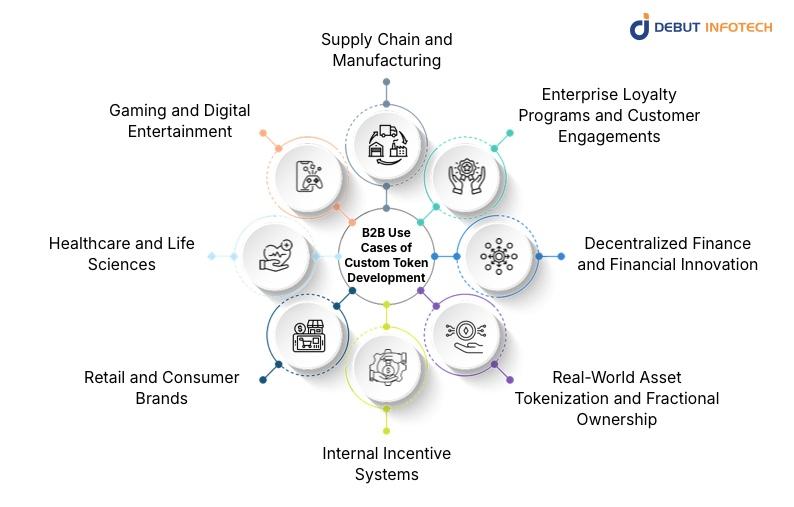
So, where do custom tokens actually move the needle inside real B2B workflows?
Below, we have highlighted 10 practical, concise use cases drawn from how enterprises are deploying tokens to clean up operations in real, everyday use.
In supply chain and manufacturing, custom utility token development can help make the entire supply chain process more coherent. For example, you can create custom tokens that connect SKUs, shipments, and even batches that are crucial to organizational workflow.
So, for example, you can easily track things when pallets move through the factory or when temperature alarms trigger. Consequently, enterprises in the manufacturing industry tend to report faster investigations, cleaner recalls, and fewer reconciliation loops because stakeholders reference the same on‑chain “container of truth.” Real‑world programs use this model to improve traceability and compliance while integrating with existing systems.
Enterprises can also use custom tokens to build customer-controlled loyalty systems. This used to be fragmented, but with custom token development services, you can create a flexible reward layer that is easy for customers to interact with across multiple brand touchpoints.
And many enterprises have been doing this. In fact, reports indicate that token-based enterprise loyalty programs are easier to automate and harder to mess up. Additionally, combining this with AI token development can also facilitate the design of tier upgrades, exclusive access, and partner-ecosystem benefits. And the incentive here is that you get higher engagement because the users can see their rewards in real time.
Financial workflows can be programmed using custom tokens that support settlements, payouts, collateralization, and access controls. Businesses use this to support controlled distribution models for partners or clients, automate approvals, and expedite treasury tasks. With lifecycle rules established at issuance and upheld on-chain, tokens can actually represent internal credits, invoice claims, revenue shares, or structured products.
Real-world examples include finance teams creating claim tokens for receivables that downstream partners can verify and trade in controlled environments, or corporations issuing tokens that cause partial payments upon milestone events. The appeal is straightforward: reduced operational friction without dismantling current systems, quicker reconciliation, and cleaner audit trails. To give compliance teams visibility and control, most enterprise programs focus on permissioned deployments that include token issuance, distribution, and restricted secondary access.
Compared to traditional systems, custom tokens allow businesses to convert physical assets into digital units that can be tracked, divided, and moved with significantly less administrative work. By creating tokens that contain ownership information, compliance guidelines, and lifecycle updates for every asset, businesses in the real estate, commodities, and finance sectors are already doing this at scale. These tokens are helpful for controlled investor access, partner collaboration, and internal record-keeping because they frequently reflect the economic rights associated with the underlying asset.
A practical example is asset managers creating tokens for property shares so internal teams can instantly verify valuations and ownership, rather than moving documents across departments. Some enterprises also tokenize inventory or equipment to simplify leasing, collateralization, or inter‑department cost allocations. The value shows up in clearer audit trails, faster verification cycles, and greater transparency across multiple stakeholders, without rebuilding their entire infrastructure.
Businesses can organize internal incentives with custom utility tokens without juggling spreadsheets or manually tracking who received what. Teams can create tokens representing performance credits, training accomplishments, contributions to innovation, safety compliance, or even points for cross-departmental collaboration. Each token has a unique history once it is minted, allowing HR or leadership to instantly confirm accomplishments without searching through numerous data sources.
Tokens help reduce administrative overhead while increasing transparency around recognition, according to several organizations experimenting with internal digital credits. For instance, a manufacturing company can issue tokens to workers who complete specialized equipment training, enabling managers to quickly monitor skill development across the workforce. Others reward knowledge-sharing, mentoring, or operational excellence with internal tokens. The method simplifies recognition, incentives, and progress monitoring in big teams while feeling contemporary without pressuring workers into complicated systems.
Retail brands can create digital representations of products, purchase actions, or customer entitlements with custom utility tokens that can move between channels without getting lost in disjointed systems. Details such as purchase history, authenticity records, ownership changes, and reward eligibility can be stored in a token. This facilitates the coordination of e-commerce platforms, physical stores, logistics partners, and customer engagement initiatives for brands.
Some international retailers experimenting with blockchain-backed product tokens use them to grant customers access to members-only drops and rewards, or to confirm authenticity in secondary markets. For example, fashion brands have used digital tokens to directly attach provenance information, resale value tracking, and care instructions to their digital counterparts. Customers have a more engaging relationship with their purchases, trust is strengthened, and fraud is decreased.
Healthcare organizations can use custom tokens to represent clinical events, medical assets, or sensitive data in an organized manner without revealing underlying records. While the actual medical data is kept safe in secure systems, a single token can contain references to lab results, chain-of-custody information, consent updates, or device-tracking data. Hospitals and research teams are already using token development companies to build models that use digital tokens to track sample movements, coordinate data access, or document compliance steps across institutions.
Custom tokens give studios and entertainment companies a way to represent digital items, achievements, access rights, and in‑game value in a format that players can verify independently. These tokens can store attributes, ownership history, upgrade states, or scarcity details, making them useful in environments where users expect portability and proof of authenticity. Many gaming media platforms experimenting with tokenized items rely on this structure to enable players to trade or display digital assets without exclusively depending on a centralized inventory system.
We’ve also seen how crypto token development has been used in the entertainment industry to control ticket bookings, fan access to shows, and even access to exclusive content. For example, a particular studio or artist may decide to grant passes to their shows using custom tokens, and this can only be made possible by custom token development services.
Custom token development services are among the modern ways enterprises are using to enhance their business operations. While some want smoother supply chain operations, others crave automated financial workflows. Regardless of the case, business advancements have enabled them to hire token developers and commence their utility token development.
And we are already seeing this in practice across manufacturing, retail, healthcare, entertainment, and finance. Enterprises in these verticals are already reducing discrepancies, improving traceability, and creating cleaner data environments across partners and internal teams.
As more enterprises explore tokenization, the most successful ones will be those that use tokens as practical tools for clarity, automation, and accountability. If your organization is thinking about how to simplify collaboration, strengthen trust with partners, or unlock new business models, custom token development might be the most strategic next step.

Our Latest Insights
USA

2501 Chatham, Rd Suite R Springfield, IL 62704
+1-708-515-4004
info@debutinfotech.com
UK

7 Pound Close, Yarnton, Oxfordshire, OX51QG
+44-770-304-0079
info@debutinfotech.com
Canada

154 Eden Oak Trail, Kitchener, ON N2A 0H9
+1-708-515-4004
info@debutinfotech.com
INDIA

Sector 101-A, Plot No: I-42, IT City Rd, JLPL Industrial Area, Mohali, PB 140306
9888402396
info@debutinfotech.com

9001:2015
Quality Certified

ISO 27001
Security Certified

A+ Rating
Accredited Business

Certik
Security & Audit


Copyright © 2026, Debut Infotech. All rights reserved. | Privacy Policy