ON THIS PAGE
Progress0%




Our Global Presence :




Technology decisions in enterprises should not be left to assumptions, market pressure or the most popular tool in the market. The type of software, platform or infrastructure you select can impact operational efficiency, data security, customer satisfaction, regulatory compliance and business growth.
That’s where a technology selection framework can help. This framework provides business leaders, IT departments, procurement and decision-makers with a systematic process to evaluate technology prior to making a significant investment. Instead of asking, “Which solution looks best?” The framework helps you ask better questions: Does this technology solve the real business problem? Will it work with our other systems? Is it secure enough? Will it scale? How much will it really cost? Will the vendor help us afterward?
From our real-life experience with enterprise projects, we’ve learned one thing: technology often doesn’t work because the tool was not properly chosen. An application might work well in a vendor presentation, but may fall short when tested against the real challenges of workflows, integration with existing systems, compliance, user adoption, and other critical business integrations.
A robust tech selection process can help avoid that. It integrates business strategy, technical requirements, security and compliance, cost, scalability and vendor stability into a single process. Using the right framework, enterprises can minimise risk, make better technology selection decisions, and choose technologies that work for both the short and long terms.
In this article, we’ll explore a practical, real-world approach to making the right choice for enterprise technology, from understanding your business objectives to assessing vendors, total cost of ownership, risks, and making a decision that supports business growth. Let’s get into it!
Related Read: Rapid Web Development Tools: Build Faster, Better, and Smarter
A technology selection framework is a method for enterprises to select the right technology with reduced risk and increased confidence. It allows them to compare software, platforms or digital solutions (or other technologies) using structured criteria rather than opinion, demos or immediate price.
In practice, it works like a decision guide. It helps bring together business leaders, IT teams, finance, procurement, security, compliance and end users to assess the technology from different perspectives.
A good framework enables an enterprise to understand:
This is important because technology decisions can impact a company’s operations for decades. The wrong choice can lead to unexpected expenses, compatibility problems, security vulnerabilities and poor user experience. The right one can boost productivity, enhance decision-making, and build a better enterprise tech stack strategy.
For small businesses, purchasing software can be simple. A team finds a problem, evaluates a couple of solutions, reviews the cost, tests the features and makes a choice. In an enterprise, however, technology selection is usually not so simple.
Every major technology choice affects more than one team. A new CRM might affect sales, marketing, customer service, finance, IT, compliance and data teams. A cloud solution could impact how apps are developed, secured, managed and scaled. A cloud solution could impact how apps are developed, protected, managed and scaled. This means technology choices for the enterprise must take into account the entire business ecosystem, not just tool features.
It’s more complicated when working with existing systems. Enterprises often rely on existing systems, custom processes, databases, and other tools. A new system may work in the vendor’s demo, but the challenge is to ensure it integrates seamlessly with existing systems, provides data security, supports user authorization, meets reporting requirements, and adheres to industry regulations.
This is why enterprise technology selection is not just a purchasing decision. It is often an enterprise architecture decision which can affect security, operational efficiency, cost, governance, customer experience, and scalability.
There are also risks that smaller purchases may not carry. Businesses need to consider issues related to data migration, vendor vetting, procurement, employee training, end-user adoption, support, and the cost of replacement. If the wrong technology is chosen, the enterprise could end up with poor adoption, integration problems, unexpected costs, compliance risks and costly replacement.
From experience, one of the biggest mistakes organizations make is trusting the demo more than the real operating environment. The product may be great in the demo, but when it comes up against complex processes, tight security, isolated data sources, compliance monitoring and real people with varying degrees of technical expertise, it often fails.
This is why enterprises should have a structured selection process. It’s not about selecting the most popular or feature-rich tool. The aim is to select a technology that suits the business, integrates with other systems, meets governance needs, and can adapt to the business’ needs as they change.
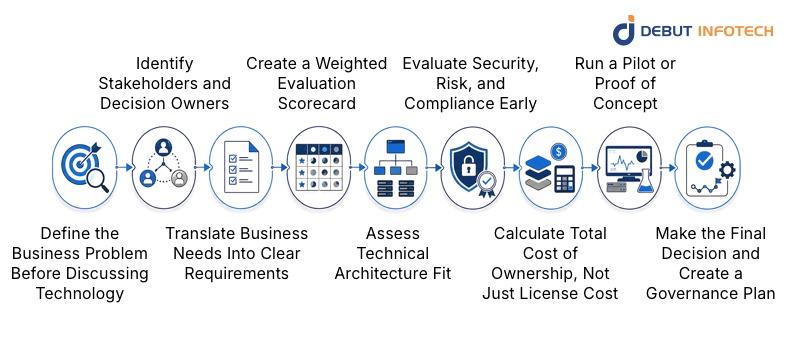
Choosing enterprise technology is not just about finding the tool with the most features. It is about finding the right technology that aligns with the business, meets the needs of users, secures data, integrates with other systems, and delivers ongoing value.
An effective technology selection process enables enterprise leaders to look beyond technology vendor claims and demos. It establishes a process to evaluate alternatives based on business value, technical fit, security and compliance, cost, scalability, scalability and performance.
Before enterprise teams begin vendor comparisons and product demos, they should ask themselves, “what are we trying to achieve?” Too often, technology initiatives start with the solution rather than the problem. For instance, an enterprise may think, “We need a new CRM,” but what they really need is for sales, marketing and customer service teams to access the same customer data. This results in poor response times, inaccurate reporting, wasted effort and lost opportunities.
It’s better to start with a definition of the problem, who it affects, the impact on the business, and what success looks like. This provides a more targeted selection process because all potential solutions are evaluated in terms of their value to the business, not just the features they contain.
Enterprise technology usually impacts multiple teams, so the decision-making process shouldn’t be relegated to just one team. A solution selected only by IT might not be adopted by users. A solution selected only by business teams may have issues with security, integration, scalability or compliance.
Successful technology decisions are made by executive sponsors, IT and architecture teams, security teams, compliance or legal teams, procurement, finance, operations, data governance teams, and end users. They all approach the decision from a different perspective. Executives are concerned with business strategy, IT with technical compatibility, security with risk, finance with cost and end users with operational compatibility.
From practical enterprise experience, technology selection often fails when ownership is too narrow. The best decisions are made when business, technical, financial, and risk considerations are considered early.
With a clear understanding of the business problem and stakeholders, the next challenge is to translate business needs into clear requirements. This ensures that ambiguous needs don’t turn into costly implementation issues.
For instance, a request for “a system that is easy to use” isn’t specific enough. The project team must specify what that means. Should the system be easy to navigate, accessible from a mobile device, have role-based workflows, be accessible, or have a quick learning curve?
A full list of requirements should cover what the system needs to do, how well it needs to do it, how it needs to interact with other systems, what security measures it needs to adhere to, what compliance and standards it needs to meet, and what commercial terms will apply. This is particularly critical when selecting a tech stack for web development, enterprise platforms or critical systems, as one vague requirement can impact performance, cost, security and user acceptance.
Good requirements also ensure that enterprise does not get sidetracked by shiny features that don’t solve the problem.
A weighted scorecard allows companies to evaluate vendors objectively. Without one, the final decision may be influenced by the most persuasive sales presentation, the most familiar brand, or the loudest internal opinion.
The key is to remember that not every criterion has the same value. A medical company might consider compliance, auditing and data privacy as more important. A rapidly growing SaaS start-up may value scalability, integration and speed for deployment.
A scorecard doesn’t take the place of human judgement, but it helps explain the decision. It allows a team to articulate the reasons why one solution is better than another and provides a more objective approach for management to sign off on the decision.
A product that works great in a demo may not work within the enterprise environment. That’s why the technical architecture needs to be assessed prior to vendor selection.
The evaluation team should ensure the solution is compatible with the enterprise deployment model, data, identity management, API, DevOps, monitoring, disaster recovery and performance needs. The question is not just “Can it do the job?” but also “Can it do the job in our technology environment?”
For example, a retail enterprise choosing an e-commerce platform should not only compare storefront design or checkout features. It must also consider the inventory system, warehouse management, payment systems, customer data privacy, peak period traffic and omnichannel reporting.
In enterprise settings, technical fit is not a background issue. It impacts reliability, costs, security, user experience and future scalability.
Security should not be considered as the last step once a preferred supplier is identified. At that stage the enterprise may be psychologically, operationally and/or financially invested in a risky solution.
Security and compliance should be reviewed early. The enterprise must know how the vendor manages encryption, access control, multi-factor authentication, audit logs, data residency, backup and disaster recovery, incident response, penetration testing, vendor certifications, subprocessors and subcontractors
This is particularly critical in regulated industries such as finance, healthcare, education, government and legal. In these sectors, inappropriate technology can lead to data security issues, regulatory concerns, reputation and financial risks.
A practical question to ask is:
Can we trust this technology with our critical data, customers, users and operations?
If the answer is unclear, the vendor should not proceed until they understand the risk
What might be the lowest price initially may not be the best value in the long term. Companies often get distracted by comparing just the license or subscription costs, but there’s more to the cost of technology than that.
Total cost of ownership (TCO) encompasses implementation, integration, data migration, training, customization, support, maintenance, upgrades, security reviews, risk of downtime and future exit or migration costs. A vendor with a lower upfront price may become more expensive if it needs heavy customization, has poor support, creates integration difficulties, or requires manual workarounds.
A vendor demonstration can illustrate how the system works, but a pilot can illustrate how it works in your real world environment. To confirm the product’s readiness, run a proof of concept with live or sample data, users, integrations, security and reporting requirements.
The proof of concept should be based on your enterprise’s needs, not the vendor’s demo. This ensures that the solution is feasible, scalable and robust before making significant investments.
The final decision should integrate the results of the scorecard, stakeholder interviews, technical review, security, cost and pilot. This provides leaders with the information needed to approve the recommended solution.
Once selected, develop a governance plan to address implementation, data migration, change management, success criteria, vendor monitoring and post-launch reviews. This helps ensure the technology remains valuable after signing the contract.
Also Read: Top 10 Web Development Companies in 2026
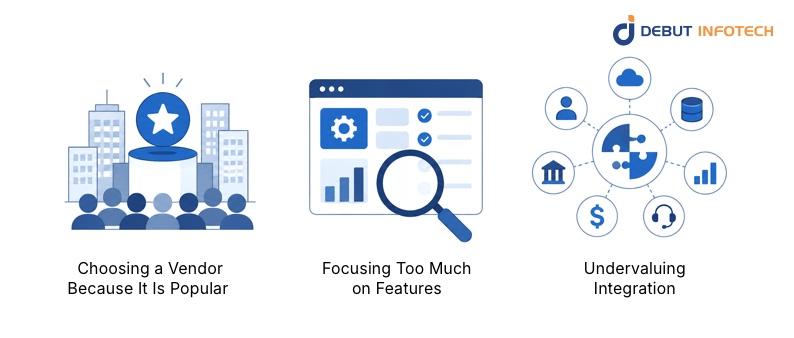
Selecting new technology is not just an IT project. It is a business decision that can impact productivity, customer satisfaction, security, compliance and future growth.
From real enterprise projects, it’s clear that many issues with technology don’t start once it’s implemented. They begin at the time of selection.
Here are some of the most common technology selection mistakes that enterprises make.
1. Choosing a Vendor Because It Is Popular
Popularity can be comforting, but just because a vendor is well-known, doesn’t mean it’s the right fit for your enterprise.
Each business has its own processes, existing software, security and compliance requirements, budget constraints and in-house technical expertise. A product that may be a great fit for one enterprise can complicate matters for another.
What matters more is to select technology based on business needs, not popularity.
2. Focusing Too Much on Features
It is easy to be impressed by long feature lists, modern dashboards, automation tools, and AI-powered capabilities. These features may seem impressive in a demo, but does not always mean the solution will be effective in a real enterprise environment.
A better question to ask is: will it solve the business problem and seamlessly integrate with our systems?
This is particularly relevant when choosing a tech stack for web development, where front-end tools, back-end services, databases, APIs, hosting, security and deployment must all be integrated to create a seamless environment.
3. Undervaluing Integration
Integration is a key factor in the success and failure of enterprise technology.
A product may seem impressive, but if it does not integrate with your CRM, ERP, HR, finance, analytics and customer support platforms, it could actually increase costs rather than save you time. Without good integration, you can end up with data duplication, manual processes, incorrect reports and isolated teams.
When evaluating technology, enterprises should examine how well it integrates with existing systems, the strength of its application programming interfaces (APIs), and whether integration will be costly.
Enterprise technology selection is not about finding a product; it is about finding the right tool to achieve business objectives, help users, ensure security, enable scalability, and allow for growth. A robust technology selection process provides a framework for leaders to make informed choices, but it takes experience to apply it.
At Debut Infotech, we work with businesses to assess, design and develop technology solutions that meet operational requirements. Our team has real-world experience in custom web development, enterprise software development, mobile apps, cloud computing, AI-powered systems, blockchain, and digital transformation initiatives.
We support businesses in reviewing their architecture, integration, performance, compliance, security, cost, and scalability considerations before adopting a technology strategy. This minimises the risk of a poor decision fit and enables business success.
Whether you are replacing old systems, creating a digital platform, or enhancing current processes, Debut Infotech can help you make the most of your investment in technology to create a secure, scalable, and forward-looking system.
A. Enterprises choose a technology stack by matching project goals with the right tools, frameworks, and platforms.
They consider factors such as speed to market, scalability, security, budget, team expertise, compliance, and long-term maintenance.
An MVP may need a simple, fast-to-build stack, while a complex enterprise system may require stronger architecture, integrations, and security.
The best stack is not always the newest or most popular. It is the one that fits the business needs and can support future growth.
A. Technology selection depends on how well a solution fits the business, its cost, scalability, security, and technical feasibility.
Enterprises should also consider vendor support, integration with existing systems, compliance needs, user adoption, and long-term reliability.
In simple terms, the right technology should solve a real business problem, work smoothly with current systems, stay secure, and support future growth.
A. Enterprise technology costs depend on the solution type, business size, number of users, customization, integrations, and support needs.
A small digital project may start around $50,000, while a full enterprise implementation can exceed $5 million. Typical costs include SaaS subscriptions, hardware, implementation, data migration, training, security reviews, and ongoing maintenance.
SaaS tools may range from $35 to $400 per user per month, while implementation can cost one to three times the software price.
To avoid hidden costs, enterprises should calculate the total cost of ownership, not just the upfront purchase price.

Our Latest Insights
USA

2501 Chatham, Rd Suite R Springfield, IL 62704
+1-708-515-4004
info@debutinfotech.com
UK

7 Pound Close, Yarnton, Oxfordshire, OX51QG
+44-770-304-0079
info@debutinfotech.com
Canada

154 Eden Oak Trail, Kitchener, ON N2A 0H9
+1-708-515-4004
info@debutinfotech.com
INDIA

Sector 101-A, Plot No: I-42, IT City Rd, JLPL Industrial Area, Mohali, PB 140306
9888402396
info@debutinfotech.com

9001:2015
Quality Certified

ISO 27001
Security Certified

A+ Rating
Accredited Business

Certik
Security & Audit


Copyright © 2026, Debut Infotech. All rights reserved. | Privacy Policy