ON THIS PAGE
Progress0%






Our Global Presence :





Education app development cost is one of the first questions founders, institutions, and startups ask when planning a digital learning product. As education continues to move toward mobile-first and on-demand experiences, apps have become a core delivery channel for schools, training providers, tutors, and edtech businesses. However, the cost of developing an education app varies widely depending on scope, features, technology, and long-term goals.
Understanding the real cost requires more than a simple price estimate. It involves analyzing the education app development process, feature complexity, design needs, development timelines, and post-launch requirements. In this article, we break down every factor that influences education app development cost and explain how businesses can plan budgets realistically while building scalable, high-quality learning platforms.
Before estimating costs, it is essential to define the type of education app being developed. Not all education apps serve the same purpose, and each category comes with different technical and functional requirements.
Some apps focus on content delivery, including video lessons, e-books, and quizzes. Others support live learning through virtual classrooms, real-time chat, and assessments. There are also skill-based learning apps, language learning platforms, corporate training systems, and test preparation apps. Each use case directly impacts the cost of developing an education app.
The broader the scope, the higher the development effort. A simple learning app with static content will cost far less than a full-featured learning management system with live classes, analytics, and certifications.
Related Read: Android App Development Cost & Key Factors
The learning model plays a major role in determining education app development cost. Self-paced learning apps typically require content management, user profiles, and progress tracking. Instructor-led apps need live streaming, scheduling, and communication tools. Hybrid models combine both and increase complexity.
Each additional learning model introduces new development requirements, which adds to the overall mobile app development cost.
Choosing between Android, iOS, or cross-platform development can significantly impact both budget and timeline. Native apps for each platform require separate codebases, which increases the cost. Cross-platform solutions reduce duplication but may require additional optimization.
Mobile app development frameworks, such as Flutter or React Native, are often used to strike a balance between performance and cost efficiency. Platform decisions should align with target users and long-term scalability.
Features are the biggest cost drivers. Common education app features include:
Advanced features like AI-driven recommendations, live classrooms, gamification, or offline access significantly increase the cost of developing an education app.
The education app development process follows a structured sequence designed to reduce risk and control cost. Each stage contributes to the overall budget.
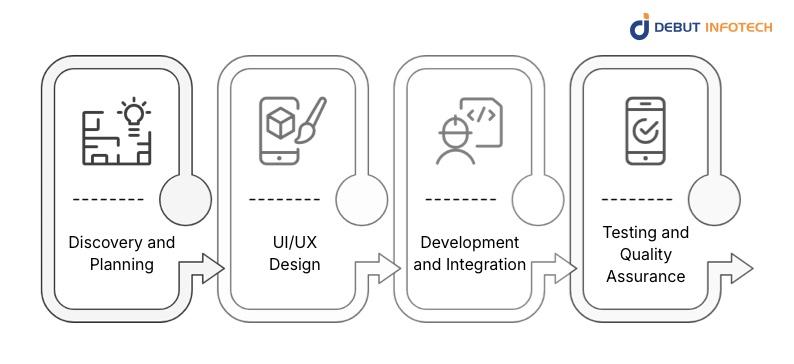
This phase defines goals, user personas, feature scope, and technical architecture. Poor planning leads to scope creep, which is one of the primary reasons education app development costs escalate.
Clear documentation at this stage saves time and money in the long run.
Education apps must be intuitive and accessible. Designing user-friendly navigation, lesson flows, and interaction patterns requires time, especially when supporting multiple age groups or adhering to accessibility standards.
Design costs are often underestimated, yet they have a direct impact on user engagement and retention.
This is where most of the mobile app development cost is incurred. Developers build the front end, back end, and APIs that power the app. API development enables integration with content systems, payment gateways, analytics tools, and third-party services.
The complexity of integrations directly affects both development time and budget.
Testing ensures the app functions properly across various devices, screen sizes, and usage scenarios. Education apps must be reliable, especially when used for assessments or live learning.
Skipping proper testing may reduce short-term costs but increase long-term maintenance expenses.
The mobile app development timeline depends on app complexity, team size, and development approach. Simple education apps typically take three to four months to develop. Mid-level apps often require six to eight months. Enterprise-grade platforms can take a year or more.
Longer timelines may increase labor costs but are sometimes necessary for achieving quality and scalability. Rushing development often leads to rework, which increases total mobile app development cost over time.
Balancing speed and stability is key when planning education app budgets.
Understanding where money is spent helps set realistic expectations and prevents budget surprises during the development process.
Each phase contributes to the overall education app development cost and should be planned accordingly.
Educational app development cost in India is generally lower compared to North America or Europe, primarily due to labor cost differences. However, lower costs do not necessarily mean lower quality when working with experienced teams.
India has a strong talent pool of developers familiar with modern mobile app development frameworks, scalable architectures, and global quality standards. Many businesses choose to work with an education app development company in India to optimize cost without sacrificing performance.
That said, communication, documentation, and project management standards still play a critical role in determining project success.
Technology decisions influence both upfront and long-term costs.
The frontend determines user experience. Native development offers high performance, while cross-platform tools reduce development effort. The choice impacts maintenance and future feature expansion.
API development is essential for managing users, content, analytics, and integrations. A well-designed backend supports scalability and prevents performance bottlenecks as the number of users grows.
Poor backend architecture may reduce initial costs, but it leads to expensive refactoring later.
An experienced education app development company brings domain knowledge, technical expertise, and structured workflows to ensure seamless development. This reduces trial-and-error costs and shortens the mobile app development lifecycle.
When evaluating education app development companies, businesses should look beyond hourly rates. Experience with similar projects, security practices, and post-launch support is equally important.
A reliable partner helps control education app development cost by avoiding unnecessary rework and ensuring efficient delivery.
Many organizations choose to hire dedicated mobile developers for flexibility and control. This model works well for long-term projects or evolving platforms.
Dedicated teams offer predictable costs and deep product understanding but require strong project management.
Fixed-price models are most effective for well-defined scopes. Time-based models offer flexibility when requirements are subject to change. Each approach impacts how the mobile app development cost is managed over time.
Maintenance and scalability are ongoing considerations that directly affect the total education app development cost over time. After launch, education apps require regular updates, bug fixes, performance optimization, and security patches to remain stable and relevant. These activities are not one-time expenses and are often estimated as a percentage of the initial mobile app development cost on an annual basis.
Failing to maintain systems can quickly lead to technical debt. Outdated dependencies, unresolved bugs, and security vulnerabilities increase operational risk and degrade user experience. As learners encounter performance issues or outdated content, their engagement drops, which in turn impacts retention and the platform’s credibility. Long-term planning ensures that maintenance is treated as a strategic investment rather than an unexpected expense.
Scalability planning plays a critical role in controlling long-term costs. Apps built without scalability in mind often require costly rebuilds when user numbers grow or new features are introduced. A scalable architecture allows the app to handle increased traffic, content expansion, and additional users without performance issues or major structural changes.
Future-ready development also supports smooth expansion. When the underlying system is designed for flexibility, new integrations, learning models, and content formats can be added without disrupting existing users. Although scalability planning may slightly increase upfront development cost, it significantly reduces long-term expenses and supports sustainable growth for education platforms.
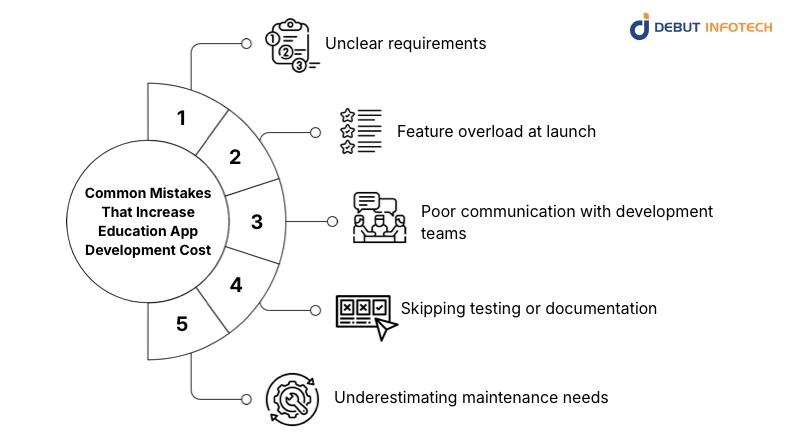
Many projects exceed budget due to avoidable mistakes:
Avoiding these pitfalls helps keep the cost of developing an education app under control.
There is no single, fixed price for the cost of education app development cost. Simple education apps with basic content delivery and limited features typically require a smaller investment, while advanced platforms that include live learning, analytics, integrations, and scalability demand significantly more resources. The real cost of developing an education app is shaped by decisions made at every stage of the education app development process, from feature prioritization to technology choices and long-term maintenance planning.
Rather than focusing only on the initial mobile app development cost, businesses should evaluate value, scalability, and long-term return on investment. An app that is cheaper to build upfront but poorly structured often leads to higher expenses later through performance issues, redesigns, or system rebuilds. Cost estimation should therefore account for both immediate development and future growth requirements.
Strategic planning plays a central role in keeping costs under control. It aligns technical decisions with business goals, ensuring that development efforts support real user needs and measurable outcomes. Clear planning helps teams prioritize essential features, avoid unnecessary complexity, and allocate budgets more effectively.
Working with the right development partners and selecting appropriate mobile app development frameworks also improves cost predictability. Experienced teams help identify risks early, recommend scalable solutions, and prevent costly mistakes. When strategic planning is integrated from the start, businesses gain better visibility into expenses and build education apps that remain sustainable and competitive over time.
At Debut Infotech, we approach education app development with a balance of technical expertise and business strategy. We focus on building scalable, secure, and user-centric education apps that align with long-term goals.
Our teams guide clients through the entire mobile app development lifecycle, from planning and design to development and maintenance. By combining proven processes with modern technology, we help organizations manage education app development cost effectively.
A well-designed education app delivers measurable benefits:
Investing upfront in quality reduces operational challenges later.
The cost of developing an education app depends on many interconnected factors, including scope, features, technology, and development approach. The cost of education app development should be viewed as a strategic investment rather than a fixed expense. Careful planning, clear requirements, and informed technical decisions play a crucial role in controlling the budget and ensuring success.
At Debut Infotech, we believe that transparency and structure are essential to building effective education platforms. By understanding the full education app development process and planning for long-term growth, businesses can build impactful learning apps that deliver value while staying within budget.
A. The cost of developing an education app varies based on features, platform choice, design complexity, and development approach. Simple apps may cost significantly less, while advanced platforms with live classes, analytics, and integrations require a higher investment.
A. UI/UX design requirements, backend architecture, and the overall mobile app development timeline.
A. Yes, educational app development cost in India is generally lower due to reduced labor costs. However, experienced teams can still deliver high-quality apps that meet global standards when proper processes and communication are in place.
A. The mobile app development timeline depends on scope and complexity. Basic apps may take 3–4 months, mid-level apps around 6–8 months, and large-scale education platforms can take 9–12 months or more.
A. A structured education app development process helps prevent scope creep, reduces rework, and ensures efficient use of resources. Clear planning and documentation early on can significantly lower overall mobile app development cost.
A. Hiring dedicated mobile developers works well for long-term or evolving projects, while fixed-price models suit clearly defined scopes. The right choice depends on flexibility needs, budget control, and project complexity.
A. Typically, maintenance is not included in the initial development cost. Ongoing updates, bug fixes, and performance improvements are recurring expenses and should be planned as part of the long-term mobile app development lifecycle.

Our Latest Insights


USA
2501 Chatham, Rd Suite R Springfield, IL 62704
+1-708-515-4004
info@debutinfotech.com
UK
7 Pound Close, Yarnton, Oxfordshire, OX51QG
+44-770-304-0079
info@debutinfotech.com
Canada
154 Eden Oak Trail, Kitchener, ON N2A 0H9
+1-708-515-4004
info@debutinfotech.com
INDIA
Sector 101-A, Plot No: I-42, IT City Rd, JLPL Industrial Area, Mohali, PB 140306
9888402396
info@debutinfotech.com