ON THIS PAGE
Progress0%






Our Global Presence :





The rapid convergence of blockchain technology and traditional commodities is reshaping how real-world assets are owned, traded, and managed. Among these assets, gold stands out as a prime candidate for digitization due to its intrinsic value, global demand, and historical role as a store of wealth. This has led to the gold tokenization platform—a system that enables physical gold to be represented as digital tokens on a blockchain.
A gold tokenization platform enables businesses, investors, and financial institutions to fractionalize gold ownership, improve liquidity, enhance transparency, and reduce operational friction. In this guide, we explore how to create a gold tokenization platform from the ground up—starting with core concepts, system architecture, and tokenization strategy before diving into development and deployment.
A Gold Tokenization Platform is a blockchain-based infrastructure that converts physical gold into digital tokens. Each token represents ownership of a specific quantity of gold (e.g., 1 gram or 1 ounce) stored securely in audited vaults and backed at a 1:1 ratio.
By leveraging blockchain technology, these platforms remove many of the inefficiencies associated with traditional gold ownership, such as manual settlement, limited liquidity, and a lack of transparency. Tokenized gold can be easily transferred, traded, or redeemed while maintaining a verifiable link to the underlying physical asset.
Unlike traditional gold investment vehicles, tokenized gold platforms provide:
These platforms fall under the broader category of RWA tokenization, where tangible assets are digitally represented on blockchain networks to improve accessibility, liquidity, and operational efficiency.
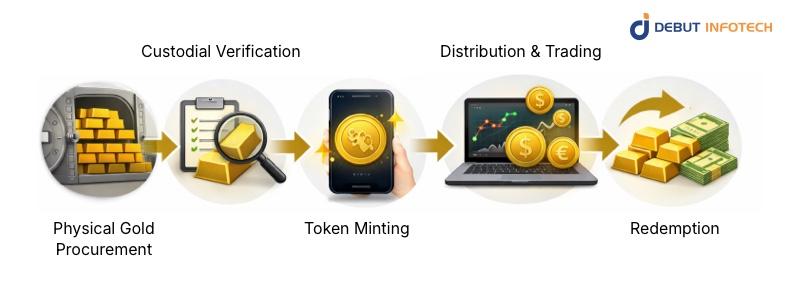
At a high level, gold tokenization follows a structured and highly regulated workflow designed to ensure asset security and regulatory compliance.
When compared to traditional gold investment methods, gold tokenization offers clear operational and accessibility advantages. Conventional gold ownership typically relies on physical certificates, manual audits, and multi-day settlement processes, which can limit liquidity and increase friction for investors.
In contrast, tokenized gold is represented by blockchain-based tokens that enable near-instant settlement, on-chain transparency, and fractional ownership. These features significantly lower entry barriers and improve liquidity, which is why gold tokenization is increasingly favored by modern investors seeking efficiency, flexibility, and global access.
| Feature | Traditional Gold | Tokenized Gold |
| Ownership | Physical certificates | Blockchain tokens |
| Liquidity | Limited | High |
| Settlement | Days | Minutes |
| Transparency | Manual audits | On-chain verification |
| Accessibility | High capital required | Fractional entry |
This comparison highlights why gold tokenization is increasingly favored by modern investors.
Building a gold tokenization platform is not just a technical initiative—it is a strategic financial decision aimed at unlocking new revenue streams, expanding investor access, and modernizing gold-backed investment models. As demand grows for digital asset exposure backed by real-world value, enterprises are increasingly turning to gold tokenization.
1. Increased Market Liquidity: Tokenization transforms traditionally illiquid gold holdings into highly tradable digital assets, enabling faster settlement and continuous market activity.
2. Fractional Ownership Access: By enabling fractional ownership, businesses can attract a broader investor base, allowing retail participants to gain exposure without purchasing full gold bars or large quantities.
3. Transparent Ownership Records: Blockchain’s immutable ledger ensures clear, tamper-proof ownership records, reducing disputes while simplifying audits and regulatory reporting.
4. Global Accessibility: Tokenized gold can be traded across borders without relying on traditional intermediaries, opening access to international markets and investors.
Together, these advantages explain why many top gold tokenization platform companies are rapidly scaling their solutions to meet growing institutional and retail demand.
Token standards determine interoperability and regulatory flexibility.
| Token Standard | Use Case | Advantages |
| ERC-20 | Retail trading | High liquidity, exchange support |
| ERC-721 | Unique gold assets | Provenance tracking |
| ERC-1400 | Security tokens | Built-in compliance |
For most enterprise platforms, ERC-1400 or hybrid models are preferred due to regulatory adaptability.
To build a production-grade gold tokenization platform, multiple technical and operational layers must work together seamlessly to ensure security, compliance, and scalability.
The blockchain layer serves as the foundation of the platform, recording all token issuance, transfers, and transaction histories on an immutable ledger. It ensures transparency, traceability, and trust across the ecosystem.
Common blockchain choices include:
Smart contracts automate and enforce the rules governing token behavior. They control:
A well-audited and modular smart contract architecture is central to any effective tokenization strategy.
Physical gold backing the tokens must be securely managed to maintain trust and regulatory compliance. This requires gold to be:
Custodial integrations ensure a reliable link between physical assets and their digital representations.
User-facing dashboards enable investors to interact with the platform by allowing them to:
Administrative dashboards provide platform operators with tools to manage token supply, oversee audits, monitor compliance workflows, and maintain operational control.
When deciding how to create a gold tokenization platform, businesses must choose an architectural model that aligns with their operational capabilities, compliance responsibilities, and long-term scalability goals. Broadly, gold tokenization platforms follow one of two approaches.
In the direct issuance model, the platform owner maintains full control over the tokenization lifecycle. This includes managing physical gold custody, issuing tokens, and handling redemption processes.
Key characteristics of this model include:
This approach is often preferred by large enterprises or financial institutions that want complete control over asset management and compliance but are prepared to handle the associated complexity.
In the platform-based model, the platform acts as a technology and infrastructure provider rather than the direct issuer of tokenized gold.
Key characteristics include:
This model offers greater scalability and faster onboarding of multiple asset issuers. It is widely used by white label tokenization platform providers and asset tokenization development companies that support multiple clients across different jurisdictions.
Compliance is not an afterthought in gold tokenization—it must be embedded into the platform’s architecture from the earliest design phase. Regulatory requirements vary by region, but failing to account for them early can significantly delay launch and increase development costs.
Key regulatory elements include:
Ignoring compliance at the architecture stage leads to costly redesigns later—especially for platforms targeting institutional investors.
A gold tokenization platform is ideal for:
Many of these organizations partner with experienced tokenization companies rather than building their own in-house solutions. Before proceeding to development, organizations must decide whether to:
Creating a Gold Tokenization Platform requires a structured, compliance-driven approach that balances blockchain innovation with real-world asset management. Below is a practical, industry-aligned roadmap followed by leading tokenization companies when building gold-backed digital asset platforms.
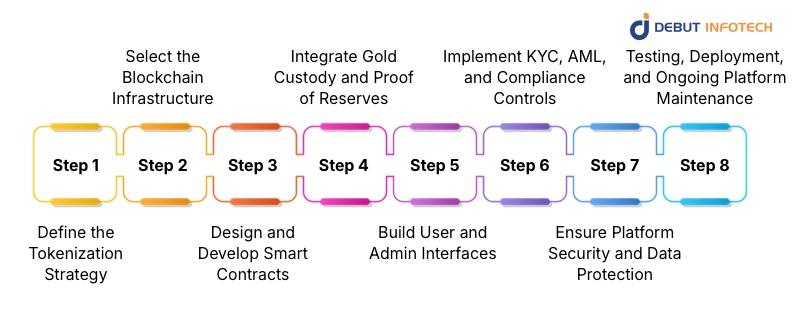
A well-defined Tokenization Strategy lays the foundation for the entire platform. At this stage, businesses determine:
Strategic clarity ensures the platform is scalable, compliant, and aligned with long-term business goals.
Choosing the right blockchain technology directly affects performance, cost efficiency, and regulatory flexibility.
Key factors to evaluate include:
Public blockchains are commonly used for open-access trading platforms, while permissioned or hybrid networks are preferred for enterprise-grade Real World asset tokenization use cases.
Smart contracts serve as the operational backbone of a gold tokenization platform. They govern how tokens are created, transferred, and redeemed.
Core smart contract functions include:
Given their role in managing real-world value, smart contracts must undergo rigorous testing and third-party security audits.
Trust in a gold tokenization platform depends on verifiable physical backing. This requires seamless integration with certified vaulting and custodial services.
Key custody considerations include:
Clear custody mechanisms strengthen investor confidence and support regulatory compliance.
A well-designed platform must cater to both end users and administrators.
User-facing applications typically allow investors to:
Administrative dashboards enable platform operators to manage:
Intuitive interfaces improve adoption and reduce operational overhead.
Regulatory compliance is a non-negotiable aspect of gold tokenization. Platforms must embed compliance directly into their workflows.
Key compliance measures include:
Embedding these controls early helps platforms operate across multiple regions while meeting evolving regulatory standards.
Security is critical for protecting both digital tokens and underlying physical assets.
Essential security practices include:
A strong security posture safeguards user trust and minimizes financial and reputational risk.
Before launch, the platform must undergo extensive testing to ensure reliability and compliance.
This phase includes:
Post-deployment, ongoing maintenance is required to:
Long-term success depends on continuous optimization and monitoring.
A Gold Tokenization Platform can generate revenue through multiple channels, depending on its operational scope, target users, and service offerings. Most platforms adopt a hybrid monetization approach to balance recurring revenue with transaction-based income.
| Monetization Model | Description |
| Transaction Fees | Fees on token trading, transfers, or redemption |
| Custody Fees | Charges for gold storage and insurance |
| Platform Licensing | Offering a white label tokenization platform to enterprises |
| Tokenization as a Service | End-to-end platform access for asset issuers |
| Premium Features | Advanced analytics, reporting, or institutional tools |
Many platforms combine multiple models to create sustainable revenue streams.
Businesses evaluating how to create a gold tokenization platform must decide whether to pursue custom development or adopt a pre-built solution. Each approach comes with distinct trade-offs.
| Approach | Advantages | Considerations |
| Custom Build | Full control and flexibility | Higher cost and longer time-to-market |
| White Label | Faster deployment, lower risk | Limited customization |
| Hybrid Model | Balance of speed and control | Requires technical expertise |
Partnering with an experienced asset tokenization development company often reduces complexity and accelerates launch.
Building a compliant, secure gold tokenization platform involves expertise across blockchain, finance, compliance, and security.
A specialized development partner provides:
This approach allows businesses to focus on growth while leveraging established tokenization platforms and infrastructure.
A Gold Tokenization Platform bridges the gap between traditional commodities and digital finance, offering transparency, liquidity, and global accessibility. With the right strategy, technology stack, and compliance framework, businesses can unlock new investment models and expand their footprint in the rapidly growing world of gold tokenization.
Whether building a custom solution or adopting Tokenization as a Service, success lies in combining technical precision with regulatory foresight.
A. A gold tokenization platform is a blockchain-based system that represents physical gold as digital tokens. Each token is backed by a specific quantity of gold stored in secure, audited vaults, enabling transparent ownership and easy trading.
A. Gold tokenization involves storing physical gold with certified custodians and issuing blockchain tokens that represent ownership of that gold. Smart contracts manage token issuance, transfers, and redemption while ensuring a 1:1 backing.
Yes, gold tokenization can be legal when platforms comply with regional regulations, including KYC/AML requirements, commodity trading laws, and audit obligations. Compliance must be integrated into the platform architecture from the start.
A. The best blockchain depends on business goals. Public blockchains offer transparency and liquidity, while private or hybrid networks provide greater control for enterprise and institutional use cases involving real world asset tokenization.
A. Yes, most gold tokenization platforms support redemption, allowing users to exchange tokens for physical gold or equivalent fiat value, subject to platform policies and jurisdictional regulations.
A. A white label tokenization platform enables faster deployment, lower development costs, and built-in compliance features, making it ideal for businesses looking to enter the market quickly without building from scratch.
A. An asset tokenization development company provides technical expertise, regulatory insight, and proven frameworks that reduce risk, accelerate time-to-market, and ensure platform scalability and security.

Our Latest Insights


USA

2501 Chatham, Rd Suite R Springfield, IL 62704
+1-708-515-4004
info@debutinfotech.com
UK

7 Pound Close, Yarnton, Oxfordshire, OX51QG
+44-770-304-0079
info@debutinfotech.com
Canada

154 Eden Oak Trail, Kitchener, ON N2A 0H9
+1-708-515-4004
info@debutinfotech.com
INDIA

Sector 101-A, Plot No: I-42, IT City Rd, JLPL Industrial Area, Mohali, PB 140306
9888402396
info@debutinfotech.com

9001:2015
Quality Certified

ISO 27001
Security Certified

A+ Rating
Accredited Business

Certik
Security & Audit


Copyright © 2026, Debut Infotech. All rights reserved. | Privacy Policy