ON THIS PAGE
Progress0%






Our Global Presence :





Real Estate tokenization trends are redefining how property assets are owned, financed, and traded as the global real estate sector enters a new phase of digital maturity. What began as an experimental application of blockchain technology has evolved into a practical investment model adopted by developers, asset managers, and institutional investors. In 2026, tokenization is no longer viewed as a disruptive idea on the fringes of real estate—it is becoming a structural shift in how property markets function.
This transformation is driven by improvements in blockchain infrastructure, smarter regulatory frameworks, and growing confidence in tokenized assets on blockchain networks. As real estate firms seek to improve liquidity, expand investor access, and streamline operations, tokenization offers a compelling alternative to traditional ownership and transaction models. This article explores the emerging trends shaping this shift and explains how they collectively redefine property investment in 2026.
Real estate tokenization refers to the process of representing ownership rights or economic interests in physical property as digital tokens stored on a blockchain. These tokens are backed by real-world assets and can represent full ownership, fractional interests, or specific rights such as rental income or profit participation.
As 2026 begins, tokenization of real world assets is moving beyond proof-of-concept deployments. Market participants now understand that tokenization is not about replacing real estate fundamentals but about enhancing them. Blockchain adds a programmable layer to property ownership, enabling automation, transparency, and flexibility without altering the underlying asset.
The growing adoption of tokenization companies reflects this shift. These platforms now support asset onboarding, legal structuring, compliance enforcement, and investor management, making tokenized real estate viable at scale.
One of the most impactful Real Estate tokenization trends is the normalization of fractional ownership. Traditionally, real estate required significant capital, limiting participation to high-net-worth individuals and institutions. Tokenization breaks this barrier by dividing property assets into smaller, digitally represented units.
Fractional ownership is no longer positioned as an alternative investment model but as a standard strategy for portfolio diversification. Investors can now gain exposure to multiple properties across regions and asset classes without committing large sums to a single investment. This shift is particularly relevant in urban and commercial markets where property values continue to rise.
For developers and asset owners, fractional ownership opens access to a broader investor base while maintaining control over asset management. The result is a more liquid and inclusive property market that benefits both sides of the transaction.
Smart contracts in real estate are no longer experimental tools; they are becoming core operational infrastructure. These blockchain-based contracts automate agreements by executing predefined conditions without manual intervention. In 2026, smart contracts handle much more than token transfers.
They are widely used to manage ownership changes, distribute rental income, enforce compliance rules, and automate reporting obligations. By embedding logic directly into the blockchain, smart contracts reduce errors, lower administrative costs, and eliminate delays associated with traditional paperwork.
This automation also improves trust. Investors can verify how funds are distributed and how rules are enforced without relying on intermediaries. As a result, smart contracts play a central role in scaling tokenized real estate models.
Read this blog: The Role of Smart Contracts in Real Estate Tokenization
Web3 real estate platforms are reshaping how investors interact with property assets. Unlike conventional property portals, these platforms are built on decentralized infrastructure and offer direct access to blockchain-based ownership records.
In 2026, Web3 real estate platforms focus on usability and compliance. Wallet-based access, identity verification, and on-chain transaction histories are integrated seamlessly into user interfaces designed for both retail and institutional investors. These platforms often act as gateways to a Tokenized Real Estate Marketplace, where users can explore offerings, review performance data, and execute transactions with minimal friction.
The appeal of Web3 platforms lies in their transparency and global reach. Investors are no longer constrained by geography or traditional banking systems, enabling cross-border participation in property markets.
Liquidity has long been one of real estate’s biggest challenges. Tokenization addresses this issue by enabling secondary trading of property-backed tokens through regulated marketplaces.
Tokenized real estate marketplace infrastructure has matured significantly. These marketplaces support compliant trading, real-time pricing, and secure settlement mechanisms. Rather than waiting months or years to exit an investment, token holders can trade their positions within regulated environments. This liquidity attracts institutional capital, which has historically avoided real estate due to illiquidity concerns.
As marketplaces become more interconnected, tokenized assets on blockchain networks can move seamlessly between platforms, further improving market efficiency.
DeFi real estate applications are redefining how property assets are used within financial ecosystems. Once real estate is tokenized, it can interact with decentralized finance protocols in ways that traditional assets cannot.
In 2026, property-backed tokens are commonly used as collateral for decentralized lending, enabling investors to unlock liquidity without selling their assets. Yield-generating mechanisms tied to rental income or asset appreciation are also gaining traction. These applications transform real estate from a static investment into a dynamic financial instrument.
While regulatory oversight remains critical, DeFi real estate applications demonstrate how programmable assets can increase capital efficiency and investor flexibility.
Real estate NFT use cases have evolved beyond novelty. In 2026, NFTs are widely used to represent unique property-related rights rather than speculative collectibles. These non-fungible tokens often serve as digital certificates for ownership, leases, or access rights.
For example, NFTs can represent individual units within a building, specific usage rights, or legally recognized documents stored on-chain. This approach improves traceability and reduces fraud while maintaining interoperability across tokenization platforms.
By focusing on functionality rather than hype, real estate NFTs have earned a practical role in modern property ecosystems.
The early stages of real estate tokenization suffered from fragmented standards. The industry has made significant progress toward defining real estate token standards that balance flexibility with compliance.
Modern standards support transfer restrictions, investor eligibility checks, and jurisdiction-specific rules directly at the token level. This standardization improves interoperability between tokenization companies and marketplaces, reducing friction for issuers and investors alike.
As standards continue to evolve, they enable greater scalability and institutional adoption across global markets.
Tokenization platforms are no longer limited to asset issuance. In 2026, they function as end-to-end ecosystems supporting the entire lifecycle of tokenized property assets. These platforms integrate legal structuring, smart contract deployment, investor onboarding, and secondary market access.
Many real estate firms adopt white label tokenization platform solutions to accelerate deployment while retaining brand identity. This approach allows organizations to focus on asset strategy rather than infrastructure development.
The maturity of these platforms plays a key role in driving mainstream adoption of tokenized real estate.
Tokenization as a Service has emerged as a preferred model for organizations seeking efficiency. Instead of building custom blockchain infrastructure, firms can rely on service providers offering ready-made frameworks.
This model reduces technical complexity and enables faster market entry. It is particularly attractive for real estate firms exploring tokenization for the first time. As service offerings mature, they provide scalable solutions adaptable to various asset classes and regulatory environments.
Advantages of this approach include:
This model lowers technical barriers and enables faster experimentation with tokenized investment products.
As projects become more complex, the role of an Asset Tokenization Development Company becomes increasingly important. These firms provide the technical and architectural expertise required to design compliant, secure, and scalable tokenization solutions.
Their involvement ensures that smart contracts, platform integrations, and compliance mechanisms align with business objectives. For organizations lacking in-house blockchain expertise, partnering with experienced developers reduces risk and shortens implementation timelines.
Tokenization companies include not only startups but also established enterprises and financial institutions. Their participation brings credibility and stability to the market.
These companies invest heavily in compliance, security, and governance, addressing concerns that previously slowed adoption. As a result, tokenized real estate is increasingly viewed as a legitimate asset class rather than an experimental concept.
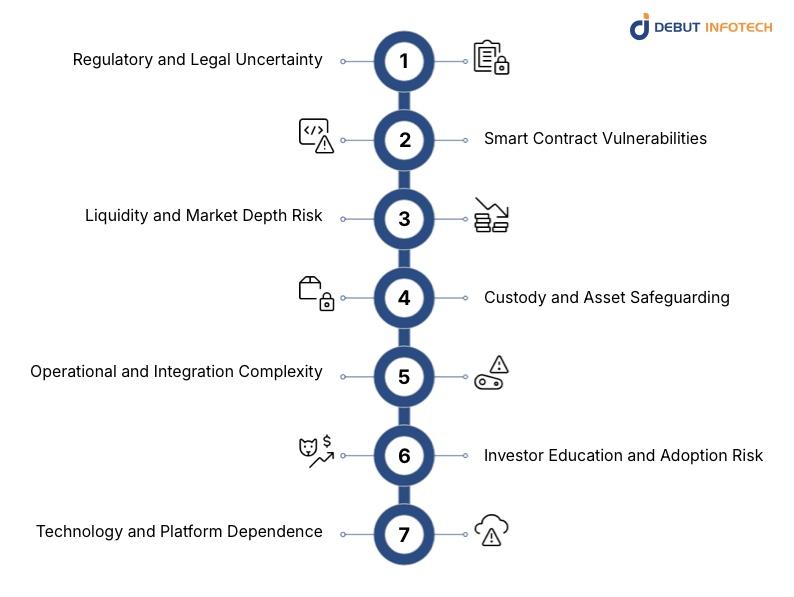
Despite strong momentum, real estate tokenization in 2026 is not without challenges. As adoption expands, market participants are becoming more aware that technology alone does not guarantee success. Regulatory uncertainty, operational complexity, and investor education remain important considerations when deploying tokenized property models.
One of the most significant risks lies in regulation. Although many jurisdictions have begun clarifying rules around tokenized assets on blockchain networks, regulatory frameworks are still evolving. Differences in securities laws, property ownership rules, and investor eligibility requirements can complicate cross-border offerings. Without proper legal structuring, tokenized real estate projects risk non-compliance, enforcement actions, or forced restructuring.
Smart contracts in real estate automate critical functions such as ownership transfers, income distribution, and compliance enforcement. However, poorly written or insufficiently audited smart contracts can expose platforms to security vulnerabilities. Coding errors or logic flaws may lead to fund loss, unauthorized access, or irreversible transaction errors, making rigorous testing and audits non-negotiable.
Although tokenization improves liquidity compared to traditional real estate, liquidity is not guaranteed. Tokenized Real Estate Marketplaces still depend on active participation from buyers and sellers. Low trading volume or limited investor interest can reduce price discovery and make it difficult for token holders to exit positions at fair value.
Tokenized real estate introduces new custody considerations. Investors must trust that underlying assets are properly held, insured, and legally enforceable. Weak custody arrangements or unclear ownership structures can undermine confidence, particularly for institutional investors with strict risk management requirements.
Tokenization platforms rely on multiple interconnected systems, including identity verification, compliance monitoring, payment rails, and secondary trading infrastructure. Poor integration between these components can create inefficiencies, delays, or system failures. Operational complexity increases further when platforms scale across multiple asset types or jurisdictions.
Many investors still lack a clear understanding of how tokenized real estate differs from traditional property investment. Misaligned expectations around returns, liquidity, or governance can lead to dissatisfaction or mistrust. Web3 real estate platforms that fail to communicate risks transparently may struggle with long-term adoption.
Finally, reliance on specific tokenization platforms or service providers introduces dependency risk. Platform outages, security incidents, or provider failure can disrupt operations and impact investor confidence. This makes long-term platform stability and technical governance critical considerations.
Read this blog: Real Estate Tokenization: Legal and Regulatory Challenges to Consider
Beyond traditional properties, firms are beginning to tokenize real estate commodities such as land parcels, parking assets, storage facilities, and energy-linked property components. This expansion demonstrates the flexibility of tokenization models.
By tokenizing these assets, owners can unlock value from underutilized resources while offering investors access to niche opportunities. This trend further diversifies the tokenized real estate ecosystem.
AI and blockchain in real estate are increasingly deployed together to enhance operational efficiency. Blockchain ensures data integrity and transparency, while AI analyzes that data to generate insights.
In 2026, this combination supports predictive maintenance, automated valuation models, and risk assessment. For investors, AI-driven analytics improve decision-making, while blockchain-backed records ensure trust in the underlying data.
Behind successful tokenization initiatives lies robust technical infrastructure. Organizations increasingly Hire dedicated development team resources to maintain and scale complex systems involving blockchain, compliance layers, and integrations.
Scalable infrastructure enables platforms to adapt to evolving regulations and market demands, positioning them for sustainable growth.
As real estate tokenization matures, experienced technology partners become essential. Debut Infotech works with real estate firms, investment platforms, and enterprises to design secure, compliant, and scalable tokenization solutions.
By combining blockchain engineering, smart contract development, and regulatory-aware architecture, Debut Infotech helps organizations implement tokenization strategies that align with long-term business goals.
Emerging Real Estate tokenization trends are redefining property investment in 2026 by introducing flexibility, transparency, and liquidity into traditional markets. From smart contracts in real estate and Web3 real estate platforms to DeFi real estate applications and standardized token frameworks, each development builds toward a more efficient investment ecosystem.
As adoption continues to grow, organizations that act early stand to gain strategic advantages. With the right technology partner, such as Debut Infotech, businesses can navigate the complexities of tokenized real estate with confidence. Debut Infotech’s expertise positions it to support scalable, compliant solutions as tokenized property investment becomes an integral part of the global real estate landscape.
A. Real estate tokenization is the process of converting ownership or economic rights in a property into digital tokens recorded on a blockchain. Each token represents a share of the underlying asset and can be transferred or traded according to predefined rules enforced through smart contracts.
A. Yes, in many jurisdictions, tokenized real estate assets are legally recognized when structured correctly. Compliance depends on how the tokens are classified, local property laws, and securities regulations. Most modern tokenization platforms embed compliance measures directly into their smart contracts.
A. Smart contracts automate processes such as ownership transfers, income distribution, and compliance checks. This reduces manual paperwork, minimizes errors, lowers transaction costs, and increases transparency for all participants involved in the investment.
A. A wide range of assets can be tokenized, including residential buildings, commercial properties, land parcels, and even real estate commodities like parking spaces or storage facilities. The flexibility of tokenization allows both traditional and alternative property assets to be represented on blockchain networks.
A. Web3 real estate platforms are built on decentralized infrastructure and provide on-chain ownership records, wallet-based access, and transparent transaction histories. Unlike traditional platforms, they enable direct peer-to-peer transactions and often support global participation without relying on centralized intermediaries.
A. AI and blockchain in real estate work together to enhance decision-making and operational efficiency. AI analyzes on-chain and off-chain data for valuation, risk assessment, and predictive maintenance, while blockchain ensures data integrity and transparency.
A. Yes, tokenized real estate is increasingly attractive to institutional investors due to improved liquidity, transparent ownership records, and automated compliance. As tokenized real estate marketplaces mature, they offer the governance and scalability institutions typically require.

Our Latest Insights
USA
2501 Chatham, Rd Suite R Springfield, IL 62704
+1-708-515-4004
info@debutinfotech.com
UK
7 Pound Close, Yarnton, Oxfordshire, OX51QG
+44-770-304-0079
info@debutinfotech.com
Canada
154 Eden Oak Trail, Kitchener, ON N2A 0H9
+1-708-515-4004
info@debutinfotech.com
INDIA
Sector 101-A, Plot No: I-42, IT City Rd, JLPL Industrial Area, Mohali, PB 140306
9888402396
info@debutinfotech.com