ON THIS PAGE
Progress0%






Our Global Presence :





Agentic AI in Finance is reshaping how financial organizations generate insights, assess risk, and drive returns. By 2026, the AI in finance market is expected to grow from about $7.3 billion in 2021 to over $22.6 billion, reflecting increased adoption of autonomous analytics and decision systems.
Additionally, 90% of finance teams worldwide are projected to run at least one AI-enabled tool, accelerating predictive insights and risk evaluations across banking and investing functions. These trends highlight how Agentic AI in Finance improves forecasting accuracy and responsiveness, supporting faster risk assessment and superior financial performance across banks, asset managers, and fintechs.
In this guide, we will explain what Agentic AI is, how it works, its key capabilities, benefits, applications, and practical implementation tips and challenges to consider.
Agentic AI in finance refers to intelligent systems that can operate with a high degree of independence while pursuing defined financial objectives. These AI algorithms do more than analyze data or automate tasks. They observe conditions, make context-aware decisions, take action across financial workflows, and refine their behavior over time.
Within banks, fintech firms, and investment institutions, Agentic AI acts as a digital operator rather than a passive tool, supporting complex financial operations with consistency and control.
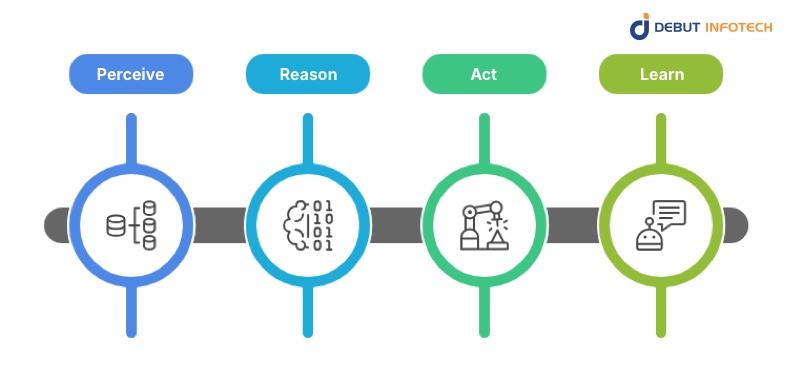
Agentic AI follows a structured operational loop that allows it to function autonomously while remaining aligned with institutional goals. Each stage builds on the previous one, enabling continuous improvement and informed execution across financial environments. Here’s how agentic AI works in finance:
Agentic AI continuously monitors structured and unstructured data from financial systems, customer interactions, market feeds, transaction logs, and regulatory updates. This perception layer ensures the system maintains situational awareness across changing financial conditions without relying on manual prompts.
Using predefined objectives, business rules, and learned patterns, Agentic AI evaluates available information to determine optimal actions. It weighs risks, forecasts outcomes, and prioritizes tasks in line with institutional policies. This reasoning capability allows financial organizations to maintain consistency while handling complexity at scale.
Once decisions are made, Agentic AI executes actions directly within approved systems. These actions may include adjusting risk thresholds, triggering compliance checks, responding to customers, or reallocating resources. Execution occurs within defined guardrails, ensuring accountability and alignment with governance requirements.
Agentic AI improves through feedback loops, performance monitoring, and outcome analysis. It refines its decision models based on successes, failures, and environmental shifts. This learning process helps financial institutions remain resilient as market conditions, regulations, and customer expectations evolve.
Related read: A Complete Guide to AI for Financial Reporting
Agentic AI can independently execute end-to-end financial tasks in accordance with predefined objectives and constraints. It operates without constant human input, while still respecting governance rules, approval thresholds, and compliance policies embedded within financial systems.
Agentic AI continuously adjusts its behavior in response to market volatility, regulatory updates, customer behavior, and operational signals. This flexibility allows financial institutions to remain resilient, responsive, and aligned with changing business and risk conditions.
By processing large volumes of financial data in real time, Agentic AI accelerates analysis, decision-making, and execution. This reduces processing delays, minimizes manual intervention, and enables faster responses across trading, compliance, and operational workflows.
Agentic AI enables seamless collaboration between multiple autonomous agents across departments. These agents share context, align priorities, and synchronize actions, ensuring consistent execution across risk management, customer service, finance operations, and compliance functions.
Agentic AI automates complex financial processes while maintaining accuracy and control. Teams spend less time on repetitive tasks and more on strategic initiatives, leading to higher output, improved resource utilization, and stronger profitability across financial operations.
By reducing manual processing, error correction, and operational bottlenecks, Agentic AI lowers staffing and infrastructure costs. Over time, automated decision execution and self-optimization help financial institutions achieve sustainable cost efficiency without compromising service quality or compliance.
Agentic AI evaluates data, assesses risk, and executes actions in near real time. This shortens approval cycles and eliminates delays caused by fragmented systems, enabling financial organizations to respond faster to market shifts and operational demands.
Customers benefit from faster responses, personalized interactions, and consistent service across channels. Agentic AI resolves issues proactively, anticipates customer needs, and maintains service continuity, helping financial institutions build trust, satisfaction, and long-term customer relationships.
Agentic AI continuously monitors systems for anomalies, identifies potential threats, and triggers automated responses. Its ability to adapt to new attack patterns strengthens cybersecurity defenses, reduces incident response times, and improves overall resilience against evolving financial cyber risks.
By coordinating product development, compliance checks, and operational readiness, Agentic AI reduces launch timelines. Financial institutions can introduce new services faster while maintaining regulatory alignment, internal controls, and consistent execution across multiple business units.
Agentic AI monitors financial exposure continuously, adjusts controls dynamically, and flags emerging risks early. This proactive approach improves credit, market, and operational risk management while supporting more informed, consistent decisions across complex financial environments.
Agentic AI enforces compliance rules automatically, maintains audit trails, and adapts to regulatory changes. This reduces compliance gaps, supports accurate reporting, and helps financial institutions meet regulatory expectations with greater consistency and operational confidence.
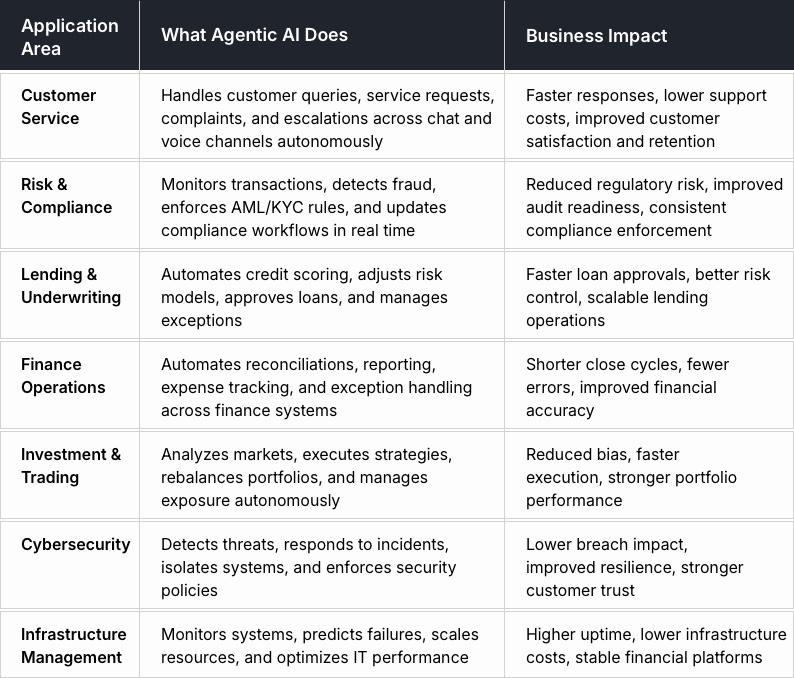
Here are some agentic AI applications in finance:
Agentic AI handles end-to-end customer interactions across chat, voice, and digital channels. It resolves account queries, processes service requests, manages complaints, and escalates complex cases when required. The system adapts responses based on customer history, intent, and real-time context.
Impact
Agentic AI improves service consistency, reduces response times, and ensures uninterrupted customer support. Financial institutions experience lower support costs and higher customer satisfaction, while agents focus on high-value interactions. This leads to stronger customer trust, improved retention, and more scalable service operations.
Agentic AI continuously monitors transactions, customer behavior, and regulatory updates to detect anomalies and compliance breaches. It autonomously applies controls, triggers investigations, and updates compliance workflows. These systems operate across AML, fraud detection, KYC processes, and regulatory reporting environments.
Impact
By acting in real time, Agentic AI reduces compliance gaps and minimizes regulatory exposure. Financial institutions benefit from consistent enforcement, improved audit readiness, and reduced manual oversight. This strengthens institutional credibility while lowering the operational burden associated with complex regulatory requirements.
Agentic AI automates credit assessments by analyzing financial histories, behavioral data, and market indicators. It adjusts risk models dynamically, supports loan approvals, and manages exception handling. These systems ensure faster underwriting decisions while maintaining policy adherence and consistent credit evaluation standards.
Impact
Agentic AI shortens loan approval cycles and improves decision accuracy. Lenders achieve better risk-adjusted returns while offering faster, fairer credit decisions. This enhances borrower experience, reduces default risk, and enables institutions to scale lending operations without proportionally increasing operational complexity.
Agentic AI for accounts payable automates reconciliations, financial reporting, expense management, and exception handling. It coordinates workflows across accounting systems, identifies discrepancies, and resolves issues autonomously. These agents ensure accurate, timely financial operations while maintaining audit trails and compliance with internal controls.
Impact
With Agentic AI, finance teams gain operational efficiency and improved accuracy. Closing cycles become faster, errors decline, and reporting consistency improves. Organizations reduce dependency on manual processes, allowing finance professionals to focus on strategic planning, forecasting, and performance analysis.
Agentic AI analyzes market data, news signals, and portfolio performance to execute predefined investment strategies. It autonomously rebalances portfolios, manages risk exposure, and adjusts trading actions in response to market conditions. These agents operate within strict risk and governance parameters set by institutions.
Impact
Agentic AI enhances trading speed, consistency, and discipline. Financial institutions benefit from reduced emotional bias, improved risk control, and faster reaction to market changes. This leads to more resilient investment strategies, optimized returns, and stronger portfolio performance over time.
Agentic AI monitors network activity, user behavior, and system logs to detect threats and vulnerabilities. It autonomously responds to incidents, isolates affected systems, and enforces security policies. These capabilities support continuous protection across financial infrastructure and sensitive customer data environments.
Impact
By responding faster than traditional security tools, Agentic AI reduces breach impact and recovery time. Financial institutions strengthen their cyber defenses, protect critical assets, and maintain operational continuity. This proactive security posture supports regulatory compliance and reinforces customer confidence in digital financial services.
Agentic AI manages financial IT infrastructure by monitoring system performance, optimizing resource allocation, and predicting failures. It autonomously scales resources, schedules maintenance, and resolves issues before disruption occurs. This ensures stable, high-performing platforms supporting core financial operations.
Impact
Agentic AI improves system reliability, reduces downtime, and lowers infrastructure management costs. Financial organizations benefit from optimized resource usage and uninterrupted service delivery. This stability supports digital transformation initiatives while ensuring consistent performance across mission-critical financial systems.
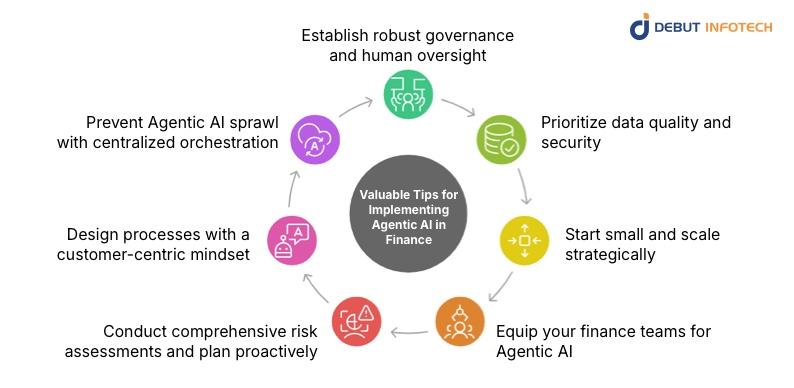
Clear governance frameworks are critical for controlling autonomous behavior. Organizations should define decision boundaries, escalation paths, and accountability models, and support them with human-in-the-loop oversight. This approach balances autonomy with control, ensuring AI agents operate responsibly, transparently, and in line with regulatory expectations across complex financial environments.
High-quality, secure data is the foundation of effective Agentic AI. Financial institutions should standardize data sources, enforce validation rules, and protect sensitive information through encryption and access controls. Strong data governance ensures AI decisions remain accurate, reliable, and compliant across all financial operations at scale.
Successful implementation of AI agents in finance industry begins with focused pilot projects. Starting small allows institutions to validate assumptions, refine controls, and measure impact. Once value is proven, Agentic AI can be scaled systematically across functions while maintaining governance consistency and minimizing operational disruption and long-term organizational confidence during expansion phases.
Finance teams need practical skills to work effectively with Agentic AI. Training should cover AI oversight, exception handling, and decision interpretation. Cross-functional collaboration between finance, risk, IT, compliance teams, or AI consultants helps embed Agentic AI smoothly into daily workflows and long-term operational planning at scale today.
Comprehensive risk assessments are essential before deploying Agentic AI in finance and accounting. Institutions should evaluate operational, model, security, and regulatory risks, then design mitigation strategies in advance. Proactive planning reduces unexpected failures and ensures autonomous systems behave predictably under stress or unusual market conditions and extreme volatility scenarios.
Agentic AI initiatives should be designed around customer needs from the outset. Mapping customer journeys helps identify where autonomy adds value. This approach ensures automation improves responsiveness, personalization, and trust, rather than introducing friction or disconnected experiences across financial touchpoints for diverse customer segments globally.
Without coordination, multiple autonomous agents can create inefficiencies. Centralized orchestration provides visibility, control, and alignment across Agentic AI deployments. It helps institutions manage dependencies, avoid duplication, and ensure that all agents operate safely toward shared business objectives and governance standards across complex enterprise environments at scale.
Agentic AI depends on consistent, integrated data across systems. Poor data quality, legacy platforms, and fragmented architectures can limit performance. Financial institutions must invest in data modernization and integration strategies to ensure autonomous decisions are accurate, timely, and aligned across the organization at enterprise scale.
Autonomous decision-making introduces governance complexity. Clear policies, approval thresholds, and accountability structures are required to manage risk effectively. Without strong oversight, Agentic AI may act beyond intended boundaries, increasing operational or regulatory exposure for financial institutions operating in tightly regulated environments with high systemic impact.
Financial decisions require transparency and fairness. Agentic AI models can introduce bias or produce outcomes that are difficult to explain. Institutions must prioritize explainability, testing, and monitoring to meet regulatory expectations and maintain stakeholder trust in automated financial decision processes across critical business functions globally.
Implementing agentic AI in financial services requires cultural and skillset shifts. Employees may resist autonomy-driven systems or lack the expertise to oversee them. Effective change management, clear communication, and targeted upskilling are essential to ensure enterprise-wide adoption, confidence, and long-term success across finance, risk, and technology teams.
Debut Infotech offers comprehensive AI Agent Development Services for financial institutions seeking autonomy without losing control. We design intelligent systems that perceive, reason, act, and learn within strict regulatory boundaries. With deep expertise in finance, compliance, and enterprise AI architecture, we help organizations deploy agentic solutions that improve decision accuracy, operational resilience, and long-term scalability across mission-critical financial environments.
Why Partner With Us:
Agentic AI is redefining how financial institutions anticipate risk, act on insights, and scale returns with confidence. By combining autonomy, continuous learning, and governed execution, organizations gain faster decisions without sacrificing control.
As adoption accelerates, Agentic AI in Finance becomes a practical path to stronger resilience, smarter operations, and sustained performance.
Institutions that invest thoughtfully, align governance, and build internal readiness are better positioned to compete in increasingly complex financial environments.
A. Generative AI creates content like reports, summaries, or forecasts when prompted. Agentic AI goes further. It plans tasks, makes decisions, and acts across systems with minimal input. In finance, that means systems that don’t just suggest actions but actually execute them under defined rules at scale reliably.
A. Yes, Agentic AI can integrate with existing finance systems via APIs, data pipelines, and workflow tools. It doesn’t replace core platforms overnight. It sits on top, connects different tools, and coordinates actions across legacy software, cloud services, and third-party systems already in use inside real-world operations daily.
A. Traditional automation follows fixed rules and breaks when conditions change. Agentic AI adapts. It understands goals, reasons through scenarios, and chooses next steps on its own. In finance, this means workflows that adjust to market shifts, data gaps, or unexpected events without manual intervention or constant oversight.
A. You need clean data, secure system access, and clear operational rules. On the skills side, teams need AI engineers, domain experts, and people who understand risk and compliance. Cloud infrastructure helps, but most value comes from aligning AI behavior with business policies across regulated financial environments today.
A. Costs vary widely based on scope, integrations, and risk controls. Small pilots might run $50,000–$150,000. Mid-size projects usually fall in the $200,000–$800,000 range.
Large enterprise-grade solutions with heavy integration, compliance, and monitoring can hit $1 million–$3 million+, depending on complexity and scale. Expenses usually include model development, system integration, security reviews, compliance checks, and ongoing monitoring, as well as infrastructure costs, support, and governance tooling.

Our Latest Insights
USA
2501 Chatham, Rd Suite R Springfield, IL 62704
+1-708-515-4004
info@debutinfotech.com
UK
7 Pound Close, Yarnton, Oxfordshire, OX51QG
+44-770-304-0079
info@debutinfotech.com
Canada
154 Eden Oak Trail, Kitchener, ON N2A 0H9
+1-708-515-4004
info@debutinfotech.com
INDIA
Sector 101-A, Plot No: I-42, IT City Rd, JLPL Industrial Area, Mohali, PB 140306
9888402396
info@debutinfotech.com