ON THIS PAGE
Progress0%






Our Global Presence :


Node.js continues to reshape backend development, and selecting the right Node.js frameworks has become crucial for building fast, scalable applications. In 2025, Node.js was cited as the most commonly used web technology by 40.8 % of developers worldwide, reflecting strong ecosystem adoption.
In addition, it powers over 30 million websites globally, demonstrating real-world impact across industries. This guide explores the top 15 Node.js frameworks to consider in 2026, detailing what each is, how it works, and why it matters. Whether you’re developing APIs, real-time apps, or enterprise systems, understanding these frameworks helps you choose tools that align with performance, scalability, and long-term maintainability goals.
A Node.js framework is a structured layer built on top of Node.js that simplifies server-side development. It provides predefined tools, libraries, and conventions for common tasks such as routing, middleware management, and request handling. This structure reduces repetitive setup work and supports consistent application of Node.js architecture, which helps teams maintain clarity as projects grow.
Node.js frameworks exist to make development predictable, efficient, and easier to scale. They help teams move faster while maintaining clean code and reliable performance across environments.
Frameworks remove the need to build everything from scratch. Ready-made patterns, utilities, and abstractions allow developers to focus on business logic rather than infrastructure concerns. This shortens development cycles and lowers the chance of basic implementation errors.
Using a node js framework for api enforces consistent coding patterns across a project. This consistency improves readability, simplifies onboarding, and reduces long-term maintenance costs. Teams benefit from shared conventions rather than personal coding styles.
Popular Node.js frameworks come with large plugin ecosystems and active communities. This means better documentation, frequent updates, and faster solutions to common problems. Long-term support becomes more predictable when a framework has broad adoption.
Most frameworks include built-in protections against common vulnerabilities. Features like request validation, secure middleware handling, and dependency management reduce risk exposure. This gives custom software development teams a more controlled foundation for building secure applications.
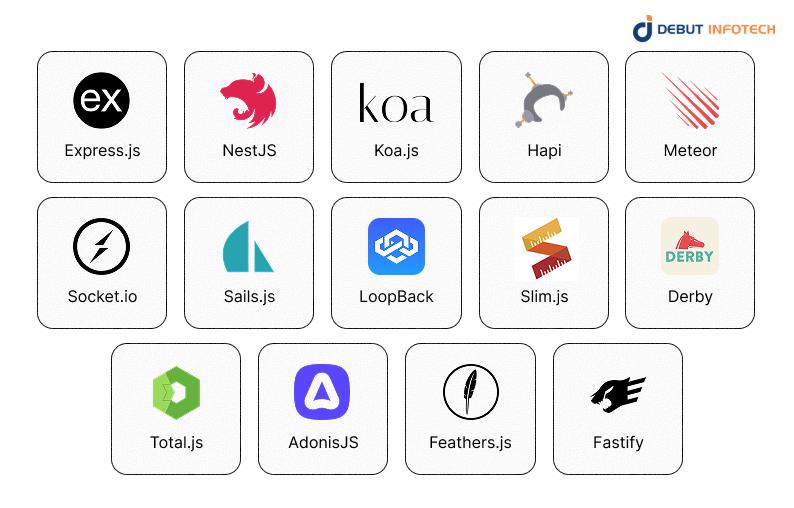
Each best node js framework serves a distinct purpose. The right choice depends on application goals, team experience, and scalability expectations.
Express.js is a minimal, unopinionated Node.js web framework for building APIs and server-side applications. It runs across major operating systems and integrates easily with databases, third-party services, and frontend frameworks. Its flexibility makes it a strong option for teams that want architectural freedom and fast setup.
Key features:
When to use:
Companies using: Uber, IBM, Accenture, PayPal, Fox Sports
NestJS is a progressive and is among the fastest Node.js framework designed for scalable, enterprise-grade applications. It uses TypeScript by default and supports modular architecture, dependency injection, and microservices. NestJS runs on Windows, macOS, and Linux and works seamlessly with Express or Fastify. Its structured approach supports long-term maintainability and dedicated software development team collaboration.
Key features:
When to use:
Companies using: Adidas, Roche, Autodesk, GitLab, Trivago
Koa.js is a modern Node.js framework created by the Express team, focused on simplicity and control. It uses async/await natively and avoids bundled middleware, allowing developers to design clean, custom stacks. Koa runs on all major operating systems and is well-suited to performance-focused environments. Its minimalist design appeals to experienced developers.
Key features:
When to use:
Companies using: Alibaba, Uber Engineering, NPM, Segment, Netlify
Hapi is a configuration-driven Node.js framework built for secure and reliable APIs. It emphasizes validation, authentication, and predictable behavior. Hapi supports all major operating systems and is commonly used in regulated or data-sensitive environments. Its plugin system encourages clean separation of concerns and maintainable codebases.
Key features:
When to use:
Companies using: Walmart, PayPal, Disney, Auth0, Yahoo
Meteor is a full-stack JavaScript framework designed for building real-time web and mobile applications. It supports Windows, macOS, and Linux and provides seamless data synchronization between client and server. Meteor is commonly used for rapid development where speed and real-time updates matter. Its integrated tooling reduces configuration overhead and simplifies deployment.
Key features:
When to use:
Companies using: IKEA, Rocket. Chat, Dispatch, Mixmax, Honeywell
Socket.io is a Node.js framework focused on real-time, event-based communication. It supports all major operating systems and enables persistent connections between clients and servers. Socket.io is widely used for applications requiring instant data exchange and low-latency updates. Its fallback mechanisms ensure reliability across unstable network conditions.
Key features:
Real-time bidirectional communication
Automatic reconnection handling
Event-driven architecture
WebSocket and fallback support
Scalable broadcasting
Cross-platform compatibility
When to use:
Companies using: Microsoft, Trello, Zendesk, Wikimedia, Coursera
Sails.js is an MVC-based Node.js framework built for data-driven and real-time applications. It supports Windows, Linux, and macOS and integrates smoothly with databases and WebSockets. Sails.js simplifies backend development by enforcing structure while remaining flexible enough for customization.
Key features:
When to use:
Companies using: Verizon, Microsoft, Paystack, Accenture, Dell
LoopBack is a highly extensible Node.js framework designed for building REST and GraphQL APIs. It runs across all major operating systems and excels in backend-heavy systems. LoopBack accelerates development through automated endpoint generation and strong database connectors. Its architecture supports scalable enterprise integrations.
Key features:
When to use:
Companies using: IBM, GoDaddy, Symantec, Siemens, Orange
Slim.js is a lightweight Node.js framework designed for building fast and simple web applications and microservices. It supports Windows, macOS, and Linux, with minimal abstractions that keep performance overhead low. Slim.js is a solid option for developers who want speed, simplicity, and direct control over application flow without heavy architectural constraints.
Key features:
When to use:
Companies using: Startups, SaaS teams, internal enterprise tools, fintech firms, digital agencies
Derby is a real-time MVC Node.js framework focused on collaborative applications. It supports major operating systems and enables shared application state between server and client. Derby simplifies the development of interactive applications that support multiple users working with synchronized data. Its model-driven design supports maintainability in real-time environments.
Key features:
When to use:
Companies using: Atlassian teams, product startups, collaboration platforms, SaaS vendors, internal tooling teams
Total.js is a full Node.js framework offering MVC, REST, real-time communication, and NoSQL support in a single ecosystem. It runs across all major operating systems and targets teams seeking an all-in-one development platform. As a top backend frameworks for node js, Total.js reduces dependency sprawl and promotes consistency across backend and frontend development.
Key features:
When to use:
Companies using: E-commerce platforms, SaaS providers, logistics firms, fintech startups, internal enterprise teams
AdonisJS is an opinionated Node.js MVC framework inspired by Laravel. It supports Windows, macOS, and Linux and provides a structured development experience with built-in tools. AdonisJS is well-suited for developers who value convention-driven design, strong authentication, and clean code organization.
Key features:
When to use:
Companies using: Startups, SaaS companies, fintech platforms, agency-built products, internal enterprise solutions
Koa is a modern, lightweight Node.js framework developed by the Express team. It is designed for building APIs and web applications with minimal overhead and supports Windows, macOS, and Linux. With the latest node version, Koa’s focus on async/await and modular middleware makes it highly flexible, giving developers full control over request handling and response flows. Its simplicity suits teams seeking performance without unnecessary abstractions.
Key features:
When to use:
Companies using: Alibaba, Uber Engineering, NPM, Segment, Netlify
Feathers.js is a microservice-friendly Node.js framework designed for real-time applications. It runs on Windows, macOS, and Linux and allows seamless integration with REST APIs and WebSockets.
Feathers.js simplifies the development of scalable, modular applications and supports a wide range of databases. Its lightweight design and flexibility make it ideal for both small projects and enterprise systems.
Key features:
Real-time functionality
REST and WebSocket support
Service-oriented architecture
Database agnostic
Lightweight and modular
Easy authentication and authorization
When to use:
Real-time collaboration apps
REST API development
Scalable microservices
Projects needing modular architecture
Companies using: Microsoft, IBM, Adidas, PayPal, Zalando
Fastify is a high-performance Node.js framework built with speed, low overhead, and scalability in mind. It supports Windows, macOS, and Linux and is commonly used for APIs and microservices that need fast response times.
Fastify focuses on efficiency without sacrificing developer experience, offering a clean plugin system and strong defaults. Its emphasis on performance makes it a solid choice for modern, traffic-heavy applications.
Key features:
When to use:
Companies using: Netflix, Walmart, Microsoft, PayPal, Airbnb
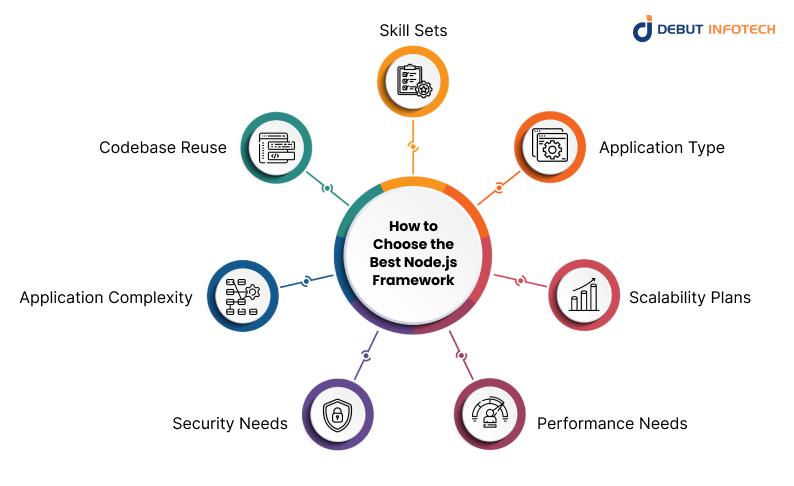
Choosing a Node.js framework is a strategic decision that shapes development speed, code quality, and long-term stability. The following factors help teams evaluate options objectively and select a node js backend framework that aligns with both current requirements and future growth plans.
Selecting a web application framework should align with your team’s existing technical strengths. Teams familiar with TypeScript and structured design often adapt more quickly to opinionated frameworks, while JavaScript-focused teams may prefer more flexible options.
Matching rapid web application development tools to skills reduces onboarding time, limits errors, and improves overall development efficiency.
Different applications demand different framework capabilities. Real-time systems, REST APIs, enterprise platforms, and microservices each require specific architectural support. Choosing a framework designed for your application type ensures better performance, cleaner implementation, and fewer workarounds during development and long-term maintenance.
Future growth should influence framework selection from the start. Some web programming frameworks support modular expansion, microservices, and distributed systems more naturally. Planning for scalability early prevents costly rewrites later. It ensures your application can handle increased traffic, features, and data without structural limitations.
Performance expectations vary by use case. Lightweight frameworks deliver faster response times with minimal overhead, while feature-rich frameworks trade some speed for structure and tooling. Understanding performance priorities helps balance speed, stability, and developer convenience in line with real-world application demands.
Applications that handle sensitive data require frameworks with robust built-in security features. Input validation, authentication mechanisms, and secure middleware handling reduce exposure to vulnerabilities. Choosing a framework that follows proven Node.js security practices reduces compliance risks and simplifies ongoing security management throughout the application lifecycle.
Simple applications benefit from minimal frameworks that avoid unnecessary structure. Complex systems, however, require enforced patterns to manage dependencies, workflows, and business logic. Selecting a framework that matches application complexity prevents overengineering while ensuring maintainability as features and teams expand.
Frameworks that encourage modular design make it easier to reuse components across projects. Shared services, middleware, and libraries reduce development effort and promote consistency. Prioritizing reuse-friendly frameworks supports faster delivery and lowers long-term maintenance costs across multiple applications.
Debut Infotech offers reliable, user-friendly, and pocket-friendly web development services. We also specialize in Node.js frameworks.
With deep expertise in building scalable, high-performance applications, we guide businesses in selecting and implementing the right frameworks for their needs.
From APIs and real-time platforms to enterprise-grade systems, our express code team ensures clean architecture, robust security, and smooth deployment. Partnering with us guarantees optimized development, faster time-to-market, and long-term application success.
Choosing from the top Node.js frameworks to consider in 2026 comes down to clarity around project goals, team expertise, and long-term plans. Each option covered serves a distinct purpose, from lightweight APIs to complex enterprise systems.
When selected carefully, Node.js frameworks support cleaner architecture, stronger security, and smoother scaling.
A thoughtful choice reduces technical friction, improves development efficiency, and positions applications for sustained growth as requirements evolve.
A. No, Node.js isn’t a framework. It’s a runtime environment that lets you run JavaScript on the server side. It provides the foundation for building applications, while frameworks like Express.js or NestJS sit on top of it to simplify development and structure your code.
A. Not exactly. React is a frontend library for building user interfaces, primarily for web apps. It runs in the browser, while Node.js runs on the server. You can use them together. However, React isn’t a Node.js framework, but it’s focused purely on rendering UI components.
A. Node.js is backend-focused. It lets you run JavaScript on the server, handle requests, manage databases, and build APIs. While it’s not a framework, it powers the backend of web applications, leaving frontend tasks to libraries like React, Angular, or Vue.
A. Node.js uses JavaScript. It’s a runtime that allows developers to write server-side applications in JavaScript, the same language used in browsers. This makes it easier to share code between frontend and backend, creating a smoother development workflow across the whole application stack.
A. It depends on what you need. Node.js is for server-side applications and handling backend logic, while ReactJS is for building dynamic user interfaces on the frontend. Neither is strictly “better”; they’re complementary and often used together in full-stack applications for maximum efficiency.

Our Latest Insights
USA

2501 Chatham, Rd Suite R Springfield, IL 62704
+1-708-515-4004
info@debutinfotech.com
UK

7 Pound Close, Yarnton, Oxfordshire, OX51QG
+44-770-304-0079
info@debutinfotech.com
Canada

154 Eden Oak Trail, Kitchener, ON N2A 0H9
+1-708-515-4004
info@debutinfotech.com
INDIA

Sector 101-A, Plot No: I-42, IT City Rd, JLPL Industrial Area, Mohali, PB 140306
9888402396
info@debutinfotech.com

9001:2015
Quality Certified

ISO 27001
Security Certified

A+ Rating
Accredited Business

Certik
Security & Audit


Copyright © 2026, Debut Infotech. All rights reserved. | Privacy Policy