ON THIS PAGE
Progress0%






Our Global Presence :





ReactJS is one of the first words that come to mind when the subject of modern frontend development is discussed, and rightfully so. ReactJS is a JavaScript library that is based on components and is more likely to simplify the building of web applications which are fast, flexible, and scalable without the need of complicating the code base. Reusable components, its efficient virtual DOM, and many other ReactJS benefits are tailored to enable products to scale without slowed down teams.
This is one of the reasons why React is not only popular, but it is also used extensively in the real world. Actually, React is always listed among the top used frontend libraries worldwide, and it is trusted by many millions of developers, with more than 20 million downloads each week on npm, which is another good indicator of long-term confidence and maturity of their ecosystem.
Popularity however is not enough. With increasing products, they are confronted with tangible problems such as traffic spikes, accelerating feature releases, and development teams working on the same codebase. Scalability goes beyond being able to serve more users but it is also about being able to maintain performance, code quality and the development speed as all other things scale in the same direction. That’s where ReactJS really starts to show its strengths.
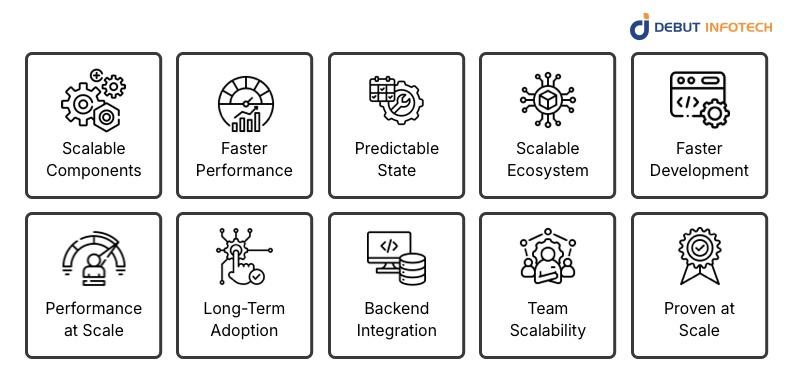
Let’s now look at the Top 10 ReactJS benefits:
Scalable Components
A component-based structure is one of the primary reasons why members of teams pose the question “why use React.” React allows you to divide the interface into small and self-contained elements rather than constructing the whole system in a single large and tightly interlocked component. Every component takes care of a certain aspect of the UI and may be reused throughout the application.
This method simplifies scaling to a high degree. New functionality can be added without having to touch unrelated sections of the codebase and maintenance is predictable even when the app becomes larger. A famous example is Facebook News Feed. It is also based on thousands of React components and each one can be updated independently without impacting the rest of the platform.
This structure also simplifies teamwork as teams increase in size. Developers are able to work on various sections of the app simultaneously, test modifications more quickly and onboard new staff without subjecting them to the whole codebase.
Faster Performance
Performance problems tend to emerge when an application is more dynamic, but React allows mitigating this danger with a virtual DOM. React only reloads the part of the page that has changed as opposed to reloading the page when a change has been made.
This creates a tangible difference where the application has plenty of updates, like a dashboard, product filters, or social feeds. With traffic and user activity growing, the leading-edge rendering of React will keep the interface responsive and smooth, which makes it a crucial tool to scale without damaging the user experience.
Predictable State
Adding new features and developers can easily make the handling of application data to be a messy affair. The one-way data flow in React provides the structure of this process and makes it clear how data flows within the app and how a change in it would influence the UI.
This predictability used together with modern state management tools can be useful in avoiding bugs, decreasing unanticipated behavior and maintaining the codebase consistent as the product grows. In the case of expanding companies, such clarity is a significant benefit, as it enables the application to grow without being constantly engaged in a battle with state-related problems.
Scalable Ecosystem
The ecosystem surrounding React is one of the most feasible causes of its scalability. With the evolution of applications, new requirements such as better routing, better performance, SEO, or quicker build time, nearly always arise. React does not impose a single mode of operation among the teams. Rather, it will fit naturally with the tools, such as React Router, to manage complex navigation and frameworks, like Next.js, when there is a need for server-side rendering or static generation. It implies that instead of overengineering a product, a team can begin with simple features and add higher-level features when the product requires them.
Such flexibility decreases technical debt with time. Rather than having to swap the frontend stack as the app grows, the teams are able to add more advantageous tooling to the core React base. That scalability in the long term is a reason why so many businesses seek to hire React.js developers when creating products that will grow within years, not months.
Faster Development
With the increase in applications, the pace of development usually declines, unless the codebase has been created to be reused. React encourages this from the start. Logic may be placed in custom hooks, while UI components may be split into reusable components that are uniform throughout the application. When teams build shared component libraries or design systems on top of React, they stop rewriting the same features for every new page or product.
This is particularly useful when teams get larger. Following the components and patterns, new developers can easily learn how the application functions. Delivery of features is quicker, bugs can be more readily isolated and modifications do not spread across the code base in an unpredictable manner. This type of development efficiency in large applications has a direct effect on time-to-market and long-term maintenance costs.
Performance at Scale
Performance problems tend to become apparent only when an application has real users. React can easily serve this expansion since it is geared towards effective updates, not complete page re-renders. React apps can be used in combination with server-side rendering or static generation to create faster delivery of content, enhancement of search visibility, and a more accessible experience to the user irrespective of their device or location.
This is important to scalable products whose traffic can be unpredictable. It could be a SaaS dashboard loading massive data, a marketplace managing peak traffic, or a content platform that caters to international audiences, the performance-oriented architecture of React can ensure that the application can be fast in terms of load as its user base grows. Rather than re-architecting the frontend to address performance issues in the future, teams are able to scale with the same platform with certainty.
Long-Term Adoption
Selecting a technology to use for a scalable application is also a long term commitment. The popularity of React alone is not what allows it to remain widely used over time, but it is backed by a large organization, actively maintained, and has a large community of developers globally. This guarantees consistent enhancements without abrupt changes which may inconvenience the applications in use.
In the case of businesses, it helps in risk reduction. React has the ability to allow teams to invest knowing that they will have active support, available talent, and a clear upgrade path as the product will continue evolving. That reliability would over time be a key benefit in scaling up the application and the team itself.
Backend Integration
The ease with which it integrates with your backend and APIs is one of the largest merits of React. Regardless of either using the REST or GraphQL approach, React enables fetching and handling data simultaneously without degrading the user experience. In the case of teams that implement microservices or headless CMSs, React can be easily adapted, which allows the frontend to interact with various systems with ease. Such flexibility is one of the main reasons why many companies use professional ReactJS development services to develop an app that can be expanded the first day.
Team Scalability
Development teams expand as your applications expand. The component-based design of React allows assigning clear responsibility to the developer and allows several employees to collaborate on different components of the app without clashes. Its micro-frontend support, as well as similar sets of consistent code, guarantee you a scalable code and scalable teams so that you can continue to develop your complex projects with ease.
Proven at Scale
React has been proven in practice by those companies that have to deal with large user bases. Facebook serves billions of users with the modular components of React, Netflix uses it to deliver performance-sensitive interfaces, Airbnb uses it to support the same design systems, and Uber serves dynamic application states in multiple products. These illustrations demonstrate that React is not only a small app builder, but it is scalable to both startups and businesses.
React is not a regular JavaScript library, but it is a stable platform on which one can create applications that are meant to scale. When you consider the actual ReactJS benefits, they are not limited to faster development, but long-term scalability, flexibility, and performance.
Since startups can be launched within minutes and businesses grow by diversifying their products, React can keep up with business requirements. Its component-based structure keeps teams efficient, while its SEO and mobile-friendly capabilities help products stay competitive over time. Backed by a strong community and a proven security model, React offers stability you can build on with confidence.
To fully unlock those benefits, having the right development partner matters. Debut Infotech, a leading ReactJS Development Company, helps businesses apply React the right way, building scalable, future-ready applications that support real growth.
Thinking about scaling your next web app with React? Talk to the experts at Debut Infotech to explore how the right React architecture can support your product today and as it grows.
A. ReactJS is primarily applied to create dynamic and interactive interfaces to web applications. It is a front-end JavaScript library that assists developers to design fast and responsive experiences. React has a component-based structure, implying that the UI is divided into parts that can be used in multiple ways. This simplifies scaling, maintaining and updating of applications as they expand.
A. ReactJS is not a substitute for HTML. HTML remains the language that is utilized in structuring web content. React, however, is an HTML-friendly JavaScript library, meaning it does not oppose it. In simple terms, It uses HTML-like syntax to help developers build interactive and dynamic user interfaces more efficiently. HTML gives the structure, and React adds the behaviors and reactions of that structure to the activities of the user.
A. ReactJS is a client side (JavaScript) library. It is used to create user interfaces and what users can see and interact with on the browser. React is not a backend technology. It does not handle servers, databases or even business logic itself. It is however compatible with other backend technologies such as Node.js, Python, Java or PHP to develop full-stack applications. Concisely, the UI part is managed by React, and the server by the backend which handles data and security, as well as server-side processing.
A. In 2026, React remains a strong choice for building fast, scalable user interfaces. Such features as React Server Components are shifting more work to the server making it more performant, SEO-friendly, and more developer-friendly. Large apps are easier to maintain and scale due to its component-based structure. React together with Next.js allows full-stack development, and React Native allows web and mobile applications that are cross-platform. React remains scalable and suitable to high-performance applications with the deployment of modern ReactJS development tools, such as TypeScript, hooks, and Tailwind CSS.

Our Latest Insights
USA
2501 Chatham, Rd Suite R Springfield, IL 62704
+1-708-515-4004
info@debutinfotech.com
UK
7 Pound Close, Yarnton, Oxfordshire, OX51QG
+44-770-304-0079
info@debutinfotech.com
Canada
154 Eden Oak Trail, Kitchener, ON N2A 0H9
+1-708-515-4004
info@debutinfotech.com
INDIA
Sector 101-A, Plot No: I-42, IT City Rd, JLPL Industrial Area, Mohali, PB 140306
9888402396
info@debutinfotech.com