ON THIS PAGE
Progress0%






Our Global Presence :





Web3 and dApps are shifting from speculative experiments to practical utility platforms that solve real business and user problems. In 2023, the number of unique active wallets interacting with Web3 applications more than doubled, rising 124% year-over-year as users engaged with DeFi, NFTs, and gaming dApps at growing rates, according to Cointelegraph.
Daily decentralized applications usage also climbed, with Web3 wallets interacting with apps at increasingly higher levels throughout 2024 and early 2025, signaling sustained engagement beyond initial curiosity, per CoinLaw.
In addition, over 560 million people worldwide now interact with crypto and Web3 tools, reflecting broader adoption outside niche circles, according to data from Market.us. These trends show that by 2026, utility-driven dApps will be judged less by hype and more by functional, measurable value in real-world settings.
In this guide, we will explain the rise of utility-driven development in Web3 and dApps in 2026, its high-impact use cases, strategic architectural patterns that scale, and the future of utility-driven dApps.
Web3 describes an internet model built on decentralized networks where control is distributed among participants rather than held by a single platform. It relies on blockchains, smart contracts, and cryptographic identities to enable trust without the need for central authorities.
Web3 applications aim to improve transparency, reduce dependency on intermediaries, and give users direct ownership of assets, data, and digital interactions across networks.
If you’re wondering: what is a dapps? A decentralized application, or dApp, is software that runs partly or entirely on blockchain infrastructure. Smart contracts handle core logic, while interfaces often resemble traditional web or mobile apps.
Unlike centralized software, dApps operate under predefined rules enforced by code in the DeFi ecosystem. Their reliability depends on network design, contract security, and how well on-chain and off-chain components are integrated.
The Web3 dapp ecosystem has moved beyond experimental tools built mainly for early adopters. Teams now focus on applications that solve operational problems, support real transactions, and integrate with existing systems. Adoption increases when dApps are easy to use, cost-predictable, and dependable at scale. Utility-driven growth favors products that deliver consistent value, handle compliance requirements, and function reliably under real-world conditions. What Is Utility-Driven dApp Development?
Utility-driven dApp development prioritizes function over novelty. The goal is to create web3 dapp that delivers clear, repeatable value to users and organizations. These dApps are designed as long-term products, not experiments. Teams focus on reliability, upgrade planning, cost management, and user experience. Success is measured by adoption, performance stability, and the extent to which the application supports business-critical workflows.
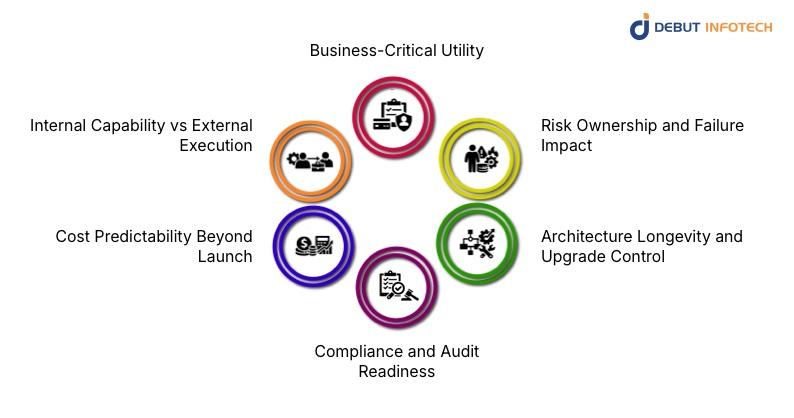
As Web3 dApps move into production environments, evaluation shifts from experimentation to accountability. Serious teams apply structured criteria to assess risk, value, and long-term viability before committing resources.
Teams assess whether the dApp supports a business-critical function, such as payments, identity verification, or asset management. If the application goes offline, operations should be meaningfully affected. Projects with optional or cosmetic value rarely justify ongoing investment. Utility must be clear, measurable, and aligned with core objectives rather than experimental goals.
Serious teams define who is accountable when things fail. This includes smart contract bugs, network congestion, or integration issues. Decentralization does not eliminate responsibility. Teams evaluate financial exposure, legal implications, and recovery processes. Clear ownership models and incident response planning are treated as design requirements, not operational afterthoughts.
Teams examine whether the dApp architecture can evolve without disruption. This includes upgrade mechanisms, contract versioning, and backward compatibility. Systems built without upgrade paths create technical and governance risks over time. Long-term viability depends on controlled flexibility, allowing improvements while preserving trust, data integrity, and operational continuity.
Compliance readiness is evaluated early, especially for applications handling financial data or identities. Teams review auditability, access controls, and transaction traceability. Regulatory expectations vary by region, but ignoring them leads to costly redesigns. A compliant architecture reduces friction with partners, auditors, and regulators while improving trust in the application.
Teams look beyond development costs and assess long-term operational expenses. Gas fees, infrastructure hosting, monitoring, audits, and support all affect sustainability. Predictable cost models matter more than low initial deployment costs. Applications that scale usage without proportional cost spikes are favored for long-term deployment and budgeting stability.
Organizations decide which responsibilities to retain internally and which to outsource. Core logic, governance rules, and sensitive data handling often remain in-house. External partners are used for specialized development, audits, or accelerated delivery. Clear boundaries, documentation, and knowledge transfer plans reduce dependency risks and support long-term ownership.
Several technical and design shifts are making utility-driven dApps practical at scale. These trends reduce friction, improve usability, and support real-world adoption of dapp development services across different user and business environments.
Web3 applications are adopting familiar design patterns from traditional software. Clear navigation, responsive interfaces, and meaningful feedback reduce user confusion. Wallet interactions are increasingly abstracted away from core workflows. This shift allows users to focus on tasks rather than blockchain mechanics, improving retention and making dApps viable for non-technical audiences.
Account abstraction simplifies how users interact with dApps by removing rigid wallet limitations. Features like social recovery, session keys, and bundled actions reduce friction during onboarding. Users can sign in and transact without managing complex credentials. This makes Web3 applications more accessible and supports use cases that require frequent, low-friction interactions.
Gasless transactions allow applications to cover or optimize transaction fees on behalf of users. Fees can be subsidized, delayed, or embedded into business pricing models. This removes a major barrier to adoption. Users interact without monitoring network costs, while developers gain the flexibility to design predictable, sustainable economic structures.
Utility-driven dApps gain traction where blockchain improves outcomes that users already care about. The following use cases highlight where decentralized systems deliver measurable, repeatable value in production settings.
Utility-driven DeFi applications focus on efficiency, transparency, and risk control. They support lending, payments, asset management, and treasury operations with fewer intermediaries. The value lies in faster settlement, lower operational overhead, and auditable transactions. Adoption grows when blockchain platforms deliver stable performance, clear governance, and predictable outcomes for businesses and individual users alike.
Web3 games succeed when gameplay comes first. Blockchain handles asset ownership, economies, and rewards without disrupting performance. Players engage because the experience is smooth, fair, and rewarding. Utility appears through transferable assets, transparent rules, and persistent economies. Games that hide blockchain complexity are better positioned to reach mainstream audiences and retain long-term players.
Web3 social platforms aim to give users control over identity, content, and monetization. Utility is measured by engagement quality, moderation effectiveness, and creator earnings. Decentralized storage and identity reduce decentralized platform dependency. Successful platforms balance openness with governance, ensuring safety and reliability while allowing users to retain ownership of their social presence.
Decentralized identity systems enable users to manage verifiable credentials without relying on centralized providers. Businesses use DID to streamline onboarding, reduce data exposure, and improve compliance processes. Utility comes from reusable identity proofs and selective disclosure. Adoption increases when identity solutions integrate smoothly with existing systems and meet regulatory expectations.
DePIN projects coordinate physical infrastructure using blockchain-based incentives and verification. Networks support compute, storage, connectivity, or sensor data through decentralized participation. Utility depends on reliable performance and transparent reward distribution. These systems work best when on-chain logic enforces rules while off-chain operations handle real-world execution efficiently.
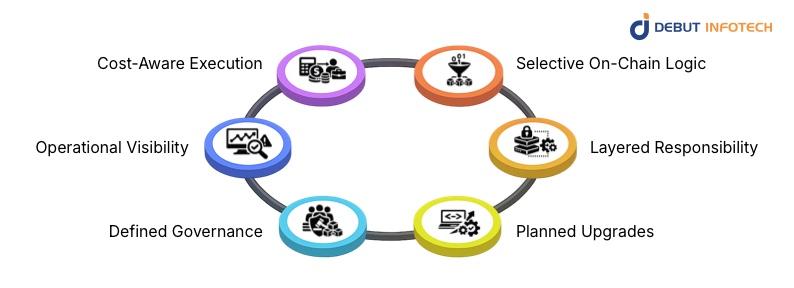
Scalable dApps share architectural traits that prioritize resilience and dApp development cost control. These patterns reflect lessons learned from production systems operating under real user demand and operational constraints.
Only logic that benefits from transparency, immutability, or trust minimization is placed on-chain. High-frequency or compute-heavy processes remain off-chain. This approach reduces gas costs and improves performance. Teams treat blockchain as a coordination layer rather than a full application runtime, enabling systems to scale without unnecessary complexity.
Scalable dApps separate responsibilities across smart contracts, middleware, and user interfaces. Each layer has a defined role and failure boundary. This structure simplifies testing, upgrades, and incident response. When issues occur, teams can isolate problems without disrupting the entire system, improving reliability and long-term maintainability.
Upgrade mechanisms are designed before deployment, not added later. Teams define how contracts evolve, who authorizes changes, and how users are protected during transitions. Planned upgrades reduce governance risk and avoid forced migrations. This approach supports continuous improvement while preserving trust and operational stability over time.
Governance structures clarify who makes decisions and how disputes are resolved. Whether centralized or decentralized, authority is explicit and enforceable. Clear governance reduces uncertainty during upgrades, incidents, or policy changes. Teams avoid ambiguous control models that slow execution or introduce hidden risks as the application grows.
Production-grade dApps include monitoring, logging, and alerting from day one. Teams track transaction success, costs, latency, and failures in real time. Visibility enables faster response to issues and informed optimization decisions. Without observability, applications become difficult to manage and expensive to maintain at scale.
Every architectural choice is evaluated for long-term cost impact. Teams model transaction frequency, gas usage, and infrastructure expenses under realistic load conditions. Cost-aware execution prevents surprises after launch. Applications that align performance needs with sustainable operating costs are more likely to survive beyond early adoption phases.
Global regulations for Web3 applications remain inconsistent. Compliance requirements vary across jurisdictions, and evolving legal frameworks can affect operations, user onboarding, and transaction handling. Working with dedicated blockchain developers allows businesses to continuously monitor regulatory changes, adapt blockchain architectures, and implement compliance-focused solutions that reduce the risk of costly redesigns, penalties, or limited market access.
Many dApps remain difficult for mainstream users, particularly around wallet management, key recovery, and transaction fees. Poor UX can discourage adoption regardless of technical quality. Streamlined onboarding, account abstraction, and intuitive interfaces are critical to ensure users can interact safely and efficiently.
Smart contracts introduce permanent code-level risks. Bugs or vulnerabilities can result in financial loss, downtime, or reputational damage. Comprehensive auditing, formal verification, and layered security measures are essential. Teams must also prepare incident response plans to minimize the impact of potential attacks or exploits.
Despite improvements, high transaction volumes can still stress blockchain networks. Even with the best blockchain for dapps, teams must balance on-chain operations with off-chain processing to maintain performance. Without careful architecture planning, dApps risk slower response times, higher fees, and reduced adoption as user expectations for speed and reliability increase.
As Web3 matures, future growth depends less on experimentation and more on reliability. Utility-driven dApps evolve toward stable infrastructure supporting everyday digital and business interactions.
Utility-driven dApps continue expanding into sectors where reliability, trust, and scale matter. Finance, gaming, identity, and social platforms lead adoption because they benefit directly from transparent execution and programmable logic. Growth favors applications that integrate smoothly with existing systems and deliver consistent value rather than relying on speculative or short-term incentives.
AI and machine learning enhance dApps by improving personalization, fraud detection, and decision support. Blockchain handles verification and settlement, while AI optimizes user interactions and operational efficiency. This combination supports more innovative automation without increasing user complexity. Utility improves when insights are delivered in real time and aligned with user intent and business goals.
Scalability improvements enable dApps to support large user bases without degrading performance or incurring unpredictable costs. Teams focus on throughput, latency, and resource efficiency. Practical performance matters more than theoretical limits. Applications that maintain reliability during peak usage are better positioned for enterprise adoption and long-term operational stability.
Web3 continues shifting away from protocol experimentation toward dependable services users can trust. Applications are judged by uptime, ease of use, and consistent outcomes. Infrastructure improvements support this transition. The network becomes less visible to users as functionality takes priority, aligning Web3 products with standard expectations for modern software experiences.
Security and usability increasingly develop together rather than as separate concerns. Teams invest in safer contract design, clearer user flows, and better error handling. Applications that feel intuitive reduce user mistakes and attack surfaces. This combined focus builds trust, lowers support costs, and supports broader adoption beyond technically experienced users.
Debut Infotech helps organizations build Web3 dapp products that function properly in real-world conditions. As a leading blockchain development company, our focus remains on utility, architectural durability, and long-term ownership. Teams design systems that balance decentralization with performance, compliance, and cost control.
From protocol-level decisions to production deployment, Debut Infotech supports Web3 initiatives that need to scale responsibly and remain maintainable well beyond initial launch phases.
By 2026, Web3 and dApps will be firmly rooted in delivering measurable, business-aligned utility rather than experimental novelty. Adoption patterns reflect sustained user engagement, evolving technical standards, and stronger integration with existing systems.
For developers and organizations targeting long-term relevance, the emphasis will remain on scalable design, cost control, and user experience. As ecosystems mature, utility-driven custom dApp development becomes the benchmark for meaningful adoption and sustainable growth.
A. Utility-driven dApps focus on solving real problems, not just showcasing blockchain. In 2026, that means faster transactions, simpler onboarding, and features people use daily. Payments, identity, gaming, and data sharing now work quietly in the background without users worrying about wallets or chains.
A. Replacement is rare. Integration is more common. Many platforms combine Web2 systems with Web3 and dApps for ownership, transparency, or automation. This hybrid approach lets companies upgrade functionality without rebuilding everything from scratch or confusing existing users.
A. Finance, gaming, supply chain, identity management, and digital content see the biggest gains. Web3 and dApps now support real-world workflows such as cross-border payments, asset tracking, and user-owned data. These apps focus on reliability and speed instead of hype-driven features.
A. Security has improved, but it depends on design. In 2026, Web3 and dApps rely on audited smart contracts, better key management, and layered security models. Teams now prioritize long-term stability and user protection rather than rushing features to market.
A. Regulation is clearer in many regions, which helps serious projects grow. Web3 and dApps in 2026 are built with compliance in mind, especially around identity and payments. This clarity attracts enterprises that previously avoided blockchain due to legal uncertainty.
A. Clear use cases, strong UX, scalable infrastructure, and long-term support matter most. In 2026, successful Web3 and dApps are planned like serious software products. Teams focus on maintenance, upgrades, and user feedback instead of one-off launches.

Our Latest Insights
USA
2501 Chatham, Rd Suite R Springfield, IL 62704
+1-708-515-4004
info@debutinfotech.com
UK
7 Pound Close, Yarnton, Oxfordshire, OX51QG
+44-770-304-0079
info@debutinfotech.com
Canada
154 Eden Oak Trail, Kitchener, ON N2A 0H9
+1-708-515-4004
info@debutinfotech.com
INDIA
Sector 101-A, Plot No: I-42, IT City Rd, JLPL Industrial Area, Mohali, PB 140306
9888402396
info@debutinfotech.com