ON THIS PAGE
Progress0%






Our Global Presence :


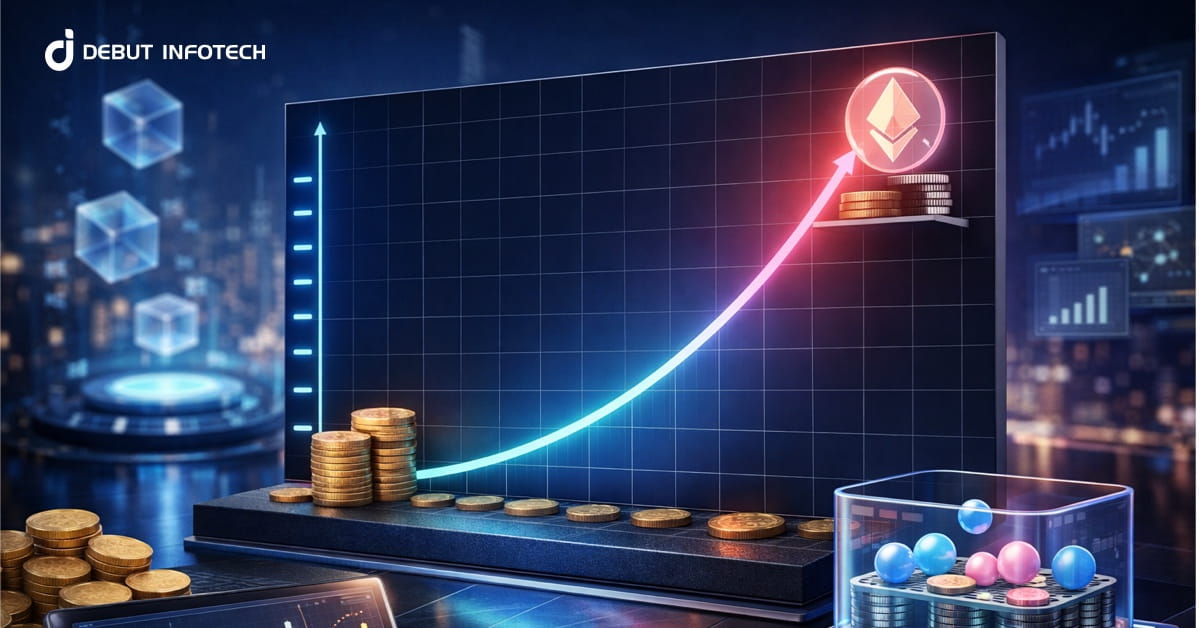


The rapid evolution of decentralized finance has introduced new economic models that fundamentally change how digital assets are issued, priced, and distributed. One such model gaining widespread adoption across token launches, DeFi crowdfunding, and automated market mechanisms is the bonding curve in DeFi. Unlike traditional fixed-price or order-book-based systems, bonding curves introduce a mathematically driven approach to token pricing that adjusts dynamically based on supply and demand.
As DeFi platforms mature, bonding curves are becoming a core primitive for designing sustainable token economies. From incentivizing early participation to enabling continuous liquidity, bonding curves help projects remove intermediaries while maintaining predictable pricing logic. For founders, developers, and investors alike, understanding how bonding curves work—and when to use them—is essential for building or participating in next-generation DeFi protocols.
To understand the role of a bonding curve in DeFi, it’s important to start with the basics.
A bonding curve is a mathematical function that defines the relationship between a token’s price and its circulating supply. As more tokens are bought, the price increases according to a predefined formula. Conversely, when tokens are sold or burned, the price decreases.
In simple terms:
This automated pricing mechanism is executed by smart contracts, removing the need for centralized exchanges or manual price discovery.
When applied to blockchain systems, the concept is often referred to as bonding curve crypto or bonding curve DeFi, highlighting its integration into decentralized protocols.
Bonding curves address several long-standing challenges in decentralized finance.
Traditional token pricing relies on:
Bonding curves replace these with on-chain, algorithmic price discovery, ensuring prices evolve transparently based on actual market participation.
One of the biggest advantages of a bonding curve in DeFi is always-on liquidity. Users can buy or sell tokens at any time directly from the smart contract, without relying on external buyers or sellers.
This model is especially useful for:
Because bonding curves follow predefined mathematical rules, they reduce the risk of price manipulation, insider advantages, or sudden liquidity shocks—issues commonly seen in early token launches.
This predictability makes bonding curves attractive to both developers and investors exploring decentralized funding models.
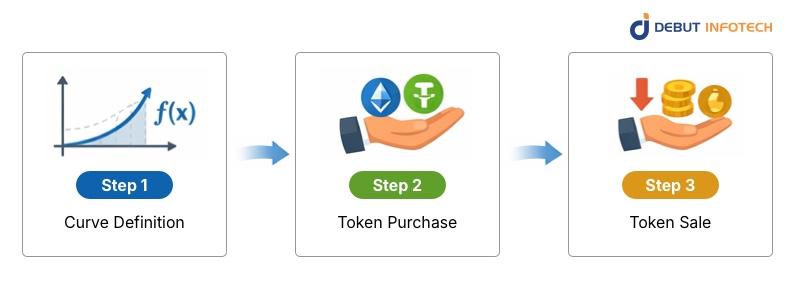
To better understand a bonding curve explained in practical terms, let’s break down the process.
A bonding curve starts with a mathematical formula that determines price behavior. This formula is embedded into a smart contract during deployment.
Common variables include:
When a user buys tokens:
When a user sells tokens:
This automated loop ensures price adjustments happen instantly and transparently.
Different DeFi projects require different economic behaviors. As a result, multiple bonding curve models exist.
A linear bonding curve increases token price at a constant rate as supply grows.
Characteristics:
However, linear curves may not scale well for large ecosystems.
In an exponential bonding curve, prices rise faster as supply increases.
Use cases include:
This model rewards early participants more aggressively but can become expensive for late entrants.
Advanced DeFi protocols often use polynomial or hybrid curves to fine-tune price behavior across different supply ranges.
These are commonly referred to as bonded curves, emphasizing their customized nature.
A dynamic bonding curve adapts its parameters based on external factors such as:
Dynamic curves are increasingly used in advanced DeFi investment platforms to maintain stability and sustainability.
Bonding curves are often compared with automated market makers (AMMs), but they serve different purposes.
| Aspect | Bonding Curve | AMM |
| Price mechanism | Formula-based | Liquidity pool-based |
| Liquidity source | Smart contract reserve | Liquidity providers |
| Use case | Token issuance & funding | Token swapping |
| Complexity | Lower | Higher |
Many modern DeFi protocols combine both models to leverage the strengths of each.
Bonding curves are not theoretical concepts—they power real-world decentralized applications.
Bonding curves enable decentralized fundraising by allowing projects to sell tokens directly from smart contracts.
Benefits include:
This model is increasingly used by DeFi companies launching community-driven products.
For teams working on DeFi token development, bonding curves offer a structured approach to managing token supply, price appreciation, and incentives.
They are particularly useful for:
Bonding curves support continuous entry and exit, making them ideal for DeFi investment platforms that require predictable liquidity and price logic.
DAOs often use bonding curves to:
From a development perspective, implementing a bonding curve requires careful smart contract design.
A typical bonding curve smart contract includes:
Because bonding curves directly control funds, they must be:
This is why many projects rely on experienced blockchain consultants or a specialized blockchain development company when implementing bonding curves.
The popularity of bonding curves is driven by several key advantages:
These benefits make bonding curves a foundational tool for modern DeFi development services.
Despite their strengths, bonding curves are not without challenges.
Bonding curves are best suited for:
They may not be ideal for tokens requiring stable pricing or traditional exchange-based liquidity.
Bonding curves are increasingly being integrated into DeFi lending platforms to enhance liquidity management and interest rate modeling. While traditional DeFi lending relies on supply–demand interest rate algorithms, bonding curves introduce an additional layer of pricing logic tied to token issuance and redemption.
In lending protocols, bonding curves can be used to:
For example, when demand for lending tokens increases, a bonding curve crypto model can automatically raise token prices, encouraging capital inflows while discouraging excessive borrowing.
This approach is particularly valuable for teams building DeFi lending platform development solutions that prioritize sustainability and long-term protocol health.
Modern DeFi wallet development increasingly includes native support for bonding curve-based tokens. Wallets must accurately display:
Because bonding curve pricing is supply-dependent, wallet interfaces must fetch on-chain data and calculate prices dynamically—adding complexity but improving transparency for users.
A DeFi aggregator pulls liquidity, pricing, and yield data from multiple protocols. When bonding curve tokens are involved, aggregators must:
As bonding curves become more prevalent, aggregator platforms are evolving to handle these dynamic pricing models efficiently.
Decentralized autonomous organizations (DAOs) often rely on bonding curves to manage governance token distribution and treasury growth.
Bonding curves allow DAOs to:
Because token prices rise as supply increases, large buyers must pay progressively more—supporting fair governance participation.
Funds collected through bonding curves flow directly into protocol treasuries. These reserves can be used for:
This makes bonding curves a powerful tool for DAO-driven DeFi companies focused on long-term sustainability.

To understand the practical impact of bonding curves, it helps to look at how they are used in real DeFi ecosystems.
Many DeFi token launch platforms use bonding curves to replace traditional presales. Instead of allocating tokens at fixed prices, projects allow prices to evolve organically as demand grows.
This model:
In DeFi crowdfunding, bonding curves enable continuous fundraising rather than fixed funding rounds. Contributors can enter or exit at any time, creating a fluid capital formation process.
This is particularly attractive for early-stage protocols that want to avoid centralized venture funding while maintaining liquidity.
Community-focused DeFi platforms use bonding curves to ensure token ownership is distributed among active participants rather than a small group of insiders.
Implementing a bonding curve is as much an economic design challenge as it is a technical one. When designing a bonding curve in DeFi, teams must evaluate:
Poor curve design can lead to unsustainable price growth or rapid capital depletion.
While linear or exponential curves are easier to implement, many projects require custom bonded curves tailored to their use case.
This is where experienced blockchain consultants or a specialized DeFi development company play a crucial role—helping balance economic theory with real-world market behavior.
Below are some of the factors affecting development cost. The cost of implementing bonding curves depends on:
Projects offering advanced features such as dynamic bonding curves typically require more development effort and testing.
Building bonding curve-based protocols requires deep expertise in:
Working with a reliable blockchain development company or DeFi development services provider ensures the bonding curve logic aligns with both business goals and user expectations.
Understanding when to use bonding curves requires comparison with traditional fixed-supply tokens.
For many modern DeFi applications, bonding curves offer greater flexibility and resilience.
While bonding curves operate in decentralized environments, regulatory considerations still apply.
Projects must consider:
Engaging experienced blockchain consultants early helps mitigate regulatory risks while maintaining decentralization.
The role of bonding curves in DeFi is expected to expand significantly.
Future bonding curves may leverage:
These innovations will make dynamic bonding curves more responsive and resilient.
As DeFi ecosystems mature, bonding curve tokens will increasingly interact with:
This interoperability will unlock new use cases and liquidity pathways.
Improved frameworks, SDKs, and auditing tools will lower the barrier to implementing bonding curves, making them accessible to a wider range of DeFi builders.
The bonding curve in DeFi represents a fundamental shift in how digital assets are priced, distributed, and governed. By replacing static pricing and centralized liquidity with transparent, algorithmic models, bonding curves empower decentralized ecosystems to grow sustainably.
From DeFi crowdfunding and token launches to lending platforms and DAO governance, bonding curves are becoming a cornerstone of modern DeFi architecture. However, their effectiveness depends heavily on thoughtful economic design, secure implementation, and continuous monitoring.
For organizations building next-generation decentralized applications, partnering with an experienced DeFi development company can make the difference between a successful bonding curve model and a fragile one. When designed and implemented correctly, bonding curves unlock powerful new possibilities for decentralized finance.
A. A bonding curve in DeFi is an algorithmic pricing mechanism that automatically adjusts a token’s price based on its circulating supply. As tokens are bought or sold, the price changes according to a predefined mathematical formula encoded in a smart contract.
A. In bonding curve crypto models, users buy tokens directly from a smart contract. When demand increases, the token supply grows and prices rise. When tokens are sold, supply decreases and prices fall, ensuring continuous liquidity without intermediaries.
A. Common bonding curve types include linear, exponential, polynomial, and dynamic bonding curves. Each model offers different pricing behaviors and is used based on the project’s economic and liquidity requirements.
A. Bonding curves are used in DeFi crowdfunding, token launches, DAO governance, DeFi investment platforms, and DeFi lending platforms to enable automated pricing, fair token distribution, and always-on liquidity.
A. Key benefits include transparent price discovery, continuous liquidity, reduced reliance on centralized exchanges, predictable token economics, and fairer participation for early and late users alike.
A. Risks include price volatility, capital inefficiency, and potential economic imbalance if the curve is poorly designed. This is why professional DeFi development services and security audits are critical.
A. Bonding curves are ideal for early-stage DeFi projects, community-owned protocols, continuous fundraising models, and governance token issuance where automated pricing and liquidity are essential.

Our Latest Insights
USA

2501 Chatham, Rd Suite R Springfield, IL 62704
+1-708-515-4004
info@debutinfotech.com
UK

7 Pound Close, Yarnton, Oxfordshire, OX51QG
+44-770-304-0079
info@debutinfotech.com
Canada

154 Eden Oak Trail, Kitchener, ON N2A 0H9
+1-708-515-4004
info@debutinfotech.com
INDIA

Sector 101-A, Plot No: I-42, IT City Rd, JLPL Industrial Area, Mohali, PB 140306
9888402396
info@debutinfotech.com

9001:2015
Quality Certified

ISO 27001
Security Certified

A+ Rating
Accredited Business

Certik
Security & Audit


Copyright © 2026, Debut Infotech. All rights reserved. | Privacy Policy