ON THIS PAGE
Progress0%






Our Global Presence :


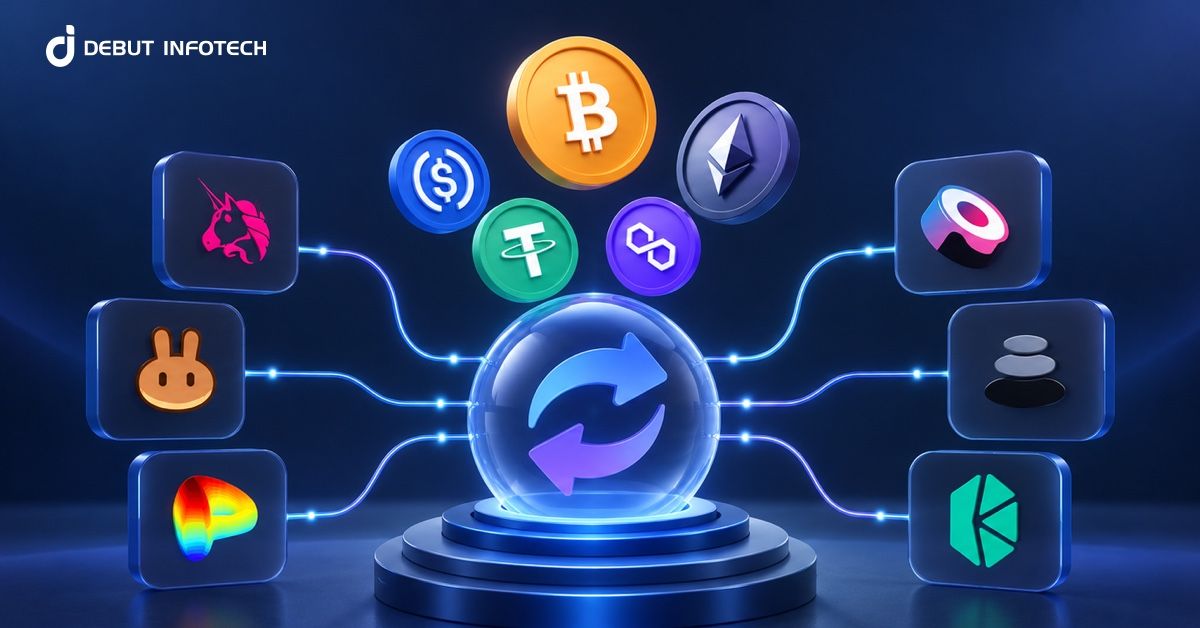


DeFi aggregators simplify fragmented liquidity by combining DEXs, yield protocols, portfolio tools, and cross-chain infrastructure into a unified interface that improves execution efficiency.
The right platform depends on your use case, whether you need token swaps, yield optimization, portfolio management, analytics, or cross-chain transactions rather than a single "best" solution.
Execution quality matters more than quoted prices, so compare routing algorithms, liquidity depth, gas costs, slippage, MEV protection, and supported blockchain networks before choosing a DeFi aggregator.
Building a DeFi aggregator requires more than integrating liquidity, with routing engines, secure smart contracts, wallet connectivity, testing, audits, and monitoring all critical to reliable production deployments.
Cross-chain aggregation expands market access but introduces additional risks, making bridge security, settlement reliability, and infrastructure resilience key evaluation criteria for businesses and developers.
API- and SDK-based aggregation reduces development time by leveraging providers such as 0x and LI.FI instead of building every DEX, bridge, and routing integration from scratch, while increasing dependency on infrastructure vendors.
A successful implementation balances performance with security, prioritizing audited smart contracts, transaction simulation, transparent execution, phased deployment, and continuous monitoring to improve long-term reliability.
DeFi has become more fragmented as liquidity, protocols, and users spread across multiple blockchain networks. Finding the best route, comparing prices, managing yield, or moving assets between chains can require interaction with several platforms. DeFi aggregators address this problem by bringing liquidity, data, and execution options together through a unified interface.
In 2026, DeFi aggregators cover far more than token swaps. DEX aggregators optimize trade execution, yield aggregators automate strategy discovery, portfolio platforms consolidate assets, while cross-chain and hybrid aggregators connect multiple DeFi functions. Their growing role also makes routing quality, security, MEV protection, and protocol integrations important considerations.
This guide examines the best DeFi aggregators 2026, how they work, their key components, types, features, benefits, risks, use cases, and emerging trends. It also explains how to choose the right platform and outlines the steps to build a DeFi aggregator.
DeFi aggregation is developing alongside a broader DeFi ecosystem that now spans thousands of protocols and hundreds of blockchain networks.
According to DeFiLlama, more than 7,000 DeFi protocols across 500+ chains are currently tracked, highlighting the scale of liquidity and application fragmentation that aggregators help address.
The broader market also provides strong signals for aggregation demand. DeFi currently holds about $87 billion in total value locked (TVL), representing capital deployed across decentralized applications.
DappRadar currently tracks 3,399 DeFi dapps, showing how extensive the application layer has become. DeFi activity also extends across major networks. For example, Solana recorded approximately $3.68 billion in DEX volume over 24 hours at the time of measurement, demonstrating the scale of decentralized trading activity aggregators can serve.
These figures do not represent the DeFi aggregator market directly. Instead, they show the environment in which aggregation infrastructure operates. As liquidity becomes distributed across thousands of protocols and hundreds of chains, users face greater difficulty comparing prices, finding efficient routes, managing portfolios, and accessing yield opportunities.
Aggregators address this fragmentation by bringing multiple liquidity sources, protocols, and data streams into a unified experience. Their role is therefore expanding beyond simple token swaps to include yield optimization, portfolio management, cross-chain execution, and infrastructure APIs for wallets, fintech applications, investment platforms, and custom Web3 ecosystems.
A DeFi aggregator is a platform that combines liquidity, pricing, yield opportunities, and data from multiple decentralized finance protocols into a single interface. Instead of checking individual DEXs, lending platforms, or other protocols, users can compare available options and execute transactions through a single application.
For example, a DEX aggregator can scan multiple liquidity pools to identify an efficient swap route. It may split a transaction across several pools to improve the final output or reduce price impact. Yield aggregators work differently by comparing or automating strategies across lending, staking, liquidity, or vault protocols.
DeFi aggregators can also focus on portfolio tracking, market data, or cross-chain transactions. Their main purpose is to reduce fragmentation and simplify access to DeFi services while improving execution, capital efficiency, and user convenience.
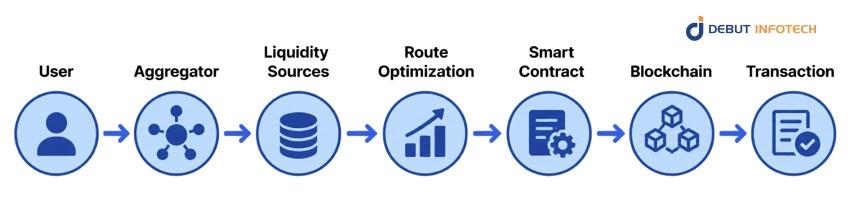
A DeFi aggregator works by collecting a user’s transaction request, checking available liquidity sources, comparing possible routes, and selecting an efficient execution path. The selected route is then sent to smart contracts for on-chain execution.
Depending on the aggregator, the process can involve DEXs, bridges, market makers, lending protocols, or other DeFi infrastructure.
A typical DeFi aggregator follows a sequence similar to this:
User → Aggregator → Liquidity Sources → Route Optimization → Smart Contract → Blockchain → Transaction
1. User: The user selects the asset they want to sell, the asset they want to receive, the amount, and the blockchain. The interface may also allow users to specify slippage limits, gas preferences, or other execution settings.
2. Aggregator: The aggregator receives the trade request and begins looking for executable routes. It queries integrated DEXs, liquidity pools, market makers, bridges, or other sources depending on the aggregator’s purpose.
3. Liquidity sources: The system gathers available prices and liquidity from multiple sources. A large trade may not fit efficiently into one pool. Splitting a transaction across several sources can sometimes yield better results.
4. Route optimization: The routing engine evaluates potential paths. It can consider token prices, pool depth, price impact, gas costs, fees, execution probability, and other conditions. Advanced systems can split orders across multiple pools or use several intermediary assets.
5. Smart contract: Once a route is selected, the aggregator generates or calls the required smart-contract functions. The contract handles on-chain execution based on the route and user permissions.
6. Blockchain: The transaction is submitted to the relevant network. Validators or block producers process it, and the connected protocols execute the required swaps, transfers, or other operations.
7. Transaction: The user receives the final asset, while the application records the transaction status and displays the outcome.
Modern aggregation can be more sophisticated than this linear model suggests. 1inch, for example, combines DEX aggregation with intent-based and cross-chain functionality. Its current platform supports 13+ networks, including Ethereum, BNB Chain, Polygon, Arbitrum, Base, Optimism, Avalanche, and Solana.
The important engineering point is that route selection happens before execution, but market conditions can change between those stages. A good aggregator therefore needs quote freshness, transaction simulation, failure handling, and execution safeguards. A route that appears optimal in a stale quote may not yield the best transaction outcome.
A DeFi aggregator relies on several interconnected components to discover liquidity, evaluate routes, execute transactions, and deliver accurate information. Each component contributes to reliable and efficient aggregation.
| Component | What It Does | Why It Matters |
| Liquidity sources | Connects DEXs, pools, market makers | Expands available liquidity |
| Routing engine | Finds efficient transaction paths | Improves execution |
| Smart contracts | Executes transactions on-chain | Enables trustless settlement |
| Oracles/price data | Provides market and asset data | Supports accurate pricing |
| Wallet integration | Connects users to the platform | Enables transaction signing |
| Blockchain infrastructure | Connects the system to networks | Supports reliable execution |
Liquidity sources are the foundation of an aggregator. These can include AMMs, DEXs, RFQ market makers, lending protocols, vaults, bridges, or other DeFi applications. More integrations can increase the number of routes available, but adding sources also increases integration, testing, monitoring, and maintenance requirements.
The routing engine determines how the aggregator turns available liquidity into an executable path. It can compare direct swaps, multi-hop routes, split orders, and different protocols.
More advanced engines also account for gas costs and expected execution quality, rather than selecting a route based solely on the displayed token price.
Smart contracts provide the execution layer. They can handle token approvals, swaps, order settlement, multi-step transactions, and other on-chain actions.
Contract design should minimize unnecessary permissions and isolate critical execution logic. Formal testing, independent audits, access controls, and carefully managed upgrade mechanisms are important parts of this layer.
Aggregators need accurate market information to evaluate routes and display useful prices. Depending on the product, this may involve DEX quotes, oracle networks, market-maker quotes, token metadata, historical prices, and on-chain liquidity data.
Oracle design becomes especially important when an aggregator also supports lending, collateral, leverage, or automated strategies.
Wallet connectivity allows users to approve transactions and sign messages without surrendering custody. A production aggregator may integrate browser wallets, mobile wallets, WalletConnect-compatible wallets, embedded wallets, or institutional custody systems.
The wallet layer should clearly communicate to the user what they are signing and which assets or permissions are involved.
The final component is the infrastructure connecting the application to blockchain networks. This includes RPC providers, nodes, indexers, mempool infrastructure, transaction broadcasters, monitoring systems, and block explorers.
Multi-chain products need reliable infrastructure for each supported network, because a single weak connection can degrade the user experience even when the routing logic itself works correctly.
DeFi aggregators can be divided into several categories based on what they aggregate. These categories overlap in some products, particularly as platforms combine swaps, portfolio management, yield strategies, and cross-chain execution.
| Type | Primary Purpose | Typical Users | Example |
| DEX Aggregator | Optimize token swaps | Traders | 1inch |
| Yield Aggregator | Optimize yield strategies | Investors | Yearn |
| Asset & Portfolio Aggregator | Track/manage holdings | DeFi users | Zerion |
| Data Aggregator | Consolidate market data | Researchers/traders | DeFiLlama |
| Cross-Chain Aggregator | Connect blockchain networks | Multi-chain users | LI.FI |
| Hybrid Aggregator | Combine multiple DeFi functions | Advanced users | DeFi Saver |
DEX aggregators compare liquidity across decentralized exchanges to find efficient swap routes. They can split orders, compare multiple pools, estimate price impact, and account for gas. 1inch, Jupiter, ParaSwap, Matcha, CoW Swap, Odos, OpenOcean, and KyberSwap are examples in this category.
Yield aggregators help users find, automate, or manage strategies designed to generate returns from DeFi positions. Yearn and Beefy are prominent examples. Pendle and Convex also occupy important positions in yield markets and optimization, though their mechanisms differ from those of traditional automated vault aggregators.
These DeFi aggregator platforms combine wallet and protocol data so users can see assets, positions, performance, and DeFi activity in one place.
Zapper, DeBank, Zerion, and Instadapp are examples of DeFi asset aggregators. Their primary value is reducing the need to inspect multiple wallets and protocols separately.
Data aggregators organize blockchain and DeFi information into dashboards, APIs, charts, and analytics tools. DeFiLlama, Dune Analytics, and DEXTools help users, researchers, developers, investors, and businesses understand protocol activity, liquidity, transactions, prices, and market trends.
Cross-chain aggregators address fragmentation between blockchain networks. They can combine bridges, DEXs, solvers, and liquidity sources to move or swap assets across chains. LI.FI, Socket/Bungee, and Rango are examples. These systems require additional controls because cross-chain execution introduces bridge, messaging, settlement, and destination-chain risks.
Hybrid aggregators combine several DeFi functions. They may let users swap assets, enter yield positions, manage leverage, or execute multiple protocol actions in one transaction. Portals.fi, DeFi Saver, and Enso Finance illustrate this direction.
1inch, Jupiter, ParaSwap, Matcha, CoW Swap, Odos, OpenOcean, KyberSwap, Yearn, Beefy, Zapper, DeBank, Zerion, LI.FI, and other specialized platforms stand out in 2026.
The best DeFi aggregators 2026 depend on your use case, supported blockchain, liquidity requirements, execution needs, and whether you need trading, yield, portfolio management, data, or cross-chain functionality.
The following DeFi aggregator comparison is therefore based on the primary use case and current product positioning rather than a universal ranking.
| DeFi Aggregator | Type | Best For | Key Strength | Supported Chains |
| 1inch | DEX | Broad EVM and cross-chain swaps | Deep routing and broad network coverage | Ethereum, BNB Chain, Polygon, Arbitrum, Base, Optimism, Avalanche, Gnosis, Linea, zkSync, Sonic, Unichain, Solana |
| Jupiter | Solana liquidity | Strong Solana-focused routing and trading infrastructure | Solana | |
| ParaSwap | EVM aggregation | Multi-source routing and developer integrations | Major EVM networks | |
| Matcha | Simple multi-chain swaps | 0x-powered aggregation and trading UX | Major EVM networks | |
| CoW Swap | MEV-aware trading | Batch auctions and solver-based execution | Ethereum, Gnosis and selected supported networks | |
| Odos | Complex route optimization | Multi-hop and split-route execution | Multiple EVM networks | |
| OpenOcean | Multi-chain trading | Aggregation across many liquidity sources | Multiple EVM and non-EVM networks | |
| KyberSwap | Route discovery | Multi-source liquidity routing | Multiple EVM networks | |
| Yearn | Yield | Automated yield strategies | Vault-based strategy management | Primarily EVM networks |
| Beefy | Multi-chain yield | Large selection of automated vaults | Multiple EVM and other supported networks | |
| Convex | Curve-related yield | Boosted Curve ecosystem exposure | Ethereum and selected networks | |
| Pendle | Yield trading | Separates principal and yield exposure | Multiple supported networks | |
| Zapper | Portfolio | Portfolio tracking | DeFi asset and position visibility | Multi-chain |
| DeBank | DeFi portfolio analytics | Wallet and protocol activity tracking | Multi-chain | |
| Zerion | Wallet and portfolio management | Integrated wallet and DeFi experience | Multi-chain | |
| Instadapp | Position management | DeFi account and strategy management | Multiple EVM networks | |
| DeFiLlama | Data | Market research | Broad protocol and DeFi datasets | Multi-chain |
| Dune Analytics | Custom analytics | Queryable blockchain data | Multiple blockchains | |
| DEXTools | Token and DEX monitoring | Trading and market analytics | Multiple networks | |
| LI.FI | Cross-chain | Cross-chain swaps | Bridges and DEX aggregation | EVM, Solana, Bitcoin, SUI and other supported systems |
| Socket/Bungee | Cross-chain transfers | Route aggregation and execution infrastructure | Multiple chains | |
| Rango Exchange | Cross-chain swaps | Broad cross-chain route discovery | Multiple networks | |
| Portals.fi | Hybrid | Swap-to-yield execution | Combining swaps with yield positions | Supported DeFi networks |
| DeFi Saver | Position management | Swaps, leverage and automation | Multiple supported EVM networks | |
| Enso Finance | Composable DeFi actions | Bundled protocol interactions | Supported EVM networks |
Chain support changes frequently, so the table should be treated as a practical 2026 snapshot rather than a permanent specification. For example, 1inch currently lists 13+ supported networks and notes that individual protocols within its ecosystem may not be available on every network.
Matcha is built on 0x infrastructure. 0x states that its Swap API aggregates liquidity across 150+ DEXs on 20+ EVM-compatible chains, while Matcha provides the consumer-facing trading experience.
Cross-chain coverage is also changing quickly. LI. FI’s current documentation describes support spanning EVM networks, Solana, Bitcoin, and SUI, while its agent documentation lists 58 supported blockchains, 27 bridges, and 31 exchanges.
Looking for the best DeFi aggregator for token swaps? DEX aggregators compare liquidity across multiple decentralized exchanges to improve swap execution. The platforms below differ in routing technology, chain coverage, liquidity access, fees, and MEV protection.
1inch remains a strong option for users who want broad DEX liquidity and sophisticated route optimization. Its aggregation engine compares liquidity sources and can split trades across different venues when that improves execution. This makes 1inch one of the best DEX aggregators for crypto swaps, particularly for users who want competitive routing across multiple liquidity sources.
The platform also supports cross-chain functionality and multiple execution modes, making it useful for traders who operate across multiple networks rather than staying within a single blockchain ecosystem.
Jupiter is one of the leading DEX aggregators for Solana users. Its routing infrastructure searches across Solana’s liquidity venues to find competitive execution and can support multi-hop and split routes. Its main advantage is ecosystem depth.
Because it is built around Solana liquidity, it is particularly suitable for traders whose activity is concentrated on that network. Its limitation is narrower chain coverage.
ParaSwap is an established DEX aggregation platform focused largely on EVM-based markets. It compares liquidity from multiple decentralized exchanges and helps users find efficient swap routes without checking each venue separately.
Its infrastructure is also relevant to developers building wallets, trading applications, and other DeFi products. For businesses, its mature aggregation architecture can reduce the effort required to maintain individual DEX integrations.
Matcha provides a straightforward trading interface backed by 0x aggregation infrastructure. It is designed to compare liquidity across multiple decentralized exchanges and market makers, enabling users to access competitive prices through a single application.
Its appeal is strongest for traders who want a simple execution experience without manually selecting liquidity venues. The platform is particularly relevant within the broader EVM trading ecosystem.
CoW Swap takes a different approach to decentralized trading by using batch auctions and solver competition. This makes it one of the best DeFi aggregators for experienced traders who prioritize execution quality and protection against MEV-related risks.
Instead of relying solely on conventional AMM routing, it allows solvers to compete to execute orders while seeking improved prices and reduced MEV exposure. This makes it particularly attractive to traders concerned about sandwich attacks and transaction-ordering risks. It is a strong option for MEV-conscious execution.
Odos is designed for complex swap routing where the most efficient transaction may involve several liquidity sources or intermediary assets. Its routing system can split orders across pools and evaluate multi-hop paths based on expected execution. This makes it useful for larger or more complex trades where a single DEX may not provide sufficient liquidity. Traders should still compare the final output and gas costs.
OpenOcean focuses on broad liquidity aggregation across decentralized and other available trading sources. Its main value lies in giving users access to multiple markets through a single interface, rather than requiring separate DEX searches. It can be useful for traders who want wider asset and chain coverage. However, actual route quality depends on the liquidity available for the specific asset pair and network.
KyberSwap provides DEX aggregation and route discovery across supported blockchain networks. Its routing infrastructure evaluates available liquidity and seeks competitive execution for token swaps. The platform can suit traders who want a combination of DEX access and routing tools from an established DeFi ecosystem. As with other aggregators, users should compare the final transaction output, gas costs, and slippage before signing.
DeFi Yield aggregators automate access to DeFi strategies by allocating assets across lending, liquidity, staking, or vault opportunities. These platforms differ in strategy design, chain coverage, automation, and risk exposure. Here are the best DeFi yield aggregators in 2026:
Yearn is one of the best-known DeFi platforms for automated yield strategies. Its vault-based architecture allows users to deposit assets into strategies designed to seek yield across supported protocols. This reduces the need to manually monitor and rebalance positions.
Yearn is better suited to users seeking automated strategy management than traders looking for simple token swaps or basic DEX price comparison.
Beefy focuses on automated yield optimization through vaults deployed across multiple blockchain ecosystems. Users can deposit supported assets and allow predefined strategies to manage the position in accordance with the vault’s rules.
Its multi-chain orientation makes it useful for users who hold assets across different networks. However, each vault carries risks related to the underlying protocol, smart contract, liquidity, and strategy that should be reviewed beforehand.
Convex is closely connected to the Curve ecosystem and focuses on improving the economics of liquidity and staking across the Curve ecosystem. It can provide users with additional incentives and optimized exposure to Curve markets without requiring them to manage every underlying mechanism manually.
Convex is therefore more specialized than general-purpose yield aggregators and is particularly relevant to users whose DeFi strategies involve Curve liquidity.
Pendle offers a specialized approach to yield aggregation by separating yield exposure from principal. Users can trade or manage these components independently, creating more precise strategies around future yield.
This makes Pendle particularly useful for experienced DeFi participants who want to speculate on, hedge, or lock in yield expectations. It should not be treated as a simple automated vault platform because its mechanics are more specialized.
Asset and DeFi portfolio aggregators consolidate on-chain balances, DeFi positions, and transaction activity. They help users monitor and manage assets across protocols without having to check multiple applications individually.
Zapper brings wallet balances, DeFi positions, transactions, and portfolio information into a consolidated interface. This helps users understand their overall on-chain financial position without having to check each protocol individually. It is particularly useful for people with assets distributed across multiple applications and networks. Its primary value lies in visibility and convenience rather than in direct trade execution or automated yield generation.
DeBank focuses heavily on wallet and DeFi portfolio tracking across multiple blockchain ecosystems. Users can review balances, protocol positions, transaction activity, and other on-chain interactions from one dashboard. This makes it useful for active DeFi participants who interact with many protocols. Its strength is portfolio visibility, though users should note that blockchain data can vary in freshness and completeness across integrations.
Zerion combines portfolio tracking with wallet functionality and DeFi access. Rather than operating solely as an analytics dashboard, it provides a broader interface for managing and interacting with on-chain assets. This makes it suitable for users who want portfolio visibility alongside transaction capabilities. Its DeFi aggregator multi-chain support approach is particularly useful for users whose assets are distributed across several DeFi ecosystems.
Instadapp focuses on DeFi position management and interaction with multiple protocols through a unified account and strategy layer. It is particularly useful for advanced users managing lending, leverage, collateral, and other programmable positions. Instead of simply displaying balances, the platform helps users actively manage their DeFi strategies. That makes it more specialized than a conventional portfolio tracking application.
Data and information aggregators organize on-chain market and protocol data into searchable dashboards. They help traders, investors, developers, and businesses research liquidity, activity, yields, and DeFi market performance.
DeFiLlama is one of the most widely used sources for researching DeFi activity and protocol performance. Its dashboards cover metrics such as total value locked, DEX volume, stablecoins, yields, fees, revenue, bridges, and protocol activity. This makes it useful for investors, developers, researchers, and businesses evaluating market opportunities. Its broad coverage also provides a useful view of DeFi’s fragmented structure.
Dune Analytics is designed for users who need custom blockchain research rather than only prebuilt dashboards. Its query-based approach allows analysts to examine transactions, wallets, protocols, token activity, and other on-chain datasets.
Users can then turn those queries into dashboards for ongoing monitoring. It is particularly valuable for businesses and researchers that need data tailored to specific protocols or questions.
DEXTools focuses on market and trading analytics across decentralized exchanges. Users can monitor token prices, liquidity, trading pairs, transaction activity, and other market signals before making trading decisions.
Its role differs from that of a swap aggregator, as it primarily helps users research markets rather than automatically execute the optimal route. It is therefore most useful as an information layer alongside trading infrastructure.
Cross-chain aggregators combine bridges, DEXs, and liquidity sources to simplify transactions between blockchain networks. They can compare routes while reducing the manual steps required to move and swap assets.
LI.FI combines bridge and DEX aggregation to simplify cross-chain transactions. Instead of forcing users or developers to select a bridge first and then locate a suitable exchange on the destination network, its infrastructure can evaluate combined routes. This makes it particularly useful for wallets, applications, and businesses building cross-chain functionality.
Its current infrastructure spans numerous chains, bridges, and exchange integrations.
Socket provides cross-chain infrastructure, while Bungee offers a user-facing experience for moving assets between supported networks. The platform focuses on route aggregation and cross-chain execution rather than simple same-chain swaps. It can help applications reduce the number of individual bridge integrations they maintain.
Developers should still evaluate bridge dependencies, settlement mechanisms, supported assets, and transaction failure handling before integrating it.
Rango Exchange focuses on cross-chain swaps and route discovery across multiple blockchain ecosystems. It can combine different bridges, DEXs, and liquidity sources to provide users with a unified transaction path. This is useful when a swap requires both moving assets between networks and exchanging them on the destination chain. Its main tradeoff is the additional security and execution complexity created by cross-chain transactions.
Hybrid aggregators combine multiple DeFi functions within a single transaction or interface, including swaps, yield strategies, leverage, and liquidity management. This approach reduces the number of separate steps users must handle.
Portals.fi extends aggregation beyond basic token swaps by allowing users to move from one asset into yield-oriented positions through streamlined transaction flows.
The approach is useful for applications that want to simplify access to multiple DeFi strategies. Instead of requiring users to understand every underlying protocol, the platform can combine several actions into a more accessible workflow while still relying on the underlying protocols for execution.
DeFi Saver combines several DeFi management functions, including swaps, leverage management, automated position protection, and strategy execution. This makes it particularly useful for active users who need to manage positions after entering them.
Rather than focusing solely on finding a better token price, it addresses broader portfolio operations. Users should still assess the risks associated with each underlying protocol.
Enso Finance focuses on composable DeFi actions that allow several protocol interactions to be combined into streamlined transactions.
For example, an application can bundle swapping, liquidity provision, and yield-related actions, rather than forcing users to go through separate steps. This model is particularly relevant to developers building financial applications because aggregation becomes an infrastructure layer that abstracts protocol-specific complexity.
Choosing an aggregator depends on what you want to accomplish. The best DeFi aggregators for beginners typically offer simple interfaces, clear transaction information, and straightforward access to common DeFi functions.
The table below gives a practical starting point.
| If you need | Consider | Why it’s a better choice | Chains Supported | Tradeoffs to Know |
| Best swap routing | 1inch / Odos | Broad liquidity and route optimization | Multiple EVM networks | Route quality varies by pair and market |
| Solana liquidity | Jupiter | Deep Solana focus | Solana | Limited value for non-Solana users |
| Multi-chain trading | 1inch / Matcha | Broad network coverage and aggregation | Multiple EVM networks; 1inch also supports Solana | Not every protocol or token is available on every chain |
| Yield optimization | Yearn / Beefy | Automated strategy and vault infrastructure | Multiple supported networks | Yield carries protocol and strategy risk |
| Portfolio management | Zapper / DeBank / Zerion | Consolidated wallet and DeFi visibility | Multi-chain | Portfolio data can lag or differ between sources |
| Cross-chain functionality | LI.FI / Socket / Rango | Aggregates bridges and swaps | Multi-chain | Bridge and settlement risk remains |
| Developer/API integration | 0x / LI.FI | Production-oriented APIs and infrastructure | Multiple networks | API fees, limits, dependencies, and vendor risk |
For developers, the choice of infrastructure deserves separate attention. 0x provides APIs for swaps and cross-chain transactions, while LI.FI provides APIs, SDKs, widgets, and routing infrastructure. These DeFi aggregator development services can reduce development time because the application does not need to build every DEX, bridge, quote engine, and execution adapter from scratch.
Several factors determine whether an aggregator delivers reliable execution and acceptable costs. Assess chain coverage, liquidity, fees, routing, security, MEV protection, cross-chain support, UX, integrations, and API capabilities.
| Factor | What to Check | Why It Matters |
| Supported chains | Networks and tokens | Determines accessibility |
| Liquidity | Pool depth and sources | Affects execution |
| Fees | Platform, DEX, gas, bridge fees | Determines total cost |
| Slippage | Expected price movement | Reduces execution surprises |
| Routing | Direct, split, multi-hop routes | Affects final output |
| Security | Audits and contract controls | Reduces technical risk |
| MEV protection | Private execution, batch auctions | Limits MEV exposure |
| Cross-chain | Bridges and destination liquidity | Enables multi-chain trading |
| UX | Transaction transparency | Reduces user errors |
| API | SDK, rate limits, documentation | Matters for developers |
Check whether the aggregator supports the networks where you hold assets or plan to trade. Chain coverage affects token availability, liquidity, transaction speeds, and gas costs.
A platform supporting many networks may still offer limited functionality on individual chains. Review the actual token and protocol availability rather than judging the platform solely by its published chain count.
Liquidity directly affects execution quality, especially for larger trades. An aggregator should connect to sufficiently deep liquidity sources across relevant DEXs and market makers.
More integrations do not automatically mean better liquidity. Compare the expected output for your specific trading pair and transaction size, as a platform may perform well with major assets but poorly with smaller or less liquid tokens.
Compare the full transaction cost, not just the aggregator’s stated fee. Consider DEX fees, bridge charges, protocol fees, network gas, and any spread included in the quoted rate.
A platform with a lower visible fee can still result in a more expensive transaction if its route has higher price impact, higher gas requirements, or intermediary costs.
Slippage determines how much the final execution price can differ from the quoted price. Check whether the aggregator provides clear slippage estimates and customizable limits.
Large trades and low-liquidity assets typically face greater price impact. Avoid setting unnecessarily high tolerance levels, because excessive slippage can leave users exposed to unfavorable execution when market conditions change quickly.
Routing quality is one of the most important factors when comparing DEX aggregators.
A strong router evaluates multiple paths and considers liquidity, price impact, gas, fees, and intermediary swaps. Test the same asset pair and transaction amount across several platforms.
The best route should be judged by expected final output, not simply the displayed exchange rate.
Review the aggregator’s smart-contract architecture, audit history, ownership model, upgrade permissions, and security practices before using it. Check whether audits cover the contracts currently deployed.
Recent incidents and unresolved vulnerabilities also matter. A platform handling user transactions should provide enough information for users to understand which contracts they are interacting with and what administrative controls exist.
MEV can affect transaction outcomes through sandwich attacks, front-running, and other transaction-ordering strategies. Check whether the aggregator offers private transaction submission, solver-based execution, batch auctions, or other MEV protection mechanisms.
Protection varies between platforms and transaction types, so review the actual execution method rather than assuming that every aggregator provides the same level of protection.
If you need to move assets between networks, evaluate the aggregator’s bridge and cross-chain infrastructure carefully. Look at supported chains, bridges, settlement times, fees, destination liquidity, and failure recovery.
Cross-chain aggregation can simplify the user experience, but it also introduces additional dependencies. The safest route is not always the fastest or cheapest route available.
The interface should make complex DeFi transactions easy to understand before signing. Users should see the selected network, token amounts, expected output, route, fees, gas estimate, slippage, and transaction status.
Good UX also includes clear error messages and useful recovery guidance. Confusing transaction details can lead users to approve actions they do not fully understand.
Review which DEXs, liquidity providers, lending protocols, bridges, and other DeFi applications the aggregator actually integrates. More integrations can improve route coverage, but reliability matters just as much as quantity.
Protocol outages, outdated adapters, or shallow liquidity can reduce execution quality. Strong aggregators continuously maintain their integrations as underlying protocols change their contracts and APIs.
Developers should examine the aggregator’s API or SDK before choosing an infrastructure provider. Check documentation, authentication, rate limits, supported networks, response speed, webhooks, testing environments, pricing, and technical support.
An API that works well for basic swaps may not support the cross-chain or advanced routing requirements of a production application. Integration quality directly affects the costs of custom DeFi aggregator development and maintenance.
A DeFi Aggregator should have features such as wallet connection, token swaps, portfolio tracking, price comparison, yield discovery, transaction history, gas estimation, slippage controls, liquidity aggregation, smart order routing, multi-DEX integration, cross-chain support, transaction simulation, monitoring, alerts, and security controls.
Together, these features support efficient execution and a safer DeFi experience.
| Feature | Purpose |
| Wallet connection | Connect and manage supported wallets |
| Token swaps | Execute token trades |
| Portfolio tracking | Monitor assets and positions |
| Price comparison | Compare available execution prices |
| Yield discovery | Find yield opportunities |
| Transaction history | Review past activity |
| Gas estimation | Estimate network costs |
| Slippage settings | Control acceptable price movement |
1. Wallet connection
Users should be able to connect supported wallets securely and switch networks without confusion. The interface should clearly display wallet balances, selected chains, token approvals, and signing requests.
Support for popular browsers, mobile devices, and WalletConnect-compatible wallets can make the aggregator accessible to a wider range of DeFi users.
2. Token swaps
A core aggregator should let users select assets, enter amounts, receive quotes, review routes, and execute swaps from one interface. The system should clearly handle approvals and transaction status.
Users should also see expected output, fees, price impact, and slippage before signing the transaction across supported networks.
3. Portfolio tracking
Portfolio tracking lets users view assets and DeFi positions across supported wallets and networks. A useful aggregator should show balances, token values, liquidity positions, lending exposure, and other relevant holdings. Accurate data and timely updates matter because users may rely on this information when deciding where to move capital.
4. Price comparison
Price comparison should show more than the nominal exchange rate. Users should be able to compare expected output, liquidity, fees, gas costs, price impact, and route details. This gives traders a clearer picture of the actual transaction economics and helps them choose between available execution options.
5. Yield discovery
Yield discovery features can help users compare lending, staking, liquidity, and vault opportunities from different protocols.
A strong interface should display estimated returns alongside fees, liquidity, strategy details, and relevant risks. Presenting this information together makes it easier to evaluate opportunities without opening multiple DeFi applications.
6. Transaction history
Transaction history should provide a clear record of swaps, approvals, transfers, bridge operations, and other actions completed through the aggregator.
Users should be able to see transaction status, timestamps, assets, amounts, network fees, and blockchain explorer references. This makes troubleshooting easier and provides a reliable activity record.
7. Gas estimation
Gas estimation should be provided before users approve a transaction. The estimate should reflect the selected network and transaction complexity, while showing the expected fee in a useful currency.
For multi-step operations, the interface should explain whether several transactions are required and how those costs affect the final result.
8. Slippage settings
Slippage settings should give users control over the maximum price movement they are willing to accept during execution. The aggregator should provide sensible defaults and explain when a selected tolerance is unusually high.
Clear warnings can reduce accidental exposure to unfavorable execution, particularly when users trade volatile or low-liquidity assets.
| Feature | Purpose |
| Liquidity aggregation | Access multiple liquidity sources |
| Smart order routing | Find efficient execution paths |
| Multi-DEX integration | Connect multiple exchanges |
| Cross-chain support | Enable multi-network transactions |
| Price optimization | Improve expected execution |
| Gas optimization | Reduce transaction costs |
| Transaction simulation | Detect potential failures |
1. Liquidity aggregation
Liquidity aggregation should collect available quotes and liquidity data from multiple DEXs, market makers, and other supported sources. The system should normalize this information so the routing engine can compare options consistently. Broader liquidity access can improve execution, particularly when one venue cannot efficiently handle the user’s requested transaction size.
2. Smart order routing
Smart order routing should evaluate multiple execution paths rather than selecting the first available pool. It can compare direct swaps, multi-hop routes, split orders, fees, gas costs, liquidity depth, and price impact.
The goal is to maximize the user’s expected final output while accounting for all transaction costs.
3. Multi-DEX integration
Connecting multiple DEXs gives an aggregator access to a broader pool of liquidity and trading pairs.
Integrations should be maintained through reliable adapters that account for protocol changes, contract upgrades, and API differences. More integrations can improve route coverage, but only when those sources provide usable liquidity and dependable execution.
4. Cross-chain support
Cross-chain support allows users to move assets between networks and complete swaps without managing every bridge and DEX separately.
The aggregator should compare bridges, destination liquidity, fees, settlement times, and execution paths. It should also provide clear status updates because cross-chain transactions can involve several stages before completion.
5. Price optimization
DeFi aggregator price optimization should consider the user’s final outcome rather than simply selecting the highest displayed exchange rate.
The system should account for liquidity, price impact, protocol fees, gas costs, and route complexity. This produces more realistic comparisons and helps prevent a seemingly attractive quote from becoming an expensive transaction for users after execution costs are applied.
6. Gas optimization
Gas optimization can improve execution by considering network fees when comparing routes.
A route offering slightly more tokens may still be worse if it requires substantially more gas. The routing engine should therefore estimate the total transaction cost and select paths that provide a competitive net result under current network conditions and congestion.
7. Transaction simulation
Transaction simulation can identify failed calls, insufficient balances, invalid approvals, unexpected token outputs, and other execution problems before a transaction reaches the blockchain. This is especially useful for complex multi-step routes. Simulation should be refreshed when important transaction parameters change, because a previously valid result may become outdated.
| Feature | Purpose |
| Transaction monitoring | Track execution |
| Risk monitoring | Identify potential risks |
| Smart-contract controls | Restrict contract interactions |
| Alerts | Notify users of important events |
| Security mechanisms | Protect infrastructure and transactions |
1. Transaction monitoring
Transaction monitoring should follow requests from quote generation through confirmation. The system can track pending transactions, reverted calls, unusual execution times, and failed routes. This gives operators visibility into infrastructure problems and helps users understand what is happening when a transaction does not confirm as expected.
2. Risk monitoring
Risk monitoring can evaluate tokens, protocols, liquidity changes, abnormal prices, contract behavior, and other signals that may indicate elevated exposure. Aggregators can use these checks to flag suspicious conditions before execution. Risk monitoring should complement, rather than replace, user research and independent assessment of the underlying protocols.
3. Smart-contract controls
Smart-contract controls should restrict which protocols, tokens, functions, and execution parameters the aggregator can access.
Carefully designed permissions reduce the impact of unexpected calls or compromised integrations. Projects should also review upgrade mechanisms, administrative privileges, approval policies, and emergency controls because these can materially affect the security of user transactions.
4. Alerts
Alerts can notify users and operators about failed transactions, unusual activity, significant price changes, security events, and infrastructure problems.
Timely notifications are particularly useful for automated strategies and cross-chain operations, where users may not immediately see what happened. Alert systems should provide enough context to help recipients respond appropriately.
5. Security mechanisms
Security mechanisms should cover the entire aggregator, including smart contracts, APIs, wallets, infrastructure, integrations, and monitoring systems.
Audits are useful but should be combined with testing, access controls, incident response procedures, dependency reviews, and continuous monitoring. A layered security model reduces the chance that one failure becomes a larger incident.
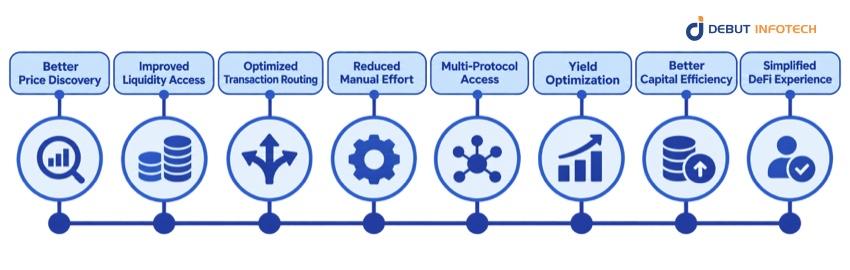
DeFi aggregators reduce the complexity created by fragmented liquidity and protocols. They can improve price discovery, execution, capital efficiency, and access to multiple DeFi services through a unified interface.
Aggregators improve price discovery by comparing quotes across multiple liquidity sources. Users can see how different pools and execution paths affect the amount they receive. This reduces dependence on a single DEX and can help traders identify more competitive opportunities, particularly in volatile markets where prices can fluctuate rapidly across liquidity venues.
DeFi liquidity is spread across many protocols, pools, and chains. Aggregators bring these sources together so users can access a broader market through one interface. This can improve execution for larger trades and less liquid assets, where relying on a single pool may create significant price impact or unfavorable pricing.
Optimized routing can reduce trade execution costs by selecting more efficient paths through available liquidity.
The router can compare direct swaps, multi-hop transactions, and split orders, taking fees and gas into account. The result can be stronger execution across changing market conditions, especially when liquidity is distributed across several competing venues.
Without aggregation, users may need to compare prices, liquidity, fees, and routes across several DeFi applications.
An aggregator performs much of this comparison automatically. This saves time and reduces the number of manual decisions required, particularly for users managing frequent trades or complex multi-step DeFi transactions. It also simplifies repeated workflows.
Aggregators give users access to multiple protocols through a unified interface. A single application can connect DEXs, lending markets, yield platforms, bridges, and other services depending on its design. This broader access can make DeFi easier to navigate while reducing the friction caused by fragmented applications and separate interfaces.
Yield-focused aggregators can compare or automate strategies across lending markets, liquidity pools, vaults, and staking opportunities.
By combining discovery with execution, they can reduce the manual work involved in monitoring rates and moving capital. This is useful for users who want to automate strategy without constant monitoring across multiple independent DeFi applications.
Aggregation can improve capital efficiency by helping users access deeper liquidity, better routes, and more suitable yield strategies.
Instead of leaving capital fragmented across inefficient pools or manually searching for alternatives, users can use aggregation infrastructure to identify more productive execution or allocation options based on current market conditions. This is useful when capital is distributed across chains or protocols.
DeFi can involve multiple wallets, networks, protocols, approvals, and transaction steps. Aggregators simplify this process by presenting relevant options through one interface and handling much of the underlying route discovery.
A well-designed platform can therefore make sophisticated DeFi functions more approachable without requiring users to understand every protocol involved. Aggregation can reduce errors caused by manually navigating applications, selecting routes, or entering settings.
Aggregators reduce complexity, but they do not eliminate DeFi risk. In some cases, aggregation can introduce additional dependencies because a single transaction may interact with multiple protocols, contracts, bridges, or data sources.
Aggregators interact with smart contracts that may contain vulnerabilities or depend on contracts operated by other protocols. A flaw in any critical component can expose users to financial losses.
Users should review audits, deployed contracts, upgrade permissions, ownership controls, and incident history rather than assume that aggregation itself makes transactions safer. Review the entire execution path before committing significant capital.
Slippage occurs when the final execution price differs from the quoted price. It can increase when markets move quickly, liquidity is shallow, or trades are large relative to available pool depth.
Aggregators can estimate and limit slippage, but users still need to understand that quoted prices are not guaranteed execution prices. Setting appropriate limits can help control this exposure.
Public blockchain transactions can expose trade intentions to searchers and other market participants. Sandwich attacks and other MEV strategies can degrade user experience.
Aggregators can reduce this exposure through private transaction flows, batch auctions, solver systems, or other mechanisms, but protection varies by network, protocol, and transaction type. Users should verify which protection mechanism applies before signing.
Aggregators that support lending, leverage, collateral, or automated strategies may depend on external price data. Manipulated, stale, or inaccurate oracle information can lead to incorrect decisions and financial losses.
Systems should use reliable data sources, monitor unusual price movements, and establish appropriate fallback mechanisms for critical operations. These controls matter during extreme market volatility.
Liquidity fragmentation is the problem aggregators are designed to address, but it also creates routing complexity. A small pool can display an attractive price while lacking enough depth for the intended trade.
Routing systems must evaluate liquidity, price impact, fees, and execution reliability rather than selecting sources based solely on quoted prices. This becomes important for trades and volatile assets.
Cross-chain transactions introduce additional risks because execution depends on bridges, messaging systems, destination-chain liquidity, and multiple smart contracts.
A cross-chain aggregator can simplify these interactions but cannot remove the underlying security assumptions. Users should evaluate the bridge’s reputation, route details, settlement processes, and failure recovery procedures before moving significant capital. Users should also understand how failed or delayed transfers are handled.
Network gas prices can change quickly during periods of congestion. A route that looks efficient when a quote is generated may become less attractive before execution if transaction costs rise.
Aggregators should refresh estimates and include gas in route calculations. Users should also compare the final expected cost rather than focusing only on token output. Gas volatility can change route economics.
Aggregators depend on external DEXs, bridges, RPC providers, oracles, indexers, and other infrastructure. An outage, contract upgrade, API change, or liquidity issue at a single dependency can affect execution.
Strong platforms need fallback sources, monitoring, and maintenance of integration to reduce the impact of individual failures and keep routes available. Reliable fallback infrastructure can reduce individual service failures.
Operational failures can occur even when smart contracts are secure. RPC outages, incorrect token metadata, compromised credentials, routing errors, stale quotes, and monitoring gaps can disrupt transactions.
Production aggregators need strong access controls, infrastructure redundancy, testing, incident procedures, and continuous monitoring to detect problems before they affect significant amounts of user capital. Testing and escalation procedures can limit the impact of incidents.
A strong DeFi aggregator should be evaluated as an execution system rather than a simple interface. The following characteristics matter most:
A good DeFi aggregator should connect users to deep and reliable liquidity across relevant trading venues. Depth matters because larger transactions can experience significant price impact in shallow pools.
The aggregator should dynamically evaluate available liquidity and avoid routes that appear attractive on paper but cannot efficiently support the requested transaction size.
Efficient routing means finding the transaction path that produces the strongest overall result, not simply selecting the pool with the highest quoted price.
A capable router evaluates direct swaps, multi-hop routes, split orders, fees, gas costs, liquidity depth, and price impact. It should also refresh routes before execution when market conditions change.
Low slippage indicates that the aggregator can execute trades without causing a significant difference between the expected and final price.
Strong liquidity, effective routing, and order splitting can help reduce price impact. The platform should also provide realistic slippage estimates and allow users to define appropriate tolerance limits before signing transactions.
A competitive aggregator should keep total transaction costs reasonable, accounting for aggregator charges, DEX fees, bridge costs, gas, and other execution expenses.
Comparing one headline fee is not enough. Users should evaluate the final expected output because a lower platform fee can still result in a more expensive transaction overall.
Broad chain coverage enables users to access liquidity and DeFi applications across multiple ecosystems through a single platform. However, the number of supported networks matters less than actual functionality on each chain.
A good aggregator should maintain reliable liquidity sources, wallet support, infrastructure, and protocol integrations across the networks it advertises.
Strong protocol integrations give aggregators access to more liquidity, trading pairs, yield opportunities, and cross-chain routes.
Quality matters more than integration count. Each connected protocol should be actively maintained, tested, monitored, and updated when contracts or APIs change. Weak or outdated integrations can produce failed transactions, inaccurate quotes, or unreliable execution.
A good aggregator should provide meaningful protection against avoidable MEV exposure where the underlying network and execution model allow it.
Private transactions, batch auctions, solver competition, and intent-based execution can reduce risks such as sandwich attacks. Users should be told clearly which protection mechanism applies to their specific transaction before they sign.
Reliable execution means quotes should translate into successful transactions with predictable outcomes. The aggregator should handle stale quotes, unavailable liquidity sources, RPC failures, reverted transactions, and network congestion without creating unnecessary losses.
Transaction simulation, route refreshes, fallback sources, and monitoring can help maintain reliable execution even when market or infrastructure conditions change.
A strong user experience should make complicated DeFi transactions understandable before approval. Users should see the route, expected output, fees, gas estimate, slippage, token approvals, and network clearly.
Error messages should explain what went wrong and what users can do next. Good UX reduces confusion and helps prevent costly signing mistakes.
Security should cover smart contracts, APIs, wallets, infrastructure, integrations, and administrative controls. A good aggregator should undergo independent audits and maintain strong testing and monitoring practices.
Users should also be able to review contract addresses, ownership, upgrade permissions, and security disclosures. Security is an ongoing process rather than something established by an audit alone.
Users should understand what will happen before approving a transaction. The aggregator should clearly show the assets involved, expected output, route, fees, gas, slippage, approvals, and relevant contract interactions.
After execution, users should receive transaction status and blockchain references. Transparency makes it easier to verify that the transaction matched the user’s expectations.
Strong cross-chain capabilities allow users to move and trade assets across networks without manually coordinating several applications.
A capable aggregator should compare bridges, exchanges, liquidity, fees, and settlement paths, and provide clear progress updates. It should also explain cross-chain risks and provide appropriate handling when a transfer becomes delayed, fails, or requires additional action.
DeFi aggregators support a wide range of applications, from everyday crypto trading and portfolio management to institutional finance, fintech products, yield strategies, and custom Web3 ecosystems.
| Use Case | How Aggregators Are Used | Primary Benefit |
| Crypto trading | Compare and route swaps | Better execution |
| DeFi wallets | Add trading and yield features | Better wallet utility |
| Portfolio management | Consolidate positions | Easier monitoring |
| Yield optimization | Compare/automate strategies | Better capital allocation |
| Institutional DeFi | Aggregate liquidity and execution | Operational efficiency |
| Fintech applications | Add DeFi through APIs | Faster integration |
| Web3 investment platforms | Provide DeFi access | Broader investment options |
| Cross-chain trading | Combine bridges and swaps | Easier multi-chain access |
| Custom DeFi ecosystems | Connect protocols | Unified experience |
Crypto traders use DeFi aggregators to compare liquidity and execute swaps without manually checking individual DEXs. This becomes especially useful when a token is available across several pools with different prices and liquidity depths.
The best DeFi aggregators for crypto trading can evaluate those sources and select a route based on expected output, price impact, gas, and fees. Larger traders can also benefit from order splitting across multiple liquidity sources.
DeFi wallets can integrate with aggregation infrastructure to provide users with swap and trading capabilities directly within the wallet interface.
Instead of sending users to separate DEXs, the wallet can request quotes, compare routes, and generate transactions through an aggregation API. This creates a more complete financial experience while reducing the engineering work required to maintain individual DEX integrations. Wallet providers can also add portfolio and cross-chain features.
Portfolio management platforms can use aggregation to combine wallet balances, lending positions, liquidity positions, staking assets, and other DeFi holdings into one interface. This gives users a clearer view of their total on-chain exposure across different protocols and networks.
Aggregators can also support portfolio actions such as swapping assets, rebalancing positions, or moving capital between strategies without requiring users to visit multiple applications.
Yield aggregators can help users identify and manage opportunities across lending markets, liquidity pools, vaults, staking platforms, and other DeFi strategies.
Instead of manually comparing rates and moving funds between protocols, users can access automated strategies designed around predefined objectives.
More advanced systems can evaluate expected returns alongside fees, liquidity, risk, and strategy performance, giving users a more practical basis for capital allocation.
Institutions can use DeFi aggregation infrastructure to access multiple liquidity venues while maintaining stronger execution and operational controls.
An institutional platform may require transaction policies, detailed reporting, risk monitoring, permissions, audit trails, and predictable settlement.
Aggregation can reduce the need to maintain separate integrations with every DEX or protocol. The architecture must still account for custody, security, compliance, governance, and counterparty risks.
Fintech companies can integrate DeFi aggregation into existing products without developing every blockchain and protocol connection internally.
For example, a fintech application could offer token swaps, yield discovery, or cross-chain transfers through an aggregation API. This can shorten development cycles and expand product functionality.
However, businesses should evaluate API reliability, regulatory requirements, user protection, security controls, pricing, and infrastructure dependencies before launching these features.
Web3 investment platforms can use aggregation to give users broader access to decentralized markets and investment strategies. Instead of requiring investors to interact with individual DEXs, lending protocols, or yield platforms, the application can provide a unified interface.
Aggregation can also support portfolio rebalancing, asset discovery, transaction execution, and strategy comparison. This makes complex DeFi products easier to incorporate into structured investment experiences.
Cross-chain aggregators allow users to combine asset transfers and trading across different blockchain networks. A user may hold an asset on one chain but want another asset on a different network.
The aggregator can evaluate available bridges, destination liquidity, DEX routes, fees, and settlement requirements. This reduces manual steps, although users remain exposed to the security and operational risks of the underlying cross-chain infrastructure.
Businesses can build custom DeFi ecosystems around an aggregation layer that connects selected DEXs, lending protocols, bridges, vaults, and other financial services. This approach allows the company to control the user experience while using established liquidity infrastructure underneath.
It can support specialized products for trading, treasury management, payments, or investment. The main challenge is maintaining integrations and ensuring that every connected protocol remains secure and reliable.
DeFi aggregation is evolving around broader chain coverage, better execution, automated strategies, and stronger infrastructure. These trends are shaping how users and applications interact with fragmented decentralized markets.
Multi-chain aggregation is becoming a core expectation as users spread their assets across different blockchain ecosystems.
Instead of choosing an application based on a single network, users increasingly want a single interface that can discover liquidity and execute transactions across multiple chains. This is pushing aggregators toward broader integrations, unified routing systems, and infrastructure capable of handling different transaction models and settlement environments.
Intent-based execution is changing how users interact with DeFi. Instead of specifying every step of a transaction, users can define the desired outcome and let solvers determine the best way to achieve it.
The execution path may involve AMMs, order books, solver inventory, or cross-chain liquidity. This approach can simplify complex transactions while creating new requirements around solver competition, settlement, permissions, and execution guarantees.
Smart order routing is becoming more sophisticated as aggregators compete on actual execution rather than quoted token prices.
Modern routers can evaluate liquidity depth, price impact, gas costs, fees, intermediary assets, and order splitting. This matters most for larger trades, where routing through one pool can create substantial price impact. Better routing can distribute an order across several venues to improve the user’s final received amount.
MEV protection is becoming increasingly important because transaction execution can expose traders to sandwich attacks and other forms of value extraction.
Aggregators are responding with private transaction flows, batch auctions, solver-based execution, intent systems, and other mechanisms that reduce exposure.
The trend is shifting user expectations from simply finding a good quote toward achieving a good final execution without unnecessarily revealing trade intentions.
Cross-chain aggregation is moving beyond basic bridge discovery toward integrated execution. A user may want to specify the asset and destination rather than separately select a bridge, wait for settlement, and perform another swap.
Aggregators can combine these steps by evaluating bridges, exchanges, and liquidity sources together. This creates a smoother experience, but it also increases the importance of bridge security, failure recovery, and transaction monitoring.
Automated yield strategies are becoming more sophisticated as protocols compete to make capital allocation easier.
Instead of manually comparing lending rates, liquidity incentives, and vault opportunities, users can increasingly rely on automated strategies to allocate or rebalance assets.
Aggregators can combine yield discovery with execution, allowing users to move an existing asset into a selected strategy with fewer transactions and less manual protocol management.
AI is emerging as a decision-support layer for DeFi aggregation. It can help analyze routes, identify unusual market conditions, summarize transaction risks, compare strategies, and assist with portfolio decisions.
However, AI should not receive unrestricted authority over user funds. Emerging research is already examining transaction-level safeguards for AI agents, as autonomous execution introduces risks that conventional DeFi interfaces do not.
Institutional DeFi is increasing demand for aggregation systems that provide stronger execution controls, reporting, monitoring, permissions, and operational reliability.
Institutions generally require more than a simple swap interface. They may need transaction policies, audit trails, risk controls, predictable settlement, and integration with existing financial infrastructure.
Aggregators serving this segment will therefore need to prioritize transparency, security, infrastructure reliability, and configurable controls.
Aggregation is increasingly moving into the backend. Developers can access routing, pricing, swaps, bridges, and execution functionality via APIs and SDKs rather than building every protocol integration themselves. This allows wallets, fintech products, investment applications, and Web3 platforms to add DeFi functionality faster.
The tradeoff is greater dependence on infrastructure providers, making uptime, documentation, rate limits, pricing, support, and vendor risk important evaluation criteria.
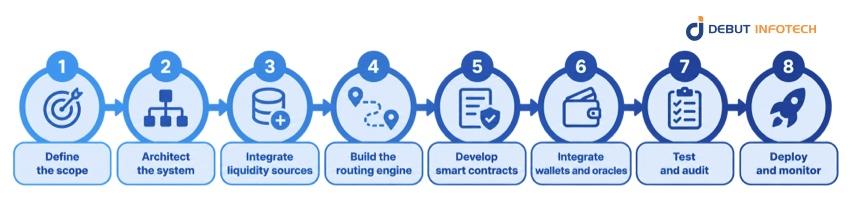
To build a DeFi Aggregator, start by defining its scope and target chains, then design the architecture, integrate liquidity sources, develop the routing engine, build secure smart contracts, connect wallets and oracles, test and audit the system, and deploy it gradually.
Each stage affects the platform’s security, execution quality, scalability, and long-term reliability.
Here is a guide on how to build a custom DeFi aggregator:
Start by deciding what the aggregator will do. Choose whether it will focus on DEX swaps, yield, portfolio management, data, cross-chain transactions, or a hybrid model.
Then select the target chains. An EVM-only product is simpler than one supporting EVM, Solana, Bitcoin, and other ecosystems. The first release should focus on chains where you can obtain meaningful liquidity and reliable infrastructure.
Define the target user as well. A retail swap aggregator, an institutional trading platform, a DeFi wallet, and a developer API each have different requirements for custody, permissions, reporting, performance, and security.
The architecture should separate the user interface, API layer, routing engine, data layer, blockchain infrastructure, and smart-contract execution layer. This separation makes it easier to update individual components without redesigning the entire system.
A typical architecture can include:
Connect the DEXs, liquidity providers, lending protocols, bridges, or other sources required by the product. Each integration should have a standardized adapter so the routing engine receives consistent information.
Developers should normalize token addresses, decimals, liquidity data, fees, gas estimates, quote formats, and transaction parameters. This prevents the routing engine from having to understand every protocol’s unique API structure.
The routing engine is the technical core of a DEX aggregator. It should compare possible routes based on the user’s actual outcome.
A simplified scoring model can consider:
Expected output − protocol fees − gas cost − price impact − execution risk
More sophisticated systems can split a transaction between multiple pools. They can also use intermediate assets when a multi-hop path produces better execution.
The routing engine should also support fallback routes. If a liquidity source becomes unavailable after the initial quote, the system needs a controlled way to reject, refresh, or reconstruct the transaction rather than blindly submitting stale data.
Smart contracts should execute only the operations required by the selected route. Keep permissions narrow and avoid unnecessary token approvals or arbitrary external calls. Experienced blockchain development services can help design these contracts with appropriate access controls and execution boundaries.
Contract development should include unit tests, integration tests, fuzzing, static analysis, fork-based testing, and independent security review.
Upgradeability should also be carefully considered, as administrative controls can introduce a separate risk beyond the contract’s code itself.
Add wallet connectivity for the target users and networks. The interface should show the wallet address, selected network, token balances, gas requirements, and transaction details before signing.
If the aggregator uses external price feeds, integrate appropriate oracle infrastructure and establish fallback logic. Oracle data should not become a single point of failure for critical financial operations.
Test the aggregator under normal and abnormal conditions. Simulate high volatility, low liquidity, failed RPC responses, unavailable DEXs, insufficient balances, reverted transactions, stale quotes, and network congestion.
Fork-based testing is particularly useful for reproducing real protocol states before deployment. Third-party audits should follow internal testing rather than replace it. An audit is a review point, not proof that a system is risk-free.
Start with a phased rollout. Limit supported chains, tokens, transaction sizes, and protocol integrations during the first release. Monitor execution success, quote accuracy, latency, gas costs, reverted transactions, and liquidity-source performance.
Once the system demonstrates stable execution, expand gradually. Every new chain, DEX, bridge, or smart contract increases the system’s attack surface and operational complexity.
Businesses planning to launch their own aggregation platform can explore reputable DEX aggregator development services for custom routing, liquidity integration, and smart-contract development.
To evaluate a DeFi Aggregator before using it, review its latest audit, check deployed smart contracts and administrative controls, test a small transaction, compare quotes with other platforms, review recent community feedback, examine on-chain activity, and confirm whether MEV protection and transaction simulation are available.
These checks help assess security, execution quality, transparency, and operational reliability before committing capital.
Find the latest independent audit and verify which contracts it covers. Review the severity of reported vulnerabilities and whether they were resolved. Do not rely solely on an “audited” badge. An old audit may not reflect the current contracts, integrations, upgrade changes, or features available on the live platform.
Verify the aggregator’s deployed contracts through a reputable blockchain explorer.
Check whether the source code is verified and review ownership, administrator privileges, upgradeability, and connected addresses. This can reveal controls or dependencies that may materially affect transaction security and help users understand who can modify critical parts of the system.
Start with a small transaction before committing significant capital. Confirm that the wallet connection, token approval, route, gas estimate, execution, and final settlement work as expected. This provides practical evidence that the aggregator functions correctly for your specific asset pair, network, wallet, and transaction type before larger funds are involved.
Request quotes for the same asset pair, amount, network, and transaction settings from several aggregators. Compare the expected final output after fees and gas rather than looking only at the displayed exchange rate. Market conditions can change quickly, so perform comparisons close to the intended execution time for useful results.
Review recent discussions on official Discord channels, X accounts, governance forums, and relevant community platforms. Look for reports involving failed transactions, exploits, suspicious contracts, outages, or unresolved support issues. Recent community feedback can reveal problems that may not appear in older audits, documentation, or promotional material.
Examine recent on-chain activity for the aggregator’s contracts. Look for transaction failures, unusual patterns, long periods of inactivity, or other signals that may indicate infrastructure problems.
Blockchain explorers can also help confirm contract addresses and activity. This provides an independent view of actual execution rather than relying entirely on platform claims.
Before signing, check whether the selected transaction uses available MEV protection and whether the route has been simulated.
Review the expected output, slippage limit, gas estimate, and transaction details. Do not assume that protection or simulation automatically applies to every network, route, or transaction type supported by the aggregator.
Building a DeFi aggregator requires more than connecting a few DEXs. Debut Infotech brings expertise across DeFi development, smart contracts, liquidity aggregation, cross-chain infrastructure, and blockchain security. Our Web3 team has delivered 50+ blockchain and digital asset implementations and supports 20+ blockchain platforms.
Our company can help with architecture, routing engines, DEX and protocol integrations, wallet connectivity, smart contract development, testing, audits, and post-launch monitoring. Our decentralized finance development services also cover DEXs, lending markets, and yield aggregators.
If you are planning to launch a custom DeFi aggregator, Debut Infotech can help turn your concept into a production-ready platform tailored to your target users, chains, liquidity sources, and business requirements.
DeFi aggregators make fragmented markets easier to access by combining liquidity, routing, data, yield opportunities, and cross-chain functionality. The best platform depends on the user’s specific requirements, from swap execution and Solana liquidity to portfolio management and developer integrations.
Building a DeFi aggregator requires careful planning around architecture, routing, smart contracts, security, and protocol connectivity.
As DeFi evolves, stronger aggregation infrastructure will continue to play an important role in improving execution, simplifying user experiences, and connecting users with increasingly diverse decentralized markets.
A DeFi yield aggregator automatically moves or allocates your crypto across different DeFi protocols to find better yield opportunities. Instead of checking lending pools, staking platforms, and liquidity pools yourself, it compares available rates and helps put your assets where they can potentially earn more.
A DeFi aggregator solves the problem of fragmented liquidity and scattered opportunities across DeFi platforms. It checks multiple protocols, compares prices and yields, and automatically finds suitable routes. This saves users time, reduces the hassle of switching between platforms, and can improve execution or returns.
LI.FI is a strong choice for multi-chain trading because it connects DEX aggregators and bridges across 60+ chains. It handles cross-chain swaps, bridging, and routing through one interface. 1inch is also strong, particularly for EVM-based trading, but LI.FI has broader cross-chain coverage.
There is no single aggregator with the best liquidity for every token and chain: 1inch, Odos, and LI.FI can access deep liquidity by aggregating multiple sources. For large trades, compare the actual quote, price impact, fees, and slippage rather than relying on an aggregator’s headline liquidity claims.
A basic DeFi aggregator can take around three to four months to build, while a feature-rich platform may take six months or longer. The timeline depends on chain coverage, smart contracts, routing logic, wallet integration, security testing, dashboards, APIs, and whether you are building from scratch or using existing infrastructure.
DeFi aggregators typically use Solidity for smart contracts, TypeScript or JavaScript for application development, and APIs or SDKs to connect to DEXs and blockchain networks. Developers also use Web3 libraries, RPC providers, databases, oracles, wallet integrations, and routing algorithms to compare liquidity and execute transactions efficiently.
Look for strong liquidity coverage, reliable routing, supported chains, competitive fees, low slippage, transaction simulation, wallet compatibility, and solid security practices. MEV protection also matters for traders. If you are building one, check API quality, scalability, smart contract architecture, monitoring tools, and how easily new protocols can be added.
DeFi aggregators carry risks from smart contract bugs, vulnerable protocols, bridge exploits, malicious tokens, failed transactions, slippage, and market volatility. Cross-chain aggregators add bridge and interoperability risks. Even when an aggregator finds a better route, users should check the transaction details, token approvals, fees, and destination protocol before signing.
Choose a DeFi aggregator based on the chains, assets, and transactions you actually use. Compare quotes across platforms, then check fees, slippage, liquidity, execution speed, security history, MEV protection, and supported wallets. For cross-chain activity, pay extra attention to bridge security and the number of available routing options.

Our Latest Insights
USA

2501 Chatham, Rd Suite R Springfield, IL 62704
+1-708-515-4004
info@debutinfotech.com
UK

7 Pound Close, Yarnton, Oxfordshire, OX51QG
+44-770-304-0079
info@debutinfotech.com
Canada

154 Eden Oak Trail, Kitchener, ON N2A 0H9
+1-708-515-4004
info@debutinfotech.com
INDIA

Sector 101-A, Plot No: I-42, IT City Rd, JLPL Industrial Area, Mohali, PB 140306
9888402396
info@debutinfotech.com

9001:2015
Quality Certified

ISO 27001
Security Certified

A+ Rating
Accredited Business

Certik
Security & Audit


Copyright © 2026, Debut Infotech. All rights reserved. | Privacy Policy