ON THIS PAGE
Progress0%





Our Global Presence :





Security and audit readiness outweigh feature delivery when selecting a DeFi development company, as smart contract vulnerabilities, oracle failures, and weak protocol logic can create significant operational risks.
The best DeFi development partners combine protocol architecture, tokenomics, compliance, and infrastructure expertise, enabling secure deployment of lending, staking, DEX, and liquidity-based products.
Vendor selection should align with the specific DeFi use case, whether building AMM-based exchanges, lending protocols, DAO governance systems, cross-chain applications, or regulated financial products.
Infrastructure and security specialists serve different roles from full-stack development firms, with providers like Chainstack focusing on blockchain infrastructure and OpenZeppelin specializing in smart contract security and audits.
DeFi development costs vary significantly based on protocol complexity, with budgets influenced by smart contract scope, multi-chain deployment, tokenomics design, compliance requirements, and audit coverage.
Successful implementation requires more than Solidity development, including wallet integration, liquidity management, governance workflows, oracle connectivity, testing, deployment, and ongoing protocol maintenance.
A structured delivery process reduces launch risk, making factors such as milestone planning, testnet validation, documentation, QA, and post-launch support critical evaluation criteria for enterprise and startup teams.
Choosing the appropriate DeFi development partner in 2026 is the key to a secure, scalable, and trustworthy product launch. The wrong vendor can provide a platform that functions well in a test environment, but faces challenges with smart contract vulnerabilities, weak liquidity logic, and poor tokenomics and compliance issues once the platform is used by real users and assets.
DeFi is now beyond just experimental crypto applications. It is serving the lending markets, staking platforms, decentralized exchanges, liquidity pools, real-world asset protocols, and blockchain finance for institutions today.
There is more to a strong DeFi partner than just writing code. It aids in creating a secure protocol architecture, audit-ready smart contracts, sustainable incentive structures, wallet integrations, governance structures, and post-launch monitoring. For example, a lending protocol needs more than deposit and borrow features. It needs collateral rules, liquidation logic, oracle integration, risk controls, and liquidity management that can hold up under market volatility.
As a DeFi development company ourselves, we know exactly what it takes to deploy secure protocols. Below, we’ve reviewed our own enterprise-grade framework alongside 9 other industry-leading infrastructure, security, and development partners.
Without further ado, let’s get started!
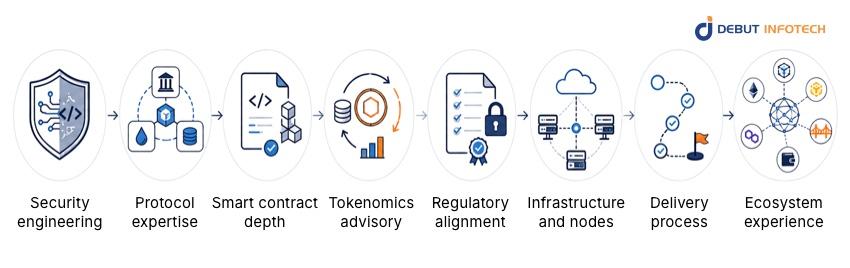
To keep this ranking fair and useful for technical decision-makers, we assessed each company using publicly available evidence rather than paid placements. The review considered mainnet deployment history, client case studies, technical capability, and real-world DeFi delivery experience.
Each company was evaluated against eight production-focused criteria:
This methodology helped identify DeFi development companies that can move beyond basic smart contract delivery and support secure, scalable, production-ready protocols.
The best DeFi development companies are not all built for the exact same project. Some are better at providing full product delivery, others have better infrastructure, smart contract security, token systems, or enterprise blockchain integration.
Use this comparison as an initial screening process, before you look at the company in detail.
| Rank | Company | Location | Best For | Strongest Capability |
| 1 | Debut Infotech | USA / India | Enterprises, fintech startups, and DeFi product teams that need end-to-end delivery | Full-stack DeFi development, blockchain engineering, and compliance-aware product architecture |
| 2 | Suffescom Solutions | India / USA | Businesses needing broad blockchain, DeFi, and crypto application development | DeFi tokens, DEX development, smart contracts, staking platforms, and blockchain apps |
| 3 | LeewayHertz | USA / India | Enterprises exploring DeFi, dApps, DEXs, wallets, and blockchain transformation | Enterprise software development combined with blockchain and DeFi platform engineering |
| 4 | SoluLab | USA / India | Startups and mid-market teams building custom DeFi and Web3 applications | DeFi platforms, smart contracts, crypto exchange solutions, and Web3 app delivery |
| 5 | Blockchain App Factory | India / USA | Crypto-native founders launching DeFi apps, exchanges, and token-based products | DeFi dApps, token development, exchange platforms, and crypto product launch support |
| 6 | Chainstack | Global / Singapore | Engineering teams that already have a product team but need reliable blockchain infrastructure | RPC nodes, managed blockchain infrastructure, APIs, and multi-chain connectivity |
| 7 | OpenZeppelin | USA | Protocol teams where smart contract security is a priority | Smart contract audits, secure contract libraries, and onchain security tooling |
| 8 | Inoru | India / USA | Web3 startups building DeFi, NFT, exchange, token, or RWA-related products | Custom Web3 development, token solutions, exchange systems, and post-launch support |
| 9 | Antier Solutions | India / USA | Businesses building digital asset, token, wallet, exchange, or DeFi ecosystems | Broad Web3, blockchain, DeFi, RWA, exchange, and token development services |
| 10 | Clarisco Solutions | India | Cost-conscious blockchain teams building crypto exchanges, wallets, and DeFi platforms | DeFi platforms, smart contracts, Web3 dApps, NFT marketplaces, and digital wallets |
One of the most effective ways to analyze a DeFi development partner is to consider more than just the delivery of features. Discuss their approach to smart contract testing, liquidity logic, wallet security, oracles integration, protocol upgrades and compliance to various jurisdictions.
For instance, a fintech startup developing a decentralized lending solution might need a bit more than just Solidity development. These can also include audit ready architecture, KYC integration, multi-chain support, treasury logic, and post-launch protocol maintenance. This is where the DeFi engineering teams with expertise can add more value in the long term than the general software vendors.
Most companies do not disclose pricing as DeFi development costs are heavily determined by the complexity and scope of the protocol, the blockchain selected, the scope of the audit, integrations, and infrastructure requirements.
Choosing the ideal DeFi development company in 2026 goes beyond looking at service pages. A good vendor should also have a deep understanding of the inner workings of decentralized finance (DeFi) products, including smart contract logic, liquidity movements, wallet integrations, audit preparations, cross-chain operations, governance, and long-term maintenance.
The ideal DeFi development companies for CTOs, Web3 founders, DeFi product leads, blockchain architects, and enterprise innovation teams are those that can take a product concept and build a functioning financial system. This means that they should help to clarify the architecture, define core modules, identify risk areas and build from the start with security in mind.
This list focuses only on publicly visible DeFi development services, blockchain and Web3 capability, security posture, delivery fit, and usefulness for real production teams. Where information such as pricing, named audit partners, specific delivery models, or engineering language depth was not clearly available, it has not been included.

Debut Infotech ranks first because its public DeFi service offering covers the full development lifecycle. The company presents services across DeFi consulting, protocol architecture, prototyping, application development, smart contract development for DeFi, cross-chain integration, security testing, compliance integration, and post-launch support.
This makes Debut Infotech a strong choice for buyers that need structured planning before development begins. For example, a fintech team building a DeFi lending platform development project may need collateral logic, smart contracts, wallet integration, oracle connections, compliance mapping, and audit preparation. Debut’s public positioning speaks directly to that kind of multi-layered requirement.
• Primary Strength: Full-stack DeFi development services with compliance-aware architecture.
• Best For: Enterprise DeFi platforms, regulated-market products, and fintech teams entering Web3.
Core Capabilities
• Protocol & Architecture: Full lifecycle consulting, protocol architecture, prototyping, and multi-chain mapping.
• Core Engineering: Secure smart contract development, lending platform mechanics, collateral logic, and wallet creation.
• Compliance & Support: Integrated KYC/AML mapping, treasury logic, audit readiness preparation, and post-launch protocol maintenance.
Why it ranks here:
Debut Infotech ranks first because it presents one of the most complete DeFi development service structures on this list. Its strength is not only development, but the connection between strategy, architecture, compliance-aware design, security, and long-term protocol support.

Suffescom Solutions publicly lists DeFi development services across tokens, dApps, wallets, DEX exchanges, smart contracts, staking platforms, yield farming, lottery systems, insurance, stablecoins, synthetic assets, tokenization, lending, borrowing, and AMM-based DEX products.
It is a broad Web3 and blockchain product development company that may suit teams building DeFi app MVPs, wallets, DEX products, staking systems, and crypto applications with DeFi features.
• Primary Strength: Broad-spectrum blockchain and crypto application development.
• Best For: General Web3 product exploration, basic MVPs, and synthetic asset platforms.
Core Capabilities
• DeFi Applications: Basic staking tools, yield farming protocols, AMM-based DEXs, and tokenization platforms.
• Advanced Mechanics: Synthetic asset generation, decentralized lottery systems, and tokenized insurance modules.
• Infrastructure Layer: Core smart contract logic, basic token generation, and mobile-friendly DeFi wallets.
Why it ranks here:
Suffescom ranks tenth because its public DeFi service coverage is broad. It is best suited to teams comparing general Web3 development vendors for MVPs and productized DeFi applications.

LeewayHertz is best suited for enterprise and mid-market buyers that need custom Web3 software development with DeFi capability. Its public DeFi services include DeFi dApps, smart contracts, wallets, lending platforms, token development, and DeFi exchange development.
It’s most useful when DeFi is being integrated into a broader digital product plan. For instance, an enterprise innovation team might require more than just a DeFi app; they could also require backend integrations, user management, analytics, infrastructure planning, and product scalability.
• Primary Strength: Enterprise-grade Web3 development and system integration.
• Best For: Corporate innovation teams and mid-market companies embedding DeFi into existing ecosystems.
Core Capabilities
• Software Delivery: Enterprise software design combined with dApp, DEX, and smart contract engineering.
• Platform Logic: Custodial and non-custodial wallet systems, lending modules, and custom token deployment.
• System Integrations: Connecting blockchain layers with legacy backend infrastructure, advanced analytics, and custom user management systems.
Why it ranks here:
LeewayHertz ranks third because it brings enterprise software positioning into the DeFi development conversation. It is a strong fit for buyers who want structured product development rather than a purely crypto-native build shop.

SoluLab is a broad DeFi app development company with public services across DeFi software development, token creation, crypto exchanges, smart contracts, liquidity management, automated market makers, yield farming, staking, stablecoins, insurance platforms, tokenized assets, crowdfunding, and liquidity pools.
The company is well positioned for startups and mid-market teams that want to build user-facing DeFi products. This may include DeFi wallets, trading products, staking apps, tokenized asset platforms, or yield-related applications.
• Primary Strength: User-centric Web3 application development.
• Best For: Startups and product teams prioritizing retail-facing DeFi experiences.
Core Capabilities
• Product Infrastructure: Crypto exchanges, liquidity management tools, Automated Market Makers (AMMs), and liquidity pools.
• DeFi Yield Products: Yield farming applications, custom staking portals, stablecoin architecture, and decentralized crowdfunding engines.
• Smart Contracts: Custom tokenized asset smart contracts and algorithmic distribution logic.
Why it ranks here:
SoluLab ranks fourth because its DeFi service coverage is broad and product-focused. It is especially useful for teams building applications that need both blockchain functionality and user-friendly product design.

Blockchain App Factory is a crypto-native DeFi software development company with publicly listed services that include DeFi platform development, DEX development, lending and borrowing apps, crowdfunding platforms, smart contract development, DeFi token development, staking, liquidity, yield farming, governance, DEX listing, and cross-chain support.
It’s a viable choice for teams looking to deploy DeFi MVPs, token-integrated platforms, decentralized exchanges, or crypto products with DeFi capabilities.
• Primary Strength: Rapid crypto-native platform and MVP deployment.
• Best For: Early-stage founders seeking fast market validation and swift product launches.
Core Capabilities
• DeFi Launchpads: Crowdfunding platforms, DEX listings, token creation, and cross-chain bridge support.
• Core Trading Modules: AMM-based decentralized exchanges, basic lending/borrowing engines, and liquidity rewards.
• Governance: Fundamental multi-sig setups and protocol governance frameworks.
Why it ranks here:
Blockchain App Factory ranks fifth because it covers many common DeFi product categories. It is best suited to buyers who want wide crypto and DeFi product coverage from a single vendor.

Chainstack is not a full-stack DeFi development company. It is included because DeFi products need reliable blockchain infrastructure to perform well in production. Its public pages are dedicated to RPC access, dedicated nodes, archive data, global node routing, self-hosted nodes and blockchain infrastructure on many chains.
For teams that have in-house developers, Chainstack can facilitate the infrastructure layer for wallets, dApps, analytics tools, DeFi platforms, and high traffic Web3 products. It is more appropriate for teams with engineers than for buyers wanting to hire DeFi developers to build a product.
• Primary Strength: Scalable blockchain infrastructure and global node routing.
• Best For: In-house engineering teams requiring resilient node access and high-performance data layers.
Core Capabilities
• Node Infrastructure: Dedicated and shared RPC nodes, archive data access, and self-hosted node deployments.
• Network Performance: Global node routing across 70+ blockchain networks with unlimited node plan availability.
• Data & APIs: Web3 APIs and real-time blockchain indexers for analytical tracking.
Why it ranks here:
Chainstack ranks sixth because infrastructure quality affects DeFi reliability. It should be treated as an infrastructure partner, not as a traditional DeFi app development company.

OpenZeppelin is not a general DeFi app development company. It is included because security is one of the most important parts of any DeFi product. The company publicly offers smart contract audits, blockchain infrastructure audits, zero-knowledge proof audits, and continuous security services for on-chain finance.
In the case of DeFi teams that process user funds, security review should not be seen as a last step item on the checklist. It should be integrated into architecture, development, testing, deployment and post-deployment monitoring.
• Primary Strength: High-security smart contract audits and defensive runtime monitoring.
• Best For: High-stakes protocols, stablecoin issuers, and teams managing significant Total Value Locked (TVL).
Core Capabilities
• Security Auditing: Comprehensive smart contract audits, zero-knowledge proof analysis, and blockchain infrastructure deep dives.
• On-Chain Defense: Continuous security programs, threat detection tools, and real-time incident response kits.
• Standardization: Maintenance of industry-standard secure contract libraries (ERC-20, ERC-721, etc.).
Why it ranks here:
OpenZeppelin ranks seventh because smart contract reliability is central to DeFi trust. It is best viewed as a security and audit partner rather than a full-stack DeFi development company.

Inoru publicly lists Web3 DeFi development services across trading, lending, liquidity, staking, yield, stablecoins, governance, DAO features, and cross-chain interoperability. Its page also references wallet SDKs, key management, and security-related integrations.
This makes Inoru a suitable option for startups that need broad DeFi development services and want to compare vendors for DEX products, staking products, DAO-linked systems, and multi-chain DeFi applications.
• Primary Strength: Custom Web3 applications and cross-chain interoperability.
• Best For: Startups requiring bespoke decentralized architectures and integrated key management.
Core Capabilities
• DeFi Modules: Specialized trading and lending frameworks, stablecoin engines, and yield/staking networks.
• Key Management: Non-custodial wallet integrations, wallet SDK customization, and secure cryptographic key setups.
• Decentralization: DAO frameworks and multi-chain cross-interoperability layer integrations.
Why it ranks here:
Inoru ranks eighth because its public DeFi positioning covers several practical product types. It is most relevant for buyers that want a flexible vendor for application-led DeFi builds.

Antier Solutions is a strong DeFi blockchain development company for teams that want broad Web3 service coverage. Its public DeFi development page lists protocol architecture, smart contract engineering, token creation, security frameworks, product deployment, lending, staking, yield farming, liquidity products, wallets, DEX development, and dApp development.
Antier is especially relevant for founders comparing vendors that can support different DeFi product types under one roof. This includes wallet-based DeFi apps, staking platforms, token ecosystems, lending products, and decentralized exchange products.
• Primary Strength: High-breadth DeFi, RWA, and asset tokenization ecosystems.
• Best For: Crypto-native startups and teams launching diverse, multi-token asset systems.
Core Capabilities
• DeFi Frameworks: Yield farming mechanics, staking platforms, lending/borrowing logic, and custom DEX configurations.
• Asset Ecosystems: Digital asset wallets, token development, white-label exchange engines, and RWA tokenization.
• Governance: Basic DAO structures and on-chain voting mechanics.
Why it ranks here:
Antier ranks second because its public service coverage is wide and directly relevant to common DeFi product models. It is a practical option for teams comparing top DeFi development companies with both consulting and implementation capability.

Clarisco Solutions publicly lists DeFi development services across DeFi exchange development, staking development, token development, smart contract development, lending and borrowing, DEX platform development, and DeFi application development.
Clarisco is best suited to startups and budget-conscious crypto teams comparing offshore blockchain development companies. It may fit simpler DeFi products, exchange-linked projects, token products, and staking-based platforms.
• Primary Strength: Cost-efficient, specialized offshore Web3 engineering.
• Best For: Budget-conscious startups looking to build lean, secure iterations of established DeFi concepts.
Core Capabilities
• Exchange Systems: Custom DEX platforms, automated token swaps, and centralized exchange models.
• Basic DeFi Modules: Staking contracts, simple lending and borrowing mechanics, and digital crypto wallets.
• Marketplaces: NFT marketplaces and basic dApp application development
Why it ranks here:
Clarisco ranks ninth because it has visible service coverage across exchange, staking, token, and DeFi app categories. It is a practical shortlist option for simpler or more budget-sensitive DeFi projects.
Why Debut Infotech is Listed First
Debut Infotech ranks #1 because it aligns well with the core requirements of a modern DeFi build. A DeFi project is more than just about launching your smart contracts. It calls for protocol design, tokenomics, liquidity management, risk mitigation measures, wallet integration, security measures, and a roadmap from prototype to production.
This is important for enterprise innovation teams, blockchain architects, Web3 founders, and CTOs. The most suitable DeFi development partner should not only possess the financial logic of the product but also know how to run it securely at scale using blockchain infrastructure.
Built for Complex DeFi Use Cases
Debut is especially suitable for teams building lending and borrowing platforms, staking platforms, yield farming platforms, DEXs, AMM protocols, liquidity pool systems, governance and DAO modules, multi-chain DeFi platforms, and compliance-aware DeFi infrastructure.
These products depend on connected technical layers. A DeFi lending platform requires features such as collateral management, borrowing rules, interest logic, liquidation conditions, oracle integration, user permissions, and secure smart contracts. If the one layer isn’t designed well, the entire protocol can be hard to scale, or even be dangerous to use.
Strong Smart Contract and Tokenomics Support
Debut’s DeFi development capability covers smart contract development for core protocol functions such as swaps, staking, lending, borrowing, liquidity rewards, governance voting, and fee distribution.
Its tokenomics advisory also supports early product decisions. This encompasses token supply mechanics, incentives design, reward mechanisms, staking logic, governance engagement, sustainability of liquidity, as well as protocol revenue models. Having the product architecture linked to the token design can minimize unnecessary redesigns during the development process.
Compliance-Aware Architecture and Enterprise Fit
Debut also brings enterprise blockchain experience into DeFi product development. This is useful for companies that need permissioned access, audit readiness, reporting flows, risk controls, or compliance-aware infrastructure.
Full-Cycle Delivery
Another reason Debut leads this list is its ability to support the full product journey. Teams can work with Debut for consultation, prototyping, architecture, development, testing, deployment, integration, scaling, and ongoing improvement.
The end-to-end delivery model makes Debut a good choice for both Web3 startups and enterprises launching serious DeFi products in 2026.
Choosing the right DeFi development company depends on the product you are building, not just the vendor’s portfolio. A strong team for a lending protocol may not be the best fit for a DEX, and a startup MVP will need a different delivery model from an enterprise-grade DeFi system.
If You Are Building a Lending or Borrowing Protocol
When building a DeFi lending platform, seek out real-world lending platform experience, rather than just smart contract samples. The team should have knowledge of how the various components of collateral logic, loan-to-value ratios, interest models, liquidation thresholds, and oracles will work together.
Discuss the methods they use to develop risk parameters, address price feed failures, and develop contracts for audit. A simple test to understand this is to have them tell you what they think will happen when the value of a piece of collateral is dropping rapidly within a single block. Their answer should cover oracle reliability, liquidation logic, borrower protection, and protocol solvency.
If You Are Building a DEX or AMM
If your project involves swaps, pools, or token trading, choose a DEX development company with deep Solidity experience and real AMM protocol development knowledge. They should understand liquidity pool development, slippage control, fee structures, routing logic, impermanent loss considerations, and Layer 2 deployment.
The right vendor should also know how front-end trading flows connect with smart contracts, wallets, analytics, and security monitoring.
If You Are Building for a Regulated Market
For regulated or institution-facing DeFi products, choose a DeFi development company with compliance expertise. This does not mean turning DeFi into traditional finance. It involves creating architecture that can accommodate flows which are KYC enabled, permissioned pools, audit logs, and jurisdiction-aware access rules, as well as reporting requirements.
Knowledge of MiCA, FATF Travel Rule and regional compliance expectations is particularly crucial for enterprise products or cross-border products.
If You Are a Startup on a Tight Budget
The best DeFi development company for startups should help you reduce scope without weakening security. Prioritise a clear MVP, fixed milestones, essential audit coverage, upgrade planning, and post-launch support.
Do not postpone security to save money. A pre-launch audit is usually cheaper than post-exploit recovery.
The top DeFi development companies in 2026 include Debut Infotech, Antier Solutions, LeewayHertz, SoluLab, Blockchain App Factory, Chainstack, OpenZeppelin, Inoru, Clarisco Solutions, and Suffescom Solutions. This ranking evaluates companies based on DeFi protocol delivery history, smart contract audit readiness, Solidity/Rust depth, tokenomics capability, compliance awareness, team depth, engagement flexibility, and pricing transparency.
Choose a DeFi development company by checking whether it has real protocol delivery experience, audit-ready smart contract development practices, Solidity and Rust engineering depth, tokenomics advisory capability, and compliance-aware architecture. Avoid vendors that make broad blockchain claims but cannot show relevant DeFi protocol experience or explain their audit process.
DeFi development costs range from $30,000 for a focused smart contract or staking module to $300,000+ for a full DeFi protocol with AMM logic, governance, multi-chain deployment, and audit support. The final cost depends on protocol complexity, chain targets, audit requirements, tokenomics, compliance scope, and post-launch support.
A qualified DeFi development company should be able to build lending and borrowing protocols, AMM-based DEXs, yield farming platforms, staking systems, liquidity pool infrastructure, DAO governance modules, and cross-chain bridge integrations. Stronger vendors should also support audit-ready smart contract development, tokenomics advisory, and compliance-aware architecture.
Hiring individual DeFi developers may work for a narrow smart contract task, but a full DeFi product usually needs a company or dedicated team. Complete DeFi development requires protocol architecture, smart contract engineering, frontend development, wallet integration, tokenomics, QA, audit coordination, DevOps, and post-launch support.

Our Latest Insights
USA
2501 Chatham, Rd Suite R Springfield, IL 62704
+1-708-515-4004
info@debutinfotech.com
UK
7 Pound Close, Yarnton, Oxfordshire, OX51QG
+44-770-304-0079
info@debutinfotech.com
Canada
154 Eden Oak Trail, Kitchener, ON N2A 0H9
+1-708-515-4004
info@debutinfotech.com
INDIA
Sector 101-A, Plot No: I-42, IT City Rd, JLPL Industrial Area, Mohali, PB 140306
9888402396
info@debutinfotech.com