ON THIS PAGE
Progress0%






Our Global Presence :


Real-time communication has become an important part of modern web applications. Be it sending a message in a chat application, seeing live stock prices updated or you are collaborating in a document editor, data must move immediately among users and servers. websockets come in at this point.
Websockets offer a high speed, persistent connection between browsers and servers which enables the exchange of data between them in real-time without the need to open new requests. This makes them a strong technology driving a lot of real-time experiences like live dashboards, multiplayer games, collaborative tools and streaming updates.
But how do websockets actually work? And more to the point, will they fit your application as it expands?
This guide will describe the concept of websockets, how they work behind the scenes and when they should be used by the developers. We will also discuss real-world applications, performance, and architectural information to make your judgment on whether or not websockets are appropriate in your real-time system design.
Technically, websockets are a full-duplex communication protocol (which is based on TCP) that enables an online communication between a client and a server to exchange messages real-time over a single long-standing connection.
After connecting to a web socket, the channel of communication remains open. This allows data to move up and down real time without the overhead of reconnecting each time as is the case with traditional HTTP requests.
Due to this efficiency, websockets are typically utilized in current applications that are developed with a scalable tech stack for web development, particularly where a real-time interaction is needed.
Websockets possess a few significant characteristics that qualify them as the right choice in a real-time application
Persistent Connection
Once the initial connection is set, it is open. This enables an uninterrupted communication between the client and the server without reconnecting several times.
Low Latency
As the connection is maintained, the exchange of data can occur practically in real time. This greatly saves on delays as opposed to repeating HTTP requests.
Full-Duplex Communication
Messaging can be done independently by both the client and the server at any time. This two-way communication is necessary in applications that need real time updates.
Efficient for Frequent Data Exchange
Websockets minimize the overhead in a network since it does not have to undergo repeated request-response cycles. This makes them much more efficient in cases in which data is changed often.
The distinction between HTTP and websockets can be used to understand why websockets make real-time systems so powerful.
| Feature | HTTP | Websockets |
| Connection | Short-lived | Persistent |
| Communication | One-way request–response | Two-way communication |
| Latency | Higher | Very low |
| Efficiency | Less efficient for real-time updates | Highly efficient |
With HTTP, every browser has to keep requesting the server to update.
Using websockets, the server can send updates instantly when there is some new data.
Being able to have a consistent connection essentially alters the way web applications will act.
Unlike the constant polling of the server to get updates, websockets enable systems to provide real time updates, a more enjoyable user experience, and a more efficient use of the network.
This is the reason why websockets are commonly utilized in:
With ongoing development of web applications in the direction of interactivity and real-time experience, websockets have become a critical component of the current web architecture.
The websocket API is one of the browser-based interfaces through which web applications are able to establish a two-way connection to a server on a persistent basis. The browser connects to the server only once, and both the server and the client exchange data in real-time, as opposed to repeatedly making the HTTP requests to check on the availability of updates.
This will make it possible to use real-time communication, which is critical to most modern web experiences.
Since the connection is open, data can flow both ways at any time, and there is a faster and much more efficient interaction between the two sides compared to the traditional request-response communication.
The websocket API operates through the establishment of a connection using web socket protocol. After the connection has been established, messages may be sent and received without a new connection being made.
Here is a basic example:
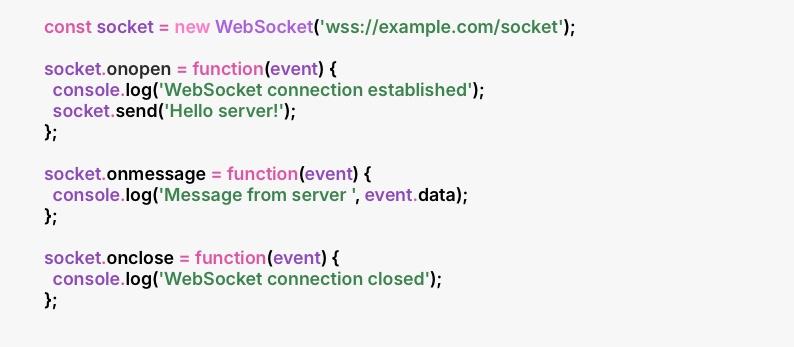
const socket = new WebSocket(‘wss://example.com/socket’);
socket.onopen = function(event) {
console.log(‘WebSocket connection established’);
socket.send(‘Hello server!’);
};
socket.onmessage = function(event) {
console.log(‘Message from server ‘, event.data);
};
socket.onclose = function(event) {
console.log(‘WebSocket connection closed’);
};
The browser establishes a connection with the server using the secure wss:// protocol that encrypts the communication.
Once the connection has been made successfully, the onopen event is fired and the client is able to send messages to the server.
Whenever the server transmits data the onmessage event gets it immediately.
If the connection ends, the onclose event is triggered.
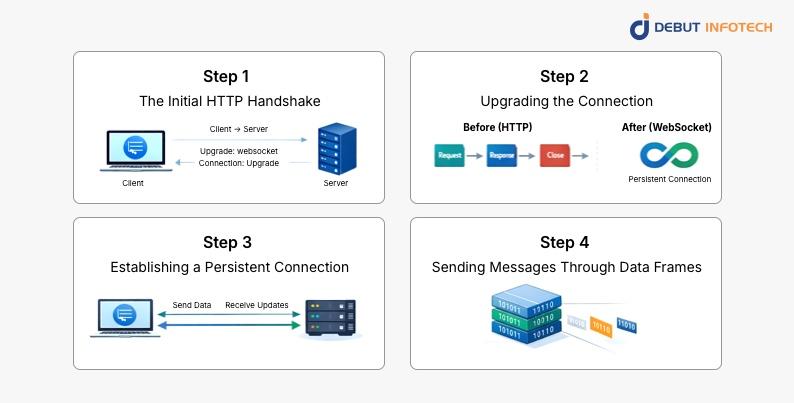
To see why websockets are effective in supporting so many real-time applications, it is more useful to follow through on what is actually occurring when a websocket connection is established. It is an incredibly easy process. Basically, the browser and the server concur to improve their means of communication, create a persistent connection, and subsequently transmit lightweight messages over the connection.
Let’s break it down step by step.
Step 1 — The Initial HTTP Handshake
Every web socket connection has an initial state of a normal HTTP request. The browser (client) connects to the server and requests the authorization to change the communication protocol
Here’s what that request looks like:

GET /chat HTTP/1.1
Upgrade: websocket
Connection: Upgrade
If the server accepts websockets, it provides a confirmation:

HTTP/1.1 101 Switching Protocols
This reply informs the client that the upgrade of the protocol has been recognized. At this stage, the regular HTTP communication is terminated and the web socket communication commences.
In the case of engineering teams in real-time platforms (messaging app, analytics dashboard, or stream service) this handshake phase is necessary since it guarantees the compatibility with existing web infrastructure.
Step 2 — Upgrading the Connection
After the response of the 101 Switching Protocols has been provided by the server, the connection transitions from the traditional HTTP model to the web socket protocol.
Why does this matter?
In a normal situation, HTTP communication is as follows:
This cycle is repeated whenever new information is required.
Websockets abolish such a repetitive process. Rather, the connection is maintained, and both parties can freely communicate without the reopening of connections.
This architecture decreases network overhead and latency significantly, and that is why websockets have become a common part in the custom software development plans of many teams that create modern real-time systems.
Step 3 — Establishing a Persistent Connection
As soon as the upgrade is finished, the connection remains open and active.
This persistent connection enables full-duplex communication, meaning:
Based on the polling model of HTTP, in which the client repeatedly requests the server to provide updates, websockets enable the server to actively relay information whenever the server has it.
This capability is what powers many real-time digital experiences, including:
The fact that the connection remains open makes communication much quicker and effective.
Step 4 — Sending Messages Through Data Frames
Once the persistent connection is connected, communication occurs based on data frames and not entire HTTP messages.
Data frames are small, efficient packets of information, which enable messages to be transported fast without redundant overheads.
In practice, this means:
For example, in a trading platform displaying live stock prices, data frames allow thousands of updates to be delivered every second without the performance bottlenecks of repeated HTTP requests.
Websockets can be regarded as the initial technology which crosses the mind when teams begin creating real-time applications. They are common in chat applications, live dashboards, multiplayer games and collaborative applications since they enable two-way communication between the client and a websocket server, which is continuous.
Nevertheless, websockets are not the sole protocol that is created to be used in real-time or near-real-time communication. Other technologies that can be used by modern architectures include Server-Sent Events (SSE), gRPC streaming, HTTP/2, or MQTT. Each option addresses a different problem and performs best under certain conditions.
Knowledge of the comparisons between these protocols assists developers in selecting the appropriate layer of communication to their application- particularly when the scalability, browser compatibility or complexity of the system is involved.
| Protocol | Best Use Case | Key Limitations |
| WebSockets | Real-time messaging, chat apps, collaborative tools | No built-in fallback or guaranteed message ordering |
| Server-Sent Events (SSE) | One-way live updates such as news feeds or stock tickers | Not bidirectional and does not support binary data |
| gRPC | High-performance microservices and streaming APIs | Limited native browser support |
| HTTP/2 | Faster REST APIs and efficient resource delivery | Still follows the request-response model |
| MQTT | IoT devices and embedded systems | Requires managing a message broker infrastructure |
The choice of the most appropriate protocol depends on three major factors:
In the majority of interactive web applications, websockets have been the preferred solution due to their performance, flexibility, and ease of adoption by developers. But in modern distributed systems, it is usual to mix websockets with other protocols based on what layer of the architecture it is.
The knowledge of these trade-offs is necessary to make sure that your real-time system is not only responsive but scalable and maintainable as your application grows.
Although the websockets are robust, they do not go through some of the standard security filters used on the RESTful HTTP. To make your real-time architecture secure, the following tips are applicable:
1. Use Encrypted Connections (wss://)
As you would use HTTPS to make web traffic, you should always use the wss:// (WebSocket Secure) protocol. This makes sure that the data is encrypted through TLS/SSL and eliminates any Man-in-the-Middle attacks by hackers who might intercept or alter live data streams.
2. Implement Heartbeats (Ping/Pong)
Sometimes TCP connections turn into zombie connections, with one side believing that the connection is open, yet the other has dropped it (usually mobile switching between Wi-Fi and 5G).
3. Authenticate During the Handshake
WebSockets do not have a built-in authentication mechanism. The most effective way of doing this is to authenticate the user at the initial stage during the HTTP Handshake.
The concept of real-time experiences has become central to modern applications, including live chats and dashboards, collaborative tools and gaming platforms. websockets make these experiences possible, as they permit a quick, long connection between the client and server, giving them a potent option in numerous real-time systems.
Nonetheless, the choice of the appropriate protocol continues to be dependent on your application’s architecture, scale, and communication needs. The idea of knowing when to utilize websockets as opposed to others will foster efficiency, security, and scalability of your system.
Debut Infotech is one of the top web development companies that can be relied upon by businesses that want to create dependable real-time applications. Having extensive experience in modern architectures and scalable digital solutions, our team assists organizations to design and deploy high-performance applications to support the needs of the modern connected users. If you’re planning to develop a scalable real-time platform, consider partnering with Debut Infotech to turn your idea into a robust, production-ready solution.
A. WebSocket and a REST API are not inherently superior to each other since they have different purposes.
REST APIs are best suited to conventional request-response functions, e.g. retrieving or submitting data. WebSockets are focused on real-time communication and two-way data flow which can be done instantly.
In the majority of modern applications they are used jointly: REST APIs to perform regular tasks and WebSockets to provide live updates.
A. ChatGPT mainly uses Server-Sent Events (SSE) to stream responses in real time. SSE enables the server to send data to the browser continuously, therefore, answers are received one token at a time as they are produced. This is the reason why ChatGPT appears to type its reply step by step as opposed to showing the whole answer immediately.

Our Latest Insights
USA

2501 Chatham, Rd Suite R Springfield, IL 62704
+1-708-515-4004
info@debutinfotech.com
UK

7 Pound Close, Yarnton, Oxfordshire, OX51QG
+44-770-304-0079
info@debutinfotech.com
Canada

154 Eden Oak Trail, Kitchener, ON N2A 0H9
+1-708-515-4004
info@debutinfotech.com
INDIA

Sector 101-A, Plot No: I-42, IT City Rd, JLPL Industrial Area, Mohali, PB 140306
9888402396
info@debutinfotech.com

9001:2015
Quality Certified

ISO 27001
Security Certified

A+ Rating
Accredited Business

Certik
Security & Audit


Copyright © 2026, Debut Infotech. All rights reserved. | Privacy Policy