ON THIS PAGE
Progress0%






Our Global Presence :





When businesses ask what is Full-stack development, they are usually trying to understand how modern applications are built from start to finish. Full-stack development refers to the ability to design, develop, and manage both the front end and back end of a web or software application. It brings together user interfaces, server logic, databases, and infrastructure into one cohesive development approach.
As digital products grow more complex, Full-stack development has become essential for companies that want speed, flexibility, and scalability. Instead of relying on multiple disconnected teams, organizations now prefer developers who understand the entire web development stack. In this guide, we explain Full-stack development in detail, explore the technologies involved, and show why it plays a critical role in modern software delivery.
Full-stack development is the practice of building complete applications by working across all layers of software architecture. This includes everything users see on the screen, as well as everything that happens behind the scenes to process data, manage logic, and deliver responses.
A Full-stack developer understands how each part of an application connects to the others. This knowledge allows teams to build features faster, debug issues more effectively, and make better architectural decisions. Full-stack web programming is not about knowing every tool in existence but about understanding how different technologies work together as a system.
In simple terms, “Full-stack” refers to the complete set of technologies and layers required to build, run, and maintain an application. Instead of working on just one part of the system, Full-stack development spans everything that makes the product function as a whole.
This typically includes:
When people ask what full-stack means, the answer comes down to scope and responsibility. A Full-stack approach covers the entire application lifecycle, from initial development to deployment and ongoing updates. This broad understanding allows developers to build systems that work smoothly across all layers, reduce integration issues, and adapt more easily as requirements evolve.
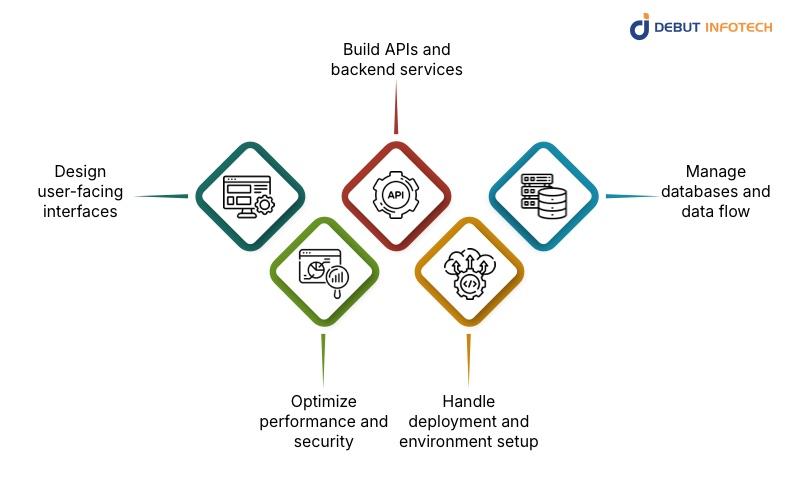
A Full-stack developer works across both client-side and server-side development. Their responsibilities go beyond writing code for a single feature or interface.
A Full-stack developer typically handles the following responsibilities:
Because Full-stack developers understand how each layer interacts, they can identify issues early and propose practical, system-wide solutions. This makes them especially valuable in fast-moving projects and enterprise software development environments where efficiency and reliability are critical.
The front end is the visual and interactive part of an application. It includes layouts, navigation menus, forms, dashboards, and every element users engage with directly. This layer shapes how users perceive the product and determines whether interactions feel smooth or frustrating.
Full-stack developers working on the front end focus heavily on usability, responsiveness, and accessibility. They ensure interfaces adapt seamlessly across desktops, tablets, and mobile devices while remaining easy to navigate. Web development frameworks are often used to structure interfaces efficiently, maintain consistency, and speed up development without sacrificing quality.
Performance is another key consideration. Full-stack developers optimize front-end assets to reduce load times and ensure fast responses, especially in data-driven applications. Because they understand backend limitations and data structures, they design interfaces that request only what is necessary, reducing unnecessary server load.
A strong front end improves user experience and directly affects engagement, retention, and conversion rates. In Full-stack development, front-end decisions are made with backend capabilities in mind, which helps reduce friction between layers and leads to more stable, scalable applications.
The back end powers application logic and supports everything that happens behind the scenes. It processes user requests, applies business rules, and communicates with databases and external services to deliver accurate responses.
Back-end development typically involves:
In Full-stack development, backend design is tightly aligned with front-end needs. This alignment ensures APIs deliver the correct data in the proper format and prevents unnecessary complexity. By avoiding overengineering, teams can build systems that are easier to maintain, adapt to, and scale with evolving business requirements.
Together, front-end and back-end development form a unified system where each layer supports the other, resulting in more efficient development and better overall application performance.
Databases store the information applications rely on, from user profiles and settings to transaction records and system logs. In Full-stack development, database design plays a central role in application performance and reliability. Full-stack developers work with various database types, including relational and non-relational systems, depending on project requirements.
Their focus typically includes:
Understanding how data flows through an application is critical to Full-stack development. Poor database design can slow down even the best-written front-end or backend logic, leading to delays, errors, and increased maintenance effort. By designing databases with long-term usage in mind, Full-stack developers help ensure applications remain responsive and stable as they evolve.
A web development stack is the set of technologies used to build, run, and maintain an application. This includes programming languages, frameworks, databases, and infrastructure tools that together support the full development lifecycle.
A typical web development stack may include:
Choosing the right web development stack depends on several factors, including performance requirements, scalability goals, security considerations, and development timelines. Full-stack developers evaluate these elements holistically rather than in isolation, ensuring each layer works well with the others.
By selecting a balanced and well-supported stack, teams can reduce technical debt, improve maintainability, and create applications that adapt more easily to changing business needs.
Full-stack technologies vary widely, but they all serve a specific purpose within the application lifecycle. These include front-end libraries, backend frameworks, database systems, and DevOps tools.
Full-stack development tools help streamline workflows, automate testing, and support continuous integration. Developers who understand how to use these tools effectively can deliver reliable applications faster.
The goal is not to use every tool available but to select a balanced production stack that supports growth and long-term maintenance.
The production stack defines how an application runs in real-world conditions. It covers everything that keeps the software stable, secure, and responsive once users start interacting with it at scale. This includes cloud infrastructure, server configuration, load balancing, monitoring systems, and security controls.
A well-designed production stack helps ensure:
Full-stack developers factor production needs into architectural decisions from the start. By aligning development and production environments early, teams avoid last-minute fixes, deployment issues, and long-term maintenance problems. This results in faster releases and more reliable applications.
In many organizations, front-end and back-end roles are split between specialists. This model works well for large teams but can introduce delays when responsibilities overlap or communication breaks down.
Full-stack development minimizes these gaps. Developers understand how front-end interactions affect backend logic, databases, and infrastructure. Decisions are made with the entire system in mind, not just one layer.
This approach often leads to faster iteration, fewer integration issues, and better collaboration. For startups, scaling businesses, and enterprise software development projects that demand flexibility, full-stack developers provide a practical balance between speed, efficiency, and technical depth.
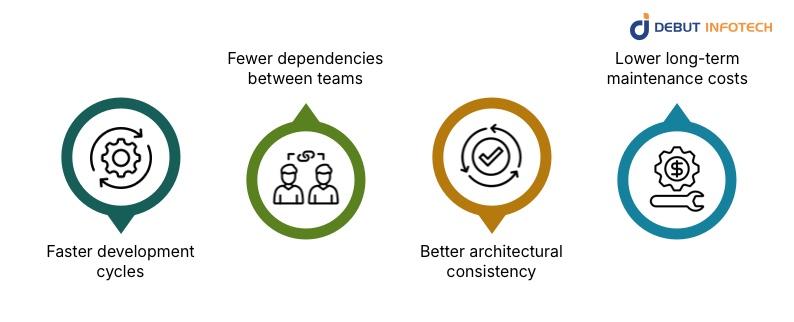
Companies increasingly rely on Full-stack development services to simplify project management and reduce overhead. Working with Full-stack teams can streamline communication, minimize handoffs, and accelerate delivery. Key benefits include:
For organizations working with a custom software development company, Full-stack teams provide a single point of accountability and clearer timelines for project delivery.
In enterprise software development, applications must scale efficiently, integrate with legacy systems, and meet strict security standards. Full-stack developers contribute to these goals by:
Their broad understanding enables enterprises to evolve their systems over time without constant restructuring, making applications more scalable and resilient.
Web app development cost depends on complexity, features, and development approach. Full-stack development often reduces costs by minimizing coordination overhead and rework.
When one team understands the full system, fewer resources are wasted on misaligned implementations. This efficiency makes Full-stack development attractive for businesses focused on long-term value rather than short-term savings.
Many organizations choose to hire Full-stack stack developers to build or maintain their applications. These professionals offer flexibility and can adapt to changing requirements.
When evaluating candidates, businesses should look for:
Full-stack developers act as connectors between design, development, and deployment.
At Debut Infotech, we deliver end-to-end Full-stack development services designed to support business growth. We approach projects with a system-wide mindset, ensuring every layer works together seamlessly.
As a custom software development company, we help clients select the right tech stack for web development, build scalable architectures, and maintain production-ready systems. Our experience across industries allows us to deliver solutions that balance performance, security, and maintainability.
A Full-stack developer is often described as the complete developer because of their ability to work across disciplines.
Their skill set includes:
This versatility makes Full-stack developers valuable contributors at every stage of a project.
As applications become more interconnected, Full-stack development will continue to play a central role. Businesses need systems that evolve quickly without constant rebuilds.
Full-stack approaches support this need by promoting shared understanding and flexible architecture. This makes them well-suited for modern web development companies and enterprises alike.
Full-stack development is more than a technical role. It is a holistic approach to building scalable, maintainable applications aligned with business goals. By understanding the entire web development stack, Full-stack developers help organizations deliver better digital products with fewer obstacles.
At Debut Infotech, Full-stack development is essential for modern software success. By combining strategic planning, the right technologies, and experienced teams, we help businesses build applications that perform reliably today and adapt confidently for tomorrow.
A. Full-stack development refers to building and managing both the front end and back end of an application. It includes user interfaces, server logic, databases, and deployment within a single development approach.
A. In web development, Full-stack means covering the complete web development stack, from browser-based interfaces to backend services, databases, and production infrastructure.
A. A Full-stack developer needs front-end development skills, backend programming knowledge, database management experience, and familiarity with deployment tools and web development frameworks.
A. Full-stack technologies typically include front-end frameworks, backend languages, databases, APIs, and production stack tools used for hosting, scaling, and monitoring applications.
A. Full-stack development can reduce web app development cost by improving efficiency, minimizing handoffs between teams, and simplifying long-term maintenance and updates.
A. Businesses should hire Full-stack developers when they need flexibility, faster development cycles, or end-to-end ownership of application architecture and delivery.
A. Yes. Full-stack development is widely used in enterprise software development because it supports scalable systems, complex integrations, and long-term system evolution.

Our Latest Insights
USA
2501 Chatham, Rd Suite R Springfield, IL 62704
+1-708-515-4004
info@debutinfotech.com
UK
7 Pound Close, Yarnton, Oxfordshire, OX51QG
+44-770-304-0079
info@debutinfotech.com
Canada
154 Eden Oak Trail, Kitchener, ON N2A 0H9
+1-708-515-4004
info@debutinfotech.com
INDIA
Sector 101-A, Plot No: I-42, IT City Rd, JLPL Industrial Area, Mohali, PB 140306
9888402396
info@debutinfotech.com