ON THIS PAGE
Progress0%






Our Global Presence :





If many founders and technical leaders thoroughly grasped how vital token minting is to their blockchain project, then I bet they would take it a bit more seriously.
Here’s some context for you:
For every blockchain project, how the tokens are minted directly affect the token supply control, project scalability, and long-term ecosystem credibility.
If you would love to know how token minting works, this article breaks it down, how it works at a smart-contract level, how token creation and minting differ, and what it really takes to do it right. We’ll also show how expert token development companies like Debut Infotech help projects approach token minting with clarity, control, and confidence.
Token minting in crypto is the process of creating new units of a cryptocurrency.
Think of it as the crypto equivalent of printing new notes of a particular fiat currency or like issuing the denver mint token. The only difference is that the new token mint is created through a complex process that includes authenticating data, creating new blocks, and recording them on the blockchain for validation. And right in the middle of this complex process is the Proof-of-Stake (PoS) protocol, which involves creating new “blocks” on a blockchain through “staking.”
The opposite of this process is Proof-of-Work (PoW), which involves “forming new blocks” in a blockchain through “mining.”
For clarity, the tokens created here DO NOT exist until they are minted. Once they are, they are added to circulation and can be traded, meaning they automatically become part of the blockchain’s permanent, verifiable record.
Therefore, if you’re a founder or technical decision maker in a coin development company, you should understand that token minting isn’t just a marketing event. Instead, it is a core infrastructural step that is pivotal to your project’s entire token supply and evolution over time. You should take it seriously, and we’re going to help you understand the nitty-gritty in this article.
To do that, you need to understand the relationship between token minting, token issuance, and the token lifecycle.
For starters, each new token is typically created on an existing blockchain, such as Ethereum or BNB Smart Chain. This means that project owners don’t have to build new blockchains from scratch. Instead, they can just define and separate their tokens using established token standards such as ERC20 or BEP20.
Why are these standards crucial?
It’s because they specify how the tokens in that particular blockchain behave in terms of how they are transferred, tracked, and most importantly, minted.
This is the key bit related to the reality of token minting in crypto in that token minting is the mechanism that brings those rules to life by issuing tokens according to the logic defined in the smart contract from the outset.
So, it is safe to say that token minting in crypto is right at the intersection of token issuance and long-term supply management. The exact structure of how this works varies by project: some projects mint the entire token supply at launch, while others set predefined minting conditions and only mint when those conditions are met. Some of these conditions may include user participation, staking rewards, and protocol growth.
Both approaches are valid, but they serve very different business and economic goals. This is why token minting should always be aligned with a project’s tokenomics, not treated as a one-time technical checkbox.
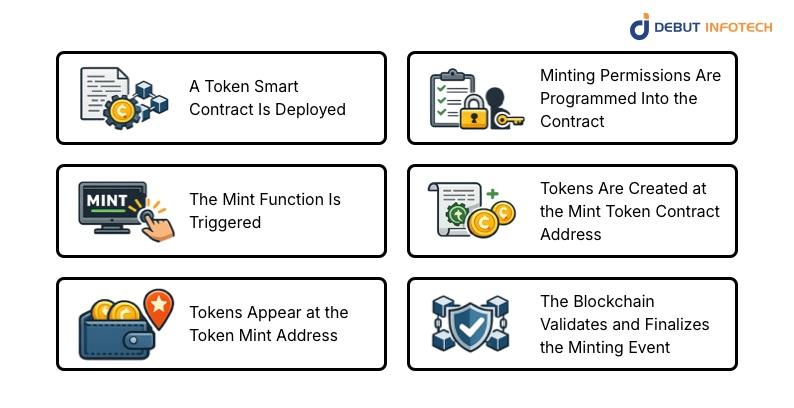
Quick question: what are the specific things happening when we say a token is being minted on the blockchain?
That’s the question we’re about to answer in this section.
But prepare your mind: the process is a sequence of tightly controlled on-chain events governed by smart contracts.
It’s a bit complex, but the following points summarize the activities that enable token minting.
Remember the established token standards we discussed earlier?
Those standards play a vital role in the initiation step of the token minting process, as they contain the contract that defines the token’s baseline identity and behaviour.
They are usually governed by a smart contract deployed on the blockchain. This is the first step in the token minting process: the contract contains the baseline details of the token’s identity and behaviour. We are talking about its name, symbol, decimals, and total supply logic.
More importantly, the smart contract also contains the conditions under which the new tokens can be minted. These conditions include the following.
Once the conditions are set in the contract and it is deployed on the blockchain, it becomes immutable (permanent). Therefore, you need to be careful at this stage.
We mentioned earlier that the smart contract specifies certain minting conditions. This means that certain conditions must be met for new tokens to be minted. These conditions must be embedded in the smart contract and explicitly authorize the minting process.
More specifically, for minting to occur, the smart contract must specify the following:
At this stage of the minting process, the developers implement key concepts such as capped supply, role-based access, and time-based minting. Without these controls, token minting becomes unpredictable and in many cases, risky.
After setting the minting conditions, the next step is to trigger them, which initiates token minting. This triggering process occurs when an authorized entity calls the mint function defined in the smart contract (as specified above).
These “authorized entities” could be any of the following:
These are the only entities authorized to initiate new token minting processes. Once they do, the blockchain executes the minting logic exactly as specified in the smart contract.
After triggering the token mint logic specified in the smart contract, the next expected outcome is the creation of new tokens. But for this to happen, they have to be stored at a specified location, which is the mint token contract address.
This is the smart contract’s unique on-chain identifier that serves as a marker for wallets, explorers, and decentralized applications. Its major purpose becomes more evident when new tokens are minted because of the following reasons:
The requirement that these updates occur at the mint token contract address is another reason the token standards we mentioned earlier (ERC30 and BEP20) are important and should be specified. Not only do they make the minting events universally readable but they also make them interoperable across the ecosystem.
The wallet address that receives newly generated tokens is called the token mint address. Depending on the project’s design, this could be a user’s wallet, a staking contract, or a treasury wallet.
From this moment on, the tokens are in circulation. They can be transferred, traded, locked, or burned—always subject to the rules defined in the smart contract.
Finally, the blockchain protocol validates the transaction. Once confirmed, the minting process is complete.
At this stage:
This transparency is what separates token minting from traditional financial issuance models. There is no ambiguity—everything is enforced by code and visible on-chain.
In reality, token minting is less about “creating tokens” and more about executing pre-defined rules with absolute precision. When those rules are well-designed, token minting becomes a powerful mechanism for controlled growth. When they’re poorly designed, it becomes a long-term liability.
Token creation and token minting are NOT THE SAME THING!
Many founders and even technical teams often get confused by both terms. And while they are closely related, they happen at different stages of the token development process and more importantly, serve different purposes.
The table below highlights the key differences between token creation and minting.
| Factor | Token Creation | Token Minting |
| Simple definition | This means actually launching a new token by deploying a smart contract. This is when you specify the token’s structure, rules, and behavior on a blockchain. | This comes after launching the token. It means generating new units of the existing digital token based on the rules defined during token creation in the smart contract. |
| When it happens | It happens once, at the very beginning of the token’s lifecycle. | It can happen once or multiple times, depending on the token’s design and minting logic. |
| Purpose | Establishes the token’s identity and operating rules. | Controls how and when the token supply enters circulation. |
| Blockchain action involved | Smart contract deployment on a blockchain such as Ethereum or BNB Smart Chain. | Execution of the mint function within the deployed smart contract. |
| Supply implications | Defines whether the token will have a fixed or flexible supply. | Determines the actual number of tokens created at any given time. |
| Who controls it | Typically controlled by the token developer or development team during deployment. | Controlled by authorized entities such as the project owner, governance contracts, or automated protocol logic. |
| Reversibility | Once deployed, the token contract is immutable. | Minting actions cannot be reversed once validated on-chain. |
| Impact on users | Users cannot interact with a token until it is created. | Users can receive, trade, or use tokens only after they are minted. |
| Common misconception | Often mistaken as the step where tokens are “issued.” | Often incorrectly assumed to be the same as token creation. |
The token minting process is very vital to the credibility, token economics, and security posture of any token development project. That’s why the experts in charge of our token development services at Debut Infotech Pvt Ltd follow a structured engineering process in order to avoid any technical issues or permanent damage to the project’s credibility.
Below, we have outlined the steps involved in our in-house engineering process:
At Debut Infotech, we start by defining why the token exists before entering into smart contract development. In concrete terms, the following are the key things they do before they get into smart contract development:
We do this because it is usually difficult to change minting rules after they have been deployed on-chain. Furthermore, we appreciate the fact that minting logic is very closely related to tokenomics, and so we endeavor to set the right foundation from the outset.
The token standards and blockchain protocols set the infrastructure for a token project’s structure. These factors affect the costs and scalability possibilities for any project.
Our experts understand this, and so they focus on selecting the perfect token standards and blockchain protocols that match the utilities agreed upon in step 1 above.
Debut Infotech assists teams in assessing the following based on project requirements:
This ensures that token minting upholds ecosystem interoperability and conforms to widely accepted token specifications.
Having clarified the token’s role and selected the desired token logic and blockchain protocol, our in-house remote developers start implementing clear conditions for the minting logic. These are the major triggers for which the smart contract should start minting new tokens.
For instance, the logic explicitly contains the following information:
The idea behind specifying and embedding these details into the smart contract is to ensure that when new tokens are only minted and added to the existing supply when the conditions are truly right for the growth of the ecosystem. As such, they reduce accidental oversupply and unauthorized minting.
The implementation of role-based access and token mint addresses follows sharply after specifying conditions to further clear up any ambiguities. This helps to avoid a situation whereby the project’s token minting is only tied to a single, unprotected wallet.
At Debut Infotech, we have a best practice approach that involves the following steps:
By following these best practices, our experts ensure that they reduce the projects risk exposure, and more importantly, make sure that the minted tokens are distributed the way the projects guidelines intended.
Token minting doesn’t end at deployment.
As part of broader token development services, Debut Infotech helps projects plan for:
This long-term perspective is what separates short-lived tokens from sustainable ones.
Token minting, the process of creating new tokens to add to a project’s existing supply, defines how value enters the projects ecosystem over time. And at the core of that, we have smart contracts and token mint addresses dictating certain minting conditions and governing the entire process. When done correctly, token minting can be a powerful tool for controlled growth and transparency.
That’s why you need experienced execution!
With proven token development services, Debut Infotech helps founders design, implement, and manage secure token minting strategies that align with real business goals.
When a token is minted, fresh cryptocurrency units are produced and put into circulation. Prior to minting, these tokens were nonexistent. They can be moved, utilized, or subject to smart-contract regulations once they are coined and added to the blockchain’s permanent record.
A smart contract’s mint function is used to carry out the minting procedure. The blockchain verifies the transaction, modifies the overall supply, and allocates freshly produced tokens to a designated wallet address when predetermined criteria are satisfied.
The blockchain being used, network fees, smart contract complexity, and security needs all affect how much it costs to issue a token. Professionally created minting logic and audits boost dependability and long-term worth, even though basic minting might be cheap.
A token is a digital asset produced by a smart contract on an already-existing blockchain. It can represent utility, access, governance rights, or value within an ecosystem by adhering to predetermined norms for transfer, ownership, and minting.
When a token is minted, new units are assigned to a wallet address, created in accordance with smart-contract regulations, and recorded on the blockchain. The minting event becomes permanent and publicly verifiable, and the overall supply updates instantly.

Our Latest Insights
USA
2501 Chatham, Rd Suite R Springfield, IL 62704
+1-708-515-4004
info@debutinfotech.com
UK
7 Pound Close, Yarnton, Oxfordshire, OX51QG
+44-770-304-0079
info@debutinfotech.com
Canada
154 Eden Oak Trail, Kitchener, ON N2A 0H9
+1-708-515-4004
info@debutinfotech.com
INDIA
Sector 101-A, Plot No: I-42, IT City Rd, JLPL Industrial Area, Mohali, PB 140306
9888402396
info@debutinfotech.com