



Table of Contents
Home / Use Case / AI
Gen AI in Technical Support: Creating Faster, Personalized, and Human-Like Customer Experiences


Introduction
Imagine your internet is not working during an important meeting, thus, you hurry to call support. What you would like is a fast, straight forward solution. What you usually end up with is waiting in line, having to repeat yourself several times to various agents, and pre-recorded replies that do not actually solve your problem.
That disconnect between customer requirements and what support departments can offer is widening. Actually, a study conducted by Zendesk revealed that 76% of consumers want a personalized support experience rather than a single size that fits all responses. The challenge is, traditional support systems aren’t built to scale in a way that feels human.
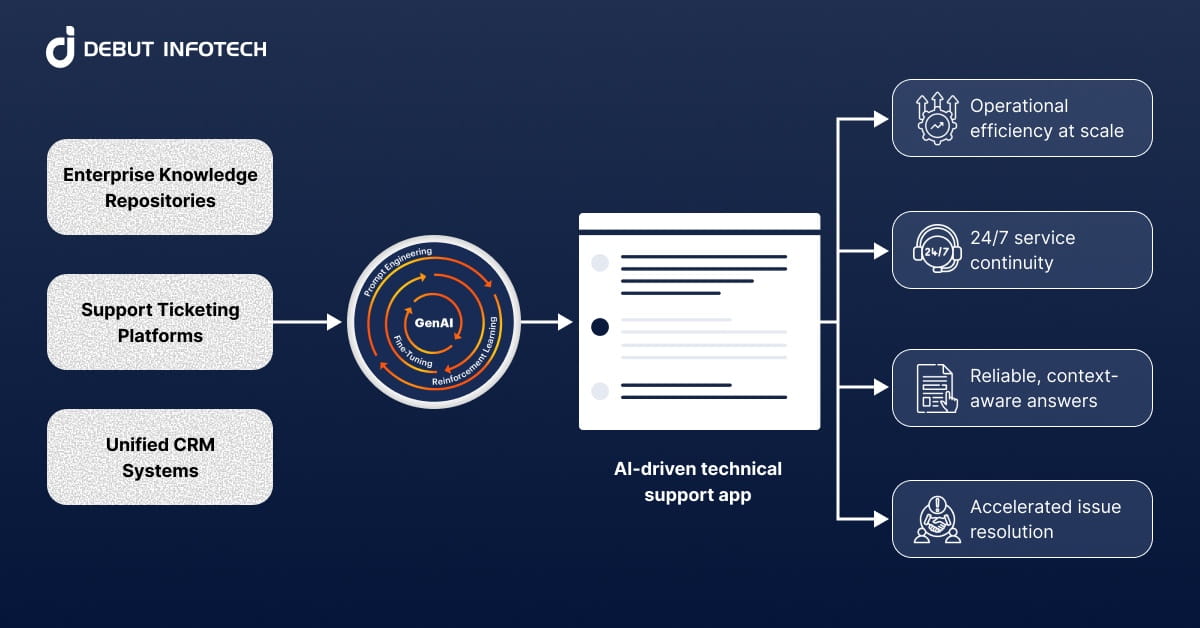
This is where Gen AI steps in. It does not only accelerate things, it assists in making things more natural and human-like. Think of it as a digital teammate that empowers agents with instant context, reduces repetitive work, and ensures customers feel heard, not just managed.
In this post, we’ll dive into real-world ways companies are using Gen AI to make technical support smarter, faster, and more personal, without losing the human touch.
Let’s delve in!
What is Generative AI in Technical Support?
In its simplest form, generative AI in technical supportis concerned with providing machines with the capability to generate responses that are natural, helpful, and human. These systems are based on generative AI models that have been trained on vast volumes of data as opposed to adhering to set, pre-written scripts. It implies that they are able to interpret the context of the problem a customer is facing and come up with solutions that are not copy-pasted but iSo, we can now compare this to what the mnstead appear personalized.
Majority of the population deems when they hear the word “AI in support.” Conventional chatbots tend to use a decision tree: in case the customer poses X, respond with Y. They can be helpful with simple questions such as changing a password or your order, but stumble badly when the issue does not fit into the rules.
Generative AI-powered assistants, on the other hand, go a step further. They do not simply choose out of a library of responses. They generate real-time answers, extracting context based on knowledge bases, previous discussions, and even documentation of products. To the customer, it does not seem like chatting with a robot but rather receiving direct assistance with a well-informed agent.
Different Approaches to Bringing Generative AI into Tech Support
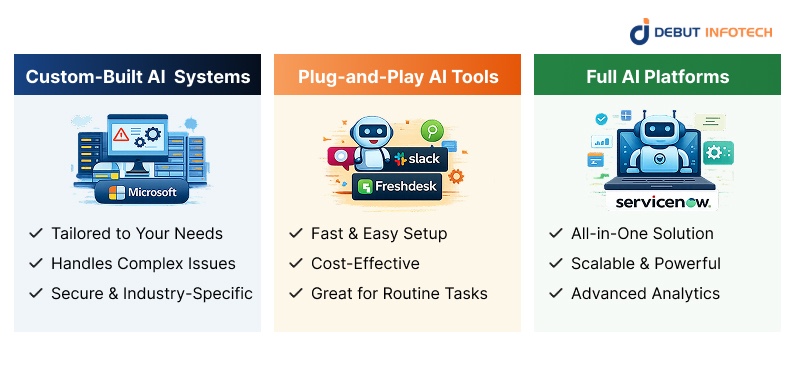
The redesign of customer support in companies is one of the biggest generative AI trends today. Businesses are not relying on scripted responses or bombarding agents with repetitive tickets, but rather making support more human, proactive, and flexible with the help of AI. The three key methods to deploy AI in support are contingent on the organization size and its purposes.
1. Custom-Built AI Systems
Certain organizations choose to take the custom approach. As an example, Microsoft has developed its own AI models in its internal IT help desk, which have been trained based on years of troubleshooting logs. These systems do not simply provide answers to questions, but predict problems and propose solutions before users even make a ticket.
Why this works well:
- Made specifically to match your products, services, and customer pain points.
- Ability to support complex and industry-specific requests
- Stores sensitive information safely, which is essential in such areas as healthcare or banking
The downside? It needs tremendous internal knowledge and funds to build and maintain.
2. Plug-and-Play AI Tools
Speed is all that matters to many businesses. That is where pre-built AI tools come in. Slack, for instance, has AI bots that automatically suggest pertinent help articles as the user encounters a problem. On the same note, Freshdesk supports AI ticket routing, which forwards questions to the corresponding department within seconds.
Why companies choose this:
- Quick to implement with minimal technical lift.
- Cost-effective compared to fully custom systems.
- Perfect for automating repetitive tasks like FAQs or password resets.
Small teams normally start here and then grow.
3. Full AI Platforms
Then there are full-stack platforms which combine everything under a single roof. The AI capabilities of ServiceNow, such as the ability to power chatbots, automate incident response, create knowledge base content, and even perform predictive support trend analytics, are not limited.
Why this stands out:
- Combines several AI features into one system.
- Designed to serve very large customer bases.
- Always gets better with the arrival of new data.
- Typically comes with built-in compliance and security standards.
In large organizations that process high volumes of tickets, this is the most optimal combination of automation, consistency, and long-term scalability.
Also Read: A Practical Guide to Generative AI for Legal Operations
Key Benefits of Generative AI for Technical Support
When customers make contact to seek their assistance, they are not interested in waiting in a lengthy line or being trapped in receiving ready-made responses. This is where AI agents fuelled by generative AI come in, to provide speed, customisation, and scalability to technical support.
1. Faster Ticket Resolution
Within seconds, generative AI is able to examine problems and suggest solutions. In the case of IT helpdesks, this may translate to a ticket that would have taken hours to close, being solved within minutes. Increased speed of resolution does not only enhance customer satisfaction, but also minimizes support team backlog.
2. Personalized, Context-Aware Responses
Generative AI can analyze context and provide personalized responses unlike the traditionally designed chatbots which provide one-size-fits-all responses. It considers the history of interactions, user preferences and the details of the problem to provide more human-like advice, making customers feel like they have been heard.
3. 24/7 Multilingual Support
Business hours and language barriers are no longer a limitation to customers. With generative AI, it becomes possible to provide round-the-clock service in various languages, which guarantees a consistent experience to users worldwide. This gives an integrated network of support to international companies without the need to employ dozens of native speaking agents.
4. Reduced Workload on Human Agents
Repetitive and low-value work such as resetting passwords or simple troubleshooting is assigned to AI agents, leaving human agents to work on higher-priority cases. This balance will help to avoid burnout among the staff and will increase the quality of support.
5. Cost Savings
McKinsey estimates that using generative AI in customer care has the potential to increase productivity by 30-45%, which can be translated into substantial cost savings in support operations. However, more than the numbers, imagine what that actually means to people: additional resources to educate the staff, more intelligent tools to make the jobs of employees easier, and even benefits directly reaching customers. The savings, in other words, not only benefit the business, but they are reinvested into the process of creating improved experiences for both teams and customers.
Transform support tickets into instant answers.
Our Gen AI solutions automate helpdesks, slash resolution times, and elevate customer joy.
Core Use Cases of Generative AI in Technical Support
With increased reliance on technology in businesses, technical support has now become a mission-critical component of business running. There are three levels of support normally designed:
- Level 1 (L1): Handles basic queries and common fixes.
- Level 2 (L2): Tackles more complex or system-related issues.
- Level 3 (L3): Manages advanced, specialized, and often code-related problems.
Incorporating generative AI and AI agent development into those levels will allow organizations to address issues more quickly, save more money, and provide users with more personalized experiences. The following is a breakdown of how Generative AI can be used to add value at each level:
Level 1 (First-Line Support)
| Use Case | Description | How Generative AI Helps |
| Automated Troubleshooting | Guides users through setup or fixes for common issues (e.g., printers, apps). | AI agents provide interactive, step-by-step solutions. Example: Dell’s AI-powered assistant resolves setup issues in minutes. |
| Ticket Creation & Routing | Automates initial ticket creation and classification. | AI models classify requests, ensuring critical issues are prioritized. Example: ServiceNow uses AI for intelligent routing. |
| Knowledge Base Search & Update | Gives quick access to relevant articles and keeps them fresh. | Tools like Microsoft Copilot generate and update FAQs and docs, ensuring customers always find up-to-date answers. |
| Self-Service Chatbots | Handles routine troubleshooting and account queries. | Telecoms like Vodafone use AI chatbots that reduce call volume by 40%, empowering customers to self-serve. |
| Proactive Issue Detection | Flags problems before they disrupt users. | Predictive AI scans user/system data to send early alerts, reducing downtime. Example: IBM AIOps predicts server outages. |
Narrative Expansion:
At the first line of support, Generative AI takes the pressure off human agents by handling repetitive tasks. Customers can also resolve their troubles using interactive AI guides instead of waiting in long lines. For example, Dell’s AI-driven assistant now helps users resolve common printer and laptop setup problems without human intervention.
Generative AI also accelerates the process of creating and routing tickets, which means that critical problems will not be buried under requests of the lowest priority. Platforms like ServiceNow have already proven how AI models can automatically categorize and route tickets to the right department.
Knowledge management is another important benefit at this stage. Generative AI products like Microsoft Copilot keep updating FAQs and documentation, and so both customers and agents always have access to the most up-to-date information. Together with self-service chatbots (such as Vodafone’s), it will help organizations to drop call-center traffic and decrease waiting times considerably.
Lastly, preventive monitoring by solutions such as IBM AIOps are useful in anticipating possible system failures before they can occur, saving business money and reputation.
Level 2 (Second-Line Support)
| Use Case | Description | How Generative AI Helps |
| Root Cause Analysis | Identifies the source of recurring or complex issues. | AI reviews logs and error patterns to suggest likely causes. Example: Atlassian Opsgenie uses AI to speed root cause detection. |
| Incident Triage & Prioritization | Ensures the most urgent problems get addressed first. | AI assesses severity and impact, escalating mission-critical incidents instantly. |
| Agent Assist in Live Chats | Supports human agents with real-time suggestions. | Platforms like Zendesk Agent Assist boost first-contact resolution rates by surfacing relevant fixes. |
| Incident Documentation | Automates detailed reporting for audits and compliance. | AI-generated reports reduce manual effort and maintain accuracy. Particularly helpful in industries like finance or healthcare where compliance is critical. |
Narrative Expansion:
When the problems go beyond the basic level, they are transferred to Level 2 support teams. Here, generative AI shines in diagnostics and triage. Instead of manually combing through logs, engineers can leverage AI to pinpoint recurring errors or unusual patterns. Indicatively, Atlassian Opsgenie has effectively implemented AI to accelerate the process of root cause detection, which reduces downtime and enhances customer confidence.
Generative AI also makes sure that incidents are handled in the correct order. Through automatic evaluation of the magnitude and possible business effect, AI assists in prioritizing mission-critical concerns, preventing expensive delays.
During live interactions, agent assist tools like Zendesk’s AI help support staff respond faster and more accurately. These tools introduce proposed solutions, associated knowledge base entries or even complete responses and make first-contact resolution significantly more feasible.
Documentation is another key area that has been ignored but is crucial. Compliance in many industries needs specific documentation of the incidents. Not only do AI-generated reports allow saving the agents a lot of time but they also guarantee accuracy and consistency, which is particularly valuable in a regulated field such as healthcare or finance.
Level 3 (Third-Line Support)
| Use Case | Description | How Generative AI Helps |
| Advanced Troubleshooting | Handles rare or highly technical cases. | AI analyzes complex logs and detects hidden issues traditional methods may miss. |
| Code Generation & Debugging | Helps resolve issues within applications or systems. | AI models generate code snippets, identify bugs, and suggest fixes, accelerating L3 engineers’ work. |
| Knowledge Graph Creation | Connects problems, solutions, and dependencies. | AI builds graphs that help engineers navigate complex systems and share best practices. |
| Collaboration & Knowledge Sharing | Improves teamwork across support tiers. | AI tools enable engineers to document solutions and collaborate seamlessly. |
| User Feedback Analysis | Enhances service quality by analyzing customer sentiment. | AI processes support feedback to reveal patterns, helping teams improve continuously. |
Narrative Expansion:
At Level 3, support engineers deal with the most technical and challenging problems, often they are system code, integrations or rare bugs. Generative AI helps by conducting deep troubleshooting across massive log files, identifying subtle issues that conventional methods might miss.
Code generation and debugging is one of the most important contributions here. With AI-powered tools, engineers can generate working code snippets, detect syntax errors, and even identify potential security flaws in applications. This does not only save time but also enhances the overall quality of the product.
To enhance efficiency in problem-solving, Generative AI has the capacity to construct knowledge graphs linking technical problems to solutions known, dependencies, and best practices. This provides engineers with a map of “what’s connected to what,” enabling quicker problem resolution.
Finally, collaboration and continuous improvement are enhanced through AI-driven documentation and sentiment analysis. User feedback can be automatically gathered, classified and evaluated to show trends and provide teams with a clear roadmap on how to better satisfy their customers.
Also Read this – Generative AI in Retail: Strategic Use Cases Transforming Operations and Growth
Real-World Case Studies: Generative AI in Technical Support
In measuring the potential of generative AI in the context of technical support, practical uses offer the most effective evidence of action. Below are three widely recognized deployments where AI-powered support has already delivered measurable results.
- ServiceNow’s Generative AI in IT Service Management
ServiceNow, an IT service management leader, has been able to incorporate generative AI into its support workflows. Rather than IT teams being overwhelmed with endless tickets, the AI now scans, classifies and even solves common requests on its own. This has resulted in quicker resolutions reducing ticket times by over a half and significant savings to enterprise clients. The best part is that employees do not spend hours on repetitive problems anymore; they can devote hours to strategic work and leave the AI to the basics. It’s a clear example of how AI agent development can boost both productivity and morale in technical support.
- Zendesk AI for Customer & Technical Support
Zendesk has deployed AI-based bots that pretend to be first-line support agents and immediately address the frequent troubleshooting queries. Customers can now obtain approximate answers to about 70% of common questions without having to wait on a human agent. Not only is that faster, but it also maintains high satisfaction scores. Meanwhile, human agents can be specialized in complex or sensitive problems, at which their professionalism is most relevant. This mixed methodology demonstrates how organizations can implement automation and human understanding to enhance customer loyalty and reduce the costs of operation. For many businesses, working with AI consultants on Zendesk integrations has become a game-changer.
- Microsoft Copilot in Technical & Developer Support
Microsoft has gone the extra mile to integrate generative AI into its Copilot tools for developers and IT administrators. Users now receive live code suggestions, troubleshooting tips and step-by-step corrections all in their workflow, instead of searching through documentation or forums. According to internal research, developers who were using GitHub Copilot were nearly 30% faster than usual, and IT admins said they were no longer spending hours on system malfunctions. This demonstrates that the future of AI agents lies not only in customer-facing support but also in the areas of developer productivity and internal IT support, where the payoff is equally high.
Implementation Roadmap: How to Adopt Generative AI in Support
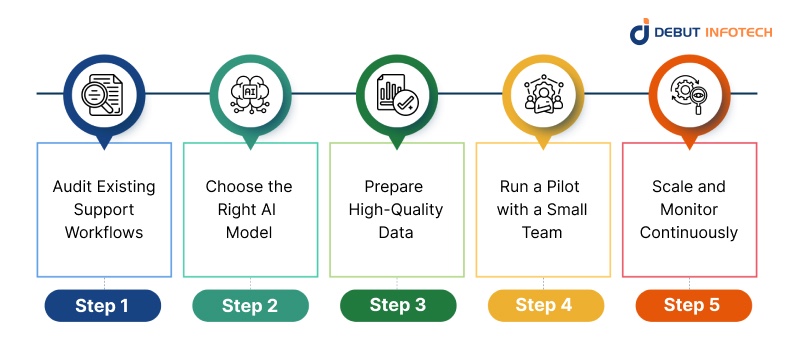
Jumping into AI without a plan can feel overwhelming. This is why it is useful to consider adoption as a process of steps instead of a one-way switch. The following is an easy, real-world roadmap that any company can take to begin implementing generative AI use cases in technical support.
Step 1: Audit Existing Support Workflows
Review what you already have before introducing AI into the picture. Where are your biggest bottlenecks, long ticket resolution times, repetitive “how-to” questions, or lack of multilingual support? Plotting these pain points will guarantee that you get the best understanding of where AI can do the most good.
Step 2: Choose the Right AI Model
All AI models are not created equal. Some such as GPT are wonderful at responding to natural language, whereas others such as LLaMA or Anthropic are more concerned with efficiency, customization, or compliance. Depending on your business objectives, data sensitivity and user requirement, the right option is selected.
Step 3: Prepare High-Quality Data
AI is only as good as the data it learns from. Create safe, organized knowledge repositories consisting of FAQs, troubleshooting manuals and product documentation. An effective base of clean and reliable data lowers the occurrence of “AI hallucinations” and provides more precise responses.
Step 4: Run a Pilot with a Small Team
Rather than changing the whole system at once, begin to change little things. Use AI in a scenario where there is one support team or a limited number of tasks such as password resets or product tutorials. This allows you to receive feedback, make improvements on the system, and instill internal confidence in the technology.
Step 5: Scale and Monitor Continuously
Once the pilot shows results, expand AI support across more teams, regions, or channels. However, do not set it and walk away, observe the results, measure customer satisfaction, and update your AI with new information on a regular basis. Continuous learning is what makes AI support smarter over time.
Challenges & Risks to Address
As any rapidly evolving technology, Generative AI in technical support has its fair share of obstacles. The good news? The majority of these risks can be addressed through the appropriate strategy and supervision. Let’s break down the big ones.
1. AI Hallucinations
In some cases, AI provides responses that sound correct but are not factual, this is called an “AI hallucination”. That may include providing customers with false troubleshooting instructions in a support environment. The only viable solution to this is to maintain a human-in-the-loop strategy wherein AI will generate draft answers and agents will check before submissions. This balances speed with accuracy.
2. Security Concerns
Technical support usually entails confidential customer information. Unless managed properly, generative AI systems may be susceptible to data leaks. This is why it is essential to comply with GDPR, HIPAA, and other compliance requirements. These should be designed with strong encryption, anonymization and access controls in the first place.
3. Bias in Responses
Since AI models are trained on huge datasets, they occasionally accept latent biases. This may cause unfair or unequal customer support experiences in respect to various groups of users. Regular audits, diverse training data, and transparent feedback loops are essential for reducing bias.
4. Over-Automation & Loss of Human Empathy
Generative AI can solve problems fast, but excessive use of the technology can cause support to be robotic. Customers do attach importance to empathy particularly where the problem is complicated or annoying. The most effective solution is to have AI complete repetitive work and leave the human component to building trust and providing a human touch.
Future Trends of Generative AI in Tech Support
Our perception of customer support is changing. Support teams have been working on how to solve problems once they have occurred. However, with the development of AI tools for technical support, we are entering the age of predicting, preventing, and addressing the problem before the customer is even aware that something has gone wrong.
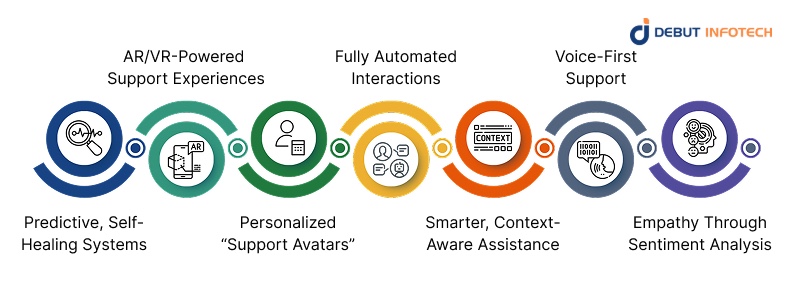
Here are some of the most exciting trends shaping the next chapter of generative AI in tech support:
1. Predictive, Self-Healing Systems
Imagine logging into a platform and never experiencing downtime because the system fixed the issue before it reached you. That’s the promise of predictive, self-healing systems. By analyzing patterns in system behavior, generative AI can detect early warning signs and automatically trigger fixes—reducing support tickets and keeping operations running smoothly.
2. AR/VR-Powered Support Experiences
Support is no longer limited to chat or phone calls. With AR and VR, customers could soon receive step-by-step virtual guidance, like having a technician “walk them through” a fix without leaving their home or office. Generative AI would power these immersive experiences, making troubleshooting feel more intuitive and engaging.
3. Personalized “Support Avatars”
One-size-fits-all support is fading fast. In the near future, customers may interact with AI-driven avatars designed to match their preferences and communication style. These avatars would use past interactions and customer data to deliver personalized guidance, essentially, a virtual support rep who “knows” you.
4. Fully Automated Interactions
Generative AI will soon be capable of handling entire support journeys from answering questions to processing transactions without human intervention. This means faster response times, around-the-clock availability, and consistent service quality across regions.
5. Smarter, Context-Aware Assistance
By understanding intent and context, AI won’t just answer questions, it will anticipate needs. This ensures customers get solutions tailored to their exact situation, not generic responses. The result? Faster resolutions and happier users.
6. Voice-First Support
Voice interactions are becoming second nature thanks to assistants like Alexa and Siri. Generative AI will take this further, enabling customers to solve technical issues through natural, conversational voice interactions. Better yet, it will seamlessly integrate with text and other channels for a smooth omnichannel experience.
7. Empathy Through Sentiment Analysis
Support isn’t just about solving problems, it’s about how people feel while those problems are solved. Advancements in sentiment analysis mean AI will soon detect frustration, urgency, or confusion in a customer’s tone and adjust its responses to be more empathetic. This creates a support experience that feels human, even when it’s AI-driven.
Ready to deploy AI that truly supports your team?
Let’s build a custom Gen AI agent trained on your workflows.
Final Thoughts
The concept of technical support is shifting towards being proactive, rather than reactive and Gen AI is where this occurs. The ability to predict and fix issues before they are even reported as well as to generate personalized, context-sensitive support is making AI transform service desks into engines of customer experience.
The real advantage? It is not about having human agents replaced but empowering them. Gen AI processes repetitive jobs, proposes the most appropriate solutions immediately and allows humans to concentrate on the sophisticated, humanistic dialogues that matter.
Forward-thinking businesses are already making this shift, and many are relying on companies like Debut Infotech, a trusted custom AI agent development company, to build solutions tailored to their unique needs. With their expertise, companies can scale smarter, serve customers faster, and stay ahead of the competition.
If you are in need of boosting customer satisfaction, cost optimization, and readiness to face the future, it is high time to consider Gen AI to help with technical support. Start with clear goals, learn from small wins, and grow into a system that works as hard as your team does.
Ready to transform your support? Partner with experts who build solutions that are not just automated, but intelligent, personal, and truly built for people.
Frequently Asked Questions (FAQs)
Q. What Are Gen AI Tools?
A. Generative AI (Gen AI) tools are advanced systems powered by artificial intelligence.
– They can create new content such as text, images, music, and even code.
– These tools work by learning patterns from large datasets, then generating original outputs in response to user prompts.
– Unlike traditional AI, which mainly analyzes existing data, Gen AI goes a step further by producing brand-new information.
Examples:
– Chatbots like ChatGPT and Gemini
– Image generators like DALL·E 3
Q. What Are Generative AI Use Cases?
A. Generative AI is being used across many industries to boost efficiency and creativity. Some of the most common use cases include:
– Customer support: Automating service with advanced AI chatbots.
– Marketing & education: Creating personalized content that connects with the right audience.
– Healthcare & pharma: Speeding up drug discovery by modeling molecules.
– Software development: Generating code, fixing bugs, and summarizing documentation.
– Design: Supporting product design and producing marketing visuals.
– Data analytics: Turning raw data into clear reports and insights.
– Content creation: Producing text, images, audio, and video at scale.
Q. How generative AI differs from traditional AI
A. Generative AI is a type of artificial intelligence that creates new content such as text, images, audio, or video.
By contrast, traditional AI usually refers to systems that help computers perform human-like tasks. These tasks include analysis, decision-making, and automation.
The key difference lies in their output:
– Traditional AI: Analyzes data and makes predictions.
– Generative AI: Uses data to create something new and original.
Q. How generative AI transforms sales and marketing
A. Generative AI helps sales and marketing teams work smarter, not harder. It does this by:
Automating repetitive tasks so teams can spend more time closing deals.
Personalizing customer experiences with tailored content, emails, and offers.
Turning data into insights that guide better campaign decisions.
Boosting creativity with fresh ideas for ads, messaging, and visuals.
The results speak for themselves:
– More qualified leads
– Improved conversion rates
– Stronger long-term customer relationships
Generative AI also delivers advanced capabilities such as:
– Real-time market analysis
– Customized sales proposals
– Context-aware support responses
Talk With Our Expert
Free 30-min consultation. No commitment.
Our Related Insights

Talk With Our Expert
LET'S WORK TOGETHER
Your Vision.
Our Engineering.
Debut Infotech works as a strategic co-creator — from concept to production-ready platform. We deliver blockchain, AI, enterprise, & mobile solutions that scale.

15+ Years · 500+ Platforms Delivered
Across blockchain, AI, fintech, mobile, and enterprise verticals

NDA Signed on Day One
Your IP and project details are protected before any conversation begins

48-Hour Scoped Estimate
A real technical estimate — not a generic template or sales pitch

Dedicated Account Managers
Available across key global time zones
 +1 708-515-4004 (USA)


