



Table of Contents
Home / Use Case / Generative AI
Generative AI in Corporate Accounting Explained: Use Cases, Challenges, and ROI


Corporate accounting is undergoing a fundamental shift as enterprises look beyond automation toward intelligent, decision-driven systems. Traditional accounting software excels at recording transactions and enforcing rules, but it struggles with scale, complexity, and the growing demand for real-time financial insight. This is where Generative AI in corporate accounting is beginning to redefine how finance teams operate.
Unlike earlier generations of AI that focused on classification or prediction, generative AI systems can interpret unstructured data, generate human-like outputs, and assist with reasoning-intensive tasks. From invoice processing and reconciliations to financial reporting and compliance support, generative AI is increasingly embedded into accounting workflows. As adoption accelerates, finance leaders must understand where the technology delivers real value, where it introduces risk, and how to evaluate return on investment realistically.
Transform Corporate Accounting with Generative AI
Partner with an experienced AI development company to implement secure, scalable generative AI solutions tailored to your accounting and finance workflows.
What Is Generative AI in Corporate Accounting?
Generative AI in accounting refers to the use of AI models capable of generating text, summaries, explanations, forecasts, and structured outputs based on large volumes of financial data. These systems go beyond pattern recognition to actively assist in decision-making, documentation, and analysis.
In corporate accounting contexts, generative AI can:
- Interpret invoices, contracts, and financial documents
- Generate journal entry recommendations
- Draft financial narratives and disclosures
- Assist with audit preparation and compliance queries
- Support forecasting and scenario modeling
When extended into finance operations, this capability also overlaps with generative AI in corporate finance, enabling closer alignment between accounting, planning, and strategic decision-making.
Why Generative AI Matters for Modern Accounting Teams
Accounting teams face increasing pressure from multiple directions:
- Growing transaction volumes
- Complex regulatory environments
- Tight reporting timelines
- Shortage of skilled finance professionals
Generative AI addresses these challenges by augmenting human expertise rather than replacing it.
What Is a Major Advantage of Generative AI in Accounting?
One of the most significant advantages is contextual intelligence. Generative AI systems can understand the “why” behind numbers—not just the numbers themselves—allowing them to explain variances, summarize financial trends, and surface insights that traditionally required manual analysis.
This shifts accounting from a back-office function to a strategic enabler.
Core Use Cases of Generative AI in Corporate Accounting
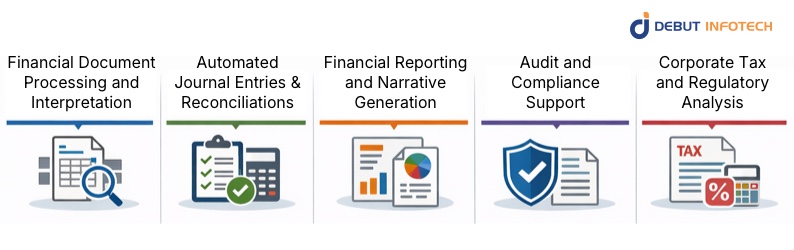
1. Financial Document Processing and Interpretation
Corporate accounting involves massive volumes of unstructured data—PDF invoices, contracts, emails, and statements. Generative AI can:
- Extract and validate key financial fields
- Identify discrepancies or missing information
- Generate structured outputs for ERP systems
This is particularly impactful in generative AI in accounts payable, where invoice processing, matching, and exception handling consume significant manual effort.
2. Automated Journal Entries and Reconciliations
Generative AI systems can analyze transaction histories and accounting rules to:
- Recommend journal entries
- Flag anomalies or unusual postings
- Assist with period-end reconciliations
Rather than replacing accountants, these systems act as intelligent copilots—reducing repetitive work while preserving human oversight.
3. Financial Reporting and Narrative Generation
One of the fastest-growing applications of generative AI in corporate accounting is narrative reporting.
AI can:
- Draft management discussion and analysis (MD&A) sections
- Generate variance explanations
- Create audit-ready documentation
This significantly reduces the time required to translate numbers into narratives for stakeholders.
4. Audit and Compliance Support
Generative AI assists auditors and accounting teams by:
- Answering compliance-related queries
- Summarizing regulatory changes
- Mapping transactions to applicable standards
As regulatory complexity grows, this capability becomes increasingly valuable—especially for multinational enterprises.
5. Corporate Tax and Regulatory Analysis
In areas such as the generative AI in corporate tax management market, AI models are used to:
- Analyze tax positions
- Identify potential exposures
- Generate scenario-based tax forecasts
This allows organizations to proactively manage tax risk rather than react to audits.
Generative AI in Corporate Finance vs Accounting
While accounting focuses on historical accuracy and compliance, corporate finance emphasizes forecasting, planning, and strategy. Generative AI bridges this gap.
In generative AI in corporate finance, systems assist with:
- Budgeting and forecasting
- Scenario modeling
- Capital allocation analysis
By integrating accounting data with forward-looking models, generative AI enables more cohesive financial decision-making.
Underlying Technologies Powering Generative AI in Accounting
Generative AI solutions are built on a combination of advanced technologies that work together to interpret financial data, generate insights, and support complex accounting workflows.
Large Language Models (LLMs)
LLMs interpret financial language, accounting policies, and regulatory documentation, enabling natural-language interaction with accounting systems. They allow finance teams to query data, generate explanations, and draft reports using conversational inputs rather than rigid commands. This capability significantly improves usability and adoption across non-technical accounting users.
Generative AI Models and Frameworks
These generative AI frameworks are often customized to reflect industry-specific accounting rules, internal policies, and regulatory requirements. By combining learned patterns with rule-based logic, enterprises can balance flexibility with control and compliance.
Depending on the use case, organizations may leverage:
- Transformer-based models
- Domain-tuned financial models
- Hybrid architectures combining rules and learning
Generative Adversarial Networks (GANs)
GANs help organizations test AI systems under rare or extreme financial conditions without exposing sensitive real-world data. This makes them useful for validation, resilience testing, and model training in controlled environments.
While less common in accounting, generative adversarial networks are sometimes used for:
- Synthetic financial data generation
- Stress-testing models
- Scenario simulation
Integration with Enterprise Accounting Systems
Generative AI does not replace existing accounting platforms—it augments them by adding intelligence to established systems and workflows.
ERP and Financial System Integration
AI models are integrated into:
- ERP systems
- General ledger platforms
- Accounts payable and receivable tools
This integration enables generative AI to work directly within existing finance processes rather than as a standalone tool. Generative AI Integration Services play a critical role here by ensuring secure data exchange, system compatibility, and compliance with enterprise governance standards.
Data Quality and Governance
The effectiveness of generative AI depends heavily on:
- Data accuracy
- Standardized chart of accounts
- Clear accounting policies
Without strong data governance, generative AI can amplify inconsistencies or errors rather than eliminate them. Well-defined policies and controls are essential to ensure AI outputs remain reliable, auditable, and aligned with accounting standards.
Benefits of Generative AI in Corporate Accounting
Organizations adopting generative AI report several tangible benefits:
- Reduced Manual Workload: Generative AI automates repetitive accounting tasks such as data entry, invoice processing, and reconciliations, allowing finance teams to focus on higher-value analytical work.
- Faster Close Cycles: By accelerating data validation, reconciliation, and reporting, generative AI helps organizations shorten month-end and quarter-end close timelines.
- Improved Accuracy and Consistency: AI applies standardized logic across processes, reducing human error and ensuring consistent treatment of financial data.
- Better Audit Readiness: Generative AI supports audit preparation by generating documentation, explanations, and traceable records that simplify audits and compliance reviews.
- Enhanced Strategic Insight: Beyond transaction processing, generative AI analyzes financial patterns and generates insights that support forecasting, planning, and informed decision-making.
Early Adoption Challenges
Despite its promise, generative AI adoption in accounting comes with several early challenges.
- Data Sensitivity and Security: Financial data is highly sensitive, requiring strong data privacy controls, secure access management, and protected AI models. Many organizations rely on experienced AI development companies or generative AI consultants to address these risks.
- Model Reliability and Explainability: Finance leaders must understand how AI-generated recommendations are produced and ensure outputs align with accounting standards. Explainability remains critical for trust, audits, and compliance.
- Change Management and Skills Gap: Successful adoption requires upskilling finance teams, redefining workflows, and building confidence in AI-assisted outputs. This often leads organizations to hire generative AI engineers or work with gen AI development services providers.
Setting the Stage for ROI Evaluation
As generative AI matures, CFOs and finance leaders are increasingly focused on measurable returns—not experimentation alone. Understanding ROI requires looking beyond cost savings to broader strategic impact, which we’ll explore in the next section.
Measuring ROI of Generative AI in Corporate Accounting
As experimentation gives way to scaled adoption, finance leaders are increasingly asking a critical question: What is the return on investment? Evaluating ROI for Generative AI in corporate accounting requires a broader lens than traditional IT initiatives.
ROI should be assessed across three layers:
- Operational efficiency
- Risk reduction and compliance
- Strategic financial impact
Focusing on only one dimension—such as cost reduction—often undervalues the technology’s true contribution.
ROI Metrics for Generative AI in Corporate Accounting
| ROI Category | Key Metrics | Business Impact |
| Operational Efficiency | Faster close cycles, reduced manual entries, lower invoice processing time | Lower operating costs, improved productivity |
| Accuracy & Compliance | Fewer reconciliation errors, audit findings reduced | Reduced regulatory and financial risk |
| Talent Optimization | Less time on routine tasks, more time on analysis | Higher-value finance work, reduced burnout |
| Decision Support | Improved forecasts, faster insights | Better capital allocation and planning |
| Scalability | Ability to handle growth without proportional headcount | Long-term cost containment |
This framework helps CFOs evaluate AI investments in terms that align with enterprise financial objectives.
Cost Considerations: What Goes Into the Investment?
Understanding ROI also requires clarity on cost structures. The cost of deploying generative AI in accounting varies widely based on scope and maturity.
Major cost drivers are:
- Model selection (off-the-shelf vs custom)
- Data preparation and governance
- System integration and security
- Ongoing model tuning and monitoring
- Change management and training
Organizations often underestimate integration and governance costs, which is why partnering with generative AI development companies or generative AI consultants can reduce long-term risk.
Typical Cost Components of Generative AI Adoption
| Cost Component | Description |
| AI Model & Infrastructure | Licensing or training generative AI models |
| Integration | Connecting AI with ERP and accounting systems |
| Data Engineering | Cleaning, labeling, and structuring financial data |
| Security & Compliance | Controls for sensitive financial information |
| Talent & Training | Upskilling teams or hiring AI specialists |
This cost structure reinforces the importance of a phased rollout rather than a large, upfront transformation.
Governance, Controls, and Risk Management
Accounting is a control-driven function, and generative AI must operate within strict governance boundaries.
Key Governance Requirements
- Human-in-the-loop review for material financial decisions
- Audit trails for AI-generated outputs
- Policy alignment with accounting standards
- Access control for sensitive data
Without these controls, generative AI can introduce risk rather than mitigate it.
Explainability and Trust
One of the biggest adoption barriers is trust. Finance leaders need confidence that AI outputs are:
- Explainable
- Consistent
- Aligned with accounting policies
Modern generative AI frameworks increasingly include explainability layers, making them more suitable for enterprise accounting environments.
Generative AI vs Traditional Automation in Accounting
Many organizations already use RPA or rule-based automation. Generative AI does not replace these tools—it complements and extends them.
Generative AI vs Traditional Accounting Automation
| Aspect | Traditional Automation (RPA) | Generative AI |
| Task Type | Rule-based, repetitive | Complex, judgment-based |
| Data Type | Structured | Structured + unstructured |
| Adaptability | Low | High |
| Human Interaction | Minimal | Collaborative |
| Strategic Value | Operational efficiency | Strategic insight + efficiency |
This distinction helps leaders decide where generative AI adds value versus where traditional automation remains sufficient.
Adoption Roadmap for Enterprises
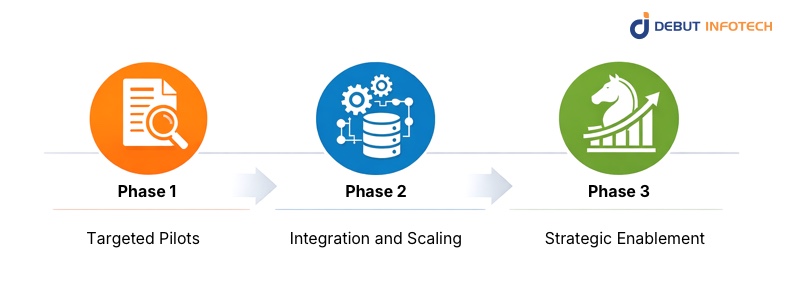
Successful adoption of generative AI in corporate accounting typically follows a phased, structured approach rather than a single large-scale rollout. A staged roadmap allows organizations to manage risk, build internal confidence, and demonstrate value early while laying the foundation for long-term transformation.
Phase 1: Targeted Pilots
Enterprises should begin with high-volume, low-risk AI use cases such as accounts payable, invoice processing, or basic reporting support. These pilots help validate model accuracy, efficiency gains, and data readiness while allowing teams to become familiar with AI-assisted workflows in a controlled environment.
Phase 2: Integration and Scaling
Once early pilots prove successful, generative AI can be integrated more deeply into core ERP systems and financial reporting workflows. At this stage, organizations typically expand usage to reconciliations, variance analysis, and narrative reporting, focusing on standardization, governance, and operational consistency across finance teams.
Phase 3: Strategic Enablement
In the final phase, generative AI moves beyond operational support to enable higher-value financial activities. This includes forecasting, tax analysis, scenario modeling, and strategic planning, where AI-generated insights help align accounting data with broader corporate finance and business objectives.
This phased approach aligns closely with enterprise Gen AI Playbook strategies, enabling organizations to scale adoption responsibly while maximizing long-term value.
Change Management: The Human Factor
Technology alone does not deliver value—people do. Skills and roles are evolving. Accountants are not being replaced; their roles are changing. Generative AI shifts focus toward:
- Financial interpretation
- Scenario analysis
- Business partnering
Organizations that invest in training and transparency see significantly higher adoption success.
Future Outlook: Where Generative AI in Accounting Is Headed
Looking ahead, generative AI will move from assistive to embedded.
Key Trends to Watch
- Hyper-personalized financial insights tailored to executives
- Continuous close models replacing monthly cycles
- AI-driven compliance monitoring across jurisdictions
- Deeper convergence of generative AI in corporate finance and accounting
As generative AI trends evolve, early adopters will gain a structural advantage in financial agility.
Strategic Role of Partners and Platforms
Very few enterprises implement generative AI in corporate accounting entirely in-house. Instead, most organizations rely on a combination of enterprise-grade Generative AI platforms, experienced AI development companies, and specialized Gen AI development services to move from experimentation to scalable adoption. These partners provide not only technical expertise, but also critical guidance on data governance, security, compliance, and integration with existing finance systems.
Choosing the right partner is essential to balancing speed, regulatory requirements, and long-term scalability. An experienced provider such as Debut Infotech helps enterprises design, implement, and scale generative AI solutions that align with business objectives while minimizing operational and compliance risk. With the right platforms and partners in place, organizations can unlock real value from generative AI without compromising control or trust.
Evaluate Generative AI ROI for Your Finance Function
Work with generative AI consultants to assess use cases, integration strategy, and ROI before scaling AI across your corporate accounting operations.
Conclusion
Generative AI in corporate accounting represents more than an efficiency upgrade—it marks a fundamental shift in how finance functions create value. By automating routine processes, improving accuracy and consistency, and enabling faster, real-time financial insight, generative AI empowers accounting teams to move beyond transactional work and act as strategic partners to the business.
However, realizing this value requires realistic expectations, strong governance, and disciplined ROI evaluation. Organizations that adopt generative AI thoughtfully—starting with focused use cases, integrating securely with existing systems, and investing in people and skills—will be best positioned for long-term success.
For enterprises navigating this transition, partnering with experienced generative AI consultants or an established AI development company like Debut Infotech can accelerate adoption while reducing risk. As the technology matures, generative AI will not replace accountants—but accountants and finance teams that leverage generative AI effectively will increasingly set the standard for modern financial leadership.
Frequently Asked Questions (FAQs)
Q. What is generative AI in corporate accounting?
A. Generative AI in corporate accounting refers to the use of AI models that can generate insights, explanations, reports, and recommendations based on financial data, helping automate and enhance accounting workflows.
Q. How is generative AI used in accounting today?
A. Generative AI is used for invoice processing, journal entry assistance, reconciliations, financial reporting, audit support, and compliance analysis, particularly in high-volume corporate environments.
Q. What is a major advantage of generative AI in accounting?
A. A major advantage is its ability to reduce manual workload while improving accuracy and consistency, allowing accounting teams to focus on analysis, oversight, and strategic decision-making.
Q. Is generative AI secure for corporate accounting data?
A. Generative AI can be secure when implemented with proper data governance, access controls, encryption, and human oversight. Enterprises typically work with trusted AI development companies to ensure compliance and security.
Q. How does generative AI improve audit readiness?
A. Generative AI improves audit readiness by generating traceable documentation, explaining financial variances, and quickly surfacing supporting records required for audits and regulatory reviews.
Q. What challenges do companies face when adopting generative AI in accounting?
A. Common challenges include data sensitivity, model explainability, integration complexity, and the need to upskill finance teams to work effectively with AI-assisted tools.
Q. How should organizations get started with generative AI in corporate accounting?
A. Organizations should start with targeted, low-risk use cases such as accounts payable or reporting support, measure ROI carefully, maintain human oversight, and scale gradually with expert guidance.
Talk With Our Expert
Free 30-min consultation. No commitment.
Our Related Insights



Talk With Our Expert
LET'S WORK TOGETHER
Your Vision.
Our Engineering.
Debut Infotech works as a strategic co-creator — from concept to production-ready platform. We deliver blockchain, AI, enterprise, & mobile solutions that scale.

15+ Years · 500+ Platforms Delivered
Across blockchain, AI, fintech, mobile, and enterprise verticals

NDA Signed on Day One
Your IP and project details are protected before any conversation begins

48-Hour Scoped Estimate
A real technical estimate — not a generic template or sales pitch

Dedicated Account Managers
Available across key global time zones
 +1 708-515-4004 (USA)


