ON THIS PAGE
Progress0%






Our Global Presence :





AI is altering the competitive landscape of countries. In Europe, that shift has led to a bold new focus on AI gigafactories.
Once considered a distant, almost sci-fi idea, AI gigafactories are now central to the European Union’s long-term technology strategy. With plans to invest around €20 billion into building four to five large-scale facilities, the EU aims to strengthen its role in global semiconductor production and accelerate home-grown AI development under the European Chips Act. But these sites go far beyond chip manufacturing. They entail state-of-the-art semiconductor manufacturing, AI-native data centers, sovereign data infrastructure, and research environments developed to prepare and execute the next generation AI models.
At this moment, this push is critical. With the United States and Asia achieving rapid AI development, Europe is establishing AI gigafactories to gain technological autonomy, recruit top talent, and limit vulnerability to chaotic international supply chains. Primarily, these gigafactories are not just a piece of infrastructure but the attempt of Europe to remain competitive in a more AI-driven world.
On a basic level, an AI gigafactory refers to a large, dedicated space that has been specifically designed to support the entire lifecycle of contemporary AI models, including training, fine-tuning and of their large-scale application.
In contrast to conventional data centers, AI gigafactories are projected to meet the demands of the heavy loads of AI. They combine vast processing units, data pipelines with high performance and specialized hardware to perform activities such as the training of large language models and the execution of advanced generative AI systems in a manner that is both efficient and reliable.
They are commonly constructed on an industrial basis, including multi-billion-euro investments, tens of thousands of GPUs and energy outputs similar to small cities. But size alone isn’t what makes them different. AI gigafactories are based on decades of experience in high-performance computing (HPC) and take a step further by optimizing all levels of infrastructure in terms of AI training, refinement, and application in manufacturing.
To a great extent, they serve as a transitional step between the current supercomputers and the future of AI-powered innovation. And although existing smaller AI factories already serve startups and researchers throughout Europe, AI gigafactories are built with enterprise scale impact in mind, serving large-scale, mission-critical AI systems that more businesses are increasingly depending on to remain competitive.
It’s easy to think of an AI gigafactory as just a bigger, more powerful data center but that comparison only scratches the surface.
Traditional data centers are designed to facilitate general business activities. AI gigafactories are different by design. They exist to support the entire lifecycle of artificial intelligence technology, from training advanced models to running them reliably at scale.
The shift isn’t only about faster hardware. AI gigafactories are built with dedicated infrastructure, specialized accelerators and AI-oriented software stacks that assist teams to transform ideas to outcome much more rapidly. Rather than balancing between mixed workloads, AI development and deployment are optimized.
Most importantly, this changes how organizations work. Traditional data centers support operations. AI gigafactories help enterprises turn data into insight, insight into action, and action into real competitive advantage. That’s the difference enterprises should care about.
Related Read: The Rise of AI in Marketing: How Companies Get Hyper-Targeted
AI gigafactories didn’t appear overnight and they’re not a trend enterprises can afford to ignore. The period of 2024 to 2027 is the obvious tipping point, given the speed with which AI is transitioning to practical business architecture.
To start with, AI models have expanded well beyond mere applications. Everything, including analytics and customer experience, is now driven by foundation models and multimodal systems, forcing organizations to take a serious consideration of how these systems are trained, run, and scaled. Meanwhile, the costs of cloud-based AI are becoming less predictable as cloud-based AI is used more frequently, particularly in the case of enterprises that use AI in several teams and products.
There is also increased pressure on where data resides and its usage. New laws and data sovereignty expectations are compelling organizations to become more responsible about their AI settings and this can hardly be done with entirely off-shelf solutions.
Above all, businesses are outgrowing small AI projects. AI is currently being integrated in fundamental processes and decision-making, as well as long-term strategy. The change is what has caused organizations to reconsider their AI development service strategy, seeking infrastructure that can provide consistent performance, more transparent costs, and a level of long-term control. In that context, AI gigafactories aren’t about doing more AI. They’re about making AI predictable, sustainable, and ready for scale.
AI gigafactories are not mere myths of the future, but they are already taking actual toll in different fields.
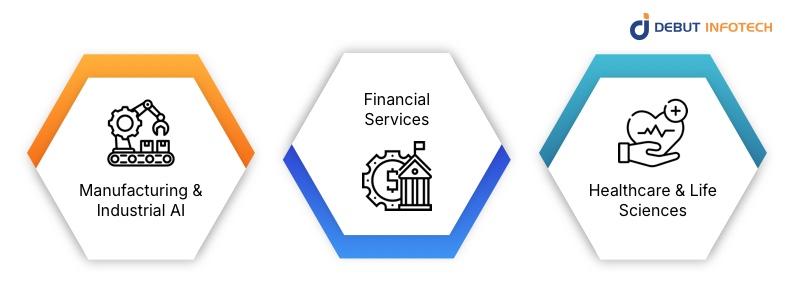
Factories are implementing AI algorithms in driving a computer vision system that identifies defects and ensures high-quality standards. Predictive maintenance frameworks perform corrective maintenance by analyzing proprietary data to avoid the expensive failure of equipment, while edge-deployed AI is regularly updated by centralized gigafactory infrastructure.
To detect fraud and predict new risks, banks and fintechs reassess AI algorithms on a daily basis. These internal models are also able to simplify compliance, reporting and risk management, as well as minimize the dependency on public cloud services.
Healthcare organizations use AI algorithms to speed up drug discovery and enhance medical imaging analysis to make faster and more precise diagnosis. On-prem or sovereign AI environments that are secure are used to store sensitive patient data and they are highly regulated.
All these examples demonstrate that AI gigafactories are not merely high-tech plants but feasible sources of innovation, which can assist businesses to work smarter, safer and faster.
These supercomputers are not any of the regular data center computers, but they are designed to address some of the most challenging problems in AI today:
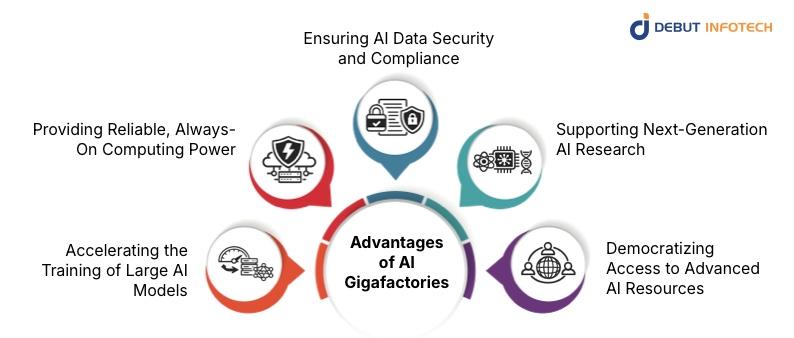
Large language models and generative AI systems can only be deployed safely when they undergo repeated training cycles before they can be used. Conventional computing systems may require weeks to complete such cycles and this slows down innovation. In AI gigafactories, models will be able to process huge workloads, which will enable enterprises to train models much faster and scale. It implies that businesses will be able to experiment, refine, and put AI solutions into practice with greater confidence regardless of whether they are utilizing pre-trained models, modifying existing pre-trained models, or creating thoroughly differentiated architectures.
Innovation is not limited by a 9-to-5 timeline and the creation of AI requires continuous access to high-performance computing. AI gigafactories provide exactly that, with flexible choices such as on-premise installations, access to the clouds, or hybrid and multi-cloud systems. Such flexibility enables the enterprises to relocate workloads according to their cost, privacy, energy, or compliance needs, such that AI projects can be sustained without pause whenever they are required by the researchers or developers.
Security and regulatory compliance is not an option for entrepreneurs, particularly in Europe. AI gigafactories are designed with AI data security at all levels, including hardware and software. These are facilities that are compliant with tough data residency laws, safeguard proprietary knowledge and explainable AI outputs. A zero-trust security model and end-to-end encryption allow enterprises to be innovative without worrying about regulatory requirements and protection of sensitive information.
General-purpose data centers were not built to match the fast speed of contemporary AI innovation. AI gigafactories offer researchers and companies programmable, high capacity supercomputers to enable next generation AI work. This will involve the training of large language models, generative AI, diffusion models and physics based machine learning systems. The effect is felt across fields, bringing breakthroughs in the medical sector, energy, climate change, and others, and providing European companies with an advantage in AI-based innovation.
Traditionally, the access to the state-of-the-art AI infrastructure has been centralized in a limited number of nations and tech corporations, and small businesses and local research centers have been disfavored. AI gigafactories are expected to transform that by moving world-class AI resources near to European organizations of any size. New enterprises, universities and startups can take advantage of the same infrastructure that industry giants are enjoying, speeding up innovation and keeping Europe on track with the world in the AI competition.
Building AI at scale isn’t just about bigger models or faster GPUs, it’s about facing the real challenges that can slow adoption, increase costs, or limit impact. For enterprises thinking about AI gigafactories, these hurdles are amplified because the scale makes every mistake more costly. Here’s what to watch out for:
Generative AI is made to work with clean and structured information. Most of the old AI programs thrive on sheer volume, however, unorganised, siloed or inconsistent data soon delivers unreliable results. CX (customer experience) and EX (employee experience) initiatives can suffer if the data foundation isn’t solid.
Scaling in a gigafactory environment requires investing in high-quality, unified data, as even the most advanced infrastructure can’t fix poor inputs.
Current models such as random forests, gradient boosting are effective in certain tasks but can hardly be easily scaled to generative AI. Transferring them to thousands of GPUs or adding new channels of data normally involves retraining or creating new models.
Without this, old assumptions can hold back innovation and slow deployment.
Running AI at enterprise scale needs robust MLOps pipelines and a culture that embraces experimentation. Engineers tend to construct new systems instead of modifying the old pipelines, however, organized, repetitive workflows are needed in a gigafactory arrangement.
This is an opportunity to rethink team responsibilities and give each business line ownership over its models and experiments.
AI at scale touches multiple functions such as developers, legal, compliance, and business teams and all need to collaborate. Oversight of approvals can be skipped, thereby accelerating prototyping, but further endangering production.
Companies that integrate governance in their AI activities early will be able to implement quicker, minimize delays, and implement regulatory oversight.
The first AI deployment is rarely the cost issue, the hundredth usually is. Without clear guidelines, multiple models, deployments, and configurations can push compute costs sky-high.
Centralized policies for architecture, resource use, and infrastructure choices are essential to keep gigafactory operations efficient and scalable.
Think about how cloud computing started. At first, it was a nice-to-have. Today, it’s fundamental. AI gigafactories appear to be on a similar path.
These centers are not another IT upgrade, but they are taking the form of strategic assets that are enabling AI at scale. Combining dedicated hardware, intelligent software, predictable energy, and talented minds, AI gigafactories develop the type of ecosystem that enterprises require to transition AI testing into practice in the long term. This infrastructure might transform into a strong competitive moat to organizations that intend to integrate AI into their core processes.
The drive of Europe in this direction indicates the bigger picture. With the support of a €20 billion investment, the achievements of this endeavor will not solely hinge on the constructions. Clear energy policies, faster approvals, and sustained investment in AI skills will be just as important. When Europe gets this right, it will not only empower its technological sovereignty, but it can also outline a more sustainable and responsible pattern of AI infrastructure construction and growth on a global scale.
The emergence of AI Gigafactories is rapidly becoming the foundation of the way big organizations construct and expand intelligence. To businesses, they are an indicator that AI is no longer an experiment; instead it is the infrastructure they should treat as long-term that will lead to the actual business benefit.
It requires more than technology to make that shift. Collaborating with an established enterprise AI development company such as Debut Infotech will enable businesses to transform complicated AI plans into scalable solutions, which are performance-driven, secure, and business-focused.
Curious how AI gigafactories could fit into your AI roadmap? Learn what you can do at Debut Infotech.
A. An AI Gigafactory is a massive and purpose-designed data center that is dedicated to training and executing advanced AI applications. It is a combination of a huge amount of computing power (often tens of thousands of GPUs) with energy efficient systems and high speed networking. In contrast to the old-fashioned data centers, AI gigafactories are constructed to support parallel AI workloads and typically have sovereign data infrastructure. In Europe, they are regarded as one of the primary tools to fund the mass development of AI and enhance technological self-sufficiency.
A. Companies embrace AI to operate more efficiently, cheaply, and competitively. AI assists in automating repetitive work, enabling teams to concentrate on more useful work. It also enhances the decision process through data analysis and providing real-time predictions. Through AI, businesses are able to make customer experiences personalized at scale resulting in improved engagement and loyalty. Above all, AI assists organizations in becoming more flexible in a rapidly evolving world of digitization by future-proofing operations.
A. An AI gigafactory is a super-sized data center, which was created with AI in mind. It employs thousands of GPUs and other specialized computers to process hundreds of computers worth of computing power needed by AI. These facilities make it possible to:
– Train large language models (LLMs) and generative AI at scale
– Implement sophisticated AI applications with more speed.
– Support innovation while strengthening regional technological independence
Concisely, AI gigafactories transform AI, which initially appears as tiny experiments, into scalable production resources.

Our Latest Insights
USA
2501 Chatham, Rd Suite R Springfield, IL 62704
+1-708-515-4004
info@debutinfotech.com
UK
7 Pound Close, Yarnton, Oxfordshire, OX51QG
+44-770-304-0079
info@debutinfotech.com
Canada
154 Eden Oak Trail, Kitchener, ON N2A 0H9
+1-708-515-4004
info@debutinfotech.com
INDIA
Sector 101-A, Plot No: I-42, IT City Rd, JLPL Industrial Area, Mohali, PB 140306
9888402396
info@debutinfotech.com