ON THIS PAGE
Progress0%






Our Global Presence :





Retail and fashion have always been visual industries because many customers are moved by what they see. However, search engines haven’t quite been able to fully satisfy these needs because when customers see what they want, they have to translate the ideas to words before searching for it on search engines.
Not anymore.
Today’s customers no longer think in keywords; rather, they’re driven by images. When they see a product they like, they want to search for that particular image, and find the exact match in a few seconds.
Advancements of AI visual search in retail and fashion is the technological innovation that has made that possible.
This article explains what AI visual search is, how it functions, the tangible advantages it offers retail and fashion firms, and how to properly apply it. We’ll also discuss how innovative brands collaborate with AI development firms like Debut Infotech to transform visual search from a feature into a scalable, profitable AI capability.
AI visual search is a new search innovation that enables users to find new content on the internet by uploading an image instead of entering search terms or text. It is one of the latest technological innovations in search engines, particularly in retail and fashion, as it enables shoppers to turn a picture into a shopping experience. As such, it bridges offline inspiration with online purchasing, thus making discovery seamless.
Here’s what it literally translates to in terms of experiences: if you randomly spot an object you would like to shop for, say a shirt or couch, on your social media feed or even physically at a friend’s house, you can easily take a picture of it and upload it to Google to find purchase links of different related products. That’s it; easy, quick, and effective. This is the new shopping reality of most online shoppers and e-commerce stores.
As such, AI-powered visual search should be a strategic application of visual technology, leveraging advanced AI algorithms and models to help every business meet customers at their point of need. It goes far beyond merely implementing a shiny new frontend feature, because AI visual search leverages computer vision and deep learning to understand visual intent —i.e., what a customer means when they show an image—bridging the gap between inspiration and transaction. Some popular examples of companies using AI for visual search in retail include Argos, Amazon, Ikea, Home Depot, etc.
Yes, AI visual search is a significant technological advancement.
But, how does it work?
How can the search engine tell the search intent behind an uploaded image?
Let’s explore the key technologies and mechanisms powering AI visual search below.
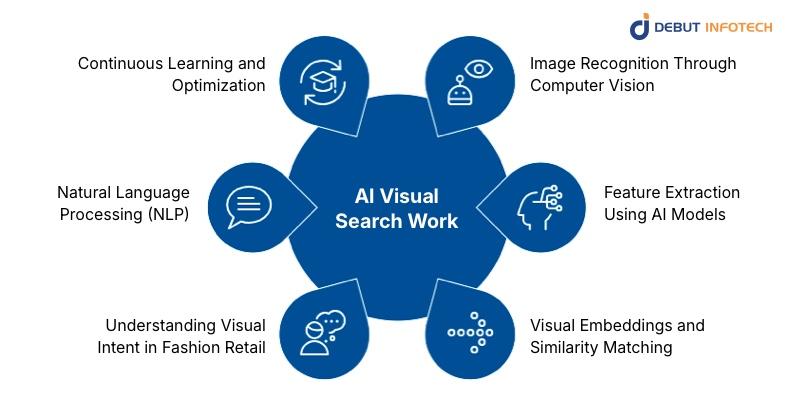
For AI visual search to work, the AI system has to first identify the object imputed, and computer vision is the metaphorical “eyes” that helps it to do this. Computer vision (CV) teaches the computer to “see” the object of interest in an image, blurring out all other unnecessary details that may be in the background. In fashion retail, this entails recognizing clothing, accessories, colors, patterns, textiles, and silhouettes even when the image contains several objects or background noise.
It’s not enough to merely “see” the ingested image, the computer must also be able to analyze and deconstruct it into its core attributes and feature vectors.
In AI visual search, this often works with the help of convoluted neural networks (CNN) which serve as the brain of the computer. They are specialized AI models that extract visual features such as shape, texture, and colour for the ultimate purpose of translating the image features into numerical representations that capture what makes each image distinctive.
The numerical representations referenced above are the visual embeddings that form the basis of the search. The AI visual search system compares the visual embeddings against the logged retailer’s product catalogue in search of a match. This matching process is governed by a number of AI algorithms that calculate the visual similarity between the uploaded image and the retailer products. This is how AI ecommerce visual search can surface relevant products even when there’s no exact match.
So, how does the computer tell the search intent behind an uploaded image?
Fashion-focused visual search differs from ordinary visual search in that it interpretes the style intent behind every image. It maps multiple data points together to guess if an image has been uploaded for either casual or formal intent, seasonal relevance, or even trend alignment. This ability to relate the image search to other associated data points is what makes artificial intelligence in retail stand out
Apart from producing search results that are visually similar to the ingested image, NLP also makes sure that the search results are contextually relevant. This AI system uses machine learning to map the image’s numerical representations to product metadata, including names, descriptions, and specifications. In fact, NLP is the bridge that matches the AI’s visual understanding to your product’s textual metadata.
Every contextually relevant search result generated by the AI visual search engine is fed back into the system for improvements. Clicks, purchases, and refinements help optimise accuracy over time, just like how visual search Google evolves through user behaviour. The key thing with this is that it helps to improve the AI visual search engine over time, so that it continuously generates near-perfect contextually relevant search results consistently.
Related Read: Generative AI in Retail: Strategic Use Cases Operations and Growth
Any company, e-commerce store, or startup in the retail and fashion industry should either be trying to build sustainable AI visual search systems or be optimizing their product catalog for AI visual search.
It’s that simple, and I’ll tell you why:
There has been a fundamental shift in how users shop. Before, most searchers enter translate their search ideas into words and enter them on Google; e.g., ‘best jackets for winter” Now, things are a bit more different in that we have more people who simply go on pinterest and Instagram to spot their favourite “looks.” And with that said, they no longer have the patience to translate what they crave (visually) into text; they just want to search that directly, and your business must be able to match to those images if you want to be a strong contender for your target customer’s attention.
More specifically, implementing and optimizing for AI visual search in retail and fashion is highly beneficial in the following ways:
AI ecommerce visual search makes product discovery absolutely seamless for your customers. The fact that they can easily pop an image into the search engine and find their ideal products boosts customer satisfaction, and in the long run improves sales for the fashion houses and retail stores. They don’t need to guess product names or even use inaccurate keywords in an attempt to get it right. This results in a faster and more intuitive discovery journey for every customer.
Conversion rate is a high-value and bottom line business metric that can be improved drastically with the help of AI visual search. This stems from the fact that prospective customers that use search for their desired products using visual search tend to generally exhibit stronger buying intent. As a result, visual search shortens their customer journey from product discovery to purchase. It does this by presenting them with highly relevant and near-perfect product ideas when they run a visual search. This application of artificial intelligence in retail helps to capture customer intent at peak moments, drastically reduce search abandonment, and increase the average order value for online retail stores.
We mentioned earlier that all customer behaviour data and numerical representations generated during an AI visual search interaction gets fed back into the AI system. When this data is paired with robust AI algorithms and AI models, it enables online fashion and retail stores to personalize their product offerings a bit more precisely for their target customers. This means they can better recommend styles, colours, and individual categories that match each individual customer’s preference per time depending on prevailing conditions like trends and seasons.
Consequently, this reduces the gaps between customer expectations and actual product characteristics, and that’s very key to minimizing the amount of “not as expected” returns that a store gets.
Because AI visual search delivers results that better match shopper expectations, it reduces frustration and mismatched purchases. This leads to lower search abandonment and fewer returns—an often-overlooked operational benefit.
If your retail store starts to adopt and optimize for AI visual search right now, you automatically have a slightly better chance of enjoying a competitive advantage most of your competitors wouldn’t enjoy, especially with platforms like visual search Google. The sweet thing about that is that it establishes your brand as a technology-driven brand, and tech-savvy customers love that.
Check out our related blog: How AI Agents in Retail Are Transforming E-commerce?
Implementing AI powered visual search is no small feat. To deliver real business value, you need to have a well thought-out strategy rooted in strategic planning, accurate technology selection, and the use of AI in visual search optimization for better user experiences.
Our AI Consultants here at Debut Infotech Pvt Ltd, recommend the X-step process below to guarantee adoption and business value realization whenever you want to implement AI visual search in any retail or fashion outfit.
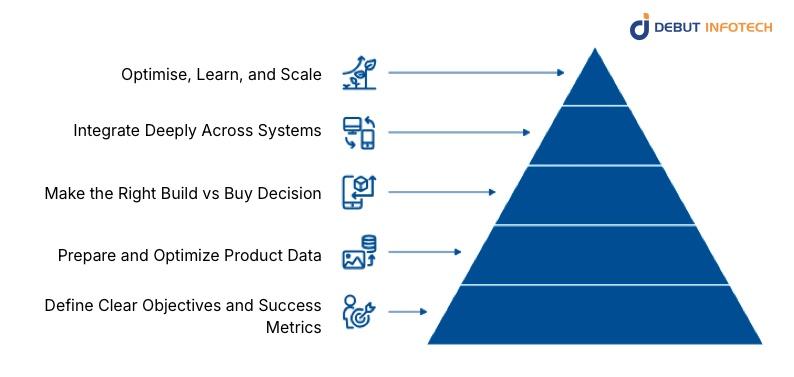
Let’s examine them below:
The first question you need to ask is: why are you deploying AI-powered visual search?
Is the goal to improve product discovery? Enable “shop the look” experiences? Reduce returns? Or increase average order value?
Being clear on these objectives helps you know how to best channel your resources and the best strategy for achieving set objectives.
However, second to that requirement is the need to tie each objective to measurable outcomes for determining success. This means your set objectives must be tied to appropriate success metrics like conversion rate, uplift, engagement duration, reduced search abandonment, and many more. This is how you quantify the impact of artificial intelligence in retail initiatives after they go live.
The effectiveness of your visual search systems is highly dependent on the quality of data you train them on. Therefore, after setting your project objectives and success metrics, you need to implement the best data visualization for AI search insights and feed the AI systems with high-quality product imagery. We’re talking about clear images with consistent lighting, clean backgrounds, multiple angles, and clear representation of colours, textures, and patterns.
Remember those numerical representations we discussed earlier?
You need to optimize for them at this point as well. This means that your product descriptions must accurately reflect tracked attributes like material, fit, style, and other design elements. These things make up the metadata which the visual search engine tries to map when determining search intent. This enables visual technology to map visual signals to textual context.
If you’re a retailer, you must also decide whether to use pre-built visual search APIs or invest in custom model development. Here at Debut Infotech, we have pre-trained AI models inspired by visual search Google that make it easy and quick for you to deploy your systems faster with lower upfront costs.
However, if you want differentiation, you can also hire experienced AI developers from us to build custom AI models trained specifically on your proprietary product data. Although the latter approach is more resource-intensive, it delivers better accuracy and long-term competitive advantage, especially in fashion categories where nuance matters.
Visual search cannot exist in isolation. It must be tightly integrated with product catalogues, inventory systems, pricing engines, and frontend experiences. Real-time synchronisation ensures customers only see relevant, available products—avoiding frustration and lost trust.
On the frontend, AI ecommerce visual search should feel intuitive and visible. Camera-based search, image upload, and “find similar” options must be seamlessly embedded into mobile and web journeys.
Implementation does not end at launch. Continuous learning is what separates static features from intelligent systems. User interactions—clicks, purchases, refinements—should feed back into the system to refine AI algorithms and improve accuracy over time.
As the system matures, retailers unlock deeper insights into visual preferences, enabling better personalization, smarter merchandising, and more informed decision-making.
In short, implementing AI visual search is a strategic journey. When aligned with business goals, powered by quality data, and continuously optimised, it becomes a durable growth engine rather than a fleeting innovation.
Now, we’ve seen a reflection of how people shop. More importantly, we have seen how visual-first platforms continue to shape consumer behaviour.
One thing you should bear in mind is that retail and fashion businesses that choose to continue to rely on only text-based discovery will be left behind by their peers. On the other hand, those that understand visual intent, invest in the right data and AI foundations, and treat visual search as a long-term growth lever will enjoy great competitive advantage.
AI Visual Search in Retail provides a simple, useful entry point into applied AI, whether your goal is to enhance product discovery, increase conversions, or personalize experiences at scale. Additionally, visual search can develop from an innovative experiment into a long-lasting competitive advantage with the correct approach, resources, and partners—such as seasoned AI consultants and AI development services.
A. Poor data quality, disjointed systems, high implementation costs, and ambiguous ROI indicators are the main obstacles to AI in retail. Due to poor interaction with current procedures and a lack of internal AI expertise, which might restrict long-term scalability, many merchants also struggle with adoption.
A. Customers can use the visual search feature instead of text to find products with the use of visual search. It enhances discovery accuracy, lowers search friction, and captures visual intent at the time of inspiration—particularly in fashion and retail, where customers frequently find it difficult to articulate their desires verbally.
A. Visual search, personalized suggestions, demand forecasting, inventory optimization, dynamic pricing, fraud detection, and in-store analytics are all areas where AI can be applied in retail establishments. When combined, these AI application cases enhance decision-making, operational effectiveness, and customer experience in both real and virtual retail settings.
A. Zara uses AI to estimate demand, manage inventory distribution, understand client preferences, and expedite design decisions. Zara can better adapt to trends, reduce overproduction, and match product availability with local customer demand by integrating real-time sales data with AI-driven insights.
A. Yes—as long as it’s done strategically. Higher conversion rates, better customisation, lower search abandonment, and fewer returns are some of the ways AI visual search adds value. It frequently becomes one of the quickest ways to achieve quantifiable ROI from artificial intelligence in retail for fashion and retail firms with visual-heavy catalogs.

Our Latest Insights
USA
2501 Chatham, Rd Suite R Springfield, IL 62704
+1-708-515-4004
info@debutinfotech.com
UK
7 Pound Close, Yarnton, Oxfordshire, OX51QG
+44-770-304-0079
info@debutinfotech.com
Canada
154 Eden Oak Trail, Kitchener, ON N2A 0H9
+1-708-515-4004
info@debutinfotech.com
INDIA
Sector 101-A, Plot No: I-42, IT City Rd, JLPL Industrial Area, Mohali, PB 140306
9888402396
info@debutinfotech.com