ON THIS PAGE
Progress0%






Our Global Presence :





The blockchain that a token is built on is the most important decision in every successful token. In crypto token development, this choice has much more impact than the technical configuration, it impacts transaction costs, scalability, security, user experience and long term growth.
Among the dozens of blockchains competing to capture people’s interest, it is easy to get lost in the hype and half-truths. Being faster does not necessarily make it better, and what is cheap today may be costly tomorrow. The major thing is actually what blockchain fits your particular use-case, budget, regulatory factors and ecosystem you are interested in developing.
This guide will take you through the process of selecting the appropriate blockchain for crypto token development, comparing and contrasting them in an easy understandable way and showing a glimpse into the future with a smart choice that is not overly technical.
One of the most significant decisions during smart contract development is the choice of the blockchain. It is not merely the location of your token, but the performance, development and longevity of your token.
Once a blockchain is unable to manage demand, users are faced with slow transactions and large fees. That exasperation drives away individuals easily.
When the ecosystem surrounding the blockchain is poor, the development process becomes more difficult and costly. Teams waste time in developing tools that are already available elsewhere.
Compliance is another major factor. Small mistakes at the blockchain level can delay exchange listings or limit where your token can operate legally.
And when you make the wrong choice at the start, it is not so simple to make it up afterwards. The process of moving a token to another blockchain is costly, unpredictable and can damage user confidence.
The data backs this up. Between mid-2021 and the end of 2025, more than half of all crypto tokens launched stopped trading. In 2025 alone, most of these failures happened, not because of one issue, but because of poor early decisions stacking up over time.
In the case of most projects, it simply began with selecting the wrong blockchain.
This is why blockchain choice is not a set up phase but a long-term commitment that determines the success of your token.
Choosing a blockchain is more than a technical decision, it is a long-term investment that will determine the performance of your utility tokens in the future, its scaling, and its subsequent trustworthiness. The correct decision must help not only your present aspirations but also your future.
When considering the various blockchains to build a crypto token, consider what will change the lives of users and builders on a day-to-day basis:
Finally, the ideal blockchain is the one, which suits the way you will use your token in the real world, not the way it works theoretically.
Hire skilledHire skilled engineers to build secure, scalable, and production‑ready AI agents that integrate seamlessly withour enterprise systems
engineers o bd secure, scalable, and production‑ready AI agents that integrate seamlessly with your enterprise systemsCT
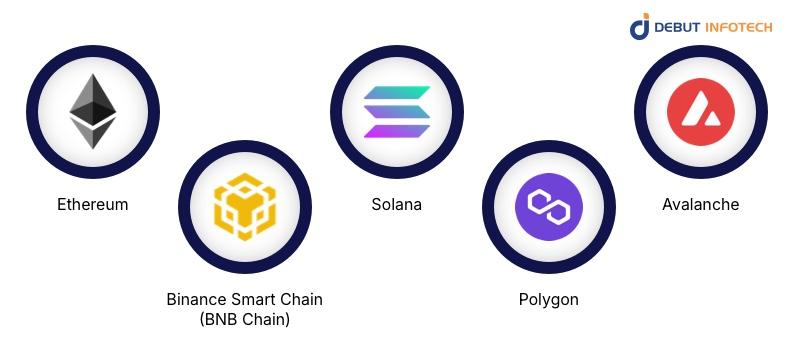
Not all blockchains are built for the same stage or goals of a token lifecycle. There are those who value security and trust and there are those who value speed or cost efficiency. By knowing these differences, you can select a chain that will not only facilitate your launch but also your long term growth.
Ethereum is the gold standard in projects that value trust, security, and depth in the ecosystem. Most DeFi protocols, DAOs, and applications designed to be used by enterprises are built on it, with its established infrastructure and established token standards such as the ERC-20 and ERC-721.
Although the gas fees may be more than new chains, several teams may accept that trade-off due to the reliability and liquidity of Ethereum.
BNB Chain is usually the choice of teams wishing to operate quickly and within a limited budget. Transactions are fast, fees are predictable and integration of exchanges are built into the ecosystem.
Its more centralized validator structure is not the right fit to every project, but in the case of utility tokens and start-ups, it provides a viable market entry without substantial initial expenditure.
Solana is a good choice in case performance is among your top priorities. It is intended to be used in high throughput applications such as gaming, micro-transactions and real-time systems where speed is important.
With that said, it is worth considering past network outages, particularly when the project needs to be online during its entire token lifecycle.
Polygon fills the gap between the security of Ethereum and the requirement of reduced fees. It is an Ethereum-compatible Layer 2 solution, which enables teams to scale without leaving Ethereum’s tooling or ecosystem.
It is a good option when it comes to projects that aim at enterprise adoption or when the project seeks to anticipate further growth beyond the initial token introduction.
Avalanche blockchain is flexible with its subnet architecture, which enables teams to create custom token ecosystems based on the requirements of a particular performance or compliance needs.
Its speed, scalability, and configurability have enabled it to be popular in institutional projects of DeFi that require more control without compromising on performance.
Not every blockchain is created equally and the appropriate option is based on what you want your token to accomplish. Here’s a simple table to help you pick the best blockchain platform for token development based on your use case:
| Token Use Case | Recommended Blockchain(s) | Why It Works |
| DeFi | Ethereum, Avalanche | Strong security, high liquidity, and mature ecosystem support for decentralized finance projects. |
| Gaming | Solana, Polygon | Fast transactions and low fees make them perfect for in-game tokens and micro-transactions. |
| Payments | Stellar, BNB Chain | Optimized for speed and low-cost cross-border payments. |
| NFTs | Ethereum, Polygon | Trusted platforms with large marketplaces and strong developer communities. |
| Enterprise | Hyperledger, Avalanche | Designed for privacy, compliance, and scalable business applications. |
| Meme Tokens | BNB Chain, Solana | Easy, low-cost launches with fast transaction processing for community-driven projects. |
By choosing an appropriate blockchain platform in the initial stages, you will easily save time, minimize expenses, and make the crypto token development experience more successful and efficient.
In regards to token development, knowing how much it would cost you right now saves you time, money and headaches. It is great to work with experienced token development companies, but knowing what happens with your money helps you make smarter decisions.
The following is the breakdown of some of the common expenses you would find on various blockchains:
The following is a summary of the cost of developing a token, depending on the platform you are using. The figures below show industry averages of a mid-level project inclusive of core developments and basic audit work:
| Blockchain | Development Cost Range (USD) | Includes |
| Ethereum | $5,000 – $12,000 | Smart contract, basic audit, gas fees |
| BNB Chain | $3,000 – $8,000 | Lower fees, simpler deployment |
| Solana | $4,000 – $10,000 | Low gas, good for budget projects |
| Polygon | $6,000 – $14,000 | Rust‑based smart contracts |
| Avalanche | $7,000 – $20,000 | Enterprise/DeFi focus |
These ranges indicate actual estimates of the development service providers and industry averages in 2025.
Below are the major cost categories that make up the total you’ll likely spend:
This is the initial price of constructing the code of your token. It will cost between approximately $1,000 and $10,000 or more depending on level of complexity.
Safety and investor trust are dependent on audits. Professional audits are usually between $2,000 and $10,000 and more comprehensive audits may be a lot more.
Deploying your token on the main network requires gas fees paid to the validators. On Ethereum this can be between $100 and $500, whereas such chains as BNB or Polygon may be up to $10-$100.
Consulting legal experts for KYC/AML, whitepapers, and regulatory guidance can add $3,000 to $10,000+ depending on jurisdiction and token complexity.
Even beyond basic development, there are other costs that many creators overlook:
The process of listing your token on centralized exchanges may cost between $5,000 and $50,000 or more based on the type of platform used and necessary requirements. Decentralized exchange listings tend to be less expensive but they also have liquidity provisioning.
Professional launch, branding, and community outreach can increase costs by an extra $10,000-$100,000 and more.
Once it has been launched, you will need updates, support, and possible upgrades of the contract in the future, you will probably need to spend between $1,000-$10,000 annually based on activity.
In case you are still experimenting or have a limited budget, no-code token generators can launch standard tokens in your case at the cost of around $100 to $500, but you will lose customization and security.
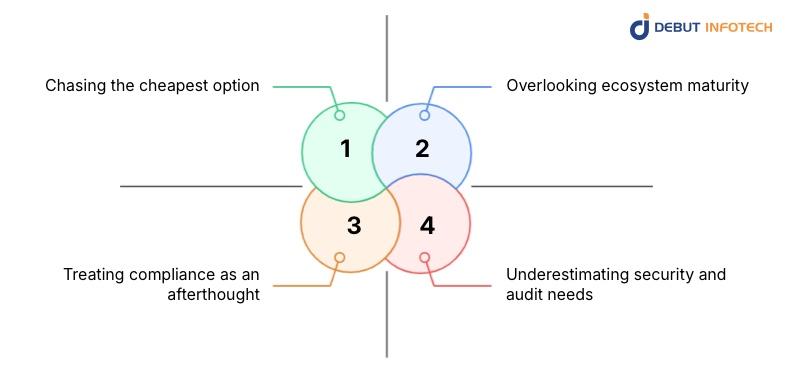
When deciding between various blockchain platforms to develop crypto tokens, it is easy to be attracted by what appears good on paper and overlook what is actually relevant in the real world. These are some of the most common mistakes founders make and how to avoid them.
Low fees are tempting, particularly at the beginning. However, the cheapest blockchain is usually accompanied by trade-offs such as less tooling, poor security or poor long-term support. What will be economical now may be a lot more expensive when your token begins to take off.
A robust blockchain ecosystem is an indicator of superior wallets, ease of listing, robust infrastructure and active developer community. Selecting a chain with a small adoption rate may slow down growth and complicate integrations more than it should.
The fact that your token is decentralized does not mean that regulatory requirements do not exist. Certain blockchains are more supportive of compliance-related features, whereas others are not. Failure to take this seriously at an early stage can result in major road blocks in the future.
Smart contract audits aren’t optional. By not using appropriate security checks or selecting a blockchain that has weak audit capabilities, you are putting your project and users in danger.
The earlier you can avoid these pitfalls, the easier it is to start on the proper footing and establish your crypto token to long-term success.
Developing a successful token does not entirely consist of writing intelligent contracts but selecting the correct blockchain, ensuring scalability, and long-term design. In crypto token development, having the right expertise can make all the difference.
This is where Debut Infotech comes in. Being a top crypto token development company, we have assisted startups and businesses in actualizing their token concepts, including developing strategy and smart contract architecture, deploying to multi-chain, and meeting regulatory requirements. Our guidance will enable you to be able to launch a token, which is secure and scalable and future oriented.
Collaborating with Debut Infotech will transform your vision into a high-performing, trustworthy token that stands out in the competitive crypto ecosystem.
A. The cost of creating a cryptocurrency token ranges from under $1,000 for simple DIY tokens to over $50,000 for complex, audited projects. Standard tokens on Ethereum or Binance Smart Chain usually cost $5,000–$30,000. Costs depend on functionality, blockchain choice, customization, security audits, and marketing.
A. The process of creating a token requires: finding out the purpose of your token, selecting a blockchain, developing tokenomics, implementing a smart contract, testing and auditing, and maintaining.
All those measures will make sure that your token is safe, operational, and can be developed over the long-term.
A. Yes, you can create a basic crypto token for almost no cost. Many online tools and testnets let you experiment without spending anything.
However, deploying your token on a live blockchain (mainnet) requires paying transaction, or “gas,” fees. These fees can be low on efficient networks like BNB Chain or Polygon. On development networks (devnets), deployment can even be free for testing purposes.
The generation of tokens is easy with no-code token generators. Coding it yourself gives you full control and customization. However, keep in mind that the primary expense is from the network charges when you roll out your token and not the creation tools.

Our Latest Insights
USA
2501 Chatham, Rd Suite R Springfield, IL 62704
+1-708-515-4004
info@debutinfotech.com
UK
7 Pound Close, Yarnton, Oxfordshire, OX51QG
+44-770-304-0079
info@debutinfotech.com
Canada
154 Eden Oak Trail, Kitchener, ON N2A 0H9
+1-708-515-4004
info@debutinfotech.com
INDIA
Sector 101-A, Plot No: I-42, IT City Rd, JLPL Industrial Area, Mohali, PB 140306
9888402396
info@debutinfotech.com