ON THIS PAGE
Progress0%






Our Global Presence :





Gold mining has been around for some time. Individuals, corporate entities, or government bodies discover gold at some location, and they start investing funds into the mining process, and I mean a lot of money has to be invested before you get pure gold from the mining sites.
But that’s the issue; while gold mining is not short on value, it has always been quite rigid. Capital is locked, ownership is rigid, and access is limited to a small circle of institutional players.
That’s exactly why gold mine tokenization is starting to gain serious attention, especially among B2B SaaS founders building infrastructure for real world assets.
Done right, gold mine tokenization introduces liquidity where there was none, opens up global capital flows, and turns complex mining economics into programmable financial instruments.
In this guide, we break down what tokenization in mining really means, how it differs from gold tokenization, and why the process demands more than generic blockchain tooling. You’ll also see how tokenized mines are being structured today, where the real opportunities lie, and what it takes to execute properly.
Let’s start with the fundamentals.
Tokenization in mining is a digital approach to managing the ownership or economic rights of a mining asset among multiple participants. It is the process of directly converting those rights to blockchain-based digital tokens that represent equity, revenue share, or production rights. As a result, the owners of these blockchain-based tokens no longer need to operate the physical means directly or even directly own them; instead, ownership of such tokens confers direct rights on them.
In a traditional mining investment, capital is locked into illiquid structures, lengthy contracts, and opaque reporting. A tokenized mine replaces these inefficiencies with programmable assets issued on a blockchain. Smart contracts automate compliance, ownership transfers, and profit distribution, while the underlying mining asset remains legally secured off-chain.
A common question here is: can tokens be mined? In this context, no. Mining tokens is not “mined” like cryptocurrencies. They are issued (minted) based on verified asset value, reserves, or projected output. Mining activity occurs in the real world, while the blockchain records ownership and transactions.
This distinction is crucial. Gold mine tokenization is not about speculative crypto creation—it’s about modernizing mining finance. The premise behind this approach is that tokenizing mining assets makes it easier for operators to access global capital, thereby increasing the feasibility of mining and processing them. Ultimately, it becomes easier for investors to gain fractional, transparent exposure to an asset class that would otherwise be inaccessible.
To start, think of gold mine tokenization as an example of tokenization in mining or even metal tokenization in general. It’s about tokenizing the economic rights of a gold mine. This could take the form of reserves, production outputs, or final profit shares issued as blockchain-based digital tokens. Regardless of the specifics, the key point is that each issued blockchain-based digital token is ultimately directly linked to a verifiable portion of the mine’s value.
It’s like dividing the asset and linking it to the token units, thus making it divisible, transferable, and easier to manage.
Now, you might confuse the idea of gold mine tokenization with gold tokenization. While they are quite related, they differ in that gold tokenization is often backed by the refined gold or bullion, gold mine tokenization is backed by the upstream value of extraction itself.
Let’s break that down:
The peculiarity of this situation is that investors gain exposure not just to gold prices but also to mining economics. This means they will be concerned with and affected by factors like production efficiency, reserve longevity, and operational performance.
As with many other tokenization projects, the ownership rights, distribution logic, and compliance conditions for the tokenized mine are encoded in smart contracts. The smart contracts ensure that tokens are issued only after asset valuation and legal structuring as opposed to being generated through mining algorithms.
And that’s a good thing because mining companies now get a more flexible way to raise capital without incurring excess debt.
But there’s more to benefit from the process as a whole. Let’s take a look at some of them below.
Related Read: How to Legally Tokenized Silver in Europe: Guide
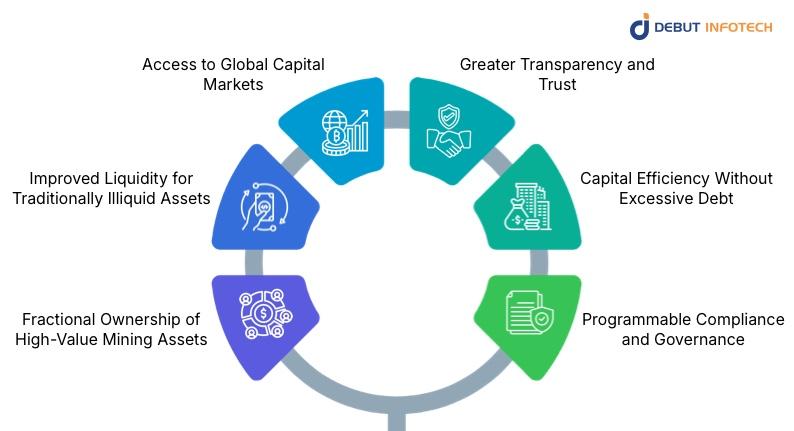
The following are some key benefits of gold mine tokenization:
Gold mine tokenization allows mining assets to be divided into smaller, investable units.
Think of it this way:
Without tokenization, only major institutions and high-net-worth individuals typically have the financial muscle to invest in the gold-mining process and, consequently, reap the financial rewards. But with tokenization, even low-capital investors can purchase small fractions of a tokenized mine and reap financial rewards.
Mining assets are inherently illiquid. But all that changes when you have a larger investor base due to increased fractional ownership.
Through gold mine tokenization, ownership interests can be traded on compliant secondary markets. This gives investors the flexibility to enter or exit positions without waiting for mine exits or acquisitions, making it easier to unlock liquidity from tokenization over time.
The blockchain-based tokenization infrastructure also helps mining companies tap into the investment pool of international investors, rather than relying solely on banks and private equity firms. In fact, this is evident for investors in gold mine tokenization in India, as it provides access to diverse funding sources that can accelerate project development and expansion.
Every transaction involving a tokenized mine is recorded on-chain. Production-linked payouts, ownership changes, and revenue distributions are handled through smart contracts, reducing information asymmetry. This level of transparency is difficult to achieve in traditional mining finance structures and significantly improves investor confidence.
Gold mine tokenization gives operators an alternative to debt-heavy financing models. This means they can avoid fixed-repayment loans for asset-backed tokens linked to production or revenue performance. This means the payout is variable and determined by how well the tokenization mining process performs. This flexibility helps mining firms grow without overleveraging their balance sheets.
With smart contracts at the core, compliance rules, investor rights, and distribution logic are enforced automatically. This makes it easier for gold mine tokenization companies to meet regulatory requirements while reducing manual oversight and administrative costs.
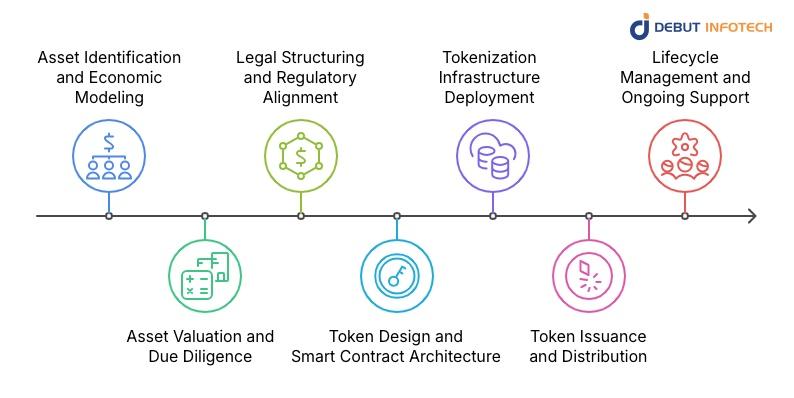
At Debut Infotech Pvt Ltd, we approach gold mine tokenization as a structured transformation exercise. As such, we treat every step with a custom approach that aligns asset value, legal clarity, and token utility with the overall project vision.
We start by defining what is being tokenized. We mentioned earlier that this could be proven reserves, future production output, or revenue share of the specific gold mine in question. Each and every one of these models have different risk and return dynamics, so we work with mining operators to establish a clear, defensible economic structure before any tokens are designed.
Next, we conduct or integrate third-party asset valuation.
Our goal here is to ascertain the real market value of the gold mine we are about to tokenize so that we know the corresponding value of the individual tokens to be created. Therefore, this process often involves reserve verification, production forecasts, and operational feasibility. Most importantly, we always make sure that token issuance is tied to verifiable data because we value token credibility when creating tokens for client projects, and also understand that that credibility depends on asset integrity to a very good extent.
This is where most projects succeed or fail. We structure the token as a compliant asset-backed instrument to align with jurisdiction-specific regulations. For gold mine tokenization in India, this often involves carefully designed ownership and revenue rights rather than direct equity claims.
If you’re operating from a different region, the key focus for you should be to identify the prevailing regulatory frameworks governing gold mining, digital asset issuance, and tokenization projects, and ensure your project structure complies with these very well.
After sorting out the legal framework of the gold mine tokenization process, we implement more structure to the overall project in terms of tokenomics. This means deciding the total token supply, transfer rules, divisibility in terms of micro transactions, and distribution logic for when the project goes live.
The reason we think of these things ahead is to ensure the project as a whole is ready for all kinds of scenarios when you eventually open up to the market. So, critical decisions are made before hand through a collaborative process involving our experts and your senior leadership teams. Shortly after that, we then encode the agreed rules in smart contracts to ensure that tokens are issued, transferred, and settled exactly as intended.
We build and deploy the underlying tokenization infrastructure, selecting the appropriate blockchain, custody model, and security layers. Whether it’s a custom build or a white label tokenization platform, scalability and compliance remain non-negotiable.
Tokens are minted only after all validations are complete. Distribution can occur through private placements or regulated marketplaces, depending on the project scope. At no point are tokens “mined”—they are issued against real asset value.
Also Read: How to Reduce Risk Management in RWA Tokenization
Tokenization doesn’t end at issuance. We provide ongoing support for governance updates, reporting, and smart contract upgrades—ensuring the tokenized mine remains operationally and legally sound over time.
While the idea of gold mine tokenization sounds all very progressive and beneficial, I do feel obliged to mention that it is still a relatively emerging concepts. As such, fully tokenized gold mine projects with large-scale investor issuance are not yet common in verified public markets.
In fact, what you’ll most commonly find in most public domains include initiatives that focus on either:
Nonetheless, the following are some of the early projects you can tap some inspirations from:
One of the earliest real-world examples of gold mining rights tokenization is the collaboration between Santo Mining Corp and Vegachi Holdings SAS. In this project, blockchain-based tokens (often minted as NFTs) are linked to fractional ownership of land with government-issued gold mining rights in Vegachí, Colombia. This approach bridges real-world mineral rights and blockchain records, enabling multiple investors to hold verifiable digital shares of mining value.
While not a tokenized mine per se, Ubuntu Tribe’s Gold International Fungible Token (GIFT) represents a tangible use case of asset tokenization tied to precious metals. Each GIFT token is 100% physically backed by physical gold stored in insured, audited vaults, making gold ownership accessible fractionally on-chain. This project showcases how gold-linked digital assets can democratize access to natural resource value.
Although not mining production projects, tokens like Paxos Gold (PAXG) and Tether Gold (XAUt) are well-established examples of tokenized gold assets in the market. Each token is backed 1:1 by physical gold, providing liquid, blockchain-based exposure to gold value—an important foundation for understanding how gold tokenization (and by extension mining value tokenization) works in practice.
Platforms and consortia building tokenization infrastructure (e.g., frameworks for real-world asset tokenization) are enabling early mining and commodity token use cases, even if direct gold mine token issuance is still nascent. These projects signal growing adoption of tokenization protocols that will support future gold mine tokenization efforts.
With gold mine tokenization, mining projects are going to be funded, owned, and scaled in a totally different manner in the next couple of years.
We’re saying this because the core benefits of unlocking fractional ownership, improving liquidity, and expanding global capital access are just too valuable to ignore. And those are the tangibles that gold mine tokenization offer. So, there’s real value for both mining operators and investors.
But the benefits only materialize when the execution is precise.
That’s right! We mentioned how this is still an emerging domain when examining the real-life projects already existing. Getting in now means you’re getting in early on the ground floor and that’s why you need to execute with ruthless precision!
Regulatory clarity is evolving, asset structures vary widely, and token economics must be aligned with real-world mining operations. That’s why gold mine tokenization is not something to approach with generic blockchain tooling or off-the-shelf solutions. It requires domain expertise, legal foresight, and a clear technical roadmap.
At Debut Infotech Pvt Ltd, we bring all of that together. Our step-by-step approach is proven, and so is our compliant structuring and tokenization infrastructure. When you partner with us, you know the experimentation is out of the equation.
So, whether you’re exploring mining expansion, alternative financing, or long-term investor engagement, our Asset Tokenization Company will help you move from concept to execution with confidence.
In order to tokenize a gold mine, the asset must be identified, reserves or production rights must be valued, legal ownership must be established, and blockchain-based tokens backed by that value must be issued. To guarantee credibility, transparency, and investor trust, the process depends on smart contracts, compliant token design, and a strong tokenization infrastructure.
Tokenized gold uses digital tokens to symbolize ownership of actual gold or value associated with gold. Every token is administered on a blockchain and supported by validated collateral, usually reserves or bullion. These tokens are issued against actual assets and immediately track the value of gold, in contrast to cryptocurrencies that can be mined.
Investors can take part by buying tokens backed by gold via private offerings or regulated marketplaces. Without the need for physical custody, these tokens offer fractional exposure to gold. Compared to conventional gold investments, investors may profit from price appreciation, liquidity, and simpler transferability, depending on the structure.
Asset identification, valuation, legal structuring, token design, smart contract creation, issuance, and lifecycle management are all common steps in the tokenization process. In order to guarantee that the tokenized mine represents actual economic value, extra focus is made on reserve verification and regulatory alignment.
Yes, but only after thorough planning. When tokens represent economic rights rather than direct ownership of minerals and when jurisdiction-specific restrictions are adhered to, gold mine tokenization is legally feasible. To guarantee compliant execution, it is essential to collaborate with seasoned gold mine tokenization firms.

Our Latest Insights
USA
2501 Chatham, Rd Suite R Springfield, IL 62704
+1-708-515-4004
info@debutinfotech.com
UK
7 Pound Close, Yarnton, Oxfordshire, OX51QG
+44-770-304-0079
info@debutinfotech.com
Canada
154 Eden Oak Trail, Kitchener, ON N2A 0H9
+1-708-515-4004
info@debutinfotech.com
INDIA
Sector 101-A, Plot No: I-42, IT City Rd, JLPL Industrial Area, Mohali, PB 140306
9888402396
info@debutinfotech.com