ON THIS PAGE
Progress0%






Our Global Presence :





Infrastructure financing tokenization is emerging as a practical solution to the long-standing challenges of funding, owning, and managing large-scale projects. Traditional infrastructure finance has relied heavily on banks, governments, and institutional investors, often resulting in limited participation, high entry barriers, and slow capital deployment. Tokenization changes this dynamic by transforming physical infrastructure assets into digital representations that can be accessed, traded, and managed more efficiently.
As infrastructure development finance grows more complex and capital-intensive, tokenization introduces new ways to unlock liquidity, diversify funding sources, and improve transparency. At Debut Infotech, we see infrastructure financing tokenization not as a theoretical concept, but as a structural shift in how infrastructure finance operates in a digital economy. This article examines how tokenization operates, its significance, and its impact on reshaping capital access across global infrastructure markets.
Infrastructure financing refers to the funding mechanisms used to develop essential assets such as transportation systems, energy facilities, water networks, telecommunications, and public utilities. These projects require long timelines, substantial capital, and predictable returns. Historically, infrastructure finance has depended on government budgets, development banks, and large private investors.
While this model has supported global development, it also comes with constraints. Capital concentration limits participation to a narrow group of stakeholders. Funding cycles are slow. Liquidity is low. Risk distribution is uneven. As infrastructure needs expand worldwide, particularly in emerging markets, these limitations have become increasingly apparent.
Infrastructure financing tokenization addresses these gaps by introducing a digital layer that restructures ownership and access. By converting infrastructure assets into tokenized units, capital can flow more freely while preserving the long-term nature of infrastructure investments.
Related Read: How Businesses Generate Money from Tokenization
Traditional infrastructure development finance faces several structural inefficiencies. Projects often require years of planning before capital is committed. Investors must lock funds for extended periods, sometimes decades. Exit options are limited, and valuation updates are infrequent.
Another challenge is accessibility. Infrastructure finance typically excludes retail investors and smaller institutions due to high minimum investment thresholds. This concentration increases systemic risk and reduces capital diversity. Additionally, manual processes, fragmented records, and opaque governance structures hinder effective decision-making.
Tokenization infrastructure introduces automation, transparency, and fractional ownership. These elements reduce friction and make infrastructure finance more adaptive to modern capital markets.
Infrastructure financing tokenization converts infrastructure-related financial interests into digital tokens on blockchain systems. It modernizes infrastructure finance by enabling programmable, fractional ownership instead of relying only on traditional debt or equity.
This approach bridges physical infrastructure and digital capital markets, improving access, liquidity, and transparency while preserving the long-term nature of infrastructure investments.
Tokenized ownership is central to the tokenization of infrastructure financing. Instead of a single entity or a small group of institutions holding large, indivisible stakes, ownership is divided into digital units known as infrastructure tokens. Each token represents a defined economic right, such as a share of future revenue, interest payments, or asset appreciation tied to the underlying infrastructure.
These tokens serve as a digital representation of real-world assets. The physical infrastructure remains unchanged, but its financial structure is converted into a digital format that can be recorded, transferred, and managed on a blockchain, a type of distributed ledger. This approach preserves asset integrity while introducing flexibility into the operation of infrastructure finance.
Infrastructure tokens are not speculative instruments. They are directly linked to tangible assets and governed by predefined rules. Their value derives from the performance and cash flows of the underlying infrastructure, making them suitable for long-term investors seeking predictable returns rather than short-term price volatility.
Tokenization infrastructure provides the technical foundation that enables infrastructure financing tokenization. At the base layer is blockchain technology, which acts as a shared ledger for recording ownership, transactions, and asset-related events. This ledger ensures data integrity, transparency, and immutability across all stakeholders involved in infrastructure finance.
Asset digitization is the next critical step. During this process, the financial rights associated with an infrastructure asset are structured and encoded into digital tokens. This includes defining ownership proportions, payout rules, transfer restrictions, and governance mechanisms. Smart contracts automate these functions, reducing manual intervention and operational risk.
Compliance and ownership tracking are embedded directly into the tokenization infrastructure. Investor eligibility, regulatory constraints, and reporting requirements are enforced at the protocol level. Ownership records are updated in real-time, creating a single source of truth for infrastructure assets. This integrated framework supports scalable, compliant, and efficient infrastructure finance without sacrificing control or accountability.
Tokenized assets are reshaping the movement of capital through infrastructure finance by aligning long-term physical projects with digital financial systems. As infrastructure needs expand globally, traditional funding models struggle to keep pace with demand, liquidity expectations, and the diversity of investors. Tokenization introduces a structural shift that allows infrastructure assets to participate more actively in modern capital markets while retaining their stable, income-driven characteristics.
This transition positions infrastructure financing tokenization as a key component of the future financial landscape. By converting infrastructure into digitally manageable assets, tokenization enhances the process of capital raising, distribution, and recycling across projects and regions.
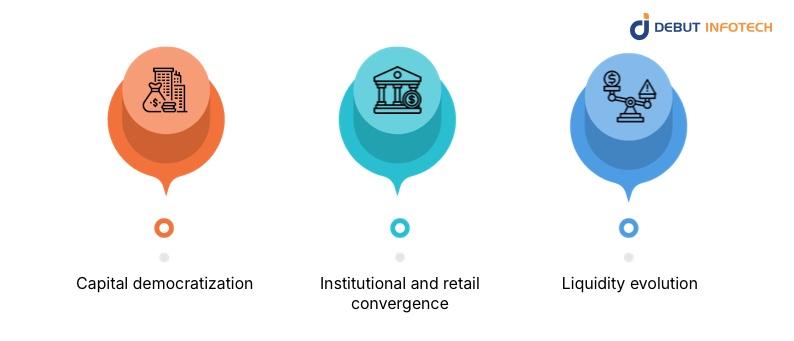
Tokenized assets are transforming the way infrastructure finance operates by enhancing access, participation, and capital flow. Their impact can be clearly understood across three key areas:
Infrastructure tokens divide large assets into smaller digital units. Each token represents a proportional claim on future cash flows or asset value. This structure lowers entry barriers and distributes risk more evenly.
Fractional ownership does not dilute asset integrity. Instead, it creates a transparent ownership registry where rights and obligations are clearly defined. For infrastructure finance, this model supports public-private partnerships, cross-border investment, and community participation.
By enabling fractional investment, infrastructure financing tokenization aligns capital availability with global infrastructure demand.
Smart contracts in real estate are widely discussed, but their relevance extends equally to infrastructure finance. Smart contracts automate financial operations, including revenue distribution, interest payments, and compliance checks.
In tokenized infrastructure projects, smart contracts reduce administrative overhead and eliminate the need for manual reconciliation. Payments are triggered automatically based on predefined conditions. Reporting becomes real-time. Disputes decrease due to transparent execution.
These capabilities enhance trust among stakeholders and improve operational efficiency throughout the infrastructure lifecycle.
Tokenization of real-world assets has moved beyond early experimentation and is now being applied to a wide range of infrastructure categories. While real estate was one of the first sectors to adopt tokenization, infrastructure assets share many of the same financial characteristics, including high capital requirements, long investment horizons, and predictable cash flows. These similarities make infrastructure a strong candidate for large-scale tokenization initiatives.
By extending tokenization frameworks to infrastructure, investors and developers gain new ways to structure ownership, manage risk, and unlock capital. This asset-focused approach connects physical infrastructure directly to digital financial systems without altering how the assets themselves operate.
Tokenization is increasingly being applied to infrastructure assets that underpin economic activity. In the energy sector, power plants, renewable energy projects, and transmission networks can be tokenized to represent ownership or revenue rights. This enables diversified funding and supports long-term investment in energy infrastructure.
Transportation infrastructure, including roads, bridges, ports, and rail networks, also benefits from tokenization. Infrastructure tokens tied to toll revenues or usage fees enable investors to participate in stable, usage-based cash flows, while enhancing funding flexibility for large projects.
Utilities such as water systems, waste management facilities, and public service networks are well-suited to tokenization due to their predictable revenue structures. Tokenization of these assets improves transparency and allows capital to be raised without relying solely on public funding.
Digital infrastructure, including data centers, fiber networks, and communication towers, represents another growing use case. These assets generate recurring revenue and support modern economies, making them attractive candidates for tokenization within the infrastructure finance sector.
Tokenization platforms offer the necessary tools to issue, manage, and trade digital assets. For infrastructure finance, these platforms must support complex asset structures, multi-party governance, and long-term reporting.
A white label tokenization platform allows organizations to deploy branded tokenization solutions without building infrastructure from scratch. This approach accelerates market entry and reduces development costs.
White label solutions are particularly useful for governments, infrastructure funds, and consortia seeking rapid deployment.
Tokenization companies play a crucial role in bridging the gap between finance, technology, and regulation. An experienced Assset tokenization development company understands asset structuring, blockchain engineering, and compliance requirements.
At Debut Infotech, we work with organizations to design tokenization infrastructure that aligns with business goals and regulatory environments. From platform architecture to smart contract logic, development partners ensure the reliable and secure deployment of applications.
Selecting the right development partner is crucial for achieving long-term success in infrastructure financing tokenization.
Ondo finance tokenization represents a broader trend of institutional adoption of tokenized financial products. While specific implementations vary, the underlying principle remains consistent: combining traditional finance with the efficiency of blockchain.
Tokenized platforms enable secondary trading of infrastructure assets. This liquidity is a significant departure from traditional infrastructure finance, where exits are limited.
Secondary markets enhance price discovery and enable investors to adjust their exposure dynamically. This flexibility attracts a wider investor base and increases capital inflow into infrastructure development finance.
Over time, liquid tokenized platforms may redefine how infrastructure assets are valued and traded globally.
Also Read: Ongoing Cost After Launching a White Label Tokenization Platform
Regulation remains a crucial factor in the adoption of tokenization. Infrastructure assets intersect with securities law, property rights, and cross-border investment rules.
Successful tokenization infrastructure incorporates compliance at the protocol level. Identity verification, transfer restrictions, and reporting obligations are embedded into smart contracts.
This proactive approach reduces regulatory risk and supports sustainable growth in infrastructure finance markets.
Risk management remains central to infrastructure financing tokenization. While tokenization improves transparency, it does not eliminate project risk.
Effective governance frameworks define decision-making authority, voting rights, and dispute resolution mechanisms. Infrastructure tokens often incorporate governance features that strike a balance between investor participation and operational efficiency.
Clear governance strengthens trust and supports long-term project stability.
Tokenization expands access to global capital pools. Emerging markets gain exposure to international investors. Local communities can participate in funding critical infrastructure.
This global reach supports sustainable development and reduces reliance on centralized funding sources. Infrastructure financing tokenization aligns financial innovation with real-world impact.
As adoption grows, tokenized infrastructure may become a cornerstone of global development strategies.
At Debut Infotech, we approach infrastructure financing tokenization with a strategic mindset. We focus on building scalable tokenization infrastructure that supports compliance, security, and long-term asset management.
Our expertise encompasses real estate tokenization platforms, smart contracts, and the development of white label tokenization platforms. We help organizations navigate complexity while unlocking new capital opportunities.
By aligning technology with financial objectives, we enable infrastructure finance models that are future-ready.
Infrastructure financing tokenization delivers measurable benefits. Capital access improves through fractional ownership. Liquidity increases via secondary markets. Transparency strengthens investor confidence.
Operational efficiency rises through automation. Governance becomes clearer. Global participation expands. These advantages position tokenization as a transformative force in infrastructure finance.
As infrastructure demands grow, tokenization offers a scalable and inclusive solution.
Despite its promise, infrastructure financing tokenization faces challenges. Regulatory harmonization is still evolving. Market education remains necessary. Technical standards continue to mature.
Addressing these challenges requires collaboration among developers, regulators, and investors. Tokenization companies and development partners play a key role in shaping best practices.
With careful execution, these challenges can be managed effectively.
Infrastructure financing tokenization represents a significant shift in how capital is allocated to essential assets. By combining infrastructure finance with blockchain technology, tokenization unlocks liquidity, expands participation, and improves transparency across the investment lifecycle. Infrastructure tokens, smart contracts, and tokenized platforms redefine ownership and access without altering the physical nature of infrastructure assets.
At Debut Infotech, we believe tokenization infrastructure will become a foundational layer in future infrastructure development finance. As regulatory frameworks mature and technology adoption accelerates, tokenization will continue reshaping capital access. Organizations that invest early in secure, compliant tokenization strategies will be better positioned to lead in the evolving landscape of infrastructure finance.
Infrastructure financing tokenization is the process of converting infrastructure assets or their financial rights into digital tokens on a blockchain. These tokens represent ownership, revenue rights, or debt exposure, making infrastructure finance more accessible, transparent, and efficient.
Tokenization lowers entry barriers by enabling fractional ownership. Instead of requiring large capital commitments, investors can participate with smaller amounts, increasing capital inflow and diversifying funding sources for infrastructure development finance.
A wide range of assets can be tokenized, including transportation networks, energy facilities, utilities, data centers, and public infrastructure projects. Any asset with predictable cash flows and clear ownership structures can potentially be converted into infrastructure tokens.
No. Real world assets back infrastructure tokens and represent tangible economic rights. Cryptocurrencies typically have no underlying physical asset. Infrastructure tokens fall under the broader category of tokenization of real world assets.
Smart contracts automate key processes, including revenue distribution, compliance checks, reporting, and governance. Similar to smart contracts in real estate, they reduce manual intervention and ensure transparent execution throughout the asset lifecycle.
Yes, but regulations vary by jurisdiction. Tokenization platforms typically incorporate compliance measures, including investor verification and transfer restrictions. Working with experienced tokenization companies helps ensure alignment with applicable infrastructure finance regulations.
An Asset Tokenization Development Company provides technical expertise, compliance integration, and platform architecture tailored to complex infrastructure assets. This reduces risk and accelerates deployment, especially when using white-label tokenization platforms or Tokenization as a Service models.

Our Latest Insights
USA
2501 Chatham, Rd Suite R Springfield, IL 62704
+1-708-515-4004
info@debutinfotech.com
UK
7 Pound Close, Yarnton, Oxfordshire, OX51QG
+44-770-304-0079
info@debutinfotech.com
Canada
154 Eden Oak Trail, Kitchener, ON N2A 0H9
+1-708-515-4004
info@debutinfotech.com
INDIA
Sector 101-A, Plot No: I-42, IT City Rd, JLPL Industrial Area, Mohali, PB 140306
9888402396
info@debutinfotech.com