ON THIS PAGE
Progress0%






Our Global Presence :





BEP20 Token Development remains central to blockchain adoption as Binance Smart Chain continues its rapid growth. Over 6.6 million BEP-20 tokens exist today, demonstrating widespread ecosystem engagement.
Furthermore, daily transactions on Binance Smart Chain often exceed 17 million, far surpassing those of many competing chains. Developers and businesses choose BEP20 tokens for low fees and fast execution, helping support 5,372,000+ tokens and smart contracts deployed across the network.
In this article, we explore what BEP20 Token Development means, how it works, its benefits, development approaches, step-by-step process, key considerations, and how to pick the right development partner for your project’s goals.
BEP20 token development involves creating fungible digital tokens on the Binance Smart Chain that conform to the BEP20 standard. This standard defines how tokens behave, transfer value, and interact with wallets, exchanges, and smart contracts. BEP20 tokens are commonly used for payments, governance, staking, utility access, and asset representation within decentralized applications.
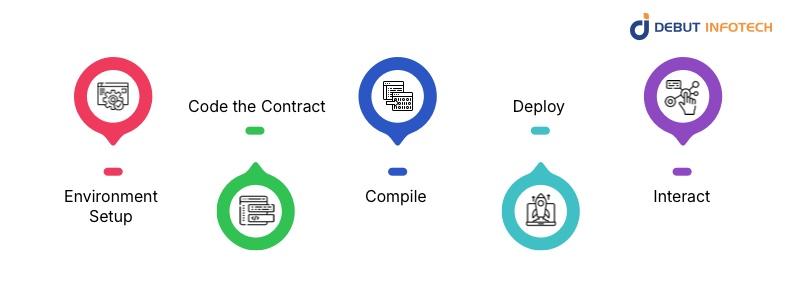
BEP20 token development follows a defined lifecycle. Each phase ensures the token functions correctly, integrates with the Binance ecosystem, and remains secure during real-world use. The process moves from local setup to on-chain deployment and interaction.
Environment setup involves configuring development tools, connecting wallets, and selecting the Binance Smart Chain test or main networks. Developers install frameworks such as Hardhat, set up RPC endpoints, securely manage private keys, and prepare deployment scripts. A stable setup reduces configuration errors and speeds up testing cycles across teams.
Code the contract by writing Solidity logic that defines token supply, transfers, approvals, and ownership rules. Optional features include minting, burning, pausing, or access control. Clean structure, comments, and consistent naming help with audits and make future updates easier to manage without breaking deployed integrations or user balances.
During compilation, the Solidity contract is converted into bytecode and an ABI that the blockchain can execute. This stage highlights syntax errors, version conflicts, and unsafe patterns. Successful compilation confirms the contract aligns with the selected compiler and network requirements before deployment begins on testnets or mainnet.
Deployment sends the compiled smart contract to Binance Smart Chain, creating a permanent on-chain bep20 token address. This step incurs gas fees and finalizes initial parameters, such as total supply and ownership. Careful checks are required, since deployed contracts cannot be easily reversed once confirmed by network validators permanently.
Interaction begins after deployment, when users and applications call contract functions through wallets or dApps. Common actions include transferring tokens, approving spend limits, and integrating with exchanges. Monitoring transactions and events helps detect issues early and ensures expected behavior in production environments over time periods consistently.
Low transaction fees make BEP20 tokens practical for frequent transfers, microtransactions, and DeFi interactions. Businesses can design models that involve staking, rewards, or in-game assets without pricing users out. Predictable costs also simplify budgeting for platforms that process high volumes of token-based operations daily across consumer and enterprise use cases, including payments, governance, and utilities.
Fast block confirmation on Binance Smart Chain improves user experience and operational efficiency. Transactions settle quickly, reducing waiting times for payments, bep20 token swap, and application actions. This responsiveness supports real-time use cases such as gaming, trading, and loyalty systems, where delays can disrupt workflows or erode user confidence during high-volume network activity and peak usage periods.
BEP20 tokens integrate smoothly with major wallets and many centralized and decentralized exchanges. This compatibility reduces friction for onboarding users and listing assets. From a business standpoint, broader support improves liquidity options, accessibility, and distribution, making it easier for projects to reach users without custom integrations across global markets, platforms, and partner ecosystems reliably at scale.
BEP20 tokens are widely supported across DeFi protocols, enabling use in staking, lending, liquidity pools, and yield mechanisms. This interoperability allows projects to extend token utility beyond basic transfers. Teams can experiment with multiple financial models while relying on a consistent standard already understood by the ecosystem, including wallets, analytics tools, exchanges, and infrastructure providers globally.
Binance Smart Chain is designed to handle high transaction throughput, making BEP20 tokens suitable for growing applications. As user numbers increase, the network maintains performance without dramatic fee spikes. This scalability supports long-term growth plans and reduces the risk of technical bottlenecks as adoption expands across consumer, enterprise, and platform-level deployments over time reliably and sustainably.
BEP20 tokens are compatible with many Ethereum-based development tools, libraries, and workflows. Developers can reuse existing knowledge, testing frameworks, and security practices. This lowers the learning curve, shortens development cycles, and helps teams transition from Ethereum while maintaining familiar processes and tooling standards across cross-chain projects, audits, integrations, and long-term maintenance efforts efficiently and predictably.
There are multiple ways to create BEP20 token, each with different costs, control, and risk profiles. The right approach depends on technical depth, timelines, and long-term plans.
Building a BEP20 token from scratch involves writing a fully custom smart contract tailored to specific business logic, token economics, and governance rules. This approach suits projects that require unique mechanics, strict control over permissions, or future extensibility. Businesses often hire experienced blockchain developers to build secure smart contracts, conduct rigorous testing, and complete formal audits before mainnet deployment.
Pros
Cons
Open-source bep20 token contract template rely on audited, community-tested smart contracts, often from libraries like OpenZeppelin. Token development Companies customize predefined modules for supply, ownership, and permissions while retaining a proven core structure. This approach balances speed and reliability, making it suitable for startups and mid-sized projects that need predictable behavior without reinventing core token logic from the ground up.
Pros
Cons
No-code platforms allow users to deploy BEP20 tokens through dashboards without writing Solidity bep20 token code. These tools handle contract generation, deployment, and basic configuration. They work well for simple tokens, internal testing, or short-term campaigns. However, they offer limited transparency, restricted customization, and reliance on third-party infrastructure for updates or fixes.
Pros
Cons
The right BEP20 token development approach depends on your project’s scope, risk tolerance, and long-term goals.
Custom development fits products with complex logic or governance needs.
Open-source templates work well for standard utility or DeFi tokens.
No-code bep20 token generator suits quick launches with limited requirements.
Evaluating budget, security expectations, and future upgrades helps prevent costly redesigns or migrations later.
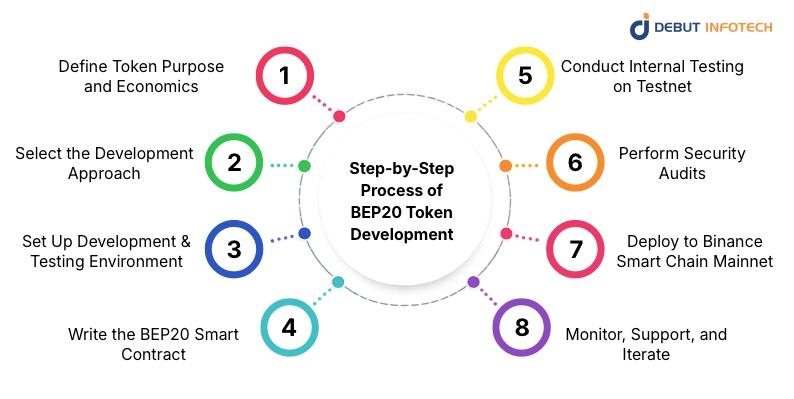
Here’s how to create bep20 token:
This step clarifies why the token exists and how it will be used. Teams define utility, supply limits, distribution rules, and incentives. Decisions around inflation, burns, or rewards directly affect long-term viability.
Clear token economics reduce redesign risks and help align technical development with business and user expectations from the start.
Choosing between custom development, templates, or no-code bep20 token maker shapes token development cost, flexibility, and security. This decision should consider project complexity, timeline, and internal expertise.
Early alignment prevents wasted effort and avoids limitations later. A mismatched approach often leads to expensive rewrites or constrained functionality once the token is already live.
Bep20 token development services configure tools, wallets, networks, and testing frameworks to support safe iteration. Testnets allow simulation of real transactions without financial risk.
Proper environment setup ensures consistent builds, easier debugging, and smooth collaboration across teams. Weak setups often cause deployment errors that surface only after costly mainnet launches.
The smart contract defines how the token behaves on-chain. Developers implement transfer logic, approvals, ownership controls, and optional features like minting or pausing.
Clean structure and documentation improve audit outcomes. Writing clear, maintainable code reduces long-term risk and simplifies future upgrades or integrations across applications.
Testing verifies that token functions behave as expected under real-world conditions. Teams simulate transfers, edge cases, permission checks, and failure scenarios. Testnet validation helps catch logic flaws early. Thorough testing reduces the likelihood of locked funds, broken transfers, or exploitable behaviors after public deployment.
Security audits involve reviewing the smart contract for vulnerabilities, unsafe patterns, and logic flaws. External audits add credibility and reduce blind spots missed during internal reviews.
Addressing audit findings before deployment protects users and minimizes reputational damage. Skipping this step often leads to costly incidents that are difficult to recover from.
Deployment publishes the token contract to the live network, making it immutable and publicly accessible. Final checks are critical, since errors cannot be easily reversed. This step includes setting ownership, supply parameters, and access controls.
Careful execution ensures the token launches as intended without misconfigurations or loss of control.
Post-deployment work includes monitoring transactions, user behavior, and contract events. Teams address issues, support integrations, and plan upgrades if applicable.
Ongoing maintenance builds trust and stability. Tokens that lack post-launch oversight often face operational problems that hurt adoption, liquidity, and long-term sustainability.
Related Read: Top Business Reasons to Invest in Token Development
Early research shapes the entire token lifecycle. Teams should clearly define utility, supply mechanics, regulatory exposure, and target users before writing code.
Understanding competitors and existing standards reduces design mistakes. Solid preparation helps avoid unnecessary features, misaligned incentives, and structural flaws that are difficult to correct after deployment.
Security auditing identifies vulnerabilities that can lead to fund loss or contract misuse. Audits should cover logic flaws, permission controls, and edge cases. Independent reviewers provide objective analysis.
Addressing findings before deployment builds trust, protects users, and reduces the likelihood of costly incidents that damage credibility and adoption.
Upgradability allows contracts to evolve without replacing the BEP20 token contract address. Proxy patterns enable updates but introduce governance and security risks if poorly managed.
Teams must define who controls upgrades and under what conditions. Clear upgrade policies help balance flexibility with decentralization and prevent abuse of administrative privileges.
Deployment finalizes the contract on-chain, making accuracy critical. Verifying source code on blockchain explorers improves transparency and enables public review. Verification helps exchanges, wallets, and users trust the token’s logic. Skipping verification raises red flags and can slow integrations or listings across platforms.
Token adoption depends on awareness and trust. Clear documentation, consistent updates, and active communication help users understand value and usage. Community feedback often highlights issues early. Strong engagement supports liquidity, retention, and organic growth, especially during early stages when credibility is still forming.
Clear decision-making structures prevent confusion and misuse. Teams should define ownership roles, emergency controls, and governance processes early. Well-documented authority reduces internal conflicts and reassures users. Poorly defined control models often create uncertainty, undermining confidence and long-term sustainability.
A capable BEP20 Token development company should demonstrate hands-on experience with BEP20 tokens and Binance Smart Chain deployments. Past projects reveal how well they handle security, testing, and scalability.
Practical experience reduces trial-and-error risks and ensures smoother execution across development, audits, and post-launch support phases.
The right partner prioritizes security from design through deployment. This includes internal reviews, third-party audits, and proper testing workflows. Transparent security practices show maturity and accountability.
Companies that treat audits as optional often expose clients to avoidable vulnerabilities and long-term operational risks.
Strong development partners understand business goals, not just code. They help align token design with revenue models, governance needs, and growth plans. This guidance prevents technically sound tokens that fail commercially. A business-aware team adds value beyond development by supporting smarter architectural and economic decisions.
Crypto Token development does not end at deployment. Reliable companies offer monitoring, updates, and issue resolution after launch. Ongoing support helps manage integrations, user issues, and potential upgrades. Teams without post-launch services often leave clients exposed during critical early adoption phases.
Debut Infotech is a top-tier BEP20 token development company that works with teams that want BEP20 tokens designed for real use, not quick launches. Our approach balances smart contract precision, security-first development, and practical business logic.
From token economics to audits and deployment, the focus stays on long-term stability and ecosystem fit. With deep Binance Smart Chain experience, we support projects that need clarity, technical discipline, and dependable post-launch support across evolving blockchain environments.
BEP20 Token Development combines accessible standards with solid performance on Binance Smart Chain. Tokens created with this standard benefit from fast transactions, broad tooling, and integration with DeFi and dApps.
Whether you choose a custom contract, a no-code BEP20 token creator, or a template-based approach, understanding the lifecycle—from environment setup to post-launch support—helps reduce risk and improve adoption.
A thoughtful development strategy ensures your token serves real utility and aligns with your long-term vision in a competitive blockchain landscape.
Many teams choose BEP20 because Binance Smart Chain offers cheaper gas fees and faster confirmation times than Ethereum. BEP20 tokens also integrate easily with popular DEXs, wallets, and DeFi platforms, helping projects launch more quickly without burning through their budget early.
BEP20 tokens are used for utility tokens, governance tokens, DeFi protocols, gaming assets, NFTs, and payment systems. They work well for projects that need frequent transactions, staking features, or liquidity pools, while keeping costs predictable for both developers and everyday users.
A basic BEP20 token usually takes one to two weeks to develop, including contract creation and testing. More complex tokens with features like staking, burning, vesting, or governance can take three to five weeks, depending on requirements, audits, and deployment readiness.
The cost of BEP20 Token Development typically ranges from $3,000 to $10,000. Simple tokens sit at the lower end, while advanced tokens with audits, custom logic, and deployment support cost more. Pricing depends on features, security needs, and development depth.
BEP20 Token Development is secure when smart contracts are correctly written and audited. Most risks come from poorly coded contracts, missing access controls, or skipped testing. Using standard libraries, following best practices, and running third-party audits reduces vulnerabilities and protects funds after launch.

Our Latest Insights
USA
2501 Chatham, Rd Suite R Springfield, IL 62704
+1-708-515-4004
info@debutinfotech.com
UK
7 Pound Close, Yarnton, Oxfordshire, OX51QG
+44-770-304-0079
info@debutinfotech.com
Canada
154 Eden Oak Trail, Kitchener, ON N2A 0H9
+1-708-515-4004
info@debutinfotech.com
INDIA
Sector 101-A, Plot No: I-42, IT City Rd, JLPL Industrial Area, Mohali, PB 140306
9888402396
info@debutinfotech.com