ON THIS PAGE
Progress0%






Our Global Presence :





If you’re considering launching cryptocurrency exchange software in the UK, 2026 could be one of the smartest times to do it.
Recent data from the Financial Conduct Authority shows that the average crypto holder in the UK owns around £1,842 worth of digital assets. While overall ownership patterns have shifted, what’s clear is that serious engagement is growing. Users are investing more deliberately as the crypto market continues to mature.
This signals a market that’s becoming more informed, more regulated, and more opportunity-driven.
In this guide, we’ll walk you through everything you need to know to launch successfully in 2026.
You’ll learn how to navigate UK regulations, choose the right cryptocurrency exchange software model, understand realistic development and operational costs, and follow a practical launch checklist.
The goal is simply to help you build a compliant, secure, and scalable crypto exchange that meets real market demand in the UK.
Let’s get started!

2026 is shaping up to be a landmark year for anyone planning to launch a cryptocurrency exchange in the UK.
The country is actively building one of the most transparent and forward-thinking crypto regulatory frameworks in the global market. New licensing pathways are emerging, giving compliant exchange operators a clear route to grow, rather than operating in ongoing regulatory uncertainty.
Starting in September 2026, the Financial Conduct Authority (FCA) will introduce a dedicated crypto licensing gateway.
This allows eligible exchange operators to apply for full authorization before a major regulatory regime comes into force in 2027. For businesses, this creates a rare opportunity to get ahead of regulation and build platforms with compliance, investor protection, and long-term stability baked in from the start.
This level of regulatory clarity makes the UK especially attractive when compared to offshore jurisdictions or regions with unclear licensing timelines.
Crypto awareness among the UK public is already widespread. While active ownership levels have fluctuated, demand for regulated and trustworthy exchanges remains strong, creating favorable conditions for platforms that prioritize transparency and compliance.
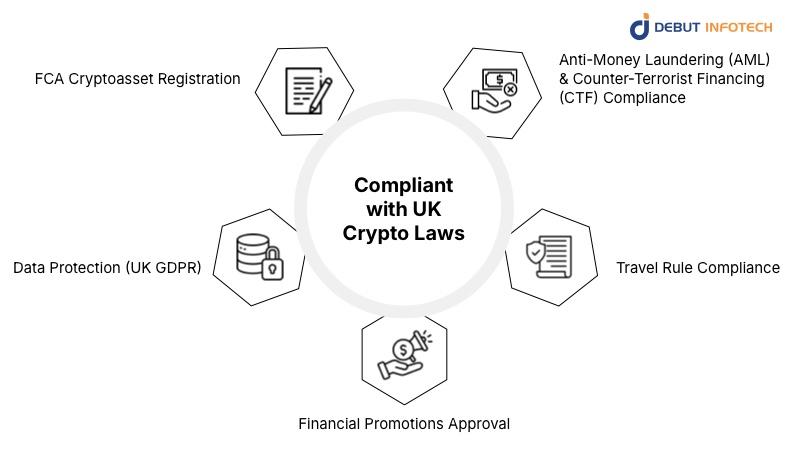
Regulations are not something to be optional and before you launch your crypto platform, you need to know them. In the UK, without the relevant crypto exchange license in the UK, you cannot operate, disregarding the rules may have severe consequences.
Here’s a step-by-step breakdown of what you need to know:
All UK-based crypto exchanges are required to be registered by the Financial Conduct Authority (FCA).
This is no mere formality, you need your legal ticket to run. The registration monitors your exchange to meet the requirements, secures customers and creates credibility in a flooded market.
Failure to do this may close your business before you can even start.
The UK does not treat money laundering lightly.
There should be good KYC (Know Your Customer) procedures, identity authentication and monitoring of transactions. This will stop any form of illegal practice and will also convince both the regulators and the users that your platform is secure and reliable.
Weak AML controls are one of the fastest ways to attract regulatory penalties.
When your users transfer crypto across wallets or platforms, you must comply with the travel rule.
This requires you to collect and securely share specific sender and receiver information during transactions. The goal is to improve transparency and traceability across the crypto ecosystem.
Meeting travel rule requirements reduces regulatory risk and improves relationships with banks and payment providers.
Crypto marketing in the UK is tightly regulated.
Any advertisements, campaigns, or promotional content must comply with FCA financial promotion rules. Misleading claims or unrealistic promises about returns can lead to fines or legal action.
Clear, accurate, and compliant messaging helps establish trust from day one.
Protecting user data is non-negotiable.
Under UK GDPR, you must store, process, and transfer personal information securely. Poor data protection practices can lead to heavy fines, legal disputes, and long-term reputational damage.
Strong data security is essential for user trust and long-term platform success.
Before launching a crypto exchange, it’s important to understand what you’re getting into.
Not all exchanges are built the same way, especially if you’re planning to operate in a regulated market like the UK.
Each exchange model comes with different technical requirements, compliance risks, costs, and timelines. Below are the three main types of cryptocurrency exchange software you can launch, along with what they mean in practice.
This is what most people think of when they hear “crypto exchange.”
In a centralized exchange, the platform manages the order book, liquidity engine, and custody of user funds. Trades are fast, liquidity is deep, and the platform maintains full operational control. Well-known examples include Binance and Coinbase.
In 2025, centralized exchanges dominated the market, accounting for approximately 87.4% of total trading volume, showing that most users still prioritize speed, liquidity, and a familiar trading experience.
However, this control also comes with higher regulatory and security responsibilities, especially in jurisdictions like the UK.
If you’re leaning toward decentralized crypto exchange development, this is your model. DEXs use smart contracts so users trade directly from their wallets without a central custodian. It’s more trustless and often more privacy‑oriented.
Users love DEXs for control and transparency, but in the UK market, you’ll need to carefully balance user autonomy with evolving compliance requirements.
A hybrid exchange combines elements of both centralized and decentralized models.
It offers the performance and liquidity of a centralized exchange while also supporting non-custodial trading features. This approach is gaining traction in markets where regulation and user trust are equally important.
Hybrid exchanges are often more complex to build, but they provide flexibility for businesses looking to balance compliance, security, and user experience.
| Model | Compliance Risk | Cost | Time to Market |
| CEX | Medium–High | High | 6–12 months |
| DEX | Lower | Medium | 4–8 months |
| Hybrid | Medium | High | 8–14 months |
Assuming you want to launch a cryptocurrency exchange in the UK in 2026, it is not merely about developing a site where people can trade crypto. Your platform must have the appropriate functionality to be secure, compliant, and reliable otherwise, users and regulators will not trust you. Here’s a breakdown of the essential features and why they matter:
Automated Know Your Customer (KYC) and Anti-Money Laundering (AML) checks are mandatory in the UK.
These systems verify user identities and monitor transactions for suspicious activity. They help keep your exchange compliant with UK regulations while reducing fraud and financial crime risks. Without proper KYC and AML controls, your exchange could face heavy fines or even be forced to shut down.
Most UK users expect to deposit and withdraw funds in pounds sterling.
Reliable GBP on- and off-ramps allow users to move money between their bank accounts and the exchange with ease. This improves the overall trading experience and encourages higher trading volumes.
It is important to protect the crypto of users.
A secure wallet setup typically includes cold wallets for long-term storage, hot wallets for active trading, and multi-signature protocols to prevent unauthorized access. Many exchange failures can be traced back to weak wallet security, making this a critical foundation.
Users expect competitive prices and fast execution.
By connecting to multiple liquidity sources, your exchange can offer tighter spreads and smoother trades. Strong liquidity not only improves the trading experience but also builds credibility and trust with users.
These tools give your team real-time visibility into operations and regulatory compliance.
Admin and compliance dashboards provide real-time insights into platform activity, user behavior, and regulatory requirements. They help streamline operations, reduce manual errors, and simplify reporting.
All transactions and activities must be recorded.
Comprehensive audit logs and reporting tools support internal security reviews and are essential for regulatory audits. They also play a key role in building transparency and long-term user trust.
One of the first questions founders ask is simple, “How much does it actually cost to launch a crypto exchange in the UK?”
The honest answer is that the cost to launch a cryptocurrency exchange in the UK in 2026 depends on how you build and how prepared you are for regulation.
Some teams prioritize speed and choose white-label solutions. Others invest in fully custom platforms to maintain long-term control. Both approaches come with very different cost implications.
Platform development usually takes up the largest share of the budget. This includes trading engines, wallets, admin dashboards, and user interfaces. White-label platforms reduce time to market, while custom builds increase flexibility but raise costs.
FCA registration and compliance is another major expense. While the FCA application fee itself is relatively modest, the real cost lies in preparing compliant policies, risk frameworks, and internal controls that meet regulatory expectations.
Legal and compliance support is essential throughout the process. Ongoing requirements such as AML, KYC, transaction monitoring, and financial promotion rules must be implemented from day one.
Liquidity provisioning is also critical. New exchanges need sufficient market depth at launch to ensure smooth trading and competitive pricing.
Finally, infrastructure and security cannot be overlooked. Secure hosting, system monitoring, penetration testing, and scalability planning are necessary to protect users and maintain platform stability.
| Cost Component | Estimated Range (GBP) |
| Exchange Software Development (White-Label) | £60,000 – £150,000 |
| Exchange Software Development (Custom Build) | £250,000 – £600,000 |
| FCA Registration & Compliance Preparation | £25,000 – £80,000 |
| Legal, AML & KYC Framework Setup | £30,000 – £100,000 |
| Liquidity Provisioning | £50,000 – £200,000 |
| Infrastructure, Hosting & Security | £20,000 – £70,000 |
Taking all factors into account, the cost to launch a cryptocurrency exchange in the UK in 2026 typically ranges from £150,000 to £1.2 million or more.
The wide range reflects differences in platform complexity, regulatory readiness, and security investment.
Exchanges that underinvest in compliance, security, or infrastructure often face delays, FCA pushback, or operational risks after launch.
On the other hand, businesses that allocate budget wisely across regulation, technology, and liquidity tend to experience fewer roadblocks and build trust faster with users and regulators alike.
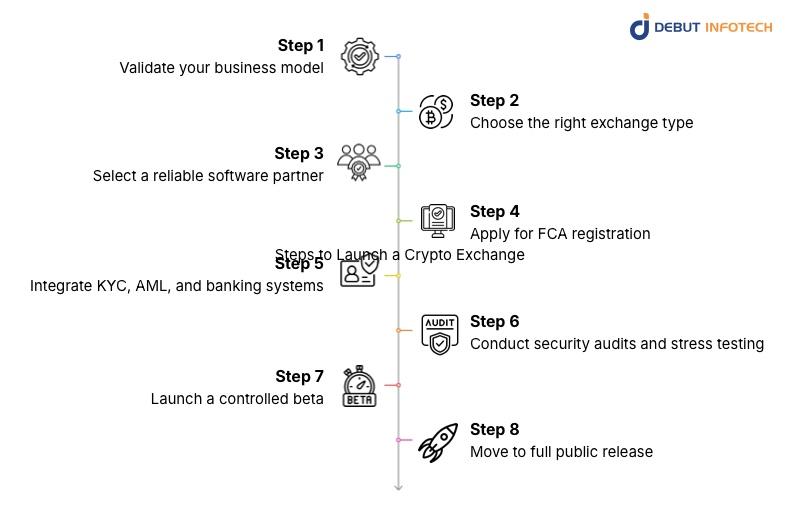
Here’s a practical step-by-step guide to launching successfully with the help of experienced cryptocurrency exchange development services.
Before writing a single line of code, define your target users, revenue model, and value proposition. UK regulators expect clarity on who your exchange serves and how it fits into the broader market.
A well-defined business model also helps guide product decisions and compliance planning.
Decide whether you’re building a centralized, decentralized, or hybrid exchange. This choice impacts everything from compliance requirements to security architecture and user experience.
Focus on what aligns with your long-term strategy, not just what’s fastest to launch.
A strong technology partner offers more than just a platform. They bring experience in UK regulations, security best practices, and scalability planning.
Look for teams that understand compliance and risk management, not just feature development.
FCA registration is a critical and often time-consuming step. Preparing documentation early, along with risk assessments and compliance frameworks, can help prevent unnecessary delays.
Starting this process early keeps your launch timeline on track.
The UK has strict requirements for identity verification, transaction monitoring, and fiat payment support. These systems must be properly integrated and ready for regulatory review from day one.
Smooth coordination between compliance and payments is essential.
From wallet security to data protection, every component of your exchange should be tested under real-world conditions. Regular audits reduce risk and help build trust with users.
Security isn’t a one-time task, it’s an ongoing commitment.
Soft launching will enable you to experiment on how it performs, get feedback and correct some of the problems and then you can launch to a wider audience. It is a clever way to customize the experience without being pressured.
When compliance checks are approved and your platform is up and running, it is time to go live with the assistance of monitoring, updates, and regulatory reporting.
Launching a crypto exchange in the UK is about much more than building features and going live quickly. Many platforms fail not because of weak ideas, but because key decisions are overlooked early on.
Below are some of the most common mistakes founders make and why they matter.
One of the biggest mistakes is starting development without a clear understanding of what the Financial Conduct Authority (FCA) requires.
It’s easy to get excited about features and launch timelines. However, in the UK, compliance cannot be treated as a later step. When regulatory requirements aren’t defined early, teams often have to rewrite core parts of the platform. This leads to wasted time, higher costs, and delayed launches.
Another common issue is undervaluing the role of strong crypto exchange partnerships.
Beyond software development, a functioning exchange needs reliable banking relationships, payment providers, and access to liquidity. Many otherwise promising platforms struggle to go live simply because these partnerships were not secured early or failed to meet UK regulatory standards.
Some founders attempt to fast-track their launch by cutting corners in compliance or partner onboarding.
While this may seem like a quicker path to market, it often raises red flags with regulators and banking partners. In a tightly regulated environment like the UK, these shortcuts can quickly erode trust and put the entire project at risk.
Most failed crypto exchange launches don’t collapse because the idea was flawed.
They fail because regulation, compliance, and partnerships were underestimated at the earliest stages of planning. Addressing these areas from day one significantly increases the chances of a successful and sustainable launch.
Building cryptocurrency exchange software in the UK today requires more than solid code. As the FCA provides more specific and strict expectations, the success of your launch now lies in your ability to build a successful platform according to regulatory, security and operational standards. For founders entering the UK market, the distinction between a seamless launch and months of setbacks can be reduced to the proficiency of the build.
This is where experienced development partners make a real impact. Debut Infotech stands out among crypto exchange development companies by combining hands-on technical expertise with a strong understanding of FCA compliance requirements. From white-label exchanges designed for faster go-to-market strategies to fully custom platforms built for long-term scale, their approach helps reduce regulatory risk while keeping the launch process practical and efficient.
Yes, trading crypto in the UK is legal. Crypto is considered property and not money and is regulated by the FCA, AML/CFT regulations and taxation, such as the Capital Gains or Income Tax. Retail investors do not enjoy the same protections as conventional financial products. The UK intends to regulate more strictly, in particular, stablecoins and crypto services, by 2026.
The most secure option is to trade with an FCA-registered exchange such as Coinbase or Kraken. Connect through bank transfer, turn on 2FA and select a highly secured platform, including eToro or Revolut. Take your crypto to your own wallet and invest only what you can afford to lose.

Our Latest Insights
USA
2501 Chatham, Rd Suite R Springfield, IL 62704
+1-708-515-4004
info@debutinfotech.com
UK
7 Pound Close, Yarnton, Oxfordshire, OX51QG
+44-770-304-0079
info@debutinfotech.com
Canada
154 Eden Oak Trail, Kitchener, ON N2A 0H9
+1-708-515-4004
info@debutinfotech.com
INDIA
Sector 101-A, Plot No: I-42, IT City Rd, JLPL Industrial Area, Mohali, PB 140306
9888402396
info@debutinfotech.com