Home / Blog / Cryptocurrency

Top 3 CEXs and DEXs for Indian Crypto Users

Daljit Singh

by

Daljit Singh

linkedin profile

20 MIN TO READ

March 6, 2026

Top 3 CEXs and DEXs for Indian Crypto Users
Daljit Singh

by

Daljit Singh

linkedin profile

20 MIN TO READ

March 6, 2026

Table of Contents

India, one of the largest crypto markets in the globe, has seen a surge in Crypto adoption recently: it has ranked first for crypto adoption across three years. This rapid adoption is thanks to its large population of increasingly digital young people. Naturally, this market opportunity has attracted all sorts of crypto stakeholders including CEXs and DEXs platforms some renowned, others less than trustworthy

Because much of the cryptotrading experience relies on which platform you choose, it is essential that you know which exchange platforms are trustworthy and can guarantee the best experience. As such we have written this article to serve as an Indian crypto exchange comparison guide. This is by no means an exhaustive list, but a curated list of those exchange platforms—Centralized and Decentralized—we have used and found to provide the best experience.

Understanding CEXs vs. DEXs: The foundation

With the number of exchanges platforms in the country rising daily, an objective Indian crypto exchange comparison is useful for those looking to identify trustworthy exchanges  that offer the best overall experience for traders. This section explores the differences between CEXs and DEXs. 

Centralized exchanges

Centralized exchanges are operated by companies that hold custody of users’ funds. Features of centralized exchanges include faster execution of transactions and fiat on-ramps. This speed and efficiency often comes with tradeoffs in security and privacy: because they hold users’ funds, centralized exchanges are often the targets of hackers, and hacks often lead to loss of users’ crypto assets. Additionally they require KYC/AML compliance and so can be an issue for users who prefer complete anonymity.

Decentralized exchanges

These are smart-contract-based protocols that run on blockchains where users hold custody of their crypto assets. Trade on decentralized exchanges occurs directly via on-chain liquidity pools. Unlike centralized exchanges, these platforms are permissionless and can be accessed around the world offering increased privacy and better security. However, they come with their tradeoffs. These platforms do not support direct fiat (INR) deposits, often have lower liquidity and higher transaction fees. 

The table below summarizes the key difference between both exchange platform types.

CategoryCentralized Exchanges (CEXs)Decentralized Exchanges (DEXs)
Custody of fundsExchange holds custody of user assetsUser retains custody via personal wallet
Access requirementAccount creation + KYC verificationNo account required; wallet connection only
Fiat support (INR)Yes – UPI, NEFT, IMPS, bank transfersNo direct fiat support
Regulatory oversightSubject to national regulationsLargely permissionless and borderless
Trading modelOrder-book basedAutomated Market Maker (AMM) or on-chain order books
Liquidity sourceExchange-managed order booksLiquidity pools funded by users
Security risksExchange hacks, custodial failureSmart contract exploits, user error
Asset varietyCurated listingsVirtually unlimited tokens
Speed of executionVery fastDepends on blockchain congestion
Customer supportAvailableNone (self-service only)
PrivacyLow (KYC required)High
Best forBeginners, INR traders, institutionsDeFi users, early adopters, self-custody advocates

Top 3 centralized exchanges (CEXs) for Indian users

Top centralized exchanges

Centralized exchanges are the main entry point for Indian crypto coin holders. This is particularly so because they support INR on-ramps and withdrawals. 

In spite of rising competition and the presence of global players,  local platforms continue to hold a place of relevance because of simple bank integrations and regulatory certainty. 

Here are three of the top Indian crypto exchanges in the Centralized category:

1. CoinDCX

CoinDCX stands out as one of the top Indian crypto exchanges. It is registered in India and also FIU-IND compliant. 

Founded in 2018, CoinDCX has scaled rapidly in almost a decade from a new player to one of the major stakeholders in the market with millions of users across India. Indian crypto coin traders prefer CoinDCX because it offers easy INT deposits and withdrawals via UPU and bank transfer. It also comes with a wide-range of assets and features that beginners and advanced traders alike find helpful. 

Beyond simple spot trading, CoinDCX boasts of the following:

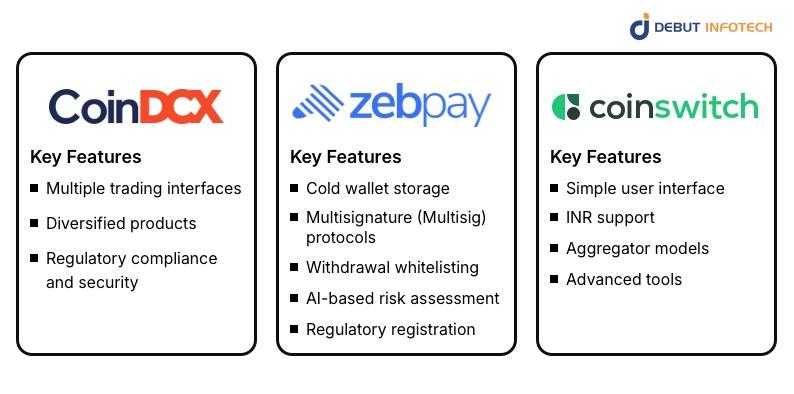
  • Multiple trading interfaces: the CoinDCX platform offers a simple interface for beginners and CoinDCX Pro for advanced charting and order types. This makes it a convenient option for traders of all sorts. 
  • Diversified products: CoinDCX offers a buffet of products, including margins, futures, staking, systemic investment plans, and structured products. 
  • Regulatory compliance and security: CoinDCX is registered with Indian authorities. It has an ISO/IEC 27001 certification and proof-of-reserves transparency. This ensures that your funds are safe and secure. 

Strengths 

  • CoinDCX allows you to transact in Indian rupees. This is unlike global platforms that often require you to convert your INR into other currencies like dollars. This accessibility makes trading faster and more efficient
  • CoinDCX offers a wealth of educational tools including the DCX learn platform, structured courses and certifications, video content, blogs and articles, interactive learning and tools such as expert picks, crypto copy trading, technical analysis tools and lots more. This makes it an ideal exchange for those venturing into crypto trading for the first time, as well as advanced traders. 
  • CoinDCX allows you to trade over 400 cryptocurrencies. This makes it one of the crypto exchanges with the broadest asset coverage. It also comes with advanced trading features. 

Trade-offs 

  • CoinDCX trading fees are typically higher when compared with global exchanges such as finance. As such, high-frequency traders might prefer global exchanges over CoinDCX. 
  • In 2025 around $44 million was stolen from an internal wallet. Even though customer funds were reported safe, the incident  highlights the risks of custodial wallets. 

All together, CoinDCX is one of the best Indian crypto exchanges for Indian crypto coin holders and traders, the direct access to INR, educational resources, and broad asset coverage make it a formidable competitor in the Indian market. 

2. Zebpay

Zebpay is one of the oldest and best Indian crypto exchange platforms. Dating back to 2014, it continues to be relevant today among security conscious investors because of its robust security infrastructure. 

Key features 

Below are some of the features of Zebpay that makes it stand out:

  • Cold wallet storage: Zebpay stores around 98% of their users funds in cold wallets. Since these wallets are kept offline (they are not connected to the internet), they are inaccessible to hackers. 
  • Multisignature (Multisig) protocols: Zebpay requires two or more private keys (signatures) to authorize payments. This reduces the likelihood of internal fraud. 
  • Withdrawal whitelisting: With Zebpay you can whitelist wallet addresses. This way only wallets in your whitelist (those you trust and pre-approve) can receive funds
  • AI-based risk assessment: Zebpay utilities artificial intelligence to simulate transactions and perform real-time risk assessments. This way they can predict possible points of failures and act preemptively to prevent frauds. 
  • Regulatory registration: Zebpay is registered with relevant financial intelligence units (FIU) and they comply with the Prevention of Money Laundering Act (PMLA)

This is not an exhaustive list of the security measures implemented to safeguard user funds. It’s no surprise then that Zebpay is famous among investors that prioritize long-term holding, steady growth, and lowered-risk exposure. This segment of Indian crypto users prefer Zebpay even though it offers fewer assets when compared to other CEXs. 

Strengths 

  • Owing to their longstanding presence in the Indian market, Zebpay has a wealth of experience in the Indian regulatory context. This reduces the risk of losing your assets due to regulatory issues. 
  • As earlier mentioned their security practice is one of their major strengths, and how they set themselves apart from other centralized crypto exchanges in the Indian market. 
  • Similar to CoinDCX, they offer INR deposit/withdrawal. 

Trade-offs 

  • If transaction fees are a big factor in choosing an exchange platform then Zebpay might not be the best for you as their fee structures are not particularly competitive. . However, for the extra security they provide, it is an option worth considering. 
  • In addition to their trading fees, they also have fewer advanced trading features when compared to global competitors. 

3. Coinswitch 

With over 25 million users in the country, Coinswitch is one of the most popular and best Indian crypto exchange platforms in India. 

Key features 

Below are some of the key features of Coinswitch
  • Simple user interface: Coinswitch boasts one of the simplest user interfaces among Indian exchange platforms. Designed with beginners in mind, this platform makes trading cryptocurrency as easy as ordering food. No wonder it has so many users. 
  • INR support: like the first two CEXs discussed, Coinswitch supports deposit and withdrawals in Indian Rupees. 
  • Aggregator models: Coinswitch connects to multiple global exchanges to offer the best prices and liquidity. This is a great feature for cost-conscious traders. 
  • Advanced tools: Like CoinDCX, Coinswitch offers a pro platform for advanced traders who require more extensive tools. Coinswitch pro offers advanced tools such as Spot and Futures trading, API trading, and Smartinvest.

Strengths 

  • Aggregator models allow Coinswitch to aggregate liquidity from various exchanges and offer you some of the best rates on the market. 
  • With just ₹100 you can invest in a cryptocurrency. This low barrier of entry makes it a great choice for beginners. 
  • Coinswitch offers 24/7 support to resolve issues with transactions. 

Trade-offs

  • The main app is too simple. As such it has limited trading features and is not well suited for advanced trade. 
  • You might experience occasional discrepancies between the displayed price and the final execution price. 

Top 3 decentralized exchanges (DEXs) for Indian users

Top decentralized exchanges

Decentralized exchanges cut out intermediaries and make peer-to-peer token swap directly from user wallets possible. You can use them to trade new tokens, DeFi assets, and for non-custodial trading. However, they come with their unique challenges such as gas fees and on-chain settlement delays.

Here are the three of the top decentralized exchanges in india:

1. Uniswap 

Uniswap is the foremost DEX platform in India. It operates as an Automated Market Maker, this means that it allows users to swap ERC-20 tokens directly from their wallets without an intermediary. In India where regulations are strict, Uniswap allows you to circumvent KYC procedures thus, keeping your transactions private. 

Key features

Below are some of the key features of Uniswap

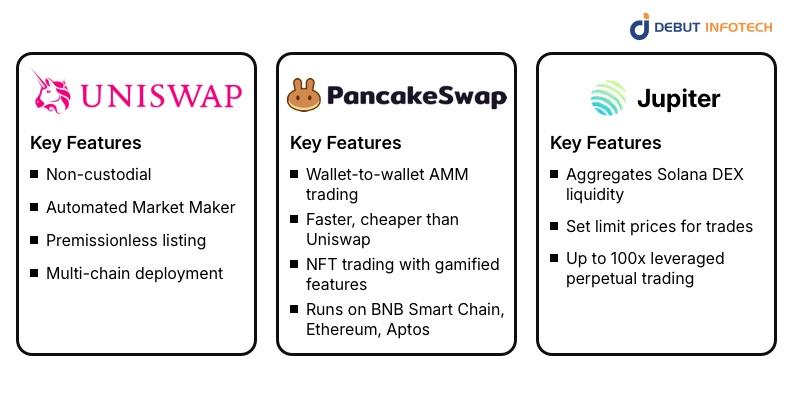
  • Non-custodial: you store and manage your funds yourself. This gives you full control of your funds but also puts full responsibility for the safety of your funds in your hands.
  • Automated Market Maker: unlike with CEXs that use order books, Uniswap uses liquidity pools to execute trades. 
  • Premissionless listing: you can list a token without taking authorization from a central body. 
  • Multi-chain deployment: even though Uniswap is native to Ethereum it has expanded to Polygon, Arbitrum, Optimism, and BNB to reduce transaction costs. 

Strengths 

  • For Indian users who have to navigate strict compliance issues common with CEXs, Uniswap is a breath of fresh air. It allows you to trade with near perfect anonymity. 
  • Uniswap has a Total Value Locked of over $3B. This high liquidity guarantees lower slippage (slippages are common for DEXs).
  • Access to new projects: you can access projects while they are still at their natal phase. Investing early allows you to make money on these projects when they are eventually listed on CEXs.
  • Trades are in crypto so it bypasses banks that may restrict transfers to crypto platforms. 

Trade-offs

  • Uniswap operates on the Ethereum blockchain. This means that transaction fees can go up astronomically during high network congestion. During these periods, it makes no sense to trade small volumes. 
  • Smart contract risks: Smart contracts can sometimes malfunction, leading to loss of funds. 
  • Uniswap does not come with customer support like CEXs. So, if you encounter any problem, you’re left on your own to figure it out. 

2. Pancakeswap 

Unlike Unisawap, Pancakeswap operates primarily on the BNB smart chain (BSC), which is known for fast transactions and low fees. 

Key features 

  • AMM models allow users to trade directly from their wallets without an intermediary. 
  • Since Pancakeswap operates on the Binance Smart Chain, it is faster and cheaper than Ethereum-based DEXs like Uniswap. 
  • Pancakeswap allows you to trade NFTs. It also contains gamified elements, including predictions and lotteries. 
  • While Pancakeswap operates primarily on the BSC blockchain, it has expanded to Ethereum, Aptos, and many more blockchains. 

Strengths

  • It operates on BSC so it is extremely fast and really cheap.
  • It features deep liquidity for BEP-20 tokens. This provides a wide range of trading pairs
  • Pancakeswap is always developing, adding new features like V3 concentrated liquidity, and reducing slippage. 

Trade-offs

  • To trade on Pancakeswap you need to first buy BNB and transfer it to a wallet. As such, you cannot deposit or withdraw in INR. 
  • Pancakeswap carries a high potential for bugs and vulnerabilities in smart contracts. This could lead to a total loss of funds.

3. Jupiter 

The leading DEX aggregator on the Solana blockchain, Jupiter acts as a DeFi superapp that aggregates various liquidity sources to provide you with the best possible prices in tokens. 

Key features 

  • Jupiter scans liquidity from major Solana DEXs including Raydium, Orca, Serum, etc to reduce slippage and provide the best rates
  • With Jupiter you can set specific transaction prices to manage risks. This is similar to CEXs. 
  • Jupiter’s perpetual trading offers up to 100 times leverage on crypto assets. 

Strengths 

  • Jupiter offers extremely low transaction cost because it operates on the Solana infrastructure. This makes it a preferred choice if you are particular about transaction fees. 
  • Jupiter takes advantage of Solana’s shb-second transaction times to offer real-time trading. As such it is ideal for high-colatility trading.

Trade-offs

  • Unlike the other two DEXs discussed, Jupiter operates exclusively on the Solana blockchain.
  • Transactions can be slow when the Solana network experience downtime or congestions
  • DeFi protocols are often susceptible to smart contract failures. 

Conclusion: Partner with Debut Infotech to penetrate the Indian market 

India is a growing market for crypto adoption. The best platforms are those that can offer INR on-ramp, and navigate complex compliance guidelines which can be tricky. In this Indian crypto exchange comparison guide, we have highlighted some of the best centralized and decentralized exchanges in India. So, if you are looking to invest in the Indian market, consider partnering with an established cryptocurrency exchange development company like Debut Infotech PVT Ltd. Our expertise goes beyond development to compliance and market research. Build the next big thing, contact us today. 

Frequently Asked Questions

Q. What are the top 3 CEXs and Dexsfor indian crypto users list?

A. The answer may be subjective as various users prefer CEXs and DEXs platforms for various reasons. However online polls often include CoinDCX, Zebpay and Coinswitch as the top CEXs. Users cite INR on-ramp, premium security and positive user experiences as the reasons for preferring these three. For DEXs, Uniswap, Pancakeswap and Jupiter are often preferred because they offer lower transaction cost, greater liquidity and faster transaction speeds. 

Q. CEXs or DEXs which should I use?

A. Your choice depends on your priorities. If you prefer convenience, compliance and support then you should go with CEXs as they help manage your keys, adhere to strict compliance and offer round the clock support. However, they may carry a higher risk of funds loss due to cyber attacks and regulatory challenges. On the other hand DEXs offer more control of your assets but put the entire responsibility of managing your crypto assets on you. 

Q. What are the two types of crypto exchanges?

A. The two types of crypto exchanges are centralized crypto exchanges and decentralized crypto exchanges. As the name suggests, one is controlled by a central body while the other does away with intermediaries and facilitates direct trade through smart contracts.

Leave a Comment


whatsapp Icon