ON THIS PAGE
Progress0%






Our Global Presence :





News flash!
The Fintech startups currently winning in the B2B space aren’t necessarily the ones with the best engineering talent.
Rather, they are the ones that move swiftly in the market, maintain a consistent brand image, and operate with seamless flexibility.
This is the reality of B2B crypto infrastructure in 2025. Many of these companies simply use white label crypto wallet solutions to get ahead of their competitors without incurring huge debt on infrastructure and engineering talent.
So, if you’re a B2B decision-maker, founder, product lead, or C-suite executive looking for ways to reduce cost without compromising on quality you need to evaluate your wallet development strategy. What we are trying to say is that a white label crypto wallet might be the strategic standard to move clear of your competitors in 2026 if you are building a neobank, running a crypto exchange, or integrating digital asset features into an existing platform.
We will cover what is driving the explosive growth of the crypto wallet market, why White Label Crypto Are Non Negotiable for B2B businesses, what a white label crypto wallet actually gives you, and how to evaluate white-label crypto wallet service providers worth partnering with.

According to Grand View Research, the global crypto wallet market was valued at approximately $12.59 billion in 2024 and is projected to reach $100.77 billion by 2033, growing at a compound annual growth rate (CAGR) of 26.3%. A separate analysis from Fortune Business Insights places the 2021 market value at $ 910.3, with projections extending to $1,902.5 million by 2028.
What do these numbers tell you?
From where we stand, it shows that cryptocurrency has continued to grow as a legitimate asset class in both consumer and enterprise contexts.
So, what does this mean for B2B businesses specifically?
It means that cryptocurrency wallet solutions are moving from optional to expected. Your clients, partners, and end users are already operating in a world where seamless digital asset access is the norm. If your platform does not offer that, you are not just missing a feature — you are losing relevance.
And here is where the B2B crypto wallet decision becomes genuinely non-negotiable: the question is no longer whether to offer wallet functionality. It is how quickly and how intelligently you can deploy it.
A white label crypto wallet is a fully developed, market-ready cryptocurrency wallet solution that a business licenses and deploys under its own brand. With this kind of solution, all the different components of the underlying architecture, such as the security, blockchain integrations, key management systems, and transaction processing systems, are already built and tested. All your company has to do is brand it and launch.
In a B2B context, this typically means you are one of the following:
In each of these cases, the question is the same: do you build or do you partner? And increasingly, the businesses getting this right are partnering — specifically with white-label crypto wallet service providers who specialise in crypto wallet development.
Building a secure, compliant, multi-chain crypto wallet from scratch requires expertise in blockchain protocol integration, cryptographic key management, regulatory compliance across jurisdictions, fraud monitoring, and UX engineering — all simultaneously. The cost is high, the timeline is long, and the failure points are many.
A white label solution compresses that entire curve into a deployment conversation.
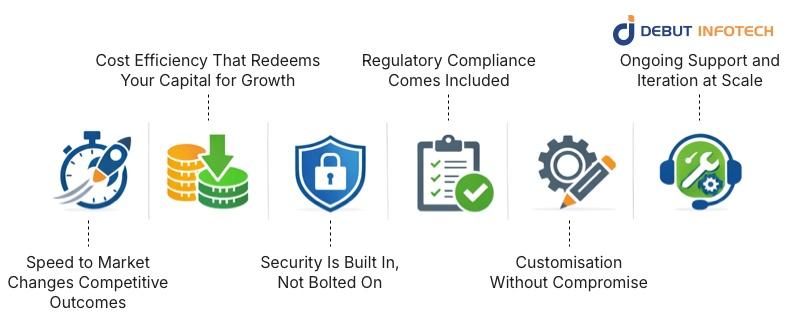
The following are some key reasons why white-label crypto wallets are non-negotiable for B2B businesses.
In technology markets, particularly in fintech, the business that ships first captures the audience. This is a documented pattern of market behaviour that our crypto wallet development services experts here at Debut Infotech Pvt Ltd have noticed over the years. Therefore, when you choose a white-label crypto wallet over a custom build, you typically cut your time to deployment from 12 to 18 months to 6 to 12 weeks.
For a B2B business selling to enterprise clients, that is the difference between landing the account and watching a competitor do it. And that’s why you have to move fast!
Custom crypto wallet development costs a lot due to the team depth you need to execute it properly. You need blockchain engineers, security specialists, backend developers, compliance consultants, QA testers and other project management and HR staff. Paying those professionals and providing the tools they need to function well immediately sets you back hundreds of thousands to millions of dollars before a single user touches your product.
White label solutions convert that capital expenditure into a manageable operational cost. Instead of paying for invention, you pay for deployment, customisation, support, and ongoing maintenance, which costs a lot less. You can then redirect that saved capital into activities like sales, marketing, customer acquisition, and product differentiation that actually grow a B2B business.
Security is where most custom wallet builds either take too long or cut corners. Crypto wallet security is not just about password protection. It involves multi-party computation (MPC) key management, biometric authentication, multi-signature transaction approval, real-time fraud monitoring, and hardware security module (HSM) integration — among other layers.
When you partner with established white-label crypto wallet service providers, these security layers come pre-built and pre-tested. They have already gone through the audit cycles. They already handle the edge cases. Your team does not need to reinvent the wheel — it just needs to configure and deploy.
For B2B businesses serving enterprise clients or operating in regulated industries, this is not a minor point. Your clients are trusting you with their digital asset infrastructure. The security of a purpose-built, thoroughly tested wallet solution is a material part of your value proposition to them.
The regulatory landscape for cryptocurrency wallet solutions is rapidly maturing. The EU’s Markets in Crypto-Assets (MiCA) framework, for example, received final approval from the European Parliament and Council in 2025, establishing comprehensive standards for crypto assets and wallets. Similar frameworks are taking shape in the US, UK, Singapore, and the UAE.
Navigating this alone — as a business whose core competency is not regulatory law — is genuinely dangerous. White label providers who specialise in crypto wallet development services maintain compliance frameworks across multiple jurisdictions as part of their core product offering. When regulations update, the solution updates. You are not scrambling to retrofit your own codebase.
This is a particularly strong argument for B2B crypto wallet solutions serving financial institutions, where non-compliance is not just a risk — it is an existential threat.
A common misconception about white-label products is that they are generic. In the context of the best crypto wallets built for white-label deployment, that is simply not true. Modern white label solutions are designed for deep customisation — your branding, your UX flows, your supported token list, your fee structures, your compliance rules, your notification systems.
What you are not building from scratch is the blockchain integration layer, the key management infrastructure, and the security architecture. Everything user-facing — the face of the product — is yours to define.
This is actually a better outcome than most custom builds produce. Why? Because white-label providers have already learned the lessons your team would have to learn the hard way, and they have built flexibility into the product architecture accordingly.
Shipping a product is not the end of the work. Crypto infrastructure requires active maintenance — protocol upgrades, new chain integrations, security patches, regulatory adaptations, and feature additions driven by market shifts. The right white label partner handles the bulk of this at a platform level, while you focus on the product experience your clients actually see.
For a B2B business, this ongoing support structure is operationally critical. Your internal team is not resourced to maintain deep blockchain infrastructure expertise indefinitely. Partnering with a provider of crypto wallet development services gives you access to a team that does exactly this as their primary function.
Some categories of B2B businesses in the cryptocurrency industry need to make the white-label crypto wallet decision more urgently than others.
Some of them include the following:
If you are operating a neobank or digital banking platform and you have not integrated cryptocurrency wallet solutions, you are watching your user base look elsewhere. Consumer expectations for a unified financial experience that encompasses fiat, crypto, and DeFi are now well ahead of most platform capabilities. The fastest way to close that gap is through a white-label solution that integrates cleanly into your existing product architecture.
An exchange without a wallet experience is a transaction processor, not a platform. Your traders want to manage assets, not just move them through your infrastructure. Therefore, a branded B2B crypto wallet solution tied to your exchange is a retention mechanism, a revenue driver, and a competitive differentiator.
As crypto-based payment rails become more competitive with traditional remittance infrastructure on cost and speed, payment businesses that want to offer digital asset transfer need wallet functionality. Building this natively is expensive and slow. A white-label crypto wallet gives you the rails quickly.
Institutional treasury teams managing digital assets need custody-grade solutions with multi-signature approvals, role-based access control, and audit trail capabilities. This is precisely what purpose-built B2B crypto wallet solutions deliver — and it is functionality that is extremely difficult to build from scratch without significant blockchain engineering depth.
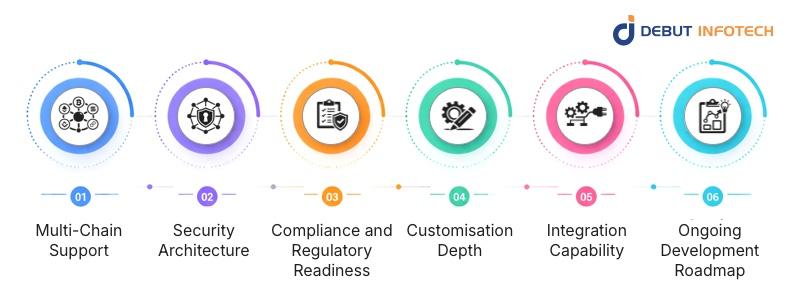
Now we know just how important it is to use white-label crypto wallet service providers.
But how do we select the best white-label crypto wallet service providers?
Here are some key things to have a look at when searching for the perfect partner.
The best crypto wallets in the white label category support Bitcoin, Ethereum, Solana, BNB Chain, Polygon, and emerging L2 networks out of the box. Single-chain solutions are a ceiling on your product.
Ask specifically about key management: do they use MPC, HSMs, or multi-signature schemes? Have they undergone independent security audits? What is their incident response process? These are not optional questions.
What jurisdictions does their compliance framework cover? How do they handle AML and KYC integration? Do they maintain ongoing regulatory monitoring, or is compliance a one-time configuration?
How much of the product can you actually control — branding, UX flows, supported assets, fee structures? Get specifics, not sales language.
How does the white label crypto wallet integrate into your existing tech stack? What APIs are available? What is the typical implementation timeline? What support is provided during and after integration?
The crypto ecosystem moves fast. Is your provider actively developing new features, such as DeFi integrations, NFT support, or cross-chain swaps? Or are they maintaining a static product?
Debut Infotech’s white-label crypto wallet service is built to meet every one of these criteria.
Our crypto wallet development services cover end-to-end delivery: from the initial architecture consultation through compliance configuration, branding, integration support, and post-launch maintenance. We have built cryptocurrency wallet solutions for clients across fintech, exchanges, payments, and enterprise asset management, and we bring that collective learning into every deployment.
The crypto wallet market is not waiting for businesses to catch up. With growth projections pointing to a $100 billion-plus market by 2033, accelerating institutional adoption, and hardening regulatory frameworks, the window for leisurely decision-making has closed.
For B2B businesses, the white-label crypto wallet is non-negotiable, not because it is the only option, but because it is the option that actually fits the strategic and operational realities of how most companies work. It compresses your time-to-market, reduces your capital exposure, provides your clients with a secure and compliant experience, and lets your team focus on what you are actually in business to do.
The companies that will define the next wave of B2B crypto infrastructure are not the ones that spent 18 months building wallets. They are the ones who deployed smart, iterated fast, and built their moats in the right places.
Debut Infotech is a white label crypto wallet provider that has helped businesses across the fintech, exchange, payments, and enterprise spaces do exactly that. If you are ready to have a real conversation about what the right cryptocurrency wallet solution looks like for your business, our team is ready to listen.
A white label crypto wallet is a pre-built cryptocurrency wallet solution that businesses license and brand as their own. The core technology — including blockchain integration, security architecture, and transaction processing — is already built. The business customises the branding, UX, and configuration, then deploys under its own product identity.
The crypto wallet development cost for white label solutions varies by provider and scope, but it is significantly lower than custom development. Depending on the feature set and customisation depth, white-label deployments typically cost a fraction of a custom build, which can run into six or seven figures for enterprise-grade solutions.
Yes — in fact, reputable white label crypto wallet service providers build with security architectures that most internal teams cannot match. These include MPC key management, multi-signature transaction approval, biometric authentication, and independent security audits. For B2B businesses serving enterprise clients, this security foundation is a core part of the product value.
Most enterprise-grade white label crypto wallet solutions are built for multi-chain compatibility, supporting major networks like Bitcoin, Ethereum, BNB Chain, Solana, and Polygon, along with ERC-20 and BEP-20 tokens. The specific asset list depends on the provider and configuration, and the best solutions allow ongoing additions without platform rebuilds.
Deployment timelines for a white label crypto wallet typically range from six to twelve weeks, depending on the level of customisation, integration complexity, and compliance configuration required. This compares favourably with custom builds, which typically require twelve to eighteen months before a production-ready product is available.
About Debut Infotech
Debut Infotech is a leading white label crypto wallet provider and blockchain product development company. We specialise in crypto wallet development services, white label neobanking, and end-to-end blockchain solutions for B2B clients across fintech, payments, exchanges, and enterprise. Our solutions are built for the businesses that need to move fast, deploy securely, and scale with confidence.

Our Latest Insights
USA
2501 Chatham, Rd Suite R Springfield, IL 62704
+1-708-515-4004
info@debutinfotech.com
UK
7 Pound Close, Yarnton, Oxfordshire, OX51QG
+44-770-304-0079
info@debutinfotech.com
Canada
154 Eden Oak Trail, Kitchener, ON N2A 0H9
+1-708-515-4004
info@debutinfotech.com
INDIA
Sector 101-A, Plot No: I-42, IT City Rd, JLPL Industrial Area, Mohali, PB 140306
9888402396
info@debutinfotech.com