ON THIS PAGE
Progress0%






Our Global Presence :





As we move into 2026, the crypto conversation has shifted.
The question is not whether the crypto bull run has started, but whether it will be able to continue its pace throughout the year.
Bitcoin has already reached its historical high in 2025 following inflows by spot ETFs and rising institutional interest.
At this point, the question becomes: Will the bull run persist into early 2026, or are we in a market of consolidation before the market goes higher?
The answer to this question is crucial. It will affect trading operations, investment choices, and the perspective of the wider market on the future of crypto.
In this post, we are going to discuss the significant changes or events that occurred in 2025, and which will probably be important in determining the course of the market in 2026. We will have a closer look at the signs to observe and what they may mean in months to come.
Let’s dive in!
As we move into 2026, it’s clear that 2025 was a pivotal year for the crypto market. Bitcoin saw its all-time high (ATH) price of $126,000, which was due to inflow of institutional capital. However, more than the price, it is the market dynamics that will determine the future of crypto, particularly in 2026.
Bitcoin started 2025 with a historic milestone, surpassing $100,000 for the first time. It was not merely a product of market speculation but a product of institutional interest never seen before, fueled by spot Bitcoin exchange-traded funds (ETFs).
These actions indicate increasing institutional support for Bitcoin, which is expected to continue through 2026.
The acceptance of a spot Bitcoin ETF, especially by financial titans such as BlackRock, has transformed the game of Bitcoin.
This rising interest is not only about price, rather it is about market maturing and a change in the mood of the investors. With Bitcoin surpassing the $50,000 mark and retaining its level above this important resistance, it might be poised to continue growing in 2026.
The success of Bitcoin is boosting the entire crypto market, and the increase in liquidity is benefiting altcoins.
In a nutshell, the power of Bitcoin is not only good to Bitcoin, but it is also contributing to powering the market at large.
Considering these changes, the future of the crypto market in 2026 is bright, yet it will depend on a number of factors:
Key Takeaways for Investors
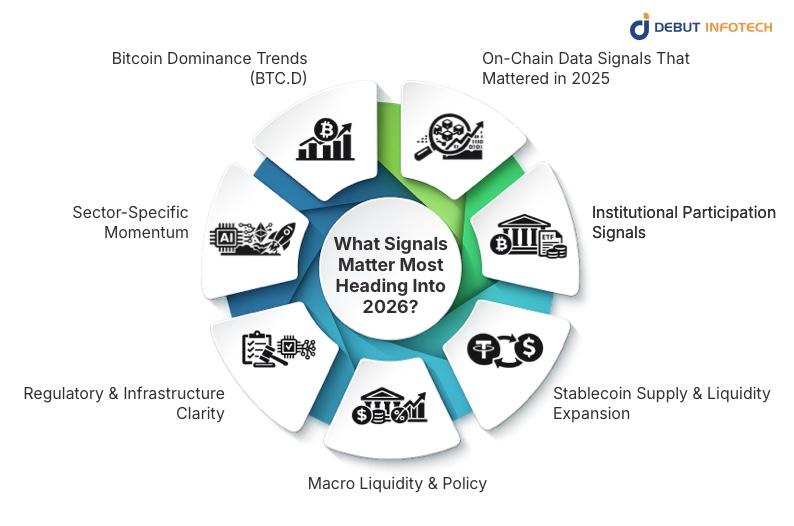
As we move toward 2026, the crypto narrative is shifting away from short-term hype to more structural, liquidity-driven signals. Here are the key indicators to watch:
A rise in the dominance of Bitcoin is usually an indicator of a risk-off market. That is to say, investors are seeking stability and moving toward Bitcoin as a safe haven.
Conversely, when the dominance of Bitcoin falls, we tend to experience an altcoin expansion phase, which is an investment period whereby individuals begin to diversify into other cryptocurrencies.
2025’s BTC.D Behavior:
Pro Tip:
These fluctuations in dominance are often followed by professional traders when altcoins are yet to take off, not when the trends burst on social media.
What does on-chain data tell us about the market?
The following are some of the signs to observe:
Example:
LTH accumulation in 2019 and 2023 was preceded by major market uptrends, and these uptrends were followed by price action after the accumulation phase.
One of the most credible indications in crypto is institutional involvement. Key indicators include:
Stablecoins are important to the liquidity of the crypto market. Here’s what to look for:
A potential shift in U.S. Federal Reserve policies away from Quantitative Tightening and toward liquidity expansion could provide a strong tailwind for risk assets like Bitcoin.
This may result in a beneficial crypto atmosphere, as additional capital will be invested in the market.
As MiCA frameworks are being implemented in the EU and there are better licensing regimes of crypto assets, there is more regulatory clarity. This is especially essential to institutional investors who like a highly controlled setting and it promotes the use of centralized wallets to store their funds safely.
Look out for emerging trends in crypto sectors like:
The larger crypto market picture will be optimistically conservative as we enter 2026.
Although it remains volatile on a short-term basis, the underlying drivers of the current bull cycle remain largely intact.
Current Market Overview:
Despite macroeconomic challenges such as:
The basic reasons are unshaken. Institutional involvement is increasing, real-world blockchain applications keep growing, and there is an increase in long-term adoption.
Cooling and Consolidation Phase:
With such considerations, we may be entering a cooling and consolidation period as opposed to the conclusion of the bull run.
The market is also in a positive mood with projections made by reputable analysts such as Standard Chartered who now estimate Bitcoin to hit approximately $150K in 2026 assuming current trends of momentum and adoption stay the same.
Short Term Risks and Changing Market Dynamics:
With that said, there are even more risks in the short term than at the beginning of the cycle.
The market cap has contracted to below $4 trillion.
The large-cap crypto assets have experienced a pullback, which suggests that capital is being rotated or consolidated, and it is not flowing in with force.
This implies that the market is moving out of a straight-line rally into a more discriminating stage.
To succeed in this new stage, investors will require:
The current crypto bull run prediction of 2026 still holds, but it is taking a new form.
In summary, the crypto bull run is not over yet, but the market is developing, and investors will have to adjust to this new reality, where being selective and timely is of utmost importance.
As we step into 2026, the crypto market is presenting a more selective outlook. Bitcoin is perpetually on the frontline, and altcoins are going through the lesser-known, narrative-driven booms and busters, as opposed to a general bull run.
Here’s an in-depth look at what’s happening in the market and how it ties into the rise of white label crypto wallets and Crypto-as-a-Service.
The 2025 experience of Bitcoin was very historic as the cryptocurrency hit an all time of $122,000. Nevertheless, following this high, the price of Bitcoin went down to approximately $95k and the entire market started to cool down.
This pullback seems corrective, not structural. The institutional position is stable, and the rising demand of Bitcoin through the spot Bitcoin ETFs contributes to maintaining its value. With this in mind, the dominance of Bitcoin is likely to be high, particularly in times of macro uncertainty.
Key Bitcoin Price Levels
| Date | Price | Notes |
| 2025 High | $122,000 | Bitcoin hits an all-time high |
| Current | $95,000 | Market cools off; corrective pullback |
| Support Zones | $94,000, $92,000 | Key levels for potential downside |
As Bitcoin has been stealing the limelight, Ethereum has remained robust, trading over $3000, although with some institutional institutions taking profits.
On the broader altcoin front, there’s a growing trend of fragmentation. Certain altcoins, such as Dash (DASH) and Internet Computer Protocol (ICP) are finding it easier to gain ground because of product launches and institutional backing, but others are finding it hard to gain ground in the prevailing market environment.
Altcoin Performance: Dash & ICP
| Coin | Price (2026) | Market Focus | Recent Development |
| Dash | $1000+ | Privacy tech; new partnerships | Adoption of privacy-focused wallets |
| ICP | $200 | Deflationary protocols; enterprise use | Growth in DeFi integration |
The market share of Bitcoin has increased to 59.43%, almost reaching its June 2025 high of 65.12%. This is an indicator of investors focusing on the liquidity and regulatory visibility of Bitcoin in an unstable market.
Bitcoin vs Altcoin Market Share Over Time
Total Bitcoin vs Altcoin Market Share Over Time
Bitcoin Market Share vs Altcoin Season Index
| Metric | Value | Notes |
| Bitcoin Market Share | 59.43% | Approaching 2025 peak |
| Altcoin Season Index | 17/100 | Reflects lack of broader altcoin momentum |
| Altcoin Liquidations | $146M | Recent liquidations show risk aversion |
Conversely, the Altcoin Season Index has fallen to 17/100, indicating that the altcoins are yet to gain traction, although certain niche areas are gaining traction.
While Bitcoin dominates, there’s still interest in specific altcoins driven by sector-focused narratives:
These altcoins could represent momentum, but are niche players. Altcoin markets are, in the meantime, stagnant and are awaiting the appropriate catalyst.
With the Crypto-as-a-Service offerings expanding, the white label crypto wallet business is booming. Companies are also adopting the customizable wallet approach to add crypto support without having to develop new infrastructure.
Why White Label Crypto Wallets Matter
The crypto bull run outlook 2026 indicates a more organized and selective market, where Bitcoin will still be in the lead with the institutional market, inflows of ETFs, and more definitive rules. In place of large, hype-based rallies, assets and infrastructure with actual use are gaining momentum.
The next step will probably be determined by more institutional involvement, consistent expansion of Crypto-as-a-Service offerings such as white label crypto wallets, and stricter regulation. Overall, the focus is shifting from speculation to sustainability, making signal-driven decision-making more important than ever for navigating the 2026 crypto cycle.
A. In 2026, crypto may not be fueled by a hype or meme trend.
Rather, it will focus on consolidation, enhanced compliance, and greater institutional involvement, which are highly determined by liquidity in the public market.
Crypto will be more deeply embedded with mainstream solutions. It will contribute more to developing financial infrastructure and modernizing payment rails.
With increased adoption, crypto is also going to start competing with established financial incumbents, not with speculation, but with actual usage and guided innovation.
A. A crypto bull run may occur in 2026, assuming historical patterns are followed. The previous cycles have intense rallies 12 to 18 months following a Bitcoin halving which is in line with the 2026 timeline.
Continued inflows of institutional ETFs, enhanced regulatory transparency, and new technologies such as AI, real world asset tokenization, and stablecoins promote this view even more, in addition to standard market volatility.

Our Latest Insights
USA

2501 Chatham, Rd Suite R Springfield, IL 62704
+1-708-515-4004
info@debutinfotech.com
UK

7 Pound Close, Yarnton, Oxfordshire, OX51QG
+44-770-304-0079
info@debutinfotech.com
Canada

154 Eden Oak Trail, Kitchener, ON N2A 0H9
+1-708-515-4004
info@debutinfotech.com
INDIA

Sector 101-A, Plot No: I-42, IT City Rd, JLPL Industrial Area, Mohali, PB 140306
9888402396
info@debutinfotech.com

9001:2015
Quality Certified

ISO 27001
Security Certified

A+ Rating
Accredited Business

Certik
Security & Audit


Copyright © 2026, Debut Infotech. All rights reserved. | Privacy Policy