ON THIS PAGE
Progress0%






Our Global Presence :






Crypto-as-a-Service (CaaS) lets businesses add crypto payments, wallets, trading, and compliance features without building blockchain infrastructure from scratch.
Adoption is gaining momentum: 34% of SMBs now use crypto tools, up from 17% a year ago, and stablecoin supply grew 54% to $247 billion in 2025, indicating real engagement with digital assets.
In addition, global payments use shows stablecoin volume up 337% year-over-year, reflecting settlement demand, and crypto adoption continues to rise in both retail and corporate settings.
These trends show how CaaS bridges business systems with scalable, secure digital asset services, letting organizations launch crypto capabilities while keeping costs and operational risk manageable.
With modular APIs and prebuilt compliance tools, businesses can integrate crypto seamlessly, support multiple networks, and expand offerings without disrupting existing operations.
In this piece, we will explain what Crypto-as-a-Service (CaaS) is, its benefits for modern businesses, key features, use cases, real-life case studies, and popular misconceptions.
Crypto-as-a-Service (CaaS) is a delivery model that enables businesses to integrate crypto functionality without building their own blockchain systems from scratch. Instead of managing wallets, nodes, security layers, and compliance internally, companies use ready-made infrastructure through APIs and managed platforms. This approach lowers technical overhead and shortens deployment timelines while keeping control over the product experience.
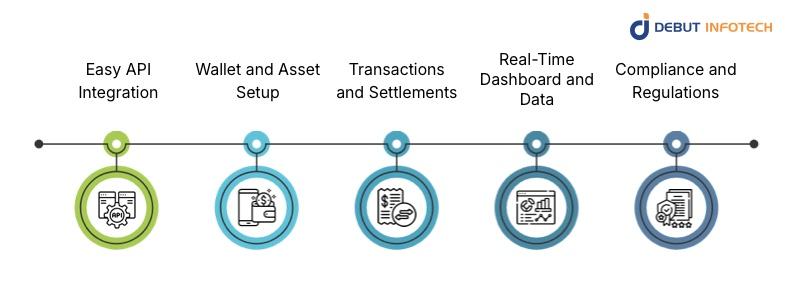
CaaS platforms provide APIs and SDKs that connect applications to blockchain networks without exposing the complexity of the underlying protocols. These interfaces handle transaction creation, signing workflows, and network interactions. Development teams or top cryptocurrency companies integrate crypto features into existing systems. At the same time, the provider manages nodes, upgrades, scaling, and availability behind the scenes.
Decentralized wallet infrastructure is provisioned through configurable services that support custodial, non-custodial, or hybrid models. Businesses define asset rules, user permissions, and recovery processes without directly managing private keys. This approach simplifies onboarding, improves operational safety, and supports multiple digital assets from a single control layer.
Transactions are processed through managed pipelines that handle fee calculation, broadcasting, confirmations, and settlement tracking. Many platforms optimize transactions using batching or internal settlement logic to reduce costs. This structure delivers predictable performance and reliable settlement outcomes, even during periods of high blockchain network activity.
Crypto as a service platforms include dashboards that present balances, transaction status, user activity, and operational metrics in real time. These tools remove the need to analyze raw blockchain data directly. Finance, compliance, and operations teams gain accurate visibility for reconciliation, reporting, and ongoing performance monitoring.
Compliance frameworks are embedded into core workflows, covering KYC verification, AML screening, transaction monitoring, and regulatory reporting. Policies are enforced automatically at the infrastructure level. This allows businesses to operate crypto services within regulatory boundaries while maintaining consistent governance, audit readiness, and jurisdiction-specific compliance requirements.
CaaS removes the need for dedicated blockchain infrastructure, security teams, and protocol specialists. Businesses avoid high upfront investment and ongoing maintenance expenses. Instead, costs are tied to usage and scale gradually as adoption increases, making budgeting simpler and reducing financial risk during early deployment stages.
With prebuilt infrastructure and standardized APIs, CaaS significantly shortens development timelines. Teams or crypto wallet development services integrate crypto functionality into existing products without long research or testing cycles. This allows faster validation of use cases, quicker market entry, and earlier feedback from users before committing to deeper investments.
CaaS platforms are designed to scale across users, assets, and regions without architectural changes. New blockchains, features, or compliance rules can be added through configuration updates. This flexibility supports long-term growth and allows businesses to adapt their crypto offerings as market and regulatory conditions change.
Security controls are implemented at multiple levels, including key isolation, access management, transaction limits, and continuous monitoring. These protections align with institutional standards and reduce exposure to operational errors and external threats. Businesses benefit from hardened security without building or maintaining complex internal defense systems.
Built-in compliance tooling ensures regulatory checks are applied consistently across users and transactions. Identity verification, monitoring, and reporting are automated within workflows. This reduces manual effort, lowers compliance risk, and supports expansion into regulated markets while maintaining clear audit trails and governance controls.
Exchange-as-a-Service enables businesses to launch branded crypto trading platforms without building matching engines, liquidity connections, or custody systems. The provider manages order execution, pricing feeds, and infrastructure reliability. At the same time, the business focuses on user experience, asset listings, and regulatory positioning across the markets it supports.
Crypto wallet as a service provides ready-made wallet infrastructure for storing, sending, and receiving digital assets. It supports custodial, non-custodial, or hybrid setups with configurable permissions.
Wallet-as-a-service for crypto platforms simplifies user onboarding, key management, and asset tracking while maintaining consistent security and recovery standards.
Payments and Banking-as-a-Service solutions enable crypto-based payments, onramps, offramps, and account-like services. Businesses can accept digital assets, settle in fiat or stablecoins, and manage transaction flows without handling blockchain complexity. These tools support commerce, remittances, and financial applications at scale.
Rollup-as-a-Service helps projects deploy and manage layer-2 solutions without deep protocol engineering. Providers handle sequencing, data availability, and infrastructure operations. This allows teams to improve scalability and reduce transaction costs while maintaining security guarantees tied to the underlying base blockchain network.
Staking and Yield-as-a-Service enable businesses to offer passive earning features without managing validator infrastructure. The platform handles staking operations, reward distribution, and risk controls. This supports compliant yield products while giving users access to staking benefits through a simplified, managed interface.
White-label crypto-as-a-service solutions deliver end-to-end crypto platforms that can be branded and customized. These offerings typically include wallets, trading, payments, dashboards, and compliance modules. Businesses reduce time-to-market while retaining ownership of the user relationship and overall product positioning.
Compliance-as-a-Service focuses on regulatory requirements, including KYC, AML, transaction monitoring, and reporting. These services integrate directly into crypto workflows, ensuring policies are enforced automatically. This allows businesses to meet regulatory obligations without building internal compliance infrastructure from the ground up.
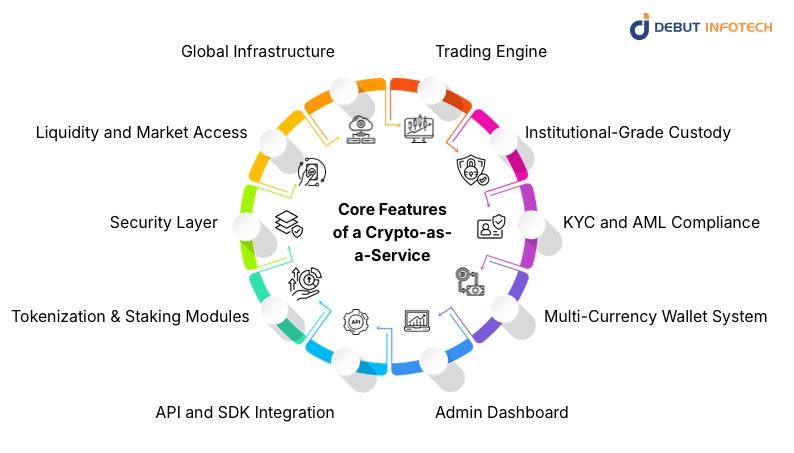
A trading engine manages order placement, matching, pricing, and execution across supported assets. It connects to liquidity sources while maintaining performance under load. This feature ensures predictable execution quality and supports both retail and institutional trading use cases within a managed environment.
Institutional-grade custody secures digital assets using hardened infrastructure, key isolation, and strict access controls. It supports asset segregation, recovery policies, and audit readiness. This feature is essential for platforms managing user funds, treasury assets, or regulated financial products at scale.
KYC and AML modules verify user identities, screen transactions, and flag suspicious activity. These controls operate automatically within onboarding and transaction flows. By embedding compliance into the platform, businesses reduce regulatory risk while maintaining consistent enforcement across users and jurisdictions.
A multi-currency wallet system supports multiple blockchains and digital assets through a unified interface. Users manage balances and transactions without switching platforms. For businesses, this simplifies asset expansion and reduces operational complexity when supporting new tokens or networks.
The admin dashboard provides centralized control over users, assets, permissions, and system settings. It offers real-time visibility into activity and performance. Operations and compliance teams rely on this interface to manage risk, resolve issues, and maintain oversight without accessing low-level blockchain data.
APIs and SDKs allow developers to integrate crypto features into web, mobile, and backend systems. These interfaces abstract blockchain logic and standardize interactions. This accelerates ewallet app development, reduces errors, and ensures consistent behavior across applications and environments as products scale.
The tokenization and staking modules support asset issuance, governance tokens, and yield mechanisms without requiring custom smart contract development. These tools include controls for supply, rewards, and permissions. Businesses can launch structured crypto products while maintaining operational consistency and reducing technical risk.
The security layer includes encryption, access controls, transaction limits, anomaly detection, and incident response mechanisms. These safeguards operate continuously to protect assets and data. By embedding security into the platform, businesses reduce exposure to breaches, internal errors, and operational failures.
Liquidity and market access features connect platforms to aggregated trading venues and liquidity providers. This improves pricing accuracy, reduces slippage, and supports reliable execution. Such access is critical for exchanges, payment services, and treasury operations that depend on efficient asset conversion.
Global infrastructure ensures low latency, high availability, and regional redundancy across supported markets. It enables platforms to serve users worldwide while meeting local compliance and performance expectations. This foundation supports business expansion without fragmenting operations or duplicating technical systems.
eCommerce platforms use CaaS to support a crypto payment gateway without managing wallets, volatility exposure, or settlement logic internally. Merchants can support stablecoins, instant conversion to fiat, and cross-border payments through existing checkout flows. This expands payment options, reduces chargeback risk, and opens access to international customers while keeping accounting, reporting, and compliance processes aligned with existing commerce operations at scale across regions and currencies reliably and securely.
Gaming projects use CaaS to power in-game assets, marketplaces, and player-owned economies without running blockchain infrastructure. Wallets, NFT minting, and asset transfers are handled through APIs, allowing studios to focus on gameplay balance and user retention. This supports scalable economies, secondary markets, and cross-platform asset ownership while maintaining security, moderation controls, and compliance, as required, across live-service games and evolving player communities globally.
Remittance apps adopt CaaS to enable faster cross-border transfers using crypto rails while shielding users from blockchain complexity. Stablecoins reduce settlement delays and friction in currency conversion.
Providers handle liquidity, compliance, and monitoring, enabling apps to offer lower fees, transparent pricing, and near-real-time transfers while integrating seamlessly with local payout systems and financial partners across regions with limited banking access and high transfer demand globally.
Enterprises use CaaS to manage treasury operations, digital asset custody, and blockchain-based workflows without rebuilding internal systems. Crypto services integrate with existing ERP, accounting, and risk frameworks. This allows controlled exposure to digital assets, improved settlement efficiency, and experimentation with tokenized assets while maintaining governance, auditability, and internal approval processes across departments and jurisdictions with clear operational oversight and defined risk boundaries for leadership teams.
Banks and fintechs use CaaS to launch regulated crypto products without disrupting core banking infrastructure. Services include custody, trading, payments, and compliance tooling integrated into existing platforms. This approach supports faster product rollout, controlled regulatory exposure, and customer demand for digital assets while preserving risk management standards and supervisory reporting obligations across retail and institutional customer segments in multiple regulated markets worldwide over time securely.
Stripe uses crypto-as-a-service infrastructure to support stablecoin payments for over 500,000 businesses globally. By abstracting blockchain operations, Stripe enables merchants to accept digital dollars with familiar payment flows, automated settlement, and compliance controls, reducing friction for businesses that want crypto functionality without operational complexity or overhead.
PayPal integrates crypto services via managed infrastructure, enabling users to buy, hold, and spend digital assets. CaaS components handle custody, compliance, and transaction processing, allowing PayPal to extend crypto functionality across its existing payment ecosystem while maintaining regulatory alignment and a consistent user experience.
Axie Infinity relies on crypto service providers to manage wallets, transactions, and scaling for its blockchain-based game economy. This approach allows the team to focus on gameplay and community growth while supporting millions of asset transfers, marketplace activity, and reward distribution without operating full blockchain infrastructure internally.
Tesla has accepted cryptocurrency payments by relying on third-party crypto service infrastructure for payment processing and conversion. Using managed services enables Tesla to experiment with digital asset payments while limiting operational exposure, efficiently handling settlements, and aligning crypto acceptance with existing financial and reporting systems.
Microsoft supports blockchain-based payments and services through cloud-integrated crypto infrastructure rather than proprietary chains. By enabling crypto services within its ecosystem, Microsoft allows partners and developers to build compliant blockchain applications while relying on managed security, scalability, and operational tooling for enterprise-grade deployments worldwide securely.
Many businesses assume crypto adoption means direct exposure to price swings and unstable assets. This view often treats all crypto as speculative instruments, ignoring the availability of stablecoins, controlled settlement mechanisms, and configurable exposure models within modern crypto infrastructure.
How to Address It
CaaS platforms support stablecoins, instant fiat conversion, and settlement controls that limit price exposure. Businesses can offer crypto payments or transfers without holding volatile assets, allowing crypto functionality to operate as a utility layer rather than a speculative balance-sheet risk.
Organizations often believe crypto requires building complex compliance operations from scratch. This includes fears around KYC, AML, transaction monitoring, reporting obligations, and ongoing regulatory updates, which can be overwhelming for teams without prior experience in blockchain or regulatory infrastructure.
How to Address It
Modern CaaS platforms embed compliance directly into transaction and onboarding workflows. Identity checks, monitoring, and reporting are automated at the infrastructure level, allowing businesses to meet regulatory expectations without maintaining separate compliance systems or expanding internal legal and operational teams.
Some businesses assume low-visibility demand means crypto features lack value. This overlooks cases where users expect digital asset support as a background capability, similar to international payments, faster settlement, or alternative payment methods integrated quietly into existing products.
How to Address It
CaaS allows businesses to introduce crypto features incrementally and measure real usage. Stablecoin payments, faster cross-border transfers, or asset custody can be offered without heavy promotion, enabling data-driven decisions based on adoption rather than assumptions about customer interest.
Debut Infotech supports businesses building crypto products without forcing them into rigid infrastructure choices. As a top-notch crypto development company, our Crypto-as-a-Service offerings include wallets, payments, exchanges, compliance tooling, and security layers, delivered through modular, production-ready systems. The focus stays on reliability, regulatory alignment, and long-term scalability, helping enterprises and fintech teams deploy crypto functionality with clear operational controls, predictable timelines, and reduced technical risk across markets.
Crypto-as-a-Service offers a practical path for businesses to integrate support for digital assets without building blockchain systems from scratch. By uniting payments, wallets, compliance, and trading into a modular infrastructure, CaaS reduces technical complexity and accelerates deployment. As stablecoin usage and crypto adoption expand across industries, CaaS enables companies to deliver compliant, secure crypto experiences tailored to their users and markets.
Crypto-as-a-Service fits fintech startups, banks, payment providers, marketplaces, and SaaS platforms that test crypto features. It also works for enterprises that want crypto exposure without hiring blockchain specialists. If speed, compliance support, and lower technical risk matter, this model usually makes sense.
Security depends on the provider’s infrastructure, audits, and custody model. Reputable platforms use encryption, multi-signature wallets, and regulatory checks like KYC and AML. While risk never disappears, using an established Crypto-as-a-Service provider is usually safer than building everything internally.
Most Crypto-as-a-Service platforms cover crypto wallets, payment processing, fiat on-ramps, off-ramps, custody, transaction monitoring, and basic compliance tools. Some providers add staking, tokenization, or NFT support. The exact mix depends on whether the service targets retail users or enterprise use cases.
Most businesses integrate Crypto-as-a-Service within 4 to 8 weeks. Simple payment or wallet setups can go live faster. More complex use cases, like custody or multi-region compliance, take longer. Timelines depend on API readiness, internal approvals, and regulatory checks.
When enterprises evaluate the crypto company Conduit on rollup as a service, they usually focus on deployment speed, tooling maturity, uptime, and cost predictability. Strong documentation, solid security practices, upgrade flexibility, and clear support terms matter too, especially when rollups move from testing into real production workloads.

Our Latest Insights
USA
2501 Chatham, Rd Suite R Springfield, IL 62704
+1-708-515-4004
info@debutinfotech.com
UK
7 Pound Close, Yarnton, Oxfordshire, OX51QG
+44-770-304-0079
info@debutinfotech.com
Canada
154 Eden Oak Trail, Kitchener, ON N2A 0H9
+1-708-515-4004
info@debutinfotech.com
INDIA
Sector 101-A, Plot No: I-42, IT City Rd, JLPL Industrial Area, Mohali, PB 140306
9888402396
info@debutinfotech.com