ON THIS PAGE
Progress0%






Our Global Presence :





The architecture of Node.js was created around newer applications where performance of speed, scale and real-time are important. Rather than receiving requests sequentially, Node.js is non-blocking and event-driven provides applications with the ability to remain responsive even when traffic is high. This is why it is one of the most popular solutions to use in e-commerce platforms, fintech systems, streaming, and collaborative tools. In fact, the Stack Overflow Developer Survey shows a consistent chart of Node.js being the most commonly used web framework and its high usage as a web framework in production-ready applications.
In this article, we shall examine a little more closely how Node.js architecture can work so well in systems that have many users and why it is a good back-end option when developing scalable and high-performance applications.
The architecture of Node.js is designed in such a way that it can accommodate the high-traffic, 24/7 applications in the modern world without being sluggish. Unlike conventional systems which open up a new thread each time a request is made, Node.js uses a single threaded event loop, which can handle numerous operations simultaneously. This is to enable applications to remain responsive with less use of system resources.
The fact that Node.js fits well in user-centric applications such as streaming platforms, real-time collaboration flows, and interactive web experiences makes it a very good fit. There is no queue to wait in, requests are faster to respond to, even when there are thousands of users using the app at a specific time. It is also the reason behind the popularity of Node.js in a microservices architecture, whereby services are required to interact rapidly and in an independent manner.
Google also has a V8 JavaScript engine that enhances performance. V8 does not interpret line by line, but it compiles JavaScript directly to machine code and this enables the applications to run faster and better. This mix of smart execution and non-blocking design combined, makes Node.js a trusted platform on which one can build high performance, scalable applications.
When building a tech stack for web development, Node.js is quite a well-known program, and justifiably so. In 2026, businesses such as Netflix, PayPal, and GitHub will still use it to operate key functions of the company. It is not merely hype because Node.js solves one of the largest performance issues in large-scale apps.
In most systems, slowdowns occur not due to the CPU being overworked, but due to I/O operations, such as reading files, responding to database queries, or responding to network requests, becoming congested. This is addressed by Node.js which is an event-driven, non-blocking architecture with which a large number of requests can be processed at the same time. The result? Reduced latency, lower infrastructure expenses and capability to implement new features at a lower rate and performance.
For companies, it would translate to easier user experience, increased interaction, and a back-end that can scale with their application. To put it briefly, Node.js is not merely a technology; but a strategic decision to make when creating scalable, efficient and future-proven applications.
The performance of your backend on requests can be of immense importance when developing a big, real-time app. Traditional blocking architecture handles only one task at a time, this implies that any new request must wait until the previous request is completed. This may cause frustrating delays and poor user experiences under heavy traffic.
The event-driven architecture of Node.js, which is its largest difference, does not make users wait, as multiple tasks can be handled at the same time in Node.js. This maintains the low response times, usage of less server resources and delivers easier interactions even in heavy traffic. To provide an example, a collaborative editing system having 10,000 users simultaneously editing would have difficulty with a standard blocking server, which would result in visible latency. Using Node.js, everything can be updated at the same time, making the experience smooth to all users.
This is a strategy that not only enhances performance and user satisfaction but also aids businesses to save on the cost of infrastructure since few threads and resources are used to process large traffic effectively.
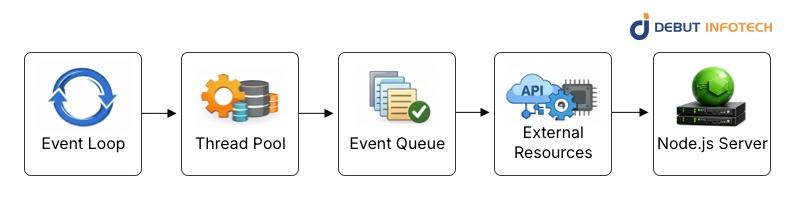
By layered architecture of Node.js, we do not merely mean being familiar with the building blocks, but rather the interaction of these components, and how they can be combined to provide fast, scalable and resilient applications. Here’s a closer look at the key components and how they interact in a real-world setup:
Event Loop
In Node.js, the event loop is its core, which can be considered a traffic controller that ensures incoming traffic is handled effectively without other incoming traffic being blocked. It is this non-blocking mechanism that enables Node.js to support thousands of connections at the same time.
Thread Pool (Libuv)
Whereas the event loop maintains a continuous flowing traffic, the thread pool is considered as the background worker. Activities such as file operations or database queries are offloaded in this location and the main loop is left to proceed with the requests immediately.
Event Queue
The event queue is used to arrange tasks to be processed. In a layered architecture, this queue makes sure that each layer has smooth and sequential execution at that point of routing, business logic or data access without any bottlenecks.
External Resources
There are operations, like a CPU-intensive calculation, or some API calls made to third parties, that cannot be entirely asynchronous. They are managed by external means, not letting them slow down the main event loop and interrupt other layers.
Node.js Server
The Node.js server unites all the elements in the middle of it all. The different layers interact in a clean and independent manner that makes the architecture modular, maintainable and scalable.
When Things Go Wrong
Even with a solid layered architecture, issues can occur:
With this knowledge, and the traps to avoid, you will be able to build applications using Node.js layered architecture that not only perform well, but also scale and have the ability to support real-world workloads without contributing to user experience deterioration.
Learning about Node.js frameworks is not just another theory-driven task, but rather a practice of applying patterns that are known to work in the field. Let’s look at the strategies developers rely on to build fast, scalable, and maintainable applications.
Microservices
Microservices use separate, smaller, and autonomous services to divide a large application, in other words, to separate authentication, payments, and notifications. This enables scaling to be easier as well as enables teams to build or upgrade a single service without affecting the entire system. However, in the case of smaller apps, microservices can introduce unwarranted complexity, which is why it is important to make a wise choice.
Singletons and Dependency Injection
Singletons are only a single object of a module that can be duplicated in your application, however, when they are not managed, they may lead to memory leaks or unsafe behavior. Dependency injection (DI) is the solution to this because it offers resources outside of your experience and you write cleaner and, therefore, easier to test codes.
Concurrency with Promises and Async/Await
Node.js is a platform that works well when it deals with many tasks. Using Promises and async/await lets you run asynchronous operations concurrently—Promise.all is great for running multiple API calls or database queries at the same time. Always keep in mind, failure of one task may impact other tasks unless it is managed well. Adequate concurrency patterns maintain your application to be responsive and reliable even when it is under heavy load.
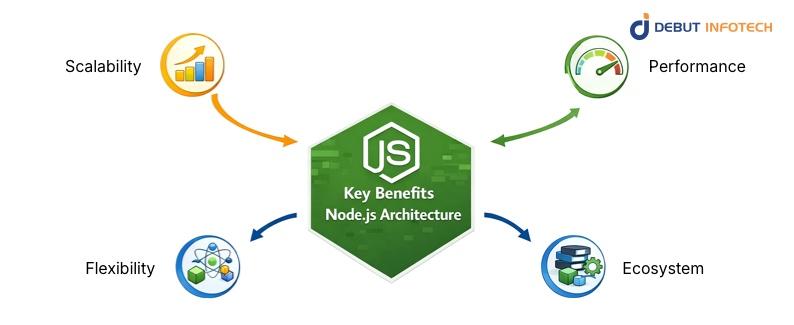
With these design patterns, the applications created using the Node.js frameworks are not only functional, but fast, scalable, and great to operate under the conditions of the real world. Here’s how Node.js architecture delivers measurable benefits:
Node.js is capable of responding to growing traffic and more complicated applications without needing to be rewritten entirely, allowing your business to grow seamlessly as the traffic increases.
Increased response times and better Core Web Vitals implies better, more responsive experience, keeping visitors more engaged and lowering the bounce rates.
Node.js supports microservices, and multiple technology stacks, which means that your development team can change hardware and software rapidly to keep up with the business requirements.
Its extensive library of modules and developer community also facilitates quicker development allowing your team to deliver new features to market at a faster rate.
To the businesses interested in getting high quality web development services, developing on Node.js will guarantee them applications that are not only functional but also scalable, high-performing, and capable of responding to the demands of real-life situations.
In order to create scalable architecture using Node.js, the architectural decisions usually determine the success. In custom software development, such choices have a direct influence on the application performance, its adaptation, and its development over a period of time. On the one hand, Node.js architecture provides teams with the freedom to scale, although this can only be achieved by adhering to the best practices.
1. Use a layered architecture
Responsibilities are well-defined by separating your application into clear layers which include controllers, services and data access. This architecture simplifies the scaling of separate components of the system, troubleshooting, and the addition of new features without affecting the whole application.
2. Apply dependency injection
Dependency injection assists in the reduction of tight coupling among components by providing such dependencies outside of them instead of building them internally. This will enhance testability, cleaner architecture and enable the teams to modify or substitute services as requirements keep evolving.
3. Handle asynchronous errors properly
Error management cannot be an afterthought because Node.js is based on heavy use of asynchronous operations. When using a proper approach in dealing with the errors of async, it is possible to avoid crashing unexpectedly, keep the event loop safe, and maintain the stability of the application under heavy load.
4. Manage configuration through environment variables
The configuration and sensitive data stored in environment variables makes your application safe and ready to be deployed. It also facilitates easier execution of the same code base in both environments without having to execute it manually.
5. Use compression and caching to improve performance
Compression and caching of popular data can be used to reduce the size of responses in order to reduce latency and server load. Such optimizations are made more significant with increased traffic.
6. Enforce linting and coding standards
Linting tools and shared style guides promote consistent, readable code across teams. This does not only minimize bugs, but also makes large applications based on Node.js easier to maintain as they grow.
The combination of these practices makes Node.js architecture provide reliable performance, long-term scalability, and maintainability, which are the essential requirements of creating modern and production-ready applications.
Node.js is very powerful in most of the modern applications, yet it is not the best in all cases, and being conscious of its boundaries helps teams make more effective architectural choices. When pushed beyond its intended purpose, Node.js may become slow in performance and even cause Node.js security issues when important processes begin to block the event loop.
As an example, CPU-heavy tasks such as scientific computations or other intricate information processing do not happen to be a good fit. These duties have the ability to saturate the single thread and impact the responsiveness of the whole app.
The same applies to long-running synchronous operations. Processes that take long durations without any control are the ones that limit the system to serve other users effectively.
Lastly, poorly designed monolithic applications may make Node.js a maintenance nightmare. Lack of modular boundaries means that the applications will be more difficult to scale, debug, and protect as time progresses.
To sum up, the Node.js architecture will achieve its optimum performance when combined with the appropriate workloads and prudent design. When applied in its proper context, it works. When it is applied improperly, it may cause unnecessary performance and reliability problems.
So, is Node.js architecture the right backend for your application?
The answer depends on what your product actually needs to do. Node.js architecture would be a great fit in practice if you are developing an I/O-intensive, real-time, or highly scalable application, like a fintech platform, e-commerce platform, streaming application, or collaborative application. Non-blocking and event based design enables its applications to be able to cope with high traffic whilst also providing users with high-speed and responsive experiences.
With that said, highly CPU intensive workloads might need an alternative or a hybrid architecture.
This is where experience makes the difference. As a leading Node.js development company, Debut Infotech helps businesses choose, design, and optimize the right backend architecture from the start, so performance and scalability never become bottlenecks.
Ready to see if Node.js is the right fit for your product? Talk to Debut Infotech and get expert guidance tailored to your application.
A. No, Node.js is not a full-stack framework.No, Node.js is not a full-stack framework. It is a JavaScript runtime that executes JavaScript on the server-side enabling developers to use it outside of the browser. Node.js is primarily used for backend development and is used to write server logic, API and data processing.
A. Not at all. As a matter of fact, the use of Node.js is steadily increasing. It is still a major technology in backend and full stack development. Millions of sites are based on it, and such large corporations as Netflix, PayPal, and LinkedIn utilize Node.js to run their apps.
A. No. Node.js is not a programming language, it’s a runtime environment. It gives you the ability to execute JavaScript code out of a browser. The major distinction is the place where the code executes and what it is capable of. Although JavaScript is traditionally executed in a browser, Node.js allows running it on servers to provide your applications with file access, databases, and network access.

Our Latest Insights
USA
2501 Chatham, Rd Suite R Springfield, IL 62704
+1-708-515-4004
info@debutinfotech.com
UK
7 Pound Close, Yarnton, Oxfordshire, OX51QG
+44-770-304-0079
info@debutinfotech.com
Canada
154 Eden Oak Trail, Kitchener, ON N2A 0H9
+1-708-515-4004
info@debutinfotech.com
INDIA
Sector 101-A, Plot No: I-42, IT City Rd, JLPL Industrial Area, Mohali, PB 140306
9888402396
info@debutinfotech.com