ON THIS PAGE
Progress0%






Our Global Presence :






P2P cryptocurrency exchange development cost depends on platform scope, with MVP, full-scale, and enterprise builds varying based on compliance, wallet architecture, security, and infrastructure requirements.
Core cost drivers extend beyond feature count, including escrow design, multi-chain wallet infrastructure, KYC/AML workflows, fiat payment integrations, and security controls.
Infrastructure and operational expenses should be budgeted alongside development, covering cloud hosting, blockchain nodes, monitoring, key management, compliance services, and ongoing maintenance.
Regulatory compliance significantly influences total investment, as jurisdiction-specific requirements such as AML, Travel Rule readiness, licensing, and reporting directly affect product architecture and implementation.
P2P exchanges are generally more cost-efficient than centralized exchanges (CEXs) for initial launches, although advanced custody, mobile apps, and enterprise-grade compliance can narrow the cost gap.
A phased implementation strategy helps control development costs, allowing businesses to launch a secure MVP first and add advanced capabilities like additional payment rails, reputation systems, and multi-chain support as demand grows.
Successful budget planning balances short-term launch goals with long-term scalability, ensuring the platform can expand without costly architectural rebuilds while maintaining security, compliance, and operational efficiency.
The cost of p2p crypto exchange development in 2026 is not the same as a few years ago. New budget requirements include stricter compliance checks, robust wallet protection, multi-chain asset support, payment rail integrations, escrow reliability, dispute management, and production-ready infrastructure. According to Grand View Research, demand is still moving in the right direction, with the global cryptocurrency exchange platform market projected to reach $264.3 billion by 2030, growing at a 28.4% CAGR from 2024 to 2030.
As a startup founder, CTO, or exchange operator, the challenge is to create an affordable platform at launch which can operate safely. A simple MVP can be developed around the user onboarding, KYC, escrow, admin dashboards and some local payment methods. For a full-scale platform, automation of compliance procedures, multi-chain wallets, advanced fraud monitoring, liquidity tools and regional payment support are expected.
This guide gives you a practical cost view across tiered build models, feature-by-feature pricing, infrastructure expenses, compliance costs by jurisdiction, P2P vs CEX development costs, hidden post-launch costs, and white-label vs custom exchange development. You can also use the cost calculator to plan a more accurate budget.
The p2p cryptocurrency exchange development cost in 2026 largely depends on the extent to which you want to own, automate, secure and regulate your platform from the beginning.
A basic MVP might suffice to gauge market demand in one market. A full build provides increased trading, compliance, mobile and operations capability. An enterprise-grade platform is designed for more transactions, increased compliance, greater reporting depth and sustainable growth.
| Build Tier | What It Includes | Estimated 2026 Cost | Timeline | Best Fit |
| MVP / Basic | Core registration, basic KYC, P2P ad posting, escrow flow, simple wallet, admin dashboard, and basic security testing | $35,000 to $60,000 | 3 to 5 months | Startups validating user demand in one target market |
| Full / Standard | MVP features plus advanced KYC and AML, fiat payment rails, mobile apps, trader ratings, dispute workflow, operational reporting, and stronger platform security | $90,000 to $180,000 | 6 to 9 months | Funded startups, fintech product teams, and regional exchange operators |
| Enterprise / Regulated | Full build plus multi-chain wallet support, compliance modules, Travel Rule readiness, audit-grade reports, penetration testing, smart contract audit, advanced admin suite, and scalable infrastructure | $180,000 to $300,000+ | 10 to 14 months | Regulated fintechs, cross-border platforms, and high-volume P2P exchange operators |
The above figures are planning ranges and not fixed prices. This final budget will depend on the wallet architecture, custody model, payment integrations, liquidity strategy, compliance region, security needs, admin workflow and the decision to opt for custom development or white label crypto exchange software.
For instance, a startup with an initial P2P platform launch in a country that offers local bank transfer processing, has simple escrow and manual dispute resolution may be close to an MVP tier. However, once it introduces automated AML screening, mobile apps, various fiat payment options, multi-chain wallet support and audit-ready compliance reports, the cost shifts to full or enterprise level.
The cryptocurrency exchange platform market is expected to grow from $54.8 billion in 2025 to $68.85 billion in 2026, reflecting a 25.6% CAGR. As founders and CTOs, a key question to ask is not just “How much does it cost to build?” It is also “Which version of the platform can we operate safely, support properly, and scale without rebuilding too soon?”
Planning note: All ranges shown are estimates. Actual P2P cryptocurrency exchange development cost depends on scope, wallet model, payment rails, compliance region, security expectations, and selected features. Use Debut Infotech’s P2P exchange cost calculator for a project-specific estimate.
The p2p cryptocurrency exchange development cost depends on more than the number of screens or user features. A P2P exchange is a trading product, a wallet system, a compliance workflow, a payment operations layer, and a security infrastructure stack in one platform.
That is why two vendors can quote very different prices for what appears to be the same idea. One may be pricing a simple web-based MVP with centralized escrow and one fiat rail. Another one could be approximating a regulated, multi-chain platform that has advanced KYC, mobile apps, fraud monitoring and institutional-grade wallet security.
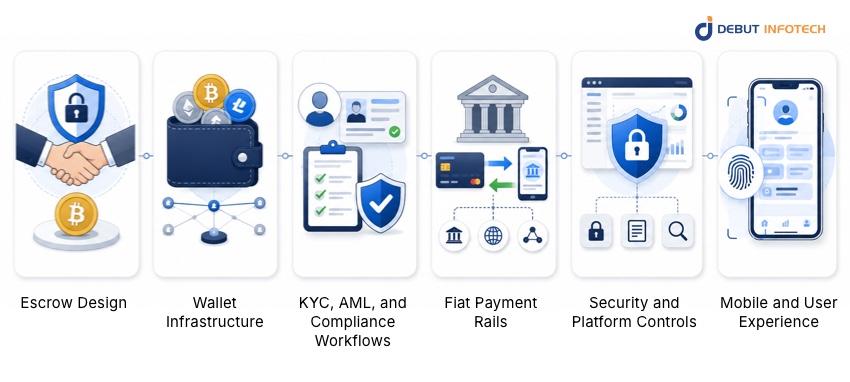
Here are the key factors that influence the final budget.
The escrow method is the method used in a trade to secure crypto and unlock it once payment is confirmed. This also impacts refunds, disputes, cancellations and admin intervention. This is a core part of how P2P cryptocurrency exchange development works because escrow connects user trust, transaction flow, and platform risk.
A centralized escrow system is usually faster and less expensive to launch because the platform controls the trade logic on its backend. This is common for MVPs and early-stage P2P marketplaces.
A smart contract escrow system requires deeper blockchain engineering. The team must design, test, optimize, and audit the contract logic before users rely on it. If the exchange supports escrow across several chains, the budget increases because each chain introduces different transaction behavior, fees, confirmation times, and security risks.
Wallet architecture can quickly become one of the largest cost drivers. A basic custodial wallet is not the same as a full wallet infrastructure with HD wallets, multi-chain support, hot and cold wallet separation, withdrawal limits, and automated balance reconciliation.
For platforms that custody user assets, key management is a serious infrastructure decision. MPC, HSMs, multi-signature approvals, treasury controls, and withdrawal monitoring all add cost, but they also reduce operational risk.
This means wallet development affects both the initial build and the ongoing cost of running the exchange safely.
Compliance cost depends on where the exchange operates, what payment methods it supports, and how much risk the business is willing to manage internally.
A basic KYC flow may only verify identity documents. A more complete setup may include sanctions screening, politically exposed person checks, transaction monitoring, risk scoring, suspicious activity review, and compliance case management.
Travel Rule readiness can add another layer of cost because the platform may need to collect and transmit required sender and receiver information for certain transactions.
Fiat payment support is often underestimated. Integrating UPI, SEPA, ACH, bank transfers, card payments, mobile money or local payment providers isn’t only a technical integration issue.
Each rail will need to handle payment status, reconcile, report settlement, process failed transactions, manage disputes, and in some cases, manage chargebacks. It also affects the compliance review process because different rails carry different fraud and regulatory risks.
For example, a single-country platform using bank transfers only will usually cost less than a multi-country platform supporting bank transfers, cards, mobile money, and local instant payment systems.
Security should be planned from the beginning, not added after launch. It influences the backend architecture, admin access, wallet functions, trade tracking, and handling of disputes.
Some of the key cost considerations are penetration testing, smart contract audits (if applicable), admin permissions by role, audit logs, fraud detection, rate limiting, key management, withdrawal approval workflows, and incident response planning.
A lower development quote could simply be due to the fact that these controls have not been integrated.
The user experience also impacts cost. A responsive web app is typically the cheapest approach to an MVP. Cross-platform mobile development can be cost-effective when compared to native applications.
But if users are primarily engaging in mobile transactions, native iOS and Android apps might be commercially required in markets. Mobile introduces additional tasks for biometric login, push notifications, device testing, app store approval, release updates, and additional security checks for mobile devices.
In summary, the true expense of a P2P exchange will depend on the way the exchange stores the money, verifies users, processes payments, manages risk, and provides trading services following the launch.
A P2P exchange budget becomes easier to understand when each feature is tied to its business purpose, technical complexity, and launch priority. The table below provides an illustrative, feature-by-feature comparison of estimated 2026 costs. These figures are designed for planning purposes only and are subject to change based on region, compliance, vendor pricing, integration and customization requirements.
| Feature Area | What the Feature Does | Why It Affects Cost | Estimated 2026 Cost | Best Launch Decision |
| User Registration & Authentication | Enables account creation, email or phone verification, 2FA, password reset, and session control | Cost depends on security rules, login methods, device tracking, and fraud-prevention requirements | $3,000–$7,000 | Build in MVP |
| KYC/AML Integration | Connects the platform to identity verification, sanctions screening, and user risk checks | Provider setup, compliance workflow, manual review screens, and monitoring rules increase cost | $7,000–$18,000 | Build early if operating in regulated markets |
| Escrow System | Locks crypto during a trade and releases funds after buyer-seller confirmation | More complex logic is needed for cancellations, timeouts, evidence review, and dispute handling | $10,000–$25,000 | Build in MVP |
| Trade Advertisement Engine | Allows users to create buy/sell offers with limits, prices, payment methods, and trading terms | Cost rises with dynamic pricing, filters, trader limits, and location-based payment options | $5,000–$12,000 | Build in MVP |
| Wallet Infrastructure | Handles deposits, withdrawals, addresses, balances, and transaction syncing | Multi-currency support, HD wallets, hot/cold wallet setup, MPC, or HSM security can increase cost significantly | $12,000–$30,000 | Build core version first |
| Fiat Payment Rails | Supports bank transfers, UPI, SEPA, ACH, mobile money, cards, or local rails | Each rail adds integration, reconciliation, settlement tracking, dispute handling, and compliance work | $8,000–$25,000 | Start with priority markets only |
| Dispute Management | Gives admins tools to review failed trades, evidence, chats, and payment claims | Requires secure evidence upload, case logs, role-based admin access, and resolution tracking | $6,000–$15,000 | Build in MVP |
| Admin & Back Office | Allows the operator to manage users, trades, fees, permissions, reports, and risk events | The more operational control the platform needs, the more admin screens and audit logic are required | $10,000–$22,000 | Build in MVP |
| Reputation & Rating | Helps users assess trading partners through scores, ratings, feedback, and fraud flags | Basic ratings are cheaper; weighted trust scoring and fraud signals require more product logic | $3,000–$9,000 | Phase after MVP |
| Mobile Trading Apps | Provides iOS and Android access, push alerts, mobile onboarding, and mobile trade flow | Native apps cost more than a responsive web MVP, especially when wallet and KYC flows are included | $25,000–$60,000 | Phase unless mobile is critical |
| Security Audit / Pen Test | Tests the platform for vulnerabilities before launch | Cost depends on platform size, wallet exposure, admin complexity, and remediation support | $8,000–$40,000 | Do before launch |
| Smart Contract Audit | Reviews escrow or settlement smart contracts for vulnerabilities | Required only when smart contracts are used, but cost rises with contract complexity and chain coverage | $8,000–$50,000+ | Required for on-chain escrow |
These costs may not always be additive. Some vendors include user authentication, admin capabilities, trade ads, basic wallet logic and reporting in an MVP or full-build. Others charge a separate price for each module, particularly if the project is about to deploy a custom wallet infrastructure, have many fiat rails, advanced compliance workflows, or an escrow system that leverages smart contracts.
A basic web MVP doesn’t require all the advanced functionality on day one. While these are not required to be a core part of launching, escrow logic, admin permissions, audit logging, dispute resolution, and basic security controls should all be considered essential to launch. A few features, like mobile apps, advanced reporting, reputation scoring, additional payment options and broader multi-chain support, can be introduced in a gradual manner once the product has proven its demand and trading volume.
The development quote is only one part of the total p2p cryptocurrency exchange development cost. After the platform is live, you must also account for the necessary infrastructure to support trading, wallets, payments, user records, security checks and dispute workflow running reliably.
The cost for infrastructure can begin anywhere from a few thousand dollars per month for a small MVP. The monthly expenses can add up rapidly on a high-volume platform that hosts multiple blockchains, fiat payment systems, more rigorous compliance measures and higher standards for uptime.
| Infrastructure Item | What It Covers | Estimated Cost |
| Cloud hosting and compute | API servers, admin backend, trading engine, autoscaling, background jobs | $500 to $5,000+ per month |
| Database and storage | User records, trade history, chat records, evidence files, wallet activity, audit logs | $200 to $2,000+ per month |
| Blockchain nodes or RPC providers | RPC calls, node access, transaction monitoring, indexing, uptime checks | $300 to $3,000+ per month |
| Wallet security and key management | HSM, MPC wallet provider, cold wallet process, custody controls | $1,000 to $10,000+ per month or custom pricing |
| Monitoring and observability | Logs, metrics, uptime alerts, fraud signals, incident tracking | $200 to $2,500 per month |
| KYC/AML provider usage | Identity checks, sanctions screening, risk scoring, ongoing monitoring | Per-check or monthly pricing |
| Security testing | Penetration testing, wallet review, smart contract audit, remediation checks | One-time cost plus periodic retesting |
| Backup and disaster recovery | Backup storage, failover setup, recovery drills, redundancy | $200 to $2,000 per month |
Infrastructure costs are not fixed because they depend on how the exchange is designed and how much activity it handles. A platform that supports only Bitcoin and USDT will usually have a different cost profile from one that supports several chains, multiple wallet types, and high-frequency trading activity.
Your custody model has a direct impact on infrastructure cost. Even with a non-custodial or semi-custodial model, the platform may still need escrow logic, transaction monitoring, wallet activity tracking, and dispute evidence capture.
A custodial exchange usually requires higher investment in wallet protection, key management, withdrawal controls, internal approvals, and audit trails.
Payment integrations also affect operating cost. If the exchange supports bank transfers, mobile money, card payments, and local payment providers across multiple markets, you will need more integration work, reconciliation logic, dispute tracking, payment status monitoring, and fraud controls.
Compliance depth is another major pricing factor. Basic KYC may be charged per identity check, but enhanced AML monitoring, sanctions screening, transaction risk scoring, and case management can increase monthly expenses.
These costs should be included in your p2p exchange development pricing model from the beginning, not treated as an afterthought.
A realistic 2026 P2P exchange budget should include both build cost and operating cost, because infrastructure, security monitoring, and compliance workflows continue after launch.
Compliance is not a fixed line item in a P2P exchange budget. It changes with the market you enter, the way your platform handles customer funds, the payment methods you support, and the level of regulatory supervision in that jurisdiction. This is why two platforms with similar features can have very different compliance budgets.
Note: This section is for planning purposes only and is not legal advice. In advance of building or launching, your regulatory position should be reviewed by qualified legal counsel in each market of interest.
| Jurisdiction / Market | Likely Compliance Workload | Budget Impact | Planning Consideration |
| European Union / MiCA | CASP authorization planning, governance controls, AML processes, Travel Rule readiness, user disclosures, and operational policies | High | MiCA creates a clearer route for regulated crypto service providers, but it also increases the need for structured compliance workflows and documentation |
| United States | Federal and state review, money transmission analysis, FinCEN AML program, sanctions controls, consumer protection, and possible state licensing | High to very high | The US can become expensive because obligations may vary by state, custody model, and fiat payment arrangement |
| United Kingdom | FCA cryptoasset registration, AML controls, financial promotion rules, risk warnings, and operational resilience planning | High | Compliance can affect onboarding, marketing, disclosures, monitoring, and how the platform communicates risk to users |
| India | FIU-IND registration planning, AML posture, tax reporting considerations, and local payment limitations | High | India may offer strong market demand, but compliance, tax, banking, and payment access should be assessed early |
| UAE / Dubai / Abu Dhabi | VARA or ADGM licensing review, governance, AML controls, custody rules, and regulatory documentation | Medium to high | The UAE can support regional expansion, but it usually requires specialist legal input and a more formal compliance setup |
| Singapore | MAS licensing analysis, AML/CFT controls, technology risk management, custody review, and transaction monitoring | High | Singapore can add credibility, but the approval process and technology governance expectations may increase setup costs |
| Emerging Markets | AML program, local payment rail rules, exchange control review, consumer protection, and tax reporting | High | Costs depend on local enforcement, banking access, licensing maturity, and the payment methods used |
Compliance is not just a legal document or registration fee. It changes how the platform is built.
A realistic estimate of p2p cryptocurrency exchange development cost should include the product systems required to support compliance, such as onboarding flows, identity checks, transaction limits, admin approvals, risk scoring, monitoring dashboards, audit logs, and record retention.
For example, AML rules may require KYC verification, sanctions screening, suspicious activity review, transaction monitoring, and reporting workflows. These requirements become actual product features, not just back-office policies.
Practical Example
A startup launching a basic escrow-based P2P exchange in one emerging market may only need KYC, sanctions screening, trade limits, admin review, and basic reporting at launch.
If the same platform later expands into the EU, UK, UAE, or Singapore, the compliance scope may grow. The platform may need stronger governance controls, more detailed user disclosures, Travel Rule readiness, formal reporting, and deeper wallet monitoring.
For this reason, P2P exchange compliance requirements should be mapped before engineering starts. Early compliance planning ensures that the team can select the optimal onboarding flow, wallet model, admin tools, reporting structure and payment integrations. It also minimizes the chances of costly rebuilds following launch.
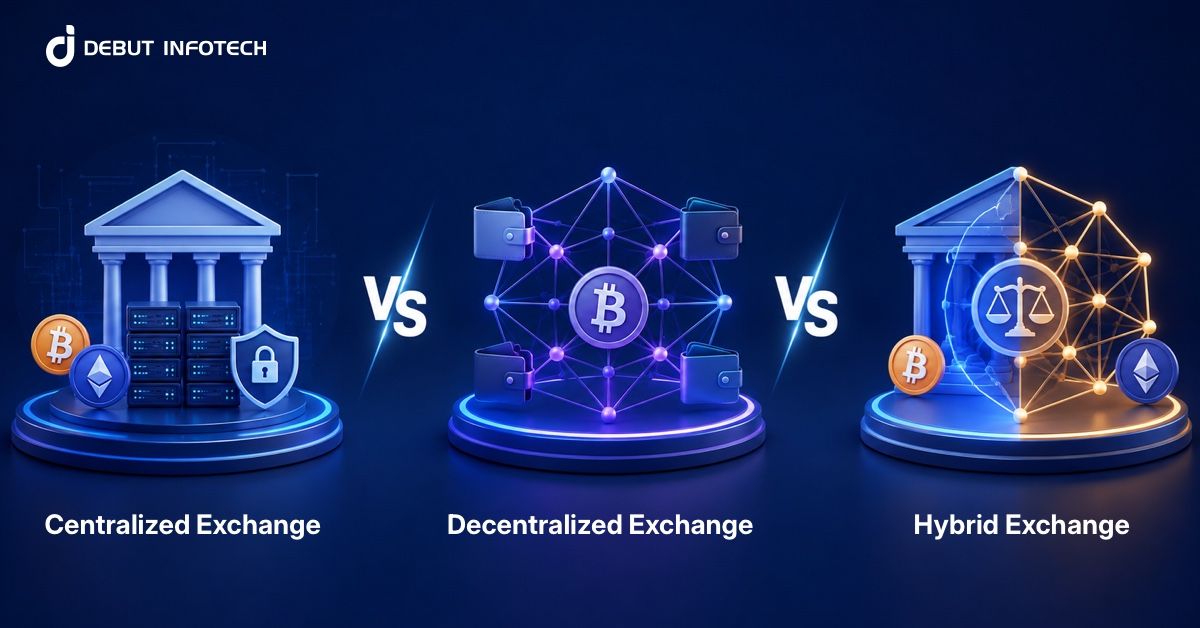
The cost to launch a P2P exchange is usually lower than the cost to launch a centralized exchange, but this can vary depending on the product architecture, custody model, scope of compliance, and liquidity strategy.
| Cost Impact | P2P Exchange | Centralized Exchange | Cost Impact |
| Trading model | Buyers and sellers post ads, agree on terms, and trade through escrow. | Users trade through an order book powered by a matching engine | CEX builds usually cost more because they need high-performance trading infrastructure |
| Custody model | Can be escrow-based, semi-custodial, or fully custodial. | Usually custodial, with stronger wallet, treasury, and withdrawal controls | CEX custody adds more security, wallet management, and operational cost |
| Liquidity needs | Users create offers, so the platform can launch with lower liquidity pressure. | Requires order book depth, market makers, spread management, and liquidity monitoring | CEX launch budgets often include liquidity bootstrapping |
| Compliance workload | Requires KYC/AML, payment monitoring, fraud checks, and dispute controls | Requires KYC/AML plus custody oversight, trading controls, and market surveillance | CEX compliance is usually more complex and expensive to maintain |
| Estimated build range | About $35,000 to $300,000+ | About $150,000 to $500,000+ | P2P is often cheaper to launch, but advanced compliance and custody can narrow the gap |
A P2P exchange doesn’t require an extensive order book, institutional level matching engine or a deep liquidity structure on day one. Rather, the platform primarily features user listings, escrow, wallets, payment proof, admin review, ratings, and dispute resolution.
This makes the p2p cryptocurrency exchange software development cheaper for those who wish to create an MVP in one area, integrate selected payment options, and wait for the market interest before massively investing in the development.
P2P becomes more expensive when the platform starts to behave like a regulated financial product. Costs rise when you add:
A simple P2P MVP for one market with escrow, wallet integration, basic KYC, trade chat, and dispute management may stay closer to the lower cost range.
However, a multi-country P2P exchange with multi-chain custody, automated compliance checks, mobile apps, fiat payment rails, and advanced fraud controls can move much closer to the cost of building a centralized exchange.
P2P is usually the more cost-efficient route for launching a crypto trading platform, especially at MVP stage. But the final budget depends less on the label “P2P” and more on the infrastructure behind it, including custody, compliance, payments, security, and operational control.
A realistic p2p cryptocurrency exchange development cost should include more than design, trading features, wallets, and escrow. The costs below are not problems to avoid. They are operational investments that assist in setting up the exchange appropriately, keeping it compliant and supporting actual customers.
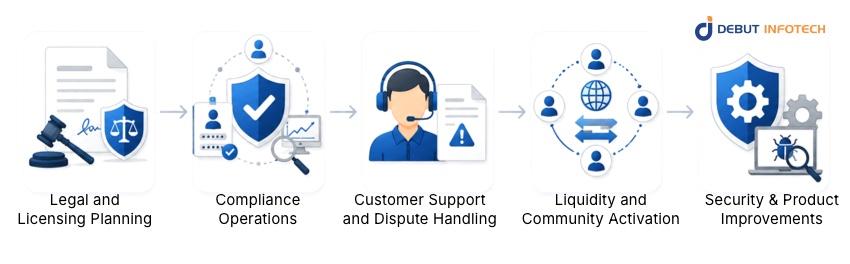
Legal consultation should happen before development begins. Product architecture can vary based on payment methods supported, product licensing, your target countries, and the model of custody involved. Such decisions can result in a need to re-architect onboarding flows, wallet flows, admin controls, or transaction monitoring logic.
After launch, compliance becomes a daily workflow. The platform may require tools and personnel to perform user screening, risk alerts, suspicious activity review, case management and regulatory reporting. This cost grows as transaction volume and market coverage increase.
P2P exchanges need strong support because trades involve external payments. Users can complain about the unsuccessful bank transfer, account recovery, fraud claims, stuck funds, or delayed withdrawals. If, for instance, somebody makes a payment on the platform but the seller refuses to accept it, the platform requires evidence to be uploaded, escalation rules, and trained support agents.
User-generated offers reduce liquidity pressure, but they do not remove it. Early budgets should cover merchant onboarding, market seeding, referral campaigns, local payment coverage, and community management.
Security testing should continue after launch through pen tests, wallet reviews, bug bounty management, and incident response drills. Real trader behavior will also reveal gaps in dispute flows, fee settings, payment options, and admin controls.
Reducing p2p cryptocurrency exchange development cost does not mean building a weaker platform. It means making better decisions about what to launch first, what to integrate, and what to delay.
The features such as user onboarding, offer creation, escrow, trade confirmation, dispute handling, admin review, basic compliance checks that ensure P2P trading is safe and usable should be the focus of your MVP. Extra features can come later.
Every payment rail, wallet option, and compliance provider adds development, testing, and maintenance cost. Start with the most important payment methods and one or two priority assets, then expand based on real trading demand.
Select cloud infrastructure, monitoring, databases and wallets which can scale and grow without the need to rebuild. A low cost first version still needs to be clean, have logs, alerts and security access controls.
Reliable APIs can be used to handle KYC, AML screening, support ticketing, transaction monitoring and analytics. This lets your team spend more time on exchange-specific workflows.
Do not remove escrow safeguards, withdrawal rules, audit trails, role-based admin permissions, key management, penetration testing, or dispute evidence storage.
The right cost-saving approach is phased development. Use Debut Infotech’s P2P exchange cost calculator to decide what belongs in the MVP and what should move to phase two.
Building a P2P cryptocurrency exchange in 2026 usually costs between $35,000 and $300,000+, depending on scope, escrow model, wallet architecture, compliance region, mobile requirements, and security depth. A lean MVP typically costs $35,000–$60,000, a full/standard build costs $90,000–$180,000, and an enterprise-grade regulated platform can exceed $300,000.
P2P exchange development pricing usually includes user registration, authentication, KYC/AML integration, trade advertisements, escrow logic, wallet infrastructure, dispute workflows, admin dashboards, reporting, APIs, security controls, and testing. More advanced builds may also include mobile apps, multi-chain wallets, fiat payment rails, Travel Rule readiness, smart contract audits, and fraud monitoring. Infrastructure, legal consultation, licensing, and post-launch compliance operations are often priced separately.
A P2P exchange is usually cheaper to launch than a centralized exchange because it does not require a high-performance matching engine, full order book, or liquidity engine on day one. A CEX often costs more because it needs deeper custody controls, treasury operations, market surveillance, liquidity management, and trading infrastructure. However, an enterprise P2P exchange with multi-chain wallets, compliance modules, smart contract escrow, and mobile apps can still require a significant budget.
Compliance can add a moderate to substantial amount to P2P exchange cost, depending on jurisdiction, custody model, fiat payment rails, and licensing exposure. KYC/AML workflows, sanctions screening, Travel Rule readiness, audit logs, case management, and reporting tools all increase build and operating costs. Legal and regulatory obligations should always be validated by qualified counsel in the target market.
The best way to reduce P2P exchange development cost is to launch a focused MVP with only the most important trading corridors, payment rails, and wallet features. Use proven third-party KYC, AML, payment, and monitoring APIs instead of building every non-core component from scratch. Do not cut escrow integrity, admin permissions, audit logs, key management, or security testing, because those are core risk controls.

Our Latest Insights
USA
2501 Chatham, Rd Suite R Springfield, IL 62704
+1-708-515-4004
info@debutinfotech.com
UK
7 Pound Close, Yarnton, Oxfordshire, OX51QG
+44-770-304-0079
info@debutinfotech.com
Canada
154 Eden Oak Trail, Kitchener, ON N2A 0H9
+1-708-515-4004
info@debutinfotech.com
INDIA
Sector 101-A, Plot No: I-42, IT City Rd, JLPL Industrial Area, Mohali, PB 140306
9888402396
info@debutinfotech.com