ON THIS PAGE
Progress0%






Our Global Presence :




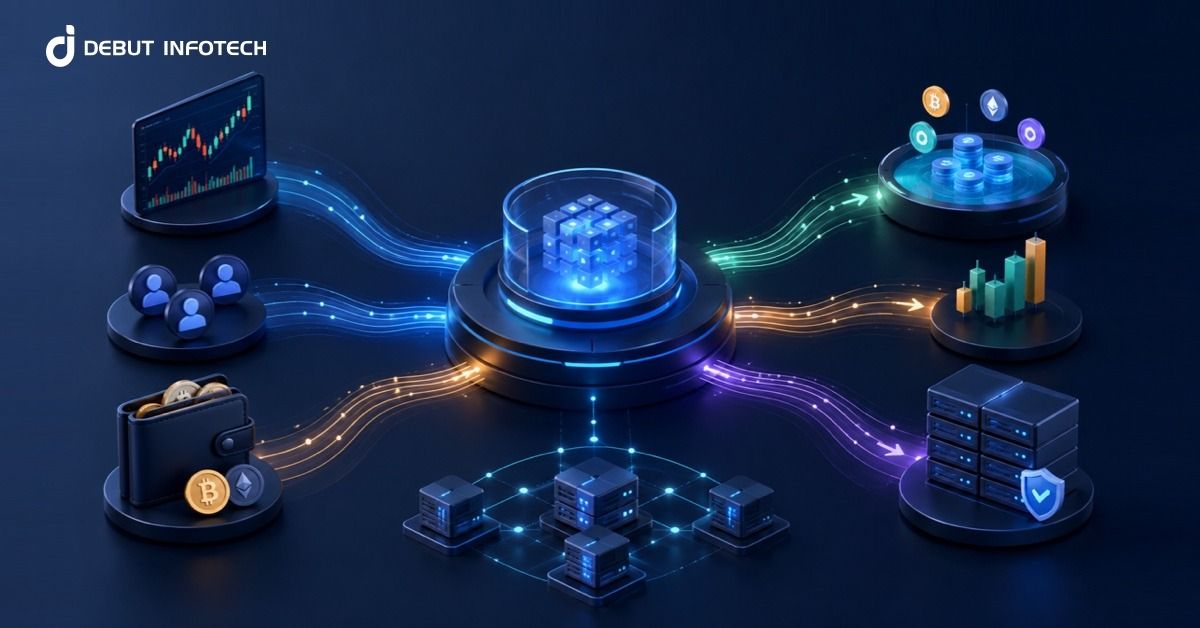
The global payments landscape is undergoing significant changes, thanks to the rise of blockchain and cryptocurrency technologies that enable p2p remittance models. People have long recognized that traditional remittance systems incur substantial costs, take a considerable amount of time to settle, and are often difficult to access, particularly when money is sent across international borders. Peer-to-peer crypto exchanges are now attempting to address these issues by enabling direct currency transfers between individuals without the need for a central authority.
As digital assets become more popular, peer-to-peer (P2P) remittances are emerging as a viable option for cross-border payments, particularly in areas where people lack access to traditional banking services. This revolution isn’t just about technology; it’s a significant shift in how money flows throughout the world. Businesses, fintech companies, and banks seeking next-generation remittance infrastructure must understand how P2P crypto exchanges facilitate this transformation.
Traditional remittance systems rely heavily on centralized intermediaries such as banks, money transfer operators, and correspondent networks. While these systems are widely used, they introduce several structural limitations that affect cost, speed, and transparency.
Cross-border remittances often involve multiple intermediaries, currency conversions, and settlement delays. Each step adds fees and increases the risk of delays or transaction failures. For users sending small or frequent payments, these inefficiencies significantly reduce the value received by the end recipient.
These challenges have created demand for alternative remittance mechanisms that prioritize speed, affordability, and accessibility—conditions that P2P crypto-based models are increasingly able to meet.
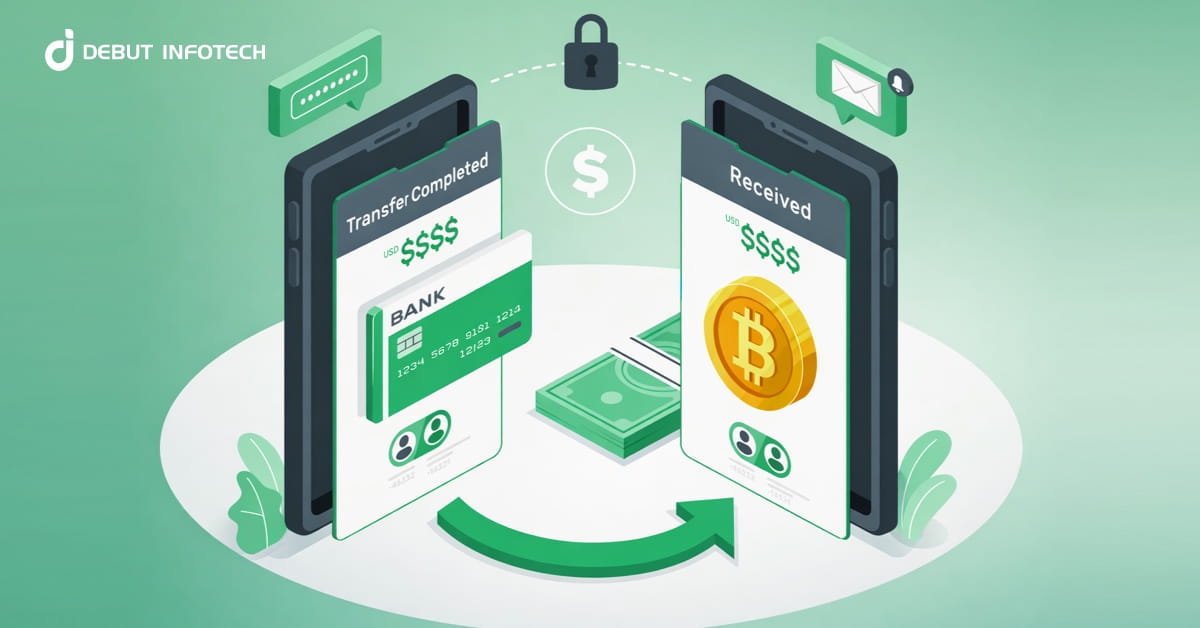
P2P remittance refers to a payment model in which individuals transfer value directly to one another using digital platforms, often powered by blockchain technology and cryptocurrencies. Instead of routing transactions through centralized financial institutions, users interact directly via peer-to-peer marketplaces.
In p2p remittance processing, the platform primarily facilitates matching, escrow, and settlement rather than acting as a custodian of funds. This reduces reliance on intermediaries and enables transactions to settle more quickly, often within minutes.
P2P remittances are particularly effective in cross-border contexts where traditional banking infrastructure is limited or costly. By leveraging crypto assets, these platforms bypass many of the friction points associated with legacy systems.
|Read this blog: Essential Features for Developing a P2P Crypto Exchange Platform
P2P crypto exchanges provide the infrastructure that enables decentralized remittance. These platforms connect buyers and sellers directly, allowing users to exchange cryptocurrency for local fiat currencies or other digital assets.
These mechanisms collectively streamline p2p remittance processing while maintaining transparency and security.
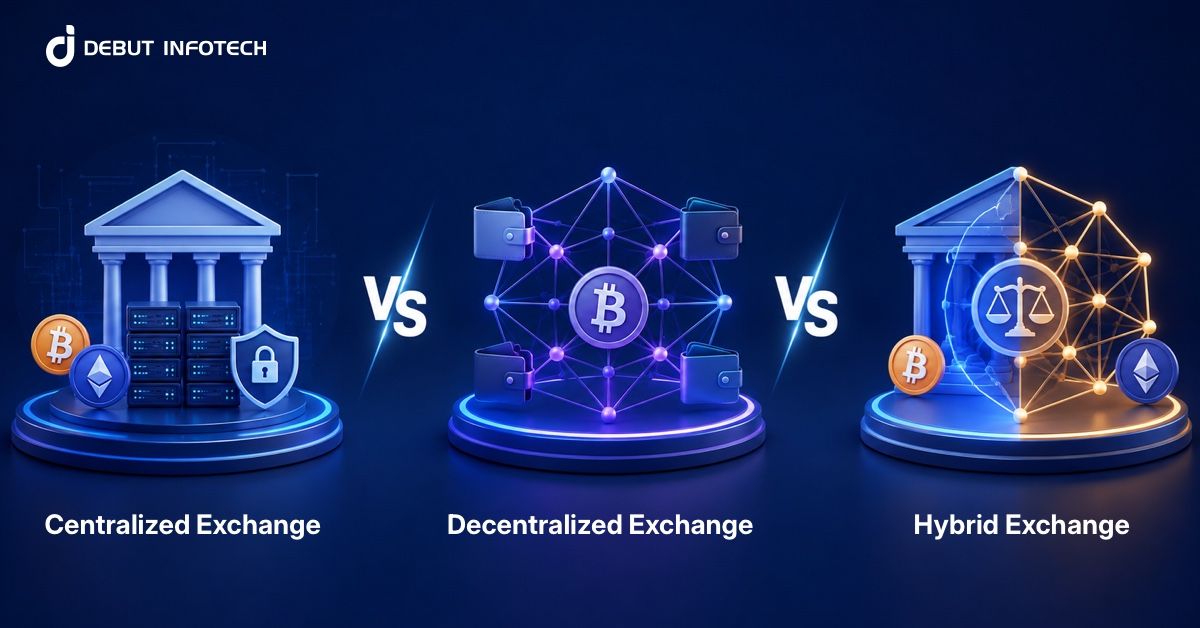
A decentralized crypto exchange plays a central role in enabling secure, trustless remittance systems by removing the need for centralized intermediaries. Unlike traditional exchanges, decentralized platforms operate through smart contracts that execute transactions automatically based on predefined rules. This architecture ensures that users retain control over their funds throughout the transaction process, rather than transferring custody to a third party.
In remittance scenarios, decentralized crypto exchange development supports peer-to-peer transfers while maintaining transparency and security. Users can send and receive value directly, with transactions recorded on the blockchain for real-time verification. This approach significantly reduces counterparty risk, as no single entity controls funds or settlement processes. It also aligns with the principles of financial self-sovereignty, which are becoming increasingly important in regions where trust in centralized financial institutions is limited.
Many of the top decentralized exchanges now include P2P trading capabilities that integrate escrow mechanisms, local payment methods, and dispute resolution tools. These features make decentralized platforms well-suited for remittance use cases where user control, transaction visibility, and reliability are priorities. As adoption grows, decentralized exchanges are becoming foundational components of modern P2P remittance ecosystems.
Read this blog: Top 10 Decentralized Crypto Exchanges You Need to Know About
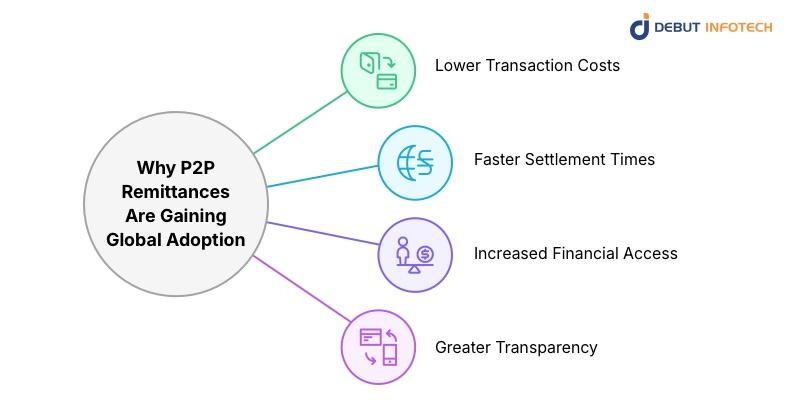
Several structural and economic advantages are driving the rapid adoption of P2P crypto-based remittances across different regions. As individuals and businesses seek faster, more affordable, and more accessible ways to move money across borders, P2P remittance models are increasingly viewed as a practical alternative to traditional systems.
Traditional remittance services often involve multiple intermediaries, each adding fees through processing, currency conversion, and settlement. P2P remittances reduce or eliminate these intermediaries by enabling direct value exchange between users. As a result, transaction fees are significantly lower, allowing senders to transfer more value while recipients receive a higher portion of the original amount. This cost efficiency is especially important for frequent or low-value cross-border transfers.
Settlement speed is another major driver of adoption. Conventional remittance systems can take several days to complete international transfers due to banking hours, compliance checks, and the use of correspondent networks. In contrast, P2P remittance transactions often settle within minutes through blockchain-based transfers. Faster settlement improves cash flow for businesses and provides families with quicker access to essential funds.
P2P remittance platforms extend financial services to users who lack access to traditional banking infrastructure. By supporting local payment methods and digital wallets, these platforms enable individuals in underbanked or unbanked regions to participate in cross-border transactions. This expanded access plays a key role in promoting financial inclusion and reducing reliance on informal payment channels.
Blockchain technology introduces a high level of transparency to P2P remittances. Users can track transactions in real time and verify transfer status directly on the network. This visibility reduces uncertainty, minimizes disputes, and builds trust between participants. For businesses and individuals alike, transparent transactions improve confidence in cross-border payments.
Building a P2P remittance platform requires specialized p2p crypto exchange development expertise. These systems must balance decentralization with usability, security, and regulatory considerations.
A reliable P2P exchange infrastructure is built on several essential components that ensure security, usability, and efficient transaction processing.
Many businesses choose to work with experienced crypto exchange development companies to ensure these components are implemented securely and efficiently.
As demand for P2P remittance platforms grows, businesses are increasingly adopting flexible deployment models that balance speed, scalability, and operational control. White label and OTC exchange models address different market needs, making them valuable options for organizations entering or expanding within the remittance space.
A white label crypto exchange services enables businesses to launch P2P remittance platforms using pre-built, tested infrastructure. This model significantly reduces time-to-market by eliminating the need to develop core exchange components from scratch. Businesses can focus on branding, user experience, and regional customization while relying on a proven technical foundation.
White label solutions also reduce development and operational risk, as key features such as escrow systems, wallets, and matching engines are already in place. For fintech startups, payment providers, and regional remittance operators, this approach offers a cost-efficient way to enter the market while retaining flexibility to scale and evolve the platform over time.
OTC crypto exchange development is designed to support high-volume remittance transactions that are not suitable for public order books. OTC models enable large transfers to be executed privately, minimizing price slippage and market impact. This makes them particularly valuable for enterprises, financial institutions, and organizations managing significant cross-border payment flows.
In P2P remittance contexts, OTC exchanges provide enhanced liquidity management, personalized pricing, and dedicated transaction support. These capabilities help businesses handle large remittance volumes efficiently while maintaining transaction confidentiality and stability.
Modern P2P remittance platforms rely on scalable and modular system architectures that support performance, security, and long-term growth. The right technical foundation ensures the platform can handle increasing transaction volumes and evolving regulatory requirements.
A microservices architecture allows platforms to divide critical functions—such as user management, payment processing, matching engines, and compliance systems—into independent services. This separation improves system resilience by isolating failures and enables teams to update or scale individual components without disrupting the entire platform.
For P2P remittance platforms, microservices also support faster development cycles and easier integration of new features, making it simpler to adapt to changing market demands.
Robust API development is essential for connecting P2P remittance platforms with external systems. APIs enable seamless integration with local payment rails, identity verification tools, analytics platforms, and third-party services. They also support interoperability across regions, allowing platforms to expand into new markets more efficiently.
Well-designed APIs enhance flexibility, improve system interoperability, and future-proof the platform as new services and technologies are introduced.
Although P2P remittance platforms are decentralized by design, regulatory compliance remains a critical requirement for long-term viability. Platforms must address obligations related to anti-money laundering, transaction monitoring, and user verification to operate responsibly across different jurisdictions.
Effective decentralized crypto exchange development integrates these compliance frameworks in a way that maintains user autonomy while meeting regulatory expectations. Striking this balance is essential for building trust, supporting institutional participation, and ensuring sustainable platform growth.
In parallel, strategic crypto exchange partnerships play an important role in strengthening P2P remittance ecosystems. Collaborations with payment providers, liquidity aggregators, and regional fintech companies enable platforms to expand their geographic coverage and maintain consistent liquidity.
These partnerships also enhance the overall user experience by offering localized payment options and facilitating smoother transaction flows. Together, regulatory alignment and strategic partnerships establish a stable foundation for scalable, compliant, and globally accessible peer-to-peer (P2P) remittance platforms.
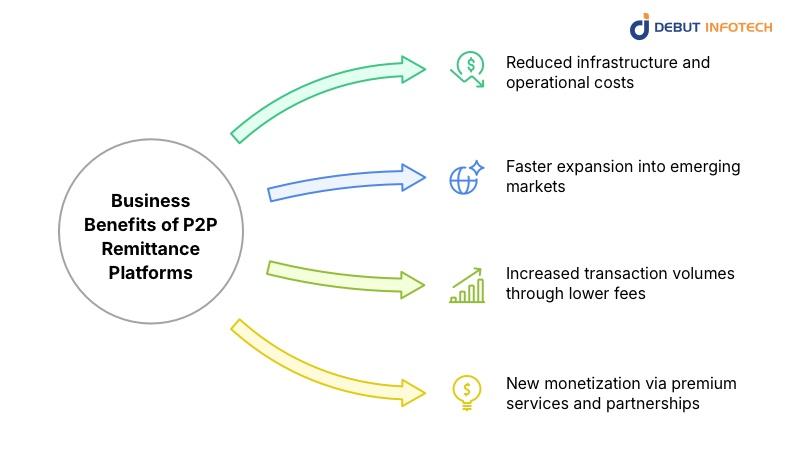
From a business perspective, P2P remittance platforms unlock new revenue models and market opportunities by offering more efficient and scalable cross-border payment solutions.
These advantages explain why many organizations are investing in cryptocurrency exchange development services tailored to remittance use cases.
Launching a secure and scalable peer-to-peer (P2P) remittance platform requires in-depth technical and domain expertise. Selecting the right development partner ensures the platform meets performance, security, and compliance expectations.
Midway through many remittance platform initiatives, organizations find value in collaborating with an experienced provider such as Debut Infotech, particularly when building complex P2P and decentralized exchange systems designed for global remittance operations.
P2P remittances are expected to play an increasingly important role in global payments. As blockchain infrastructure matures and regulatory clarity improves, adoption will likely accelerate across both consumer and enterprise segments.
Innovations in decentralized finance, stablecoins, and interoperability will further strengthen P2P remittance ecosystems, positioning them as core components of future payment networks.
P2P remittance models powered by crypto exchanges are redefining how cross-border payments are executed. By eliminating intermediaries, reducing costs, and accelerating settlement, these platforms address long-standing inefficiencies in traditional remittance systems. As demand for faster and more inclusive financial services grows, P2P remittances offer a compelling alternative for individuals and businesses alike.
Organizations seeking to enter or expand in the remittance space must approach platform development strategically, striking a balance between decentralization, security, and compliance. By working with experienced technology partners like Debut Infotech, businesses can build robust P2P remittance solutions that scale globally. With Debut Infotech’s expertise in cryptocurrency exchange development services, companies are well-positioned to participate in the next evolution of global remittances.
A. P2P remittance is a peer-to-peer payment model that allows individuals to send and receive money directly using digital platforms, often powered by blockchain and cryptocurrencies. It removes the need for traditional intermediaries such as banks or money transfer operators.
A. P2P remittance processing involves matching users directly on a platform, securing transactions through escrow mechanisms, and settling transfers using blockchain networks. This approach enables faster and more cost-effective cross-border payments.
A. P2P remittances reduce costs by eliminating multiple intermediaries, correspondent banking fees, and excessive currency conversion charges. Users typically pay lower platform or network fees while retaining more value in each transfer.
A. P2P remittances can be secure when built on well-designed platforms that use escrow systems, encryption, and blockchain-based transparency. Security depends largely on the quality of the platform’s architecture and its compliance measures.
A. A decentralized crypto exchange enables users to trade and transfer assets directly without centralized custody. In remittance use cases, this supports trustless transactions, faster settlement, and greater user control over funds.
A. P2P remittance platforms are used by individuals sending cross-border payments, freelancers, small businesses, and enterprises operating in regions with limited banking access. They are especially popular in emerging markets and among underbanked populations.
A. Businesses typically work with cryptocurrency exchange development services or Crypto Exchange Development Companies to build P2P remittance platforms. Options include custom development, white label crypto exchange solutions, or partnerships with existing platforms.

Our Latest Insights
USA

2501 Chatham, Rd Suite R Springfield, IL 62704
+1-708-515-4004
info@debutinfotech.com
UK

7 Pound Close, Yarnton, Oxfordshire, OX51QG
+44-770-304-0079
info@debutinfotech.com
Canada

154 Eden Oak Trail, Kitchener, ON N2A 0H9
+1-708-515-4004
info@debutinfotech.com
INDIA

Sector 101-A, Plot No: I-42, IT City Rd, JLPL Industrial Area, Mohali, PB 140306
9888402396
info@debutinfotech.com

9001:2015
Quality Certified

ISO 27001
Security Certified

A+ Rating
Accredited Business

Certik
Security & Audit


Copyright © 2026, Debut Infotech. All rights reserved. | Privacy Policy