ON THIS PAGE
Progress0%






Our Global Presence :





In October 2024, the React Native team released React Native 0.76, introducing the latest React Native architecture. This new architecture has evolved to support modern features such as Suspense, Transitions, automatic batching, and useLayoutEffect.
These advancements have significantly influenced how modern enterprises design and scale their applications. More importantly, the React Native architecture determines how apps are structured, how different layers communicate, and how effectively they scale as user demand, features, and business requirements grow.
This is exactly why the React Native new architecture has become such a major shift in the ecosystem. It changes how apps are rendered, how JavaScript interacts with native code, and how modern applications are expected to perform under real-world conditions.
As a result, development teams—and any React Native development company working on large-scale applications—are now building smoother, more resilient, and more scalable apps by aligning with these architectural changes. To help you understand and leverage these advancements, this guide breaks down what the new React Native architecture means in 2026.
In this article, you’ll learn how React Native architecture has evolved, how the new model works at a conceptual level, what patterns make sense today, and what to consider if you’re planning a migration. If you’re building or scaling a React Native app this year, this is a conversation worth having—so let’s start early.
Initially, the React Native Architecture was based on facilitating direct connection between JavaScript and native code without developers having to write everything twice. While this architecture worked perfectly for the kinds of apps that were mostly built at that time, it had some major limitations. Basically, although the initial architecture was functional, it couldn’t scale properly with increased functionality and app uses. Therefore, at maximum capacities, animations stumbled, updates to the complex UI were slow, and debugging got more challenging.
This prompted Meta to rethink the entire React Native foundation altogether with a new architecture. With this new architecture, the aim was to eliminate the Bridge’s restrictions completely, not to “optimize the Bridge.” That choice paved the way for the new architecture that we now call React Native.
The React Native team concentrated on enhancing rendering efficiency, facilitating more direct communication between JavaScript and native layers, and developing a system that could develop with contemporary mobile devices.
This change is more important than ever in 2026.
In terms of technical structures, the following are some of the tangible changes that have been made to the React Native Architecture.
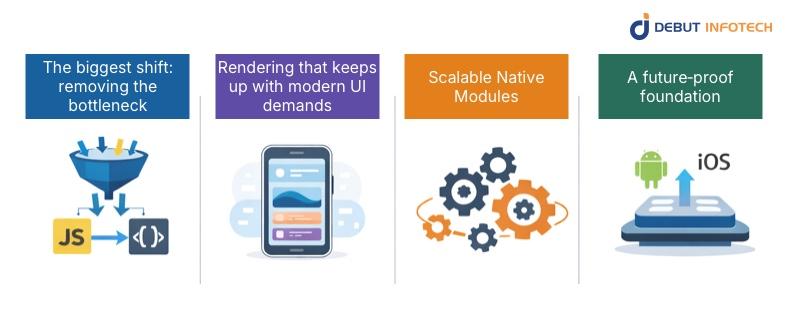
One of the main components of the old React Native architecture was an asynchronous message-passing system. Everything would go through a queue, with JavaScript sending instructions and native code responding later. However, as apps started getting more interactive, that system became less sustainable.
The React Native New Architecture eliminated this bottleneck by structuring the system in a way such that JavaScript communicates with native code more directly, instead of passing everything through a single communication layer. This change has resulted in faster execution, fewer delays, and more consistent performance under load.
UI consistency was one of the silent problems with older React Native apps. The system is struggle to cope with high interactivity, which means the animations may be all over the place, and user interactions may cause layout updates to drag.
The new architecture addresses these inconsistencies by rethinking rendering altogether.
To put it simply, UI changes are now managed in a way that more closely resembles how contemporary mobile systems are expected to function. Because of this, apps developed using the new React Native architecture version feel more fluid, not because they’re doing more, but rather because they’re removing pointless tasks.
Frankly, the use of native modules is not new. However, the way they are loaded, accessed, and controlled in the React Native New Architecture is the novel thing happening. With the new design, native modules are handled more effectively, which speeds up startup and enhances runtime performance, particularly in large applications.
This is crucial for teams creating durable products. With the old architecture, it was clear that the inefficiencies grew as the app complexities increased. The purpose of the React Native new architecture version was to stop that gradual deterioration.
Without interfering with already-existing programs, the new architecture makes space for future enhancements. Instead of always catching up, it provides React Native with a base that can develop with iOS and Android.
This means the new architecture has made provisions for any more future add-ons that could lead to performance issues. By implementing the new React Native design, teams are purchasing insurance against future limitations rather than only resolving today’s problems.
The main conclusion is that the new design is the basic foundation for React Native’s future development.
Also Read this: Top React Native Databases for Building Fast and Offline-Ready Apps
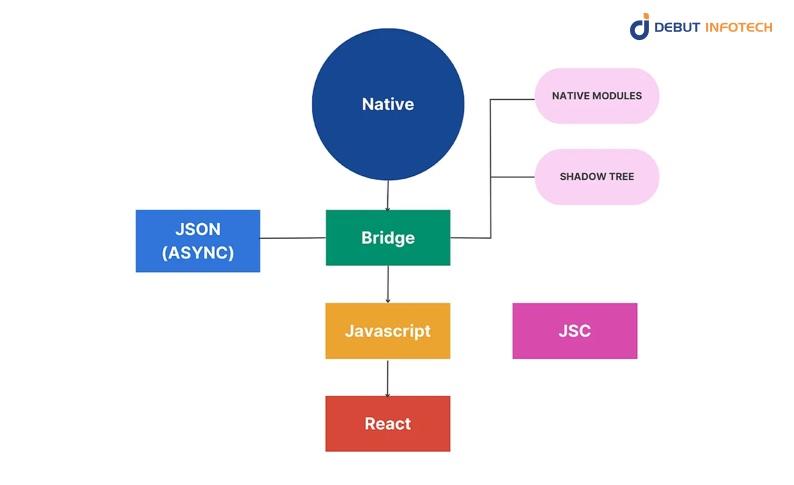
A React Native Architecture Diagram is a visual aid for understanding the flow of information within an application.
Every React Native application, at its core, adheres to the same principle. Behavior is defined by JavaScript. Platform-specific execution is handled by native code. On top of that, the user interface responds to changes as they occur.
All the new React Native architecture does is simply change the degree of friction between these components and the directness of their communication.
In the old React Native Architecture, the Bridge was positioned in the center of earlier models, resembling a traffic controller. Everything went through it in an orderly fashion. While this structure simplified the explanation of graphics, it also concealed significant performance costs.
When you compare that to the New React Native new Architecture version, the diagram appears flatter. As a result, there are fewer delays, fewer hops, and fewer surprises in communication routes.
Why should diagrams even be important?
Architecture diagrams play a major role in how teams think about bugs, performance issues, and upcoming features. Developers make better choices, particularly as apps expand, when they know where logic resides and how data flows.
In fact, when you examine how React Native impacts the different aspects of development, you’ll realise the following:
The advantages of applying clean architecture React Native concepts to mobile app development are compounded across multiple areas, as UI updates become more predictable and the new architecture’s direct communication mechanism easily couples with clear separation of concerns. It is simpler to track down side effects. It gets easier to test.
Consider it this way: things move more quickly thanks to the new architecture.
During transformation, there is an additional useful advantage. A well-structured application that follows contemporary architectural diagrams is much more adaptable to change than one that is tightly coupled, whether you’re rewriting a feature, changing a data source, or preparing for the next React Native upgrades.
Also Read this blog: Top React Native Development Tools In 2026
Let’s say your React Native app was built on the old React Native architecture. What happens to your existing codebase?
Or better yet, how do you structure your new app following the React Native New Architecture?
In all honesty, there’s no one-size-fits-all answer for these questions. However, certain patterns work better than others in 2026. Let’s take a look at them below.
Below we have highlighted some tried-and-true React Native architecture patterns that have been proven to be scalable when application requirement increases:
These are the most typical ones you’ll encounter today:
One thing all these designs have in common is clarity. They reduce random configurations and make it clear where logic resides. They also make it easier to think about speed improvements when combined with the new React Native architecture, since roles are well-defined.
While the new React Native design architecture doesn’t need you to change your application’s structure, it does reveal if your app is built on a weak structure.
As such, the new architecture raises the bar by ensuring that inefficiencies are no longer “smoothed over” by abstraction layers. It does this using direct communication channels and improved rendering. For example, you might sense a tangled state of management, which is painful to debug when side effects are dispersed. For this reason, teams frequently use the chance to tidy up patterns when they revisit their React Native architecture.
Tightening the seams is more important than completely redesigning everything.
This is one of the most common questions teams ask—and the honest answer is: it depends.
Migration to the new architecture makes sense when:
It’s less urgent for small, stable apps with limited change ahead. That said, delaying migration indefinitely usually increases cost later. This is why many teams choose to hire React Native developers with hands‑on experience in both legacy and modern setups—to assess risk before committing.
Migration isn’t just a technical task. Third‑party libraries, native dependencies, and internal tooling all play a role. For larger products, working with experienced React Native app development companies often reduces uncertainty—not because migration alone is impossible, but because it’s easy to underestimate its scope.
The takeaway is simple: architecture patterns and migration strategy are inseparable. Treat them as a combined decision, not separate checklists. Teams that do this tend to move forward with confidence—while others spend cycles reacting to structural issues that could have been addressed earlier.
By the time teams reach the new React Native architecture, one thing becomes obvious: this isn’t just a framework upgrade. It’s an architectural commitment. And like any commitment that affects performance, maintainability, and long‑term growth, the way it’s handled matters as much as the technology itself.
At Debut Infotech, we approach React Native architecture with that mindset.
We don’t start with tools or libraries. We start with intent. What is the app expected to become over the next two or three years? How fast will it evolve? Where will performance pressure likely appear? Those questions shape how we structure the app long before the first screen is built.
When working with the React Native new architecture, our teams focus on alignment rather than experimentation. That means designing around direct communication paths, predictable rendering behavior, and clean separation of responsibilities—so legacy habits don’t dilute the benefits of the new model. The architecture is treated as a foundation, not an implementation detail.
Another key part of our approach is restraint. The new architecture enables more powerful patterns, but power without discipline creates complexity. We help teams adopt modern React Native architecture patterns without over‑engineering—keeping logic where it belongs and avoiding tight coupling that makes future changes risky.
This approach is especially important for growing products. As features multiply, early architecture choices tend to surface later—sometimes painfully. That’s why many clients engage Debut Infotech not just for development, but for architectural guidance as part of our broader mobile app development services. It’s about building apps that don’t fight their own structure six months down the line.
For existing apps, we take a measured view. Migration isn’t treated as a single event, but as a controlled transition. We help teams evaluate readiness, identify pressure points, and adopt the new architecture incrementally—minimizing disruption while improving performance and stability where it matters most.
In short, our role isn’t to “apply” the new React Native architecture. It’s to make sure it works in the real world—across teams, across releases, and throughout the product’s full lifecycle.
By this point, one thing should be clear: React Native architecture is no longer a background concern you can afford to postpone. In 2026, it sits right at the center of performance, scalability, and long‑term maintainability. The introduction of the React Native new architecture didn’t just modernize how apps run—it changed what “well‑built” means for React Native products going forward.
We’ve looked at how the architecture evolved, what fundamentally changed with the new model, why architecture diagrams and clean separation of concerns matter, and how real‑world teams are thinking about patterns and migration. The common thread across all of this is intent. Teams that treat architecture as a strategic decision tend to move faster over time. Teams that treat it as a technical afterthought often end up paying for it later.
This is especially true as apps grow. More features, more users, more integrations—all of these amplify early architectural choices. Adopting modern React Native architecture isn’t about chasing trends; it’s about building a foundation that won’t resist change six or twelve months down the line.
That’s also why choosing the right partner matters. Working with an experienced React Native development company can make the difference between a smooth transition and a costly learning curve. The goal isn’t just to use the new architecture—it’s to use it well, in a way that fits your product, your team, and your roadmap.
React Native is clearly investing in its future. The question now is whether your app’s architecture is ready to grow along with it.
A. Although there isn’t a single “best” pattern, feature-based and layered structures are the most prevalent in contemporary React Native design. Because they explicitly segregate UI, business logic, and data concerns, these patterns are well suited to the new architecture and facilitate the scalability and maintenance of systems over time.
A. Predictable data flow, distinct concern separation, and avoiding tightly connected components are the main focuses of current best practices. Teams are urged to use the new React Native architecture to organize programs neatly so that when the software expands, performance advantages aren’t lost to disorganized or hidden dependencies.
A. A React Native architectural diagram illustrates the communication between the UI layer, native code, and JavaScript. Diagrams in the new design show fewer bottlenecks and are flatter and more straightforward. Teams may more confidently reason about performance and debug problems more quickly when they understand these representations.
A. An asynchronous bridge that frequently turned into a bottleneck was a key component of the previous React Native architecture. By facilitating improved rendering and more direct communication, the new architecture eliminates that restriction. Better performance, more seamless UI upgrades, and a foundation built for long-term evolution result from this.
A. Indeed, the new architecture of React Native often results in higher performance, particularly in apps with a lot of interaction or complexity. Reduced communication overhead, more effective rendering, and improved native module handling are the improvements. Real benefits, however, rely on how well the entire architecture of the program is created and maintained.

Our Latest Insights


USA
2501 Chatham, Rd Suite R Springfield, IL 62704
+1-708-515-4004
info@debutinfotech.com
UK
7 Pound Close, Yarnton, Oxfordshire, OX51QG
+44-770-304-0079
info@debutinfotech.com
Canada
154 Eden Oak Trail, Kitchener, ON N2A 0H9
+1-708-515-4004
info@debutinfotech.com
INDIA
Sector 101-A, Plot No: I-42, IT City Rd, JLPL Industrial Area, Mohali, PB 140306
9888402396
info@debutinfotech.com