ON THIS PAGE
Progress0%






Our Global Presence :






Tokenized real estate is changing how property is owned, traded, and managed by turning physical assets into blockchain-based digital tokens. At the center of this shift is Fractional Ownership, which allows multiple investors to hold shares in a single property without the burden of full ownership. This model improves access, liquidity, and efficiency across global markets.
The tokenized real estate market could reach $4 trillion by 2035, up from roughly $300 billion in 2024, at a projected 27% CAGR, according to Deloitte’s forecast on tokenized real estate growth.
A broader industry estimate suggests that global tokenized assets may reach about $16 trillion by 2030 (covering illiquid assets such as real estate, private equity, and bonds) based on a 2024 research synthesis.
These projections reflect growing demand for more flexible property investment models, where blockchain enables transparency, automation, and global participation at a level traditional systems have struggled to achieve. In this piece, we’ll discuss everything you need to know about fractional ownership and tokenized real estate.
Tokenized real estate refers to converting ownership rights in physical property into blockchain-based digital tokens, each representing a fractional share of the asset. These tokens are backed by legal structures that link digital ownership to real-world property rights. Transactions are recorded on an immutable ledger, ensuring traceability and security. This approach allows investors to buy, sell, or transfer ownership more efficiently while maintaining compliance with property laws and financial regulations across jurisdictions.
Several factors are accelerating the adoption of tokenized real estate across global markets.
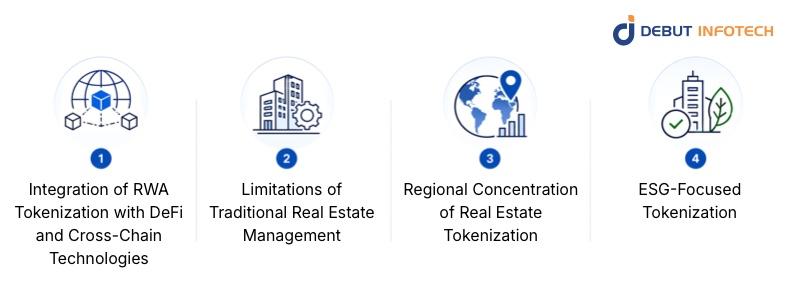
RWA tokenization is expanding through integration with decentralized finance platforms, allowing tokenized real estate to be used in lending, staking, and liquidity pools. Cross-chain infrastructure enables the transfer of assets between blockchain networks, improving accessibility and reducing fragmentation. This interoperability strengthens market participation and creates new financial use cases beyond simple ownership.
Traditional real estate systems rely heavily on manual processes, intermediaries, and fragmented record-keeping, which increase costs and delays. Property transactions often take weeks or months to complete due to legal and administrative procedures. Tokenization streamlines these processes by digitizing ownership records, automating workflows, and reducing reliance on third parties, enabling faster, more efficient asset management.
Tokenized real estate adoption remains concentrated in regions with clear regulatory frameworks and strong digital infrastructure, including parts of Europe, North America, and Asia. These regions benefit from investor confidence and institutional participation. However, this concentration also highlights gaps in emerging markets, where regulatory uncertainty and limited blockchain adoption continue to slow broader global expansion.
Environmental, social, and governance considerations are influencing how tokenized real estate projects are structured and marketed. Developers and tokenization companies are embedding ESG metrics into token frameworks, allowing investors to track sustainability performance and ethical standards. This approach attracts socially conscious investors and aligns real estate investments with global sustainability goals, adding measurable accountability to property ownership and management.
Regulation continues to shape how tokenized real estate evolves across different jurisdictions. Governments and financial authorities are introducing frameworks that aim to balance innovation with investor protection and market stability.
Policy directions under Donald Trump have emphasized tighter oversight of digital assets while encouraging innovation within regulated boundaries. Executive-level actions have pushed for clearer classification of tokenized assets, including real estate tokens, under existing financial laws. This evolving stance aims to reduce uncertainty for investors while ensuring compliance with securities, taxation, and reporting requirements.
The European Union’s Markets in Crypto-Assets Regulation establishes a structured legal environment for digital assets, including tokenized real estate offerings. It introduces licensing requirements, investor protection rules, and transparency obligations for issuers and platforms. This clarity strengthens institutional confidence and supports cross-border investment activities within the EU’s regulated financial ecosystem.
Project Guardian focuses on integrating asset tokenization into traditional financial systems under regulatory supervision. Led by Singapore’s central bank, it explores interoperability, liquidity, and compliance in tokenized markets. The initiative demonstrates how regulated institutions can adopt blockchain technology while maintaining strict governance standards, providing a scalable model for tokenized real estate adoption.
Also Read This: Future of Real Estate Tokenization
Tokenized real estate significantly lowers the capital required to invest in property by enabling fractional ownership. Investors can participate with smaller amounts rather than committing to full property purchases. This model also simplifies cross-border investment, allowing individuals to access international real estate markets without complex legal structures or reliance on multiple intermediaries.
Unlike traditional real estate, which often requires lengthy sale processes, tokenized assets can be traded on secondary marketplaces. This provides investors with more flexibility to enter or exit positions based on market conditions. Improved liquidity makes blockchain real estate behave more like financial assets, aligning it with modern investment strategies that prioritize faster capital movement.
Tokenization reduces reliance on intermediaries such as brokers, legal agents, and custodians by automating processes through smart contracts. This lowers transaction costs and administrative overhead. At the same time, blockchain technology ensures transparent and tamper-resistant records of ownership and transactions, giving investors clear visibility into asset performance and operational activities.
Investors can allocate funds across multiple properties, locations, and asset types using smaller capital commitments. This enables broader portfolio diversification compared to traditional real estate investments, where high entry costs limit exposure. By spreading investments, individuals can reduce risk concentration and improve the stability of returns across different market conditions and geographic regions.
Tokenized real estate fractional ownership platforms often use smart contracts to distribute rental income or dividends directly to token holders. Payments are processed automatically based on predefined rules, reducing delays and manual intervention. This creates a consistent and predictable income stream while improving operational efficiency, making property investment more accessible and easier to manage for investors.
Fractional ownership in tokenized real estate allows multiple investors to collectively own portions of a single property through blockchain-based tokens.
Each token represents a defined share, granting proportional rights to rental income, appreciation, and, in some cases, governance decisions. This structure is supported by legal entities that tie digital tokens to real-world ownership.
It reduces capital requirements, improves accessibility, and enables investors to build diversified property portfolios without direct property management responsibilities.
Fractional ownership in tokenized real estate follows a structured process that ensures legal compliance, technical implementation, and investor participation.
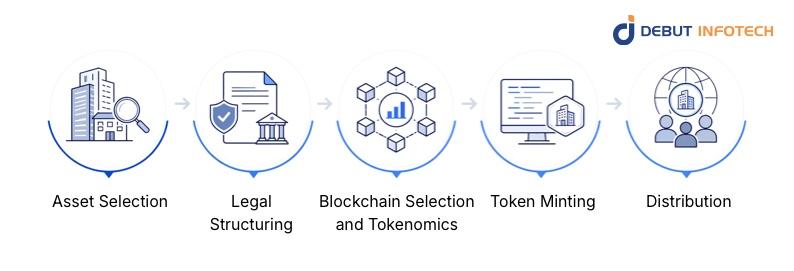
The process of fractionalized real estate investing begins with identifying a suitable property based on location, income potential, and long-term value. Detailed due diligence is conducted, including legal verification, financial analysis, and risk assessment, to ensure the asset meets investment criteria and can be effectively structured for tokenization.
The selected property is placed under a legal entity, often a special purpose vehicle, which holds ownership on behalf of investors. Tokens issued are legally linked to this entity, ensuring that digital ownership corresponds to enforceable rights and aligns with jurisdiction-specific regulatory and compliance requirements.
A blockchain network is chosen based on scalability, security, and transaction costs. Tokenomics are defined, including total token supply, pricing structure, and investor rights. These parameters determine how ownership is divided, how returns are distributed, and how tokens function within the broader investment ecosystem.
Digital tokens representing ownership shares are created and recorded on the blockchain through a minting process. Each token is uniquely identifiable and linked to the underlying asset. This ensures transparency, traceability, and secure verification of ownership across all transactions within the system.
Once minted, tokens are offered to investors through specialized tokenization platforms or marketplaces. Investors purchase tokenized property shares in the form of tokens using fiat or digital currencies, gaining proportional ownership of the property. The distribution phase may include compliance checks, investor onboarding, and allocation processes to ensure regulatory adherence and fair access.
Also Read This: How Real Estate Tokenization Works: A Step-by-Step Guide
Comparing tokenized real estate with traditional property investment reveals clear operational and financial differences. These advantages explain why investors are increasingly considering blockchain-based ownership models as part of their broader portfolios. Here’s a comparison table:
| Factor | Tokenized Real Estate | Traditional Real Estate |
| Liquidity | Assets can be traded on secondary markets, enabling investors to enter and exit more quickly. | Sales require lengthy processes, often taking weeks or months to complete transactions. |
| Minimum Investment | Allows fractional participation with lower capital requirements, making entry accessible. | Typically requires significant upfront capital to purchase full or large property shares. |
| Transparency | Blockchain records provide immutable, real-time visibility into ownership and transactions. | Relies on manual records and intermediaries, which can limit visibility and traceability. |
| Income Distribution | Automated through smart contracts, ensuring timely and accurate payouts to investors. | Rental income distribution is manual, often delayed, and dependent on intermediaries. |
| Global Reach | Enables cross-border investment with fewer barriers through digital platforms. | International investment involves complex legal processes and multiple intermediaries. |
Real-world implementations show how tokenization is moving beyond theory into practical deployment across commercial and residential markets.
BrickMark executed a landmark tokenized transaction involving a prime commercial property on Zurich’s Bahnhofstrasse. The deal combined traditional financing with blockchain-based equity issuance, allowing partial ownership through digital tokens. It demonstrated how high-value real estate can be fractionalized while maintaining regulatory compliance and attracting institutional-grade investor participation.
Kin Capital introduced a $100 million tokenized debt fund focused on real estate-backed lending opportunities. Investors gain exposure to structured credit instruments rather than direct property ownership. The model improves transparency, speeds up capital deployment, and opens access to debt markets that were previously limited to institutional participants.
Lofty provides a platform where investors can purchase fractional shares in rental properties and receive income distributions on a daily basis. It handles property management, tenant relations, and maintenance, making the investment process hands-off. This approach simplifies entry into rental markets while ensuring consistent income through automated blockchain-based systems.
Qarat is focused on enabling fractional property investments within the UAE by digitizing the ownership of premium properties. The platform aligns with regional regulatory developments and supports cross-border investor participation. It demonstrates how tokenization can integrate with local real estate markets while improving accessibility and transparency for both regional and international investors.
Red Swan operates a marketplace specializing in tokenized commercial real estate, including office buildings and large residential complexes. By fractionalizing high-value assets, it enables accredited investors to access institutional-grade opportunities. As a top-tier real estate tokenization company, the platform focuses on improving liquidity, simplifying ownership structures, and enhancing transparency in traditionally illiquid commercial real estate investments.
Despite its advantages, tokenized real estate comes with operational, technical, and regulatory challenges. Understanding these considerations is important for investors and platforms aiming to build sustainable and compliant tokenization strategies.
Smart contracts in real estate govern ownership, transactions, and income distribution. Still, vulnerabilities in their code can expose platforms to exploits or unintended behavior. Errors in logic or inadequate testing may result in financial losses or frozen assets. Since these contracts are often immutable, fixing issues after deployment becomes complex and costly.
To mitigate risks, platforms should conduct thorough third-party audits and continuous security testing before deployment. Using standardized, battle-tested contract libraries reduces exposure to common vulnerabilities. Regular monitoring, bug bounty programs, and upgradeable contract frameworks also help maintain system reliability while preserving investor confidence.
Tokenized real estate operates across jurisdictions with varying legal frameworks, creating compliance challenges for issuers and platforms. Requirements around securities laws, investor accreditation, and anti-money laundering checks can limit participation. Inconsistent global regulations also create uncertainty, slowing adoption and complicating cross-border investment opportunities.
A structured KYC / AML compliance strategy is essential. Platforms should integrate robust KYC and AML systems while aligning real estate token offerings with local securities regulations. Working closely with legal experts and regulators helps ensure adherence. Standardizing compliance processes and adopting interoperable identity solutions can improve accessibility while maintaining regulatory trust.
Accurate valuation of real estate assets remains a challenge due to market fluctuations, location-specific factors, and subjective appraisal methods. Token prices may not always reflect true property value, especially in illiquid or emerging markets. This can lead to pricing inefficiencies and affect investor confidence in tokenized offerings.
To address this, platforms should use transparent valuation models supported by independent appraisals and real-time market data. Regular revaluation cycles and disclosure of methodologies improve trust. Integrating data analytics and automated valuation tools can enhance accuracy, helping investors make informed decisions based on reliable asset pricing.
Managing decision-making across a distributed group of token holders introduces governance challenges. Disputes may arise over property management, profit distribution, or exit strategies. Without clear structures, decision processes can become slow or fragmented, affecting operational efficiency and potentially reducing the overall value of the investment.
Effective governance frameworks should be defined from the outset, including voting mechanisms, decision thresholds, and dispute resolution processes. Leveraging on-chain governance tools can streamline participation while maintaining transparency. Clear communication, predefined roles, and professional asset management support help ensure smoother operations and aligned investor interests.
Tokenized real estate is redefining property investment by introducing efficiency, accessibility, and global reach through blockchain. With real estate fractional ownership, investors can diversify portfolios, access high-value assets, and benefit from improved liquidity and automated income.
While regulatory and technical challenges remain, the model continues to gain traction as infrastructure and compliance frameworks mature across key markets.
If you’re looking to build scalable solutions around fractional ownership, Debut Infotech offers tailored blockchain development services for tokenized real estate platforms.
From smart contract design to compliance-ready architectures, our team helps businesses launch secure, efficient, and investor-friendly ecosystems that align with evolving market demands.
A. Yes, but it depends on local laws. Some countries treat fractional ownership as securities, so you need to comply with financial regulators. Places like the US, UK, and Singapore allow it under strict rules, while others are still unclear. Cross-border offerings can get complicated fast, especially when tokenization is involved.
A. When you buy tokenized real estate shares, you’re dealing with both property and tech risk. Property values can drop, tenants can default, and liquidity isn’t guaranteed. On the blockchain side, smart contract bugs, platform failure, or regulatory crackdowns can hit. There’s also the risk that secondary markets remain thin, slowing exits more than expected.
A. It can be, but it’s not automatic. Returns usually come from rental income and property appreciation. Since you own a small share, gains are smaller in absolute terms. Fees, vacancy rates, and market conditions matter a lot. Some investors prefer the lower entry point to the returns themselves.
A. It usually takes between 4 and 9 months, depending on the scope. A simple MVP with basic tokenization and investor onboarding can be launched faster. Full platforms with compliance layers, KYC, smart contracts, and secondary trading take longer to implement. Delays often come from legal reviews, not just development work.
A. Costs vary widely, but most builds land between $50,000 and $250,000. A lean MVP sits on the lower end. Add custom smart contracts, compliance tools, integrations, and security audits, and the price climbs. Ongoing costs like maintenance, hosting, and legal updates also add up over time.

Our Latest Insights


USA
2501 Chatham, Rd Suite R Springfield, IL 62704
+1-708-515-4004
info@debutinfotech.com
UK
7 Pound Close, Yarnton, Oxfordshire, OX51QG
+44-770-304-0079
info@debutinfotech.com
Canada
154 Eden Oak Trail, Kitchener, ON N2A 0H9
+1-708-515-4004
info@debutinfotech.com
INDIA
Sector 101-A, Plot No: I-42, IT City Rd, JLPL Industrial Area, Mohali, PB 140306
9888402396
info@debutinfotech.com