ON THIS PAGE
Progress0%






Our Global Presence :



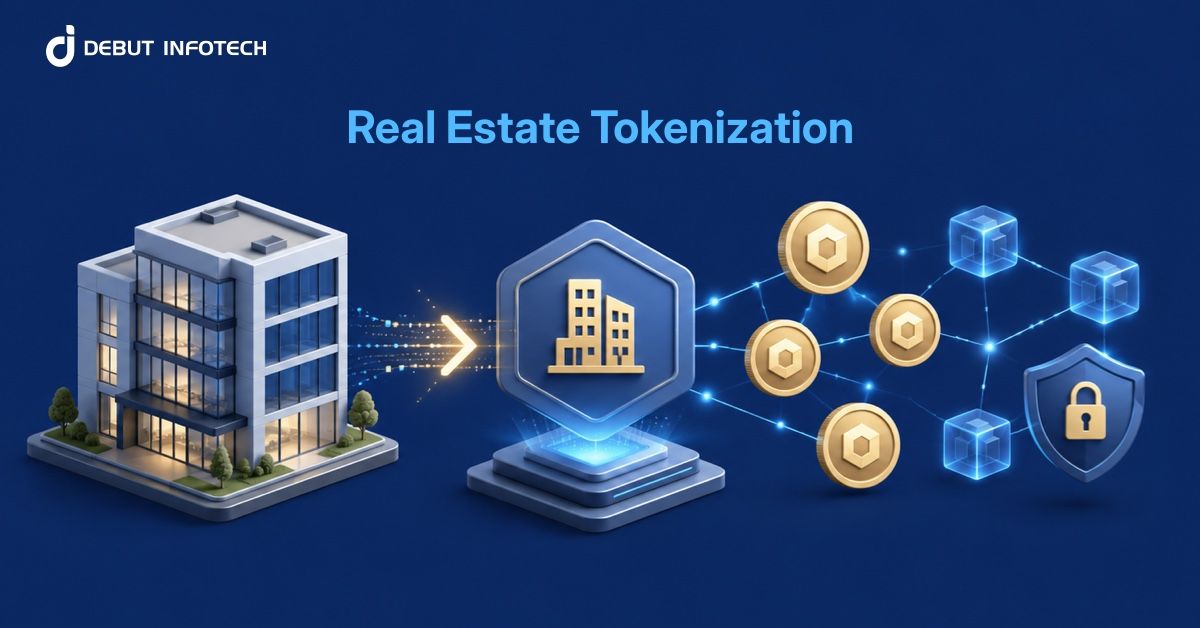


Real estate tokenization represents legally defined investment interests on blockchain—such as equity, debt, fund units, or revenue shares—rather than automatically transferring direct property ownership.
Legal rights, compliance controls, and technology infrastructure must stay aligned so investor rights, KYC/AML requirements, transfer restrictions, and smart-contract workflows operate consistently.
The tokenization process starts with asset due diligence and legal structuring, followed by regulatory mapping, token economics, blockchain selection, smart-contract development, security testing, issuance, and lifecycle management.
Tokenization does not automatically create liquidity; secondary-market activity still depends on investor demand, eligible transfers, compliant venues, custody infrastructure, disclosures, and price discovery.
Blockchain selection should follow business and compliance requirements, with factors such as permissioning, transaction costs, privacy, custody, interoperability, reliability, and migration options considered across public networks, Layer 2s, and permissioned blockchains.
Real estate tokenization costs extend beyond software development, covering legal structuring, due diligence, KYC/AML, valuation, custody, smart-contract audits, integrations, blockchain fees, compliance, and ongoing support.
White-label and custom platforms involve different trade-offs: white-label solutions can accelerate delivery with standard workflows, while custom development offers deeper control over compliance, integrations, architecture, and proprietary processes.
Real estate tokenization is changing how property investment interests can be structured, issued and managed. Instead of relying entirely on traditional ownership and investment records, a legally defined interest in a property can be represented by digital tokens on a blockchain. But tokenizing real estate is not as simple as putting a property deed on a blockchain. In most projects, the underlying property remains owned by a company, fund, trust or other legal entity, while the tokens represent shares, debt, income rights or other contractual interest in that structure.
So, how does real estate tokenization actually work?
The process typically involves property due diligence, legal structuring, regulatory and investor compliance, token design, blockchain selection, smart contract development, security testing, token issuance and ongoing asset management. This guide explains each stage of the real estate tokenization process, along with the potential benefits, costs, risks, technology choices and factors businesses should consider before building or launching a tokenized real estate platform
Real estate tokenization is the process of representing a legally defined interest in a real estate asset as digital tokens on a blockchain.
The token does not necessarily represent direct ownership of the physical property. In many projects, a special-purpose vehicle (SPV), company, fund, trust or similar legal structure owns the property. Investors then receive tokens representing their interest in that entity or in a defined financial arrangement connected to the property.
Depending on the structure, a token may represent:
| Token type | What it represents | Typical investor rights |
| Equity | Shares in a property-owning entity | Distributions, voting, sale proceeds |
| Debt | A property-backed or property-linked loan/note | Interest and principal repayment |
| Fund/REIT | Units or shares in an investment vehicle | Distributions and applicable redemption rights |
| Revenue share | Contractual claim on defined property income | Payments based on agreed terms |
| Direct title | Registered property interest where legally supported | Rights recognized under local property law |
The legal structure determines what investors actually own and what rights they receive. The blockchain provides the technology for recording and managing those interests.
This distinction is critical: a token does not automatically create legal ownership of a property. The investor’s rights come from the underlying legal agreements, ownership records and applicable property and securities laws.
A successful tokenization project has to align three layers: legal rights, compliance controls, and technology.
First, define what the investor is actually receiving. This may include equity, debt, fund units, income rights, voting rights, distribution rights or other contractual interests.
Next, determine who can invest, hold, and transfer the tokens. This can involve KYC and AML checks, investor eligibility, jurisdiction restrictions, holding limits, lockups and resale requirements.
Finally, translate the approved rules into the platform and blockchain infrastructure. This includes smart contracts, identity verification, custody, payments, investor portals, cap-table systems, reporting and other integrations.
These three layers must remain aligned throughout the asset’s lifecycle. A technically valid blockchain transaction does not necessarily mean that the underlying legal transaction is valid.
| Layer | Core question | Required outputs | Platform effect |
| Legal rights | What is being offered? | Instrument, economics, governance, governing documents and authoritative ownership record | Defines what the token and investor workflows must represent |
| Compliance controls | Who may participate and under which conditions? | Offering route, investor verification, KYC and AML checks, transfer restrictions, monitoring, and exceptions | Determines which wallets and transactions may be approved |
| Technology rails | How will approved actions be executed? | Blockchain, token standard, smart contracts, custody, payments, and record synchronization | Supports token issuance, distributions, voting, reporting, recovery, and authorized transfers |
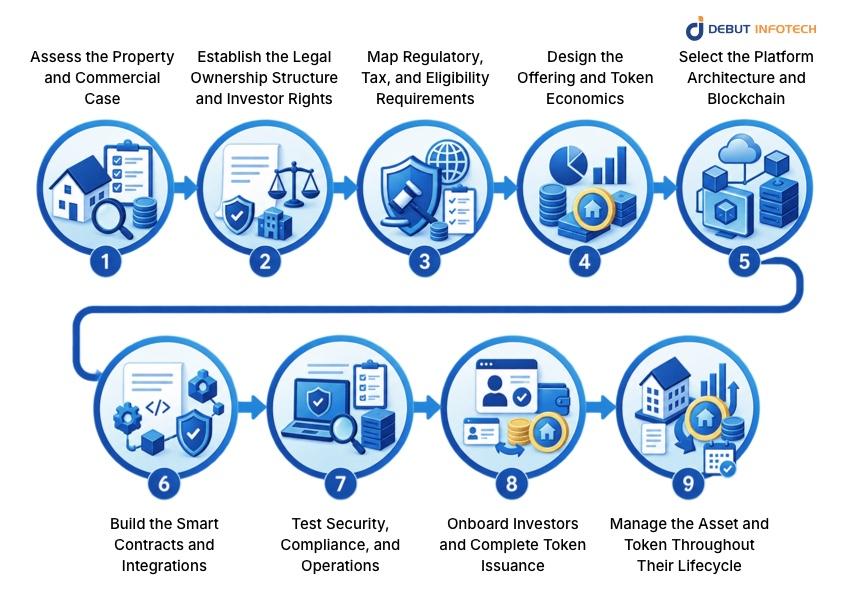
Real estate tokenization typically follows a structured process that starts with the property and legal model, not the blockchain.
Before development begins, the project team needs to establish what is being tokenized, who will own the underlying asset, which investors can participate, what rights token holders will receive and how those rights will be managed throughout the investment lifecycle.
The process generally involves nine stages:
The first step is to determine whether the property and investment model are suitable for tokenization. The project team should review ownership and title records, liens, mortgages, zoning, leases, insurance, taxes, disputes, property-management agreements, valuation, occupancy, operating expenses and projected cash flow.
The commercial case should also answer a basic question: Why tokenize this asset instead of using a traditional investment structure?
Consider the target investors, minimum investment size, expected holding period, distribution model, potential resale options, transaction volume and exit strategy. The result should be a clear asset dossier, risk assessment, financial model and feasibility decision before the project moves to legal structuring and technology development.
Before choosing a blockchain, define the legal structure behind the investment.
In many models, a company, special-purpose vehicle, fund or trust owns the property while investors receive tokenized interests in that structure. Other models may use debt instruments, revenue-sharing arrangements or direct property interests where local law permits.
The governing documents should clearly define investor rights, including distributions, voting, information access, transfers, redemption, sale proceeds, fees, defaults, disputes and other obligations.
The token’s metadata and smart contract logic should then reflect those approved rights. Technology should implement the legal structure not create rights that the legal documents do not provide.
Real estate tokenization can involve securities, property, financial-services, tax, privacy and AML/KYC requirements. The applicable rules depend on the property location, issuer, investor base, offering structure and jurisdictions involved.
Before development begins, the project should determine:
These requirements should be documented before they are translated into platform workflows and smart contract controls.
Because regulations differ between jurisdictions, legal and tax professionals should validate the structure before an offering is launched.
Define the fundraising target, token supply, token price, minimum investment, investor allocations, fees, reserves, distribution model, voting rights, lockups, redemption rules and treatment of unsold tokens.
Every token should map back to a clearly defined interest in the underlying legal structure.
The team should also determine how rental income, operating expenses, refinancing, property valuation changes and a future sale affect token holders.
Projected returns should never be presented as guaranteed, and tokenization should not be positioned as a guarantee of liquidity.
Blockchain selection should follow the project’s legal, compliance, operational, and technical requirements—not the popularity of a particular network.
Evaluate factors such as:
The platform may include investor and administrator portals, KYC/AML integrations, payment systems, custody or wallet infrastructure, cap-table management, property-management software, document storage, and reporting tools.
For businesses deciding between a white-label solution and custom development, the choice should be based on required customization, integrations, control, delivery time and long-term ownership costs.
Smart contracts translate approved business and compliance rules into executable blockchain logic.
Depending on the project, contracts may manage:
Security-token standards such as ERC-3643 and ERC-1400 can be evaluated based on the project’s requirements and ecosystem compatibility.
The smart contracts should integrate with identity verification, payments, custody, cap-table, document-management and other required systems.
Importantly, smart contracts should automate defined rules rather than make legal decisions. Where an action depends on an off-chain legal or administrative decision, the platform needs a controlled process for authorizing and recording that action.
Before launch, test both the blockchain layer and the surrounding platform.
Testing should cover smart contract functions, permissions, upgrades, wallet recovery, transaction failures, reconciliation, investor eligibility, transfer restrictions, payment failures, emergency pauses and integration failures.
An independent smart contract audit should be performed before deployment. However, an audit should be treated as an additional security review not as a guarantee that the system contains no vulnerabilities.
The team should also document incident response, privileged-access procedures, key management, backups, disaster recovery, and recovery processes before the platform goes live.
Provide approved offering documents, risk disclosures, fee information, and wallet instructions. Complete investor verification, KYC and AML screening, sanctions checks, eligibility screening, wallet verification, subscription signing and necessary payment or escrow procedures. FATF requires that covered virtual-asset service providers conduct customer due diligence, maintain records and report on suspicious transactions, but the specific obligations vary depending on the parties and jurisdiction. FATF outlines these measures.
At closing, reconcile signed agreements, cleared funds, approved wallets, and the legal ownership register. Administrators can then authorize token issuance, allocate the approved supply, and provide transaction records. Blockchain balances, investor records, and the capitalization table must agree.
After launch, the operator manages distributions, expenses, notices, votes, valuations, tax documents, maintenance, capital expenditure, eligibility changes, approved transfers, and regulatory reporting. Each event should update the relevant legal, financial, investor, and blockchain records through a defined reconciliation process.
Secondary trading is only permitted in situations where the offering rules, the investor status, the token controls, and venue support it; tokenization does not provide a guarantee to a buyer. When refinancing, selling, defaulting or dissolving, the administrators adhere to the legal waterfall, distribute proceeds, redeem and burn tokens as needed, and close records in a consistent manner.
Continuous monitoring should be done on privileged accounts, contract events, identity data, sanctions status, vendors, integrations, network change and regulatory changes. There should be periodic reviews to ensure that the token is still a representation of the rights to be disclosed to investors. Lifecycle management keeps the legal asset, operational data, and blockchain record aligned until final redemption.
Real estate tokenization can involve multiple areas of law, including securities regulation, property ownership, financial services, AML/KYC, taxation, privacy and data protection.
The applicable requirements depend on the property’s location, the legal structure, the type of token, the target investors and where the offering is marketed or sold.
For this reason, there is no single global regulatory framework for real estate tokenization. A structure that works in one jurisdiction may require significant changes in another.
If the token is a security, the issuer must identify the registration, prospectus, private-placement, crowdfunding, or other exemption available in each market. That route can determine fundraising limits, solicitation methods, disclosures, investor numbers, resale conditions, and filings.
In the United States, all securities offers and sales are required to be registered or made exempt. An exemption may still require notices, state filings, fees, offering legends, or limits on promotion and resale. The SEC provides an overview of exempt offering pathways.
For real estate security tokens, counsel should approve the offering memorandum, subscription agreement, risk disclosures, financial information, valuation basis, conflicts, fees, and use of proceeds before marketing. Website copy and sales presentations must remain consistent with those documents.
Review the platform according to what each party does, not its marketing label. Raising capital, arranging transactions, holding client assets, maintaining official ownership records, operating an order book, or settling trades may require separate permissions.
The role map should cover the issuer, placement agent, broker or funding portal, payment provider, custodian, transfer agent, marketplace operator, and property manager. A technology vendor should not perform a regulated function outside its authorization. Outsourcing may also leave the issuer responsible for supervision, record access, resilience, and vendor oversight.
If secondary trading is planned, the venue must be authorized to support the instrument and target market. ESMA, for example, publishes authorized infrastructures under the EU DLT Pilot Regime. Technical compatibility alone does not grant trading permission.
While it is possible for an online offering to be visible around the world, that visibility alone does not grant permission to solicit investors across the world. Have an approved-country matrix of advertising regulations, required warnings, languages, local representatives, filing and resale terms.
Analyze all email campaigns, webinars, referrals, paid advertising, events and third-party promotions individually as each platform may generate a different exposure. The use of geofencing and investor declarations can complement compliance but cannot be used as a substitute for an analysis of the destination and reception of an offer.
Financial and identity records should be kept off a public blockchain. Correction, deletion, retention, confidentiality and access control obligations can come into conflict with permanent storage.
A more secure architecture will store personal documents in controlled systems that are off-chain and will store limited identifiers or cryptographic references on-chain. Purpose of collection, minimization, retention, access roles, processor responsibilities, international transfers and breach response should be all defined by the data governance. The EU GDPR requires data minimization and protection by design and default. These principles appear in Articles 5 and 25.
Tokenization can create obligations for the property, issuing entity, platform, and investors. Before pricing the offering, advisors should review withholding, consumption taxes, capital gains, distributions, redemptions, entity income and property-transfer or stamp taxes.
The accounting for proceeds, liabilities, transaction fees, reserves, and distributions should be determined by the issuer. A compliance calendar should set up a schedule for filings, financial statements, valuation updates, material-event disclosures, regulator requests and document retention. Because real estate tokenization regulations evolve, regulatory change management should remain an operating control rather than a one-time review.
Smart contracts ensure that the project rules are followed by verifying certain conditions before altering the token record. They have the authority to approve or decline issuance, transfers, freezes, redemptions and other administrative activities. However, code only enforces rules translated into clear technical conditions. It cannot determine legal ownership, interpret ambiguous agreements, or validate off-chain events independently.
For real estate security tokens, a transfer commonly passes through three connected layers:
If one condition fails, the transaction stops and should return a usable reason where the standard supports it. This “verify, authorize, execute” sequence prevents an ordinary wallet transfer from bypassing offering controls.
Contracts can also restrict token issuance to authorized administrators, cap supply, pause activity, freeze balances, recover tokens after an approved wallet-loss process, and burn tokens following redemption. Privileged actions should require role separation, multisignature approval, and auditable events.
Projects assessing token standards ERC-3643 and ERC-1400 should compare their control models rather than select one by name recognition.
ERC-3643 is a permissioned token that includes an identity registry and modular compliance contracts. Its transfers are conditioned, meaning tokens are allowed to be transferred between validated counterparts only when rules are set up to allow it. It also supports supply controls, freezes, recovery, and agent roles.
ERC-1400 is a draft suite of security-token interfaces covering transfer checks, issuance and redemption, document references, controller actions, and balance partitions with different restrictions or rights. Its draft status and ecosystem compatibility require evaluation before adoption.
Neither standard creates securities compliance automatically. Legal professionals define the rule, compliance systems confirm off-chain facts, and the contract enforces the approved result.
Important inputs change outside the blockchain. A verification provider may update an investor’s status, an administrator may execute a court-directed transfer, or an issuer may amend a restriction after legal review. The architecture should specify who may submit each update, what evidence is required, and how the action is recorded.
Sensitive identity documents should remain off-chain. The contract normally needs only a verified status, eligibility attribute, or signed authorization. This separation enables blockchain enforcement without making the ledger the source of legal or identity truth.
Test permitted and prohibited transfers, expired credentials, holding limits, administrator misuse, upgrades, recovery, pauses, and integration failures. Complete an independent smart contract audit, correct material findings, and retest. Ethereum’s guidance notes that audits add a review layer but cannot guarantee every defect will be found. Operational safeguards remain necessary.
For further technical context, review how smart contracts in real estate tokenization connect legal rules, compliance services, and blockchain execution.
There is no best blockchain for real estate tokenization in every situation. The answer is the network that satisfies the compliance, settlement, privacy, integration and operating requirements for the project, without leaving long-term dependency. Use the following four decision gates.
Confirm that the network can restrict ownership, reject unauthorized transfers, apply holding limits, pause activity, support recovery, and separate administrator permissions. These functions must connect with identity, custody, payment, and ownership-record systems.
Estimate the cost and completion time for issuance, transfers, distributions, voting, redemption, and reporting during peak demand. Examine transaction finality, fee volatility, congestion, outages, and failed-transaction recovery. Low fees provide little value if settlement is unreliable or administration becomes difficult.
A public Layer 1 may offer transparent settlement and broad wallet support, but public metadata and variable fees need assessment. An Ethereum Layer 2 can reduce costs and increase capacity, although its sequencer, bridge, withdrawal, upgrade, and security assumptions require review. Ethereum notes that Layer 2 solutions have different risk models.
A permissioned blockchain can provide controlled participation and private channels. However, it requires defined governance, node operation, participant management, and interoperability. Hyperledger Fabric demonstrates this permissioned approach.
Assess operator dependence, upgrade authority, monitoring, support, custody availability, marketplace compatibility, and migration options. Test an approved transfer, rejected transfer, payment reconciliation, recovery, and reporting before committing.
When evaluating blockchain development services, request an architecture decision record showing the networks considered, selection criteria, rejected options, operating responsibilities, and exit plan. The network should remain suitable for the property’s holding period, not only at launch.
Fractional ownership is a method used to share an asset or investment interest between multiple investors. Tokenization is the method used to digitally represent and manage an asset, claim or right on a blockchain. They can be used together but do not rely on each other.
| Aspect | Fractional ownership | Tokenization |
| Purpose | Divides an investment into smaller portions. | Digitally represents an asset or legally defined interest. |
| Structure | May use company shares, partnerships, trusts, co-ownership agreements, or syndications. | May represent equity, debt, income rights, or an entire asset. |
| Recordkeeping | Can use contracts, cap tables, and conventional databases. | Uses blockchain tokens and smart contracts alongside legal and operating records. |
| Transfers | Often requires manual approvals and register updates. | Can automate approved transfers, but cannot remove contractual or regulatory limits. |
For example, investors can purchase shares in a company that owns an apartment building without using blockchain. That is fractional ownership. Representing those shares with compliant digital tokens creates fractional real estate tokenization.
The token does not create property ownership rights. Those rights come from the deed, company documents, subscription agreement, or another contract. Blockchain records the token position and executes permitted actions under those documents.
The distinction affects project evaluation. Fractional ownership may reduce the capital required from each participant. Property tokenization may improve record administration and enable programmable workflows. But, neither option is guaranteed to provide you a liquid asset, rental income, appreciation or unrestricted resale.
Investors must consider the property, ownership structure, fees, manager, exit process, and token holder rights independent of the technology employed to run the investment.
The main real estate tokenization benefits are flexible investment access, programmable administration, transaction traceability, and potentially more efficient transfers. None occurs automatically. Each requires enforceable rights, suitable technology, compliant distribution, accurate data, and sufficient market participation.
| Potential benefit | Conditions required | What prevents it |
| Smaller investment units | The interest can be divided, onboarding supports target investors, and per-investor costs remain economical. | Legal, verification, custody, or servicing costs make small subscriptions impractical. |
| Wider investor reach | The offering is permitted in each market and supports accessible payments, wallets, custody, and disclosures. | Cross-border restrictions or difficult onboarding reduce participation. |
| Faster approved transfers | Eligible buyers, compliant venues, integrated records, and reliable settlement are available. | Weak demand, lockups, manual reconciliation, or limited trading infrastructure restrict transfers. |
| Consistent administration | Distribution, voting, redemption, and reporting rules connect to accurate operating data. | Ambiguous agreements, weak integrations, or exceptional cases require manual work. |
| Better traceability | Blockchain events connect to verified identities, legal records, and source systems. | Recording inaccurate data only preserves the error. |
| Less reconciliation | Blockchain, capitalization, payment, and investor systems exchange data reliably. | Disconnected systems create more records to compare. |
One of the most common misconceptions about real estate tokenization is that issuing tokens automatically makes a property investment liquid.
It does not.
Tokenization can make an eligible investment interest easier to transfer, but actual liquidity depends on investor demand, applicable transfer restrictions, compliant marketplaces or transfer mechanisms, custody infrastructure, disclosures and price discovery.
A token that has no active buyers can still be difficult to sell.
Liquidity requires the strongest qualification. Tokenization can make an eligible interest easier to transfer, but it cannot create buyers, fair pricing, or continuous market depth. A credible liquidity plan requires approved resale rules, investor demand, a suitable marketplace or transfer process, current disclosures, custody support, and price discovery. Without them, the token may remain as difficult to sell as the conventional interest.
Automation works best for predictable decisions. Smart contracts can execute a distribution formula or reject a prohibited transfer. They cannot validate a property valuation, resolve a disputed entitlement, or interpret an unexpected legal event. Human governance remains necessary for exceptions.
Before pursuing property tokenization, compare the proposed model with the conventional alternative. Include structuring, technology, compliance, custody, payments, security review, integration, support, and reporting. The project creates value only when improvements in access, control, or administration exceed the lifecycle costs without weakening investor protection.
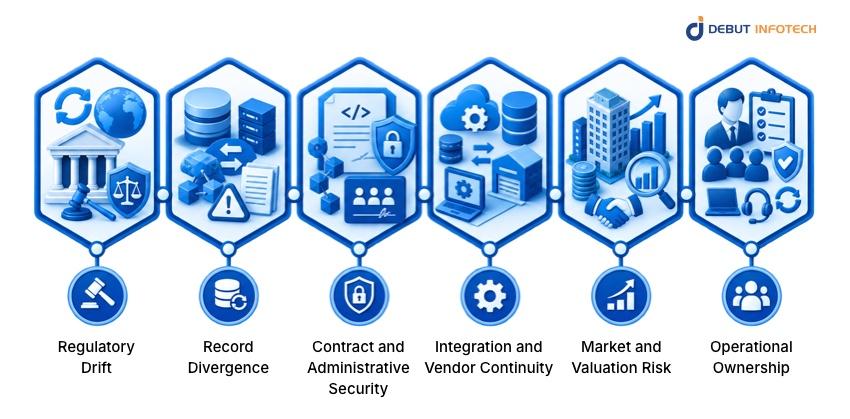
Real estate tokenization introduces technology and operational risks alongside the risks already associated with property investment.
The most important risks usually occur where legal structures, blockchain infrastructure, investor compliance, third-party services, and property operations intersect.
Understanding these risks before development helps businesses design appropriate controls rather than treating security and compliance as post-launch concerns.
Offering permissions, reporting duties, and resale rules may change during the holding period. Maintain a jurisdiction register, assign legal monitoring to an owner, and review platform rules whenever real estate tokenization regulations change. Contracts and investor notices should follow an approved update process.
Blockchain balances can conflict with capitalization, payment, investor, or records after integration failures or manual corrections. Designate the authoritative source for each data field, reconcile systems regularly, and route differences into an exception queue. Corrections should require approval and preserve the record.
Defects may block valid activity, while compromised administrator access could enable unauthorized minting, freezing, or upgrades. Utilize the least privilege role, multisignature approval, key storage, monitoring, emergency pause and controlled upgrades. Do a smart contract audit, fix vulnerabilities and re-test before deployment.
Identity, payment, custody, accounting, and property systems can fail or return outdated information. Validate inputs, monitor service levels, retry messages safely, and provide a fallback. Vendor agreements should cover data portability, incident notification, support, termination assistance, and deployment documentation.
Technical transferability does not ensure buyers or dependable pricing. Disclose resale limits and avoid liquidity promises. Keep property performance, valuation methods, fees, and material-event information current. The exit plan should include alternatives when the marketplace is unavailable.
A platform cannot remain controlled if only its vendor understands it. Assign owners for investor verification, reconciliation, privileged access, disclosures, incidents, and investor support. Maintain procedures, escalation contacts, training records, recovery drills, and evidence that controls have operated.
These safeguards belong within the real estate tokenization cost from the start. Each control record should specify its owner, frequency, evidence, escalation trigger, and recovery objective. Before launch, the team should prove it can detect failure, contain the impact, restore accurate records, and communicate with affected investors.
The cost of real estate tokenization depends heavily on the project’s legal structure, platform scope, number of assets, investor requirements, blockchain architecture, integrations, security controls and target jurisdictions.
For software development alone, an indicative range may look like:
| Platform scope | Development range |
| Basic issuance platform | $50,000–$100,000 |
| Intermediate platform with compliance and integrations | $100,000–$250,000 |
| Advanced customized platform | $250,000+ |
These figures should be treated as planning ranges rather than fixed project prices.
The total cost of a tokenization project can also include:
A single-property project with a limited investor base can have very different requirements from a multi-asset platform operating across several jurisdictions.
For this reason, an accurate estimate should be based on the project’s scope rather than a standard tokenization package.
Businesses typically have three options when building a real estate tokenization platform: use a white label solution, build a fully custom platform or combine established third-party components with custom modules.
The right approach depends on the level of customization, regulatory requirements, integrations, expected scale, development timeline and long-term ownership strategy.
| Factor | White-label fit | Custom fit |
| Delivery | Faster when standard modules need limited configuration. | Requires discovery, architecture, development, and testing. |
| Control | Follows the vendor’s supported workflows and roadmap. | Supports proprietary workflows, interfaces, roles, and automation. |
| Compliance | Works when configurable rules cover the offering and jurisdictions. | Handles specialized approvals, investor categories, and reporting. |
| Integrations | Depends on available APIs and connectors. | Supports deeper connections with property, payment, custody, identity, and accounting systems. |
| Ownership | Requires clear data-access, portability, hosting, upgrade, and termination terms. | Provides architectural control but creates maintenance and security responsibilities. |
| Cost | Usually reduces initial development but adds licensing or usage fees. | Requires higher upfront investment and continuing engineering support. |
Real estate tokenization requires more than blockchain development. It brings together asset structuring, investor workflows, compliance requirements, smart contracts, payment infrastructure, security and ongoing platform management.
At Debut Infotech, we help businesses bring these components together to develop real estate tokenization solutions tailored to their specific business and investment models.
Our approach starts with understanding what needs to be tokenized, who the platform is intended for, how investors will participate, and which operational and technology requirements the solution needs to support. From there, our blockchain and software development teams can design the platform architecture, develop the required smart contracts and applications, integrate supporting systems and prepare the solution for deployment.
Whether the goal is to tokenize a single real estate asset or build a scalable platform for managing multiple properties and investors, the technology needs to be designed for the project’s long-term requirements. This includes considerations such as investor onboarding, token issuance and management, authorized transfers, distributions, reporting, security, integrations and platform administration.
Debut Infotech can support the development journey from solution architecture and blockchain integration through smart contract development, platform engineering, testing, deployment, and ongoing technical support.
Our focus is to build technology around the business model not force the business model to fit a predefined blockchain solution.
Q1. Does a Real Estate Token Automatically Place Its Holder on the Property Title?
Not necessarily. The effect depends on the legal structure and governing documents. A token may represent equity in a property-owning entity, debt, revenue participation, or another contractual interest instead of registered title. In the United States, SEC staff notes that tokenized structures can provide different holder rights. Buyers should verify the land registry, issuer register, and documents establishing property ownership rights.
Q2. Can Real Estate Security Tokens Be Traded Immediately After Issuance?
No. These instruments may remain subject to holding periods, investor eligibility rules, geographic limits, issuer approvals, or venue restrictions. A technically valid wallet-to-wallet transaction can still be prohibited by the offering terms or applicable law. FINRA also cautions that exchange or redemption is not guaranteed. Confirm permitted venues, settlement arrangements, fees, and transfer restrictions before relying on liquidity.
Q3. Does One Investor Verification Remain Valid for Every Future Transfer?
Not always. Identity documents expire, sanctions and politically exposed person status may change, and a new transaction can trigger different jurisdictional rules. A robust workflow records when each check occurred, which policy applied, and when re-screening is required. FATF expects covered virtual asset providers to perform customer due diligence, maintain records, and report suspicious activity, but local obligations determine the exact KYC and AML controls.
Q4. What Happens if the Tokenization Platform Provider Stops Operating?
Ownership should not depend solely on continued access to one vendor’s interface. Before launch, the issuer should define how authorized parties can retrieve holder records, transfer system control, access source code and documentation, rotate keys, and appoint a replacement provider. The legal register, custody arrangement, backup strategy, and exit clauses determine whether token holder rights and essential operations can continue.
Q5. How Are Rental Income, Expenses, and Sale Proceeds Handled?
The property operator calculates revenue and approved expenses under governing agreements, then reconciles those figures with banking and holder records. A platform may execute the resulting distribution, but it cannot independently verify whether rent was collected or an expense was legitimate. The documents should define calculation methods, reserves, payment timing, taxes, reporting responsibilities, and dispute procedures.
Q6. Is Real Estate Tokenization Legal?
Real estate tokenization can be legally implemented in many jurisdictions, but the applicable requirements depend on how the property and investor interest are structured.
A token may be subject to securities, property, financial-services, AML/KYC, tax, privacy, and other regulations. The legal treatment can also vary depending on where the property is located, where the issuer operates and who the investors are.
Businesses should obtain jurisdiction-specific legal advice before launching or marketing a tokenized real estate offering.

Our Latest Insights
USA
2501 Chatham, Rd Suite R Springfield, IL 62704
+1-708-515-4004
info@debutinfotech.com
UK
7 Pound Close, Yarnton, Oxfordshire, OX51QG
+44-770-304-0079
info@debutinfotech.com
Canada
154 Eden Oak Trail, Kitchener, ON N2A 0H9
+1-708-515-4004
info@debutinfotech.com
INDIA
Sector 101-A, Plot No: I-42, IT City Rd, JLPL Industrial Area, Mohali, PB 140306
9888402396
info@debutinfotech.com