ON THIS PAGE
Progress0%






Our Global Presence :





How nice would it be if the crypto token idea you have were developed, launched, and widely accepted, like established coins such as Bitcoin and Ethereum?
Honestly, it’s very possible.
But you need to pay close attention to how the tokens are issued, and not just how they are built. This is because one poorly structured token issuance can dilute value, attract regulatory scrutiny, or lock your project into an economic model that’s impossible to fix later.
Here at Debut Infotech Pvt Ltd, we don’t just rush into token minting. We understand that the details matter more than ever, from tokenomics and crypto regulatory compliance to choosing the right token issuance platform.
In this guide, we’re sharing our tokenization secret with you. We break down what token issuance is, how it works, and the choices that shape its success—starting with a clear definition of token issuance.
Are you ready?
Token issuance literally translates to creating and distributing digital tokens into a blockchain ecosystem. It’s the process by which crypto tokens are issued into circulation within a blockchain network, and it matters because how the system is managed influences the token’s value, availability, and market dynamics.
The potential impact of this vital process on potential value makes it a foundational step for any blockchain project, whether you’re launching a decentralized application (dApp), raising capital, or tokenizing real-world assets.
Now, many people conflate token issuance with related terms such as token minting and tokenization. Let’s declutter that:
Token minting is the process of generating tokens on-chain. On the other hand, token issuance encompasses additional details, including design, compliance, distribution, and long-term management. Finally, tokenization is the process of converting real-world assets or rights into digital tokens.
For founders and technical leaders, issuing tokens is more about designing a safe, legal, and durable economic system than about “creating a coin.” When implemented properly, it serves as the foundation for long-term value creation, network expansion, and user incentives.
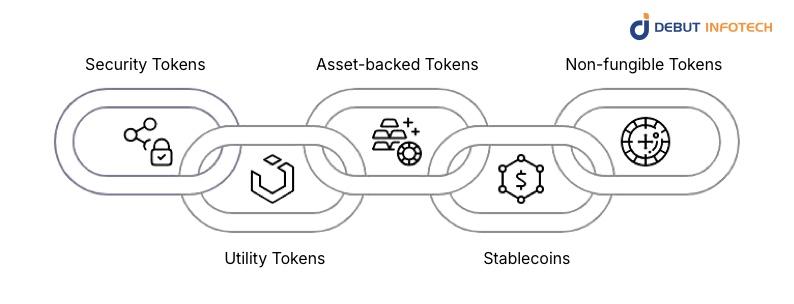
It goes without saying that crypto tokens are digital assets issued in a token issuance.
But what are these “tokens” exactly?
More so, how are they distinct from cryptocurrencies like Bitcoin (BTC) and Ethereum (ETH), which are known for holding value?
For clarity, tokens are digital assets or rights used within the blockchain ecosystem. As such, tokens vary widely depending on the assets or rights they represent. And by extension, this difference in their nature also culminates in a difference in how they are issued.
Without further ado, the following are some of the most important crypto tokens issued on the blockchain:
Security tokens are digital equivalents of the common traditional financial instruments such as shares, bonds, and investment contracts. The only difference is that they are used and issued on the blockchain rather than within financial institutions.
These tokens are well-suited for use as investment vehicles in companies, real estate, and other traditional investment contexts. As such, any entity (individuals and institutions) that has access to such tokens automatically has rights to economic privileges, such as profit-sharing, voting power, and dividends from the underlying asset or company. The fact that they grant holders economic rights qualifies them as securities in most legal jurisdictions.
With that in mind, any company issuing a security token must maintain a high level of legal and regulatory compliance. That is why it is advisable to rely on a security token issuance platform with compliance at its core that conducts thorough KYC and AML checks, investor accreditation checks, and transfer restrictions before issuing the token.
Utility tokens are digital tokens that are created to help holders to access specific services or products within a blockchain-based ecosystem. Unlike security tokens, utility tokens are not primarily designed as investment instruments.
Let’s break it down:
As their name implies, these tokens are designed to be functional. Anyone holding a utility token is expected to use it for certain functions like paying transaction fees, unlocking platform functionality, participating in on-chain governance, and incentivizing user behavior within the network.
As such, utility tokens do not inherently grant holders access to profits, dividends, or equity. That’s what makes them different from security tokens, and that difference usually determines the specific token issuance strategy for each token.
That said, the line is not always clear-cut.
Here’s what we mean:
If a utility token is structured, distributed, or marketed to emphasize speculative returns rather than strictly functional use, regulators may scrutinize it more closely. So, you can’t just decide on the token issuance strategy based on the labels alone.
These are crypto tokens directly tied to physical assets such as real estate, gold, intellectual property, or revenue streams. As an asset class, asset-backed tokens properly sit at the intersection of traditional finance and blockchain. Therefore, they enable the digital representation and transfer of value on-chain, rather than relying solely on paper-based ownership.
Like with the other categories of tokens, the issuance of asset-backed tokens is slightly different and doesn’t just translate to a mere technical exercise. In fact, most successful asset-backed token issuances rely on white-label tokenization frameworks to manage the complexities involved. In these instances, these frameworks help to establish a fine connection between on-chain logic and off-chain legal reality.
While asset-backed tokens are tied to physical assets, stablecoins are typically 1:1 pegged to stable assets such as fiat currencies (e.g., the US dollar) or backed by reserves such as cash, treasuries, and crypto assets, primarily to reduce volatility.
While they seem uncomplicated, stablecoins can be difficult to issue responsibly. This is because the value of any stablecoin project depends largely on trust. Think about it this way: the coin’s value is heavily reliant on the premise that the reserves actually maintain the value of the underlying fiat currencies; that the issuance controls kick in as at when due; and that the redemption mechanisms function properly.
Consequently, it doesn’t matter whether the model is fiat-backed or crypto-collateralized; you will most likely encounter serious operational risks and regulatory scrutiny when issuing stablecoins. This is one area where adhering to cryptocurrency regulations is crucial.
On the blockchain, non-fungible tokens (NFTs) represent distinct, indivisible assets such as artworks, digital content, or videos that are unique and unrepeatable. This is because every single NFT has its own distinct metadata and cannot be traded one-for-one, unlike fungible tokens.
As noted above, art and collectibles are frequently linked to NFT issuance, but that’s not the whole story. NFTs are increasingly used for enterprise use cases, ticketing, gaming assets, licensing, and identity.
Technically, NFT issuance entails several standards and storage considerations. From a strategic perspective, longevity and utility are the true challenges. When NFTs are issued without a clear lifecycle strategy or purpose, they often generate short-lived buzz rather than long-term value.
Token issuance can take different forms depending on the purpose, audience, and type of token. The following are some of the most vital types you should be aware of.
An Initial Coin Offering (ICO) is a widely used fundraising method in the blockchain ecosystem. When a token project launches an ICO, it simply means they have just developed a new token and are now distributing it into circulation by selling a portion of the created token in exchange for established cryptocurrencies such as Bitcoin (BTC) and Ethereum (ETH).
The established cryptocurrencies that the tokens are exchanged for are intended to fund the remaining aspects of the project. At the same time, they also account for each investor’s ownership stake in the entire project.
Most of the time, ICOs are used to launch utility tokens and to fund the development of decentralized applications (dApps) or blockchain platforms. However, their open and permissionless nature also makes them sensitive from a regulatory standpoint.
For starters, security token offerings (STOs) are the process of issuing security tokens. It’s a more regulated token issuance process because it involves securities, so every step is subject to existing financial regulations.
Additionally, investor accreditation processes, KYC and AML checks, and jurisdictional limitations are typically part of the compliant token issuance process. Token investors in STO-issued tokens typically enjoy certain legal rights and protections, and mandated inspections make STOs a more secure investment process than ICOs.
Many founders and project directors usually conduct STOs on a security token issuance platform that uses smart contracts to enforce some of the regulatory requirements. This is because, although STOs give institutional investors additional assurance and legal certainty, they are more difficult to launch.
Token airdrops are free token distribution processes in which newly launched tokens are randomly distributed to specific wallet addresses. The beneficiaries of this free distribution are typically existing ecosystem users, early adopters, and wallet holders. Although the process is typically free, project owners often set arbitrary, predefined criteria to determine who receives tokens.
When a project issues token airdrops, it signals that the project directors are trying to bootstrap their token community, reward loyalty, or decentralize token ownership. Despite these insightful intents, token airdrops can be quite risky. In fact, poorly planned airdrops can attract short-term participants with no intention of engaging with the platform long-term.
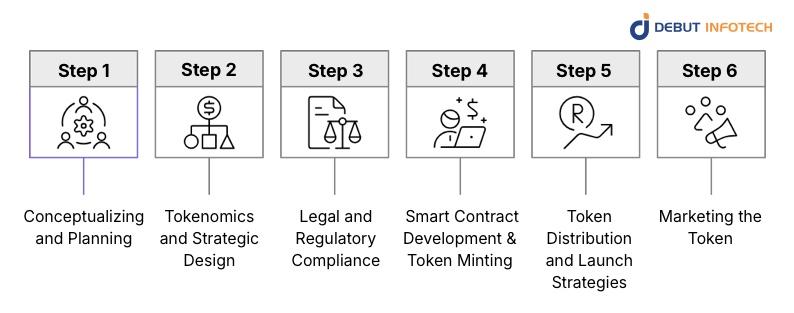
When issuing tokens, it is important to follow a sequential approach to ensure all key factors are considered before proceeding. Doing this helps to avoid regulatory exposure, weak incentives, and technical limitations.
The following are the 6 tested and proven steps our token development experts at Debut Infotech use to issue tokens successfully.
The first step our experts determine through a series of conversations with project owners is the token’s purpose and function within the project. We ask questions like:
Answers to questions like this help us determine the token’s role in that ecosystem and the best way to structure its issuance. For example, you need to establish early on whether the token enables access, governs behaviour, represents value, or supports fundraising.
To accurately position the token, we conduct thorough market research to understand market demand and competition. More importantly, these factors help us shape a unique value proposition that can not be overlooked
The tokenomics covers economic characteristics such as token supply, distribution, utility, and so on. Therefore, when issuing a token, you need to create a sustainable structure and strategic design for how many tokens you’re releasing into circulation, their issuance schedules, vesting periods, and incentives.
Our experts ask questions like:
As you answer these questions and make these choices, it is important to understand that your decisions directly influence user behaviour and market dynamics. Moreover, this is where you begin to determine the total token lifecycle.
Before you start issuing tokens based on your tokenomics structure, you need to make sure that your operations align properly with the prevailing legal regulations and compliance requirements in your jurisdiction.
Start by confirming if the token qualifies as a security or not. Next, clarify the applicable regulatory frameworks and the required compliance. Leave no stone unturned, ranging from KYC requirements to AML laws and customer protection statutes. At Debut Infotech, we model some of the tools for regulatory compliance token issuance strategy
With strategy and compliance defined, it’s time for some on-chain execution. And that starts with smart contract development, as smart contracts govern the token’s behaviour, including minting, transfers, restrictions, and burning.
Furthermore, smart contracts automate token creation, distribution, and transactions. Therefore, when undertaking this, it is advisable to thoroughly audit the code and conduct penetration testing to ensure robust security and efficiency. No matter how well planned, a single flaw in a token contract can jeopardize the entire issuance. So pay attention to details!
By now, you should have minted the tokens on the blockchain based on the rules predefined in the smart contracts. The next step is to distribute the tokens to the specified wallet addresses according to the defined issuance model.
This distribution process helps to incentivize adoption and enhance liquidity. Therefore, it is advisable to collaborate with exchanges to list the tokens and, therefore, facilitate trading.
While doing all this, it is important to bear in mind that timing, transparency, and access controls play a major role in determining the token’s liquidity, community trust, and price stability.
Lastly, you need to inform the public about the token issuance event explicitly.
This is not about false media hype. Rather, it should focus on informing stakeholders and users about the token’s long-term goals, usefulness, and purpose. Instead of attracting only speculative interest, clear messaging helps attract the right participants, such as builders, users, and long-term holders.
Here’s one thing to take away: token issuance is the overarching strategy that determines how value flows through your token development project, how users engage with it, and how regulators interpret it.
More importantly, you should know that successful tokens are designed, not improvised.
At Debut Infotech Pvt Ltd, our token development services approach token issuance with that same mindset. We look at the full token lifecycle, from tokenomics and compliant token issuance to smart contract development, distribution, and long-term sustainability.
If you’re serious about launching a token that isn’t just built—but adopted, trusted, and resilient—then partnering with an experienced crypto token development company makes all the difference. And that’s exactly where we come in.
Planning the token’s purpose, designing tokenomics, ensuring compliance with cryptocurrency regulations, developing smart contracts, minting tokens, and distributing them via ICOs, STOs, or airdrops are all part of the token issuance process. Each stage impacts long-term sustainability.
A token is a blockchain-based digital asset that represents rights, value, or access within an ecosystem. Smart contracts that specify the issuance, transfer, and use of tokens across decentralized applications are how it operates.
The process of creating tokens on a blockchain is called token minting. Token design, compliance, distribution, and lifecycle management—including vesting, burning procedures, and governance regulations—are all part of token issuance.
While not all tokens are subject to the same rules, many are. While utility tokens must still be carefully structured to avoid classification as securities under crypto regulatory frameworks, security and asset-backed tokens must comply with stringent regulations.
The decision is based on your use case and blockchain. While BEP-20 tokens are popular on Binance Smart Chain due to lower fees and faster transactions, the ERC-20 token standard is widely used on Ethereum.

Our Latest Insights
USA
2501 Chatham, Rd Suite R Springfield, IL 62704
+1-708-515-4004
info@debutinfotech.com
UK
7 Pound Close, Yarnton, Oxfordshire, OX51QG
+44-770-304-0079
info@debutinfotech.com
Canada
154 Eden Oak Trail, Kitchener, ON N2A 0H9
+1-708-515-4004
info@debutinfotech.com
INDIA
Sector 101-A, Plot No: I-42, IT City Rd, JLPL Industrial Area, Mohali, PB 140306
9888402396
info@debutinfotech.com