ON THIS PAGE
Progress0%






Our Global Presence :





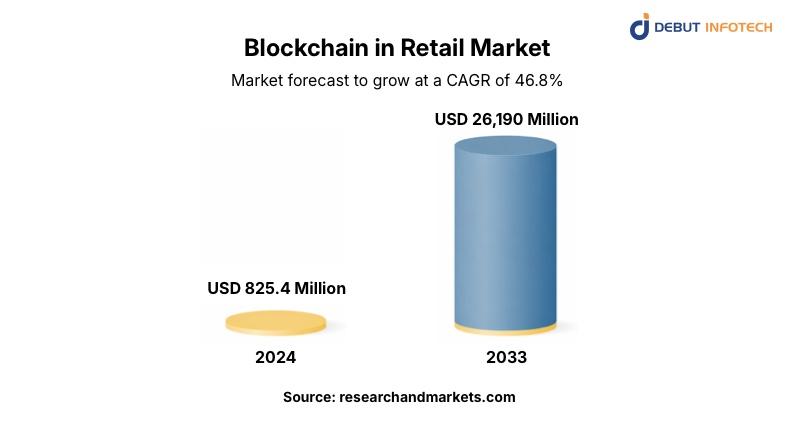
According to Research and Markets, the global blockchain-in-retail market size is expected to reach USD 26.19 billion by 2033, growing at a compound annual growth rate (CAGR) of 41.3% between 2025 and 2033. More tellingly, Grand View Research reports that retail and e-commerce are anticipated to reach the fastest growth during the forecast period.
The takeaway?
The use of blockchain in ecommerce is gaining significant momentum, and smart retailers are positioning themselves to be at the forefront of the future of online shopping.
But you already know this.
Through years of experience working with e-commerce decision makers like yourself, our blockchain consultants here at Debut Infotech Pvt Ltd have realised that the two major issues faced when trying to integrate blockchain technology into retail operations are:
That’s why we have decided to cover the specific role of blockchain in ecommerce operations in this article. To help you visualise this properly, we have highlighted notable brands currently deploying blockchain technology, the outcomes they have achieved, and how their setups compare with the infrastructure you are likely running today. Finally, and most importantly, we suggest the realistic path to implementation for a business at your stage.
Without further ado, let’s get started.
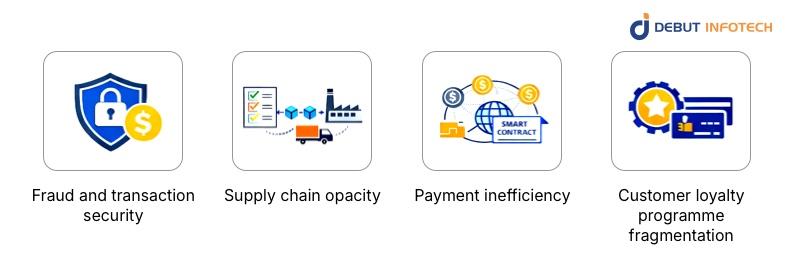
Blockchain technology addresses four concrete problems that every scaled e-commerce operation encounters.
These are:
E-commerce fraud losses are projected to exceed $107 billion globally by 2029, according to Juniper Research. Using blockchain in ecommerce can address this by making transaction records immutable. This means that every order, payment, and fulfilment event is permanently logged and cryptographically sealed, eliminating the opportunities for manipulation that enable both external fraud and internal disputes.
When a product recall hits or a counterfeit complaint surfaces, the inability to trace a product’s origin quickly costs retailers money, reputation, and sometimes regulatory standing. Blockchain-enabled traceability systems reduce counterfeit and fraud incidents by an estimated 30–40% by making every step of a product’s journey, beginning from manufacturer to warehouse to customer doorstep, verifiable by all authorised parties simultaneously.
Cross-border ecommerce payments still route through networks of correspondent banks and payment processors, each adding cost and delay. Smart contracts on blockchain automate the release of payments upon verification of fulfilment, eliminating the reconciliation work that currently consumes significant operational resources in high-volume ecommerce environments.
Nearly 43% of retailers are now focusing on tokenised loyalty programmes. These are blockchain-based reward systems in which points are issued as verifiable tokens that cannot be duplicated or fraudulently claimed and can be structured to work across partner brands. This addresses the core problem with legacy loyalty infrastructure, which is that points issued on centralised databases are vulnerable to manipulation and impossible to share across ecosystems.
Below, we have highlighted some real brands currently integrating blockchain technology into their everyday retail operations and doing so excellently.
There are a couple of things to pick up from them.
Walmart’s blockchain deployment is arguably the most rigorously documented case study in retail. Faced with growing food safety liability and the inability to trace contaminated products quickly through a sprawling supply network, Walmart partnered with IBM to build a food traceability system using Hyperledger Fabric.
As a result, the brand has reduced the time needed to trace the provenance of mangoes sold in US stores from seven days to 2.2 seconds. Walmart can now trace the origin of over 25 products from five different suppliers using the system.
Here’s what this implementation means for their day-to-day operations.
When a contamination event occurs, for example, E. coli in leafy greens, Listeria in deli meats, the fact that they can run a trace in 2.2 seconds instead of 7 days means that they don’t have to pull every product of that category from shelves at enormous cost. Instead, they can easily pull only the affected batch. For a retailer at Walmart’s scale, that precision is worth hundreds of millions of dollars per incident. The system enabled the uploading of certificates of authenticity to the blockchain for pork sold in Walmart China stores, addressing trust issues that had been a serious structural problem in the market.
Here’s the takeaway for operators like you considering the viability of blockchain in ecommerce.
The value of blockchain technology in your supply chain is measurable in seconds, traceable to specific SKUs, and scalable to supplier networks of significant complexity. This is what blockchain development companies like Debut Infotech Pvt Ltd help you get.
MercadoLibre is Latin America’s dominant e-commerce platform, serving nearly 70 million users across 18 countries. Its blockchain deployment is a payments and financial inclusion strategy built for a region where a significant percentage of the population is underbanked and local currencies are volatile.
To implement this, MercadoLibre selected Paxos, a blockchain infrastructure platform regulated by the New York Department of Financial Services, to power cryptocurrency access within its Mercado Pago digital wallet. This partnership meant that users could now buy, hold, and sell Bitcoin, Ethereum, and stablecoins directly from their e-commerce accounts. Consequently, the platform experienced rapid adoption, surpassing 1 million crypto wallet users in its first 60 days, with more people trading crypto through the app than on Brazil’s stock exchange.
In August 2024, MercadoLibre went further, launching its own US dollar-tied stablecoin — the Meli Dollar — allowing Brazilian users to buy and sell the stablecoin using their account balances in Brazilian reais with no fees. The company also accepts Bitcoin as a payment method in Brazil and Argentina and has enabled real estate listings in Argentina to be priced and transacted in Bitcoin.
The takeaway here is that blockchain’s payment application is not limited to large-market retailers with sophisticated customer bases. MercadoLibre’s success is built specifically on serving users that traditional financial infrastructure excludes, and that’s something you should consider. This is because it is a model with significant relevance for any e-commerce business operating in emerging markets or targeting financially underserved demographics.
In January 2023, Lowe’s announced Project Unlock — a solution developed in its Innovation Labs division that combines IoT sensors, low-cost RFID chips, and blockchain to combat retail theft. The system activates power tools at the point of purchase while creating a publicly accessible, anonymised record of legitimate purchases on the blockchain. The significance of this deployment is that they don’t have to add security through centralised databases that can be manipulated or queried improperly. Lowe’s created a public, immutable proof-of-purchase record that renders stolen goods functionally unusable without an authenticated on-chain purchase event.
The lesson for e-commerce operators: blockchain’s anti-fraud application extends beyond payment security to the physical product itself. As click-and-collect and omnichannel fulfilment models grow, the boundary between online transactions and physical asset security becomes increasingly important.
So, do you think investing in blockchain for your e-commerce infrastructure is worth the investment?
This is a question that most decision-makers exploring the idea of using blockchain technology in ecommerce often ask.
To address this, we’ll compare blockchain and traditional infrastructure to highlight key differences and the edge blockchain offers.
Here is the honest comparison:
| Capability | Traditional infrastructure | Blockchain infrastructure |
| Transaction record | Centralised database — editable by administrators | Immutable distributed ledger — tamper-proof |
| Supply chain visibility | Siloed per-system, requires manual reconciliation | End-to-end, real-time, shared across all authorised parties |
| Payment processing | Multi-intermediary, 2–5 business day settlement | Peer-to-peer, near-instant settlement via smart contract |
| Fraud investigation | Requires a forensic audit across multiple systems | Single verifiable audit trail, accessible in seconds |
| Customer data ownership | Platform-held, centralised, breach-vulnerable | Cryptographically secured, patient-controlled access |
| Loyalty programme integrity | Points stored in databases susceptible to manipulation | Token-based, cryptographically verified, interoperable |
| Cross-border transactions | High fees, currency conversion delays, regulatory complexity | Reduced intermediaries, stablecoin options, smart contract compliance |
| Integration complexity | Mature APIs, broad vendor support | Requires specialist development, legacy system middleware |
| Implementation cost | Lower upfront, higher ongoing fraud/reconciliation cost | Higher upfront, lower long-term fraud and operational cost |
The bottom row deserves particular attention. Blockchain’s upfront implementation cost is real and should not be minimised. But the cost comparison changes materially when fraud losses, reconciliation overhead, and supply chain incident response costs are factored into the baseline.
No serious analysis of blockchain in e-commerce omits the obstacles. There are five that consistently determine whether implementations succeed or stall.
Legacy system integration is the most underestimated. Most e-commerce platforms — Magento, Shopify Plus, SAP Commerce, and their equivalents — were not built with blockchain data structures in mind. Connecting a blockchain layer requires significant middleware investment and careful API architecture. Organisations that treat this as a simple integration rather than a re-architecture project consistently underestimate both cost and timeline.
Regulatory complexity varies significantly by geography. GDPR’s right to erasure creates a specific tension with blockchain’s immutability that must be resolved at the architecture level — not as a compliance afterthought. Cross-border ecommerce operations must map their specific regulatory obligations before selecting a blockchain architecture, not after.
Scalability under peak load remains a genuine technical constraint for public blockchains. High-volume sale events — Black Friday, Singles Day — generate transaction volumes that can exceed the throughput of some blockchain networks. Private and consortium blockchain architectures address this more effectively than public chains for most e-commerce use cases.
Consumer education is a softer but real barrier. Blockchain-based loyalty tokens and digital ownership certificates require user interfaces simple enough that customers gain the benefit without needing to understand the underlying technology. Deployments that expose blockchain complexity to end users consistently see lower adoption.
Talent scarcity affects both build and maintenance. The pool of developers with both blockchain expertise and ecommerce domain knowledge is limited, which is why most successful deployments are delivered in partnership with specialist development firms rather than built entirely in-house.
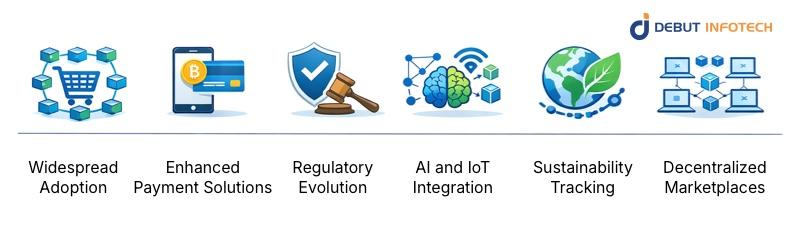
The trajectory of Blockchain technology in e-commerce points towards a broader and more innovative integration. Here are a few predictions and emerging trends:
As businesses seek to enhance security and efficiency, blockchain is expected to become a standard component of e-commerce infrastructure. This technology’s ability to provide transparent, immutable records will drive its adoption across all sizes of e-commerce operations.
Blockchain’s impact on payment methodologies will intensify, likely making cryptocurrencies and smart contracts more mainstream. This shift will facilitate faster, more secure transactions with reduced transaction costs, appealing to a global customer base.
With the rise of blockchain, regulatory frameworks will evolve to better accommodate and govern its use in e-commerce. This evolution will provide clearer guidelines and foster greater trust in blockchain as a viable component of retail and commercial platforms.
Blockchain is being set up as the playing field where other technologies like artificial intelligence and the Internet of Things will converge. For instance, IoT devices can leverage Blockchain to autonomously verify and record transactions across multiple supply chains.
Artificial intelligence could analyze Blockchain data to optimize customer service and inventory management.
Blockchain will become even more vital when tracking products from origin to sale. This transparency will transform consumer behavior, especially towards sustainable products, while enabling customers to make informed choices.
The rise of decentralized e-commerce platforms is expected in the near future. This is where peer-to-peer transactions powered by Blockchain technology will thrive, as there will be zero central authority. This could revolutionize market structures and open up new models for business and consumer interaction.
Most e-commerce businesses do not and should not attempt to blockchain-enable their entire operation simultaneously. The deployments that deliver measurable ROI typically start with one clearly defined problem — a supply chain traceability gap, a fraud vector in a specific payment flow, a loyalty programme that is losing customer trust — and build a proof of concept that demonstrates value at contained cost before scaling.
The architecture decisions made in the first phase determine whether the result is a scalable platform or an expensive pilot. The most consequential early decisions are: the choice between public, private, and consortium blockchain (which depends on who your trusted parties are and what data they need to share); the approach to legacy system integration; and the strategy for handling regulatory compliance — particularly GDPR and cross-border data obligations — within the smart contract logic from the outset.
Debut Infotech has delivered enterprise blockchain development solutions across ecommerce, supply chain, and payment infrastructure for clients ranging from growth-stage retailers to enterprise platforms. The pattern that consistently separates successful implementations from stalled pilots is the same one Walmart, MercadoLibre, and Lowe’s share: a clearly scoped first use case, a realistic timeline, and a development partner that understands both the blockchain architecture and the commercial context it serves.
A. Walmart uses Hyperledger Fabric for food supply chain traceability, reducing traceability time from 7 days to 2.2 seconds. MercadoLibre integrated blockchain payments via Paxos, surpassing one million crypto wallet users in 60 days. Lowe’s deployed Project Unlock, combining blockchain with RFID to create tamper-proof proof-of-purchase records that render stolen goods unusable.
A. Blockchain is deployed across four primary ecommerce functions: supply chain traceability, where every product movement is permanently recorded; payment processing, where smart contracts automate settlement; fraud prevention, where immutable transaction records eliminate manipulation; and loyalty programmes, where tokenised rewards cannot be duplicated or fraudulently claimed across partner brand ecosystems.
A. Yes, materially. Blockchain creates a permanent, tamper-proof record of every transaction, making post-event manipulation computationally impossible. It eliminates the vulnerabilities of centralised databases that enable both external fraud and internal disputes. Blockchain-enabled traceability systems have demonstrated 30–40% reductions in counterfeit and fraud incidents in documented retail deployments.
A. A proof of concept covering one use case — supply chain traceability or payment automation — typically costs $50,000 to $150,000. A full enterprise integration across payments, supply chain, and loyalty infrastructure is a multi-phase project budgeted at $400,000 or more. Long-term fraud reduction and operational savings typically offset the initial investment significantly.
A. Yes, though the entry point matters. Small businesses benefit most from joining existing blockchain networks — such as industry consortium supply chain platforms — rather than building proprietary infrastructure. Blockchain-as-a-service providers have also significantly reduced implementation barriers. The most practical starting point for smaller operators is typically a single contained use case, not a full integration.
A. Blockchain gives every authorised supply chain participant — manufacturers, logistics providers, warehouses, retailers — simultaneous access to a single, verifiable record of a product’s journey. This eliminates reconciliation delays, reduces counterfeit risk, and dramatically compresses incident response times. Walmart’s documented experience — tracing produce provenance in 2.2 seconds versus seven days — illustrates the operational value at scale.
A. Shopify does not have native blockchain functionality, but it supports integration via API and third-party middleware. Blockchain payment gateways, NFT-gated storefronts, and supply chain traceability systems can all connect to Shopify Plus through custom development. Integration complexity and cost depend on the specific use case, but no fundamental technical incompatibility prevents blockchain deployment on Shopify infrastructure.
A. Blockchain can cryptographically verify that a review was submitted by a confirmed purchaser of that specific product, making it impossible to publish unverified reviews on participating platforms. Because the purchase record on the blockchain cannot be forged or retroactively created, review manipulation — fake positive reviews and coordinated negative attacks — becomes computationally unfeasible at the protocol level.
A. Traditional payment gateways route transactions through multiple intermediaries — acquiring banks, card networks, issuing banks — adding fees and 2–5 day settlement delays at each step. Blockchain payments move peer-to-peer via smart contracts, settling near-instantly with significantly reduced intermediary costs. The trade-off is integration complexity: blockchain payments require specialized development, while traditional gateways offer mature, widely supported APIs.
A. Blockchain will become the unifying data layer across multichannel operations — a single verifiable record of inventory, orders, and customer interactions that is accessible and trustworthy across every channel simultaneously. This eliminates the reconciliation problem that currently makes multichannel ecommerce operationally expensive. Tokenised loyalty programmes that work across channels and partners represent the near-term commercial application already in active deployment.

Our Latest Insights
USA
2501 Chatham, Rd Suite R Springfield, IL 62704
+1-708-515-4004
info@debutinfotech.com
UK
7 Pound Close, Yarnton, Oxfordshire, OX51QG
+44-770-304-0079
info@debutinfotech.com
Canada
154 Eden Oak Trail, Kitchener, ON N2A 0H9
+1-708-515-4004
info@debutinfotech.com
INDIA
Sector 101-A, Plot No: I-42, IT City Rd, JLPL Industrial Area, Mohali, PB 140306
9888402396
info@debutinfotech.com